When Your Own Data Betrays You
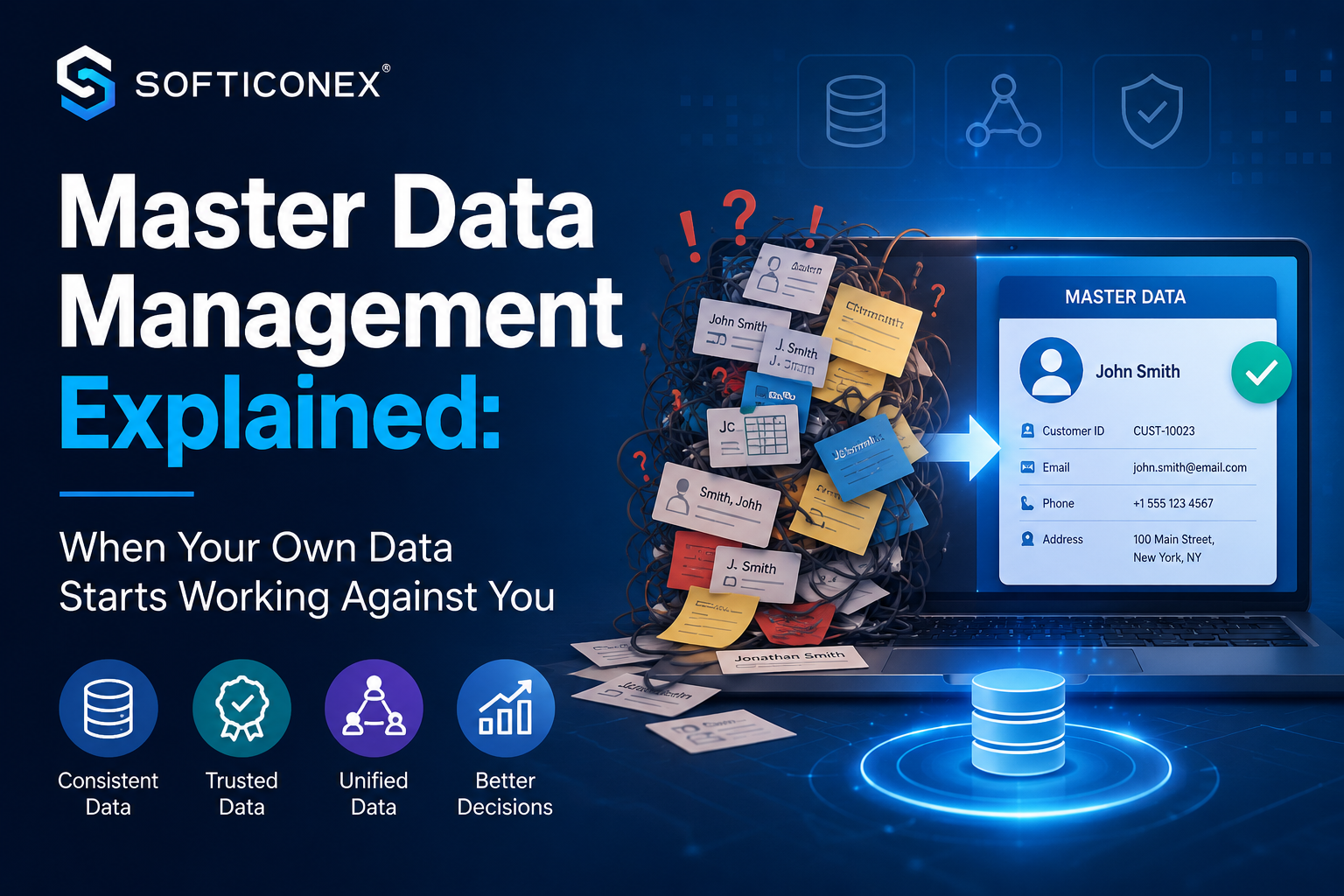
Picture this. A bank has the same customer listed three times with three different addresses. The marketing team sends the same promotion to this one person three times. The finance team cannot figure out which record is correct. The customer gets frustrated and leaves.
This happens every day in thousands of companies worldwide. Data duplication, inconsistency, and poor quality cost organisations billions of dollars each year in wasted effort and wrong decisions. Master Data Management (MDM) was built to solve exactly this problem. It gives every organisation one reliable, single version of its most important data, so everyone works from the same trusted source.
What Is Master Data Management?
Master Data Management, or MDM, is a set of tools, processes, and policies that a business uses to create and maintain one single, accurate, and consistent version of its most critical data across the entire organisation.
In simple words, MDM makes sure that when your sales team, finance team, and customer service team all look up a customer or a product, they all see the same correct information. No contradictions, no guesswork.
The Single Source of Truth
Think of MDM as the master copy of a song in a music studio. From that one master copy, thousands of duplicates are made. If a mistake is found, you fix the master, and every copy reflects the correction. MDM works the same way for business data. This reliable master copy is called the Single Source of Truth.
Why Master Data Management Is Important
Businesses today collect enormous volumes of data from websites, mobile apps, ERP systems, CRM platforms, and customer interactions. Without proper management, this data becomes chaotic and unreliable. Here is why MDM matters:
- Data Accuracy: Every department works with verified and up-to-date information, removing errors caused by duplicated or outdated records.
- Better Decision Making: Leaders make confident decisions only when they trust the data. MDM provides that trust across the entire organisation.
- Reduced Duplication: MDM identifies and eliminates redundant records, saving storage costs and processing time.
- Regulatory Compliance: Industries like banking and healthcare face strict data regulations. MDM helps organisations stay compliant by maintaining clean, auditable records.
- Improved Customer Experience: Accurate, unified customer profiles allow companies to serve customers faster and avoid embarrassing mistakes like sending duplicate emails.
Types of Master Data
Master data refers to the core entities that the business revolves around. Here are the five main types:
- Customer Data: Names, contact details, purchase history, and preferences of people or companies that buy your products.
- Product Data: Details about what a company sells, including product names, descriptions, prices, and specifications.
- Supplier Data: Information about vendors and partners, including contact details, payment terms, and contracts.
- Employee Data: Records about staff, including roles, departments, payroll information, and performance data.
- Financial Data: Core records such as the chart of accounts, cost centres, and budget codes used by finance teams.
Core Components of Master Data Management
Data Governance
Data governance is the framework of rules and responsibilities that defines how data should be created, stored, and used. Think of it as the legal system for your data. Without governance, there are no rules, and chaos follows.
Data Quality Management
This is the ongoing process of checking, cleaning, and improving data. It involves removing duplicates, correcting errors, and standardising formats. Poor data quality is the root cause of most business data problems.
Data Integration
Most organisations have data sitting in dozens of different systems, including ERP platforms, CRM tools, and legacy databases. Data integration connects all these sources so that master data stays synchronised and consistent across every system.
Data Stewardship
A data steward is a person officially responsible for a specific type of data. They monitor quality, resolve conflicts, and ensure that governance policies are followed. Every major dataset should have an assigned steward.
How Master Data Management Works
Here is a straightforward step-by-step walkthrough of how an MDM system operates in practice:
- Data Collection: The system gathers data from multiple sources across the organisation, including ERP systems, CRM platforms, and external databases, into one central pipeline.
- Data Cleaning: Automated tools and data stewards review the collected data, fix errors, remove duplicates, and fill in missing information where possible.
- Data Matching: Intelligent algorithms identify records that refer to the same entity. Two customer records with slightly different spellings of the same name are matched and merged.
- Data Consolidation: The most accurate version of each matched record is stored as the master record, also called the golden record, which the entire organisation references.
- Data Distribution: The master record is pushed out to all connected systems, so every application and department has access to the same accurate, unified information.
MDM Architecture Models
| Model | How It Works | Best For |
|---|---|---|
| Centralized | All master data is stored in one hub. All systems connect to this hub to read or update data. | Large enterprises with strong IT governance. |
| Decentralized | Each department manages its own master data with agreed standards and occasional synchronisation. | Organisations with autonomous divisions or regional requirements. |
| Hybrid | Central control for critical shared data with local flexibility for department-specific data. | Mid to large enterprises need both consistency and flexibility. |
Real-World Use Cases
Banking
Banks manage millions of customer records across retail banking, credit cards, and mortgages. MDM ensures every product line sees the same verified customer profile, enabling personalised service and accurate risk assessment.
Healthcare
Hospitals deal with patient records spread across clinics, labs, and pharmacies. A single wrong patient record can lead to medication errors. MDM creates a unified patient master record that follows the patient across every point of care.
Retail and E-Commerce
Large retailers manage hundreds of thousands of product records across websites, stores, and warehouses. MDM keeps product names, prices, and descriptions consistent across every channel, reducing returns caused by inaccurate information.
Master Data vs Transactional Data
| Factor | Master Data | Transactional Data |
|---|---|---|
| Definition | Core reference data about key business entities that rarely change. | Records of business events and activities that happen constantly. |
| Examples | Customer profiles, product catalogues, employee records. | Sales invoices, purchase orders, and payment receipts. |
| Change Frequency | Changes slowly and infrequently. Highly stable. | Changes rapidly. New records are created constantly. |
Common Challenges in MDM
- Data Inconsistency: Different departments use different naming conventions for the same data. Aligning these is one of the hardest parts of any MDM project.
- Legacy System Integration: Older ERP and database systems were not built to communicate with modern MDM platforms. Integrating them requires significant technical effort.
- High Implementation Cost: Building an MDM system requires investment in software, infrastructure, training, and ongoing maintenance.
- Resistance to Change: Employees who are used to managing their own data often resist centralised MDM initiatives because they feel it takes away their control.
Best Practices for MDM Success
- Define clear data ownership before starting. Every critical data domain should have an assigned data steward who is accountable for its quality.
- Start with a data audit. Understand what data you have, where it lives, and how clean it is before designing your MDM architecture.
- Invest in automation. Manual data cleaning is error-prone. Modern MDM platforms use AI to match, deduplicate, and validate data automatically.
- Engage business stakeholders from the beginning. MDM is not just an IT project. Business teams must define what good data looks like for their domain.
- Monitor data quality continuously. Set up dashboards and alerts that catch quality issues before they spread through connected systems.
Popular MDM Tools in 2026
- IBM InfoSphere MDM: An established platform offering robust data matching, integration, and governance. Widely used in financial institutions and healthcare networks.
- SAP Master Data Governance: Deeply integrated with the SAP ERP ecosystem. Ideal for organisations already running SAP systems with strong workflow-driven governance.
- Oracle MDM: Specialised solutions for customer and product data management. Popular with large retailers and telecommunications companies.
- Informatica MDM: AI-driven data matching with strong cloud deployment flexibility. Frequently rated as a leader in analyst evaluations.
Conclusion
Master Data Management is no longer an optional luxury. In a data-driven world where every business decision depends on the quality of information, MDM has become a strategic necessity.
When your customer data is accurate, your teams serve customers better. When your product data is consistent, your sales and logistics run more smoothly. When your financial data is clean, your reports are trustworthy. MDM ties all of this together by creating a single source of truth that the entire organization can rely on.
The businesses that invest in Master Data Management move faster, make smarter decisions, and build stronger relationships with their customers. Clean data is not just an IT goal. It is a true business advantage.
Frequently Asked Questions
What is Master Data Management in simple words?
MDM is the process of creating and maintaining one accurate, consistent version of a company’s most important data so that every team and system works from the same trusted source.
Why is MDM important for businesses?
Businesses rely on accurate data to make decisions, serve customers, and comply with regulations. Without MDM, data becomes inconsistent, leading to costly mistakes, poor customer experiences, and failed reporting.
What are examples of master data?
Common examples include customer profiles, product catalogues, supplier records, employee details, and financial account structures such as the chart of accounts and cost centres.
What is the difference between MDM and data governance?
Data governance is the framework of rules and policies. MDM is the actual implementation of those rules through processes and tools. Governance is the policy; MDM is the practice that enforces it.
Which industries use Master Data Management the most?
Banking, healthcare, retail, manufacturing, telecommunications, and government sectors all depend heavily on MDM to manage critical business data across multiple systems.
Is Master Data Management difficult to implement?
Modern cloud-based MDM platforms have simplified the process significantly. The biggest challenges are usually organisational, such as getting stakeholders aligned and defining clear data ownership, rather than purely technical.
How Softiconex Helps with Master Data Management (MDM)
Softiconex helps businesses organize, clean, and centralize their data for better accuracy and smarter decision-making. Our MDM solutions remove duplicate data, improve data consistency, and streamline business operations across multiple systems. Contact us today to streamline your data.