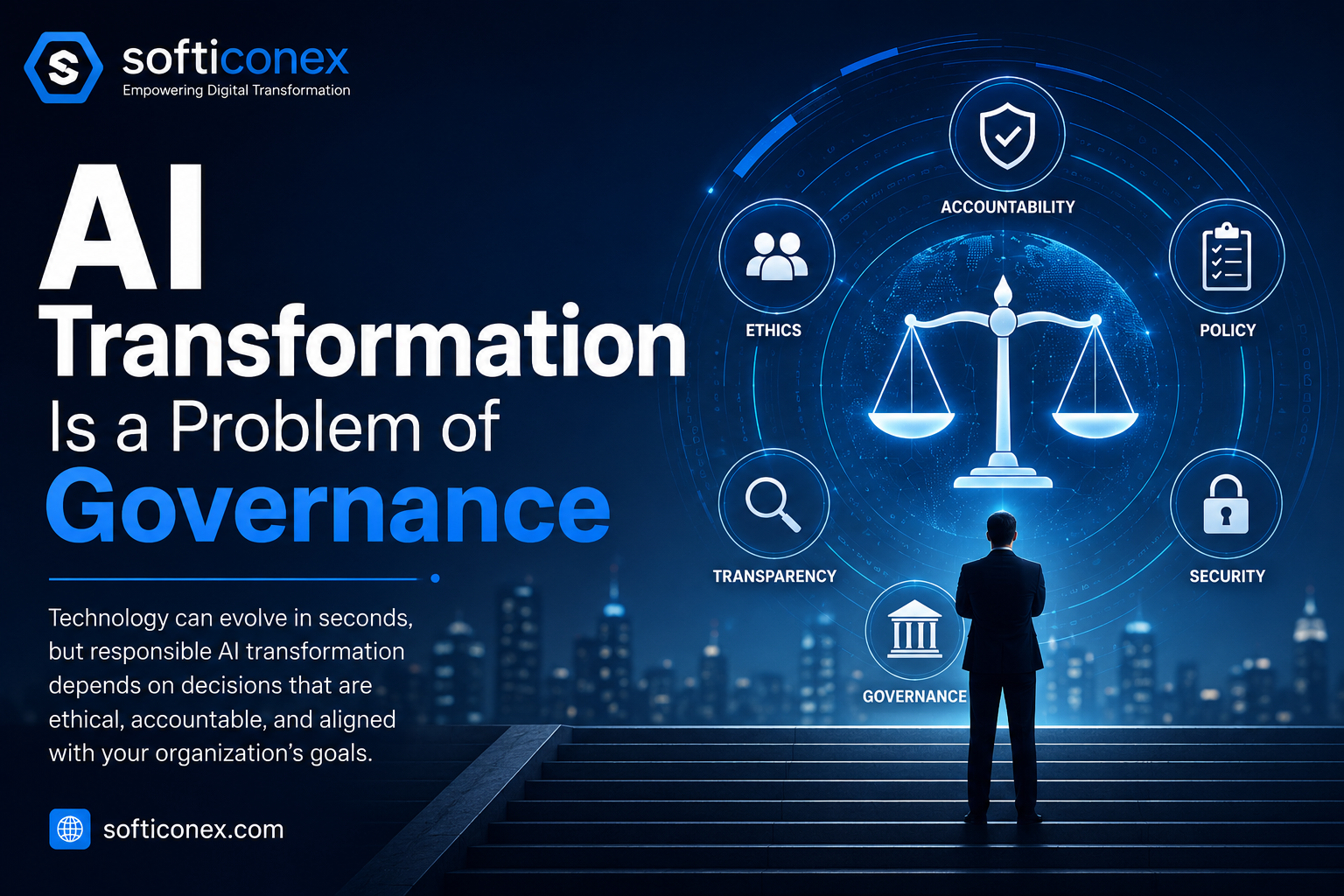
AI is transforming businesses faster than computers, the internet, or mobile technology ever did. Yet most companies that attempt AI transformation do not fail because the technology was weak. They failed because no one was governing how technology made decisions. AI transformation is a problem of governance, not a problem of code or computing power.
This guide shows that the success of AI transformation depends more on good governance than on the technology itself. It is written for business leaders, policymakers, AI engineers, IT managers, students, and digital transformation consultants who need a clear and practical understanding of AI governance, its risks, and the frameworks that solve it.
What Does AI Transformation Mean
AI transformation means embedding artificial intelligence into the core processes of an organization rather than using it as an occasional tool. It includes automating decisions once made by people, building systems that learn from data instead of following fixed instructions, and running operations where algorithms recommend, predict, or act on behalf of humans.
A bank that uses AI to approve loans, a hospital that uses AI to flag high-risk patients, and a retailer that uses AI to set prices in real time are all undergoing AI transformation. The technology itself is only the starting point. True transformation takes place when AI starts influencing decisions that impact customers, employees, and society as a whole.
Why AI Transformation Is a Problem of Governance
AI transformation is a problem of governance because technology can scale faster than the rules meant to control it. A company can deploy a new AI model in weeks, while writing clear policies, defining accountability, and building oversight structures can take much longer.
This gap creates five recurring governance problems: unclear rules for how AI should behave, accountability that no single person owns, data that is collected or used without proper consent, ethical blind spots that surface only after harm has occurred, and compliance gaps that expose the organization to legal risk. None of these problems is caused by the algorithm itself. They are caused by the absence of governance around the algorithm.
Key Governance Challenges in AI Transformation
Five categories of risk appear again and again across industries. Understanding each one is the first step toward solving it.
Data Governance Issues
AI systems depend heavily on the quality of the data they are trained on, which directly affects how reliable they are. When organizations do not control where data comes from, how it is structured within an AI knowledge base, or who has access to it, the AI built on that data inherits every flaw. A hiring system that learns from old, biased recruitment data will likely repeat those same biases, even without anyone deliberately adding them.
Algorithm Transparency Problems
Many AI models, especially deep learning systems, behave like a closed box. They produce an output, but the path to that output is difficult to explain. When a bank cannot explain why an algorithm denied a loan, it cannot defend that decision to a regulator, a customer, or a court.
Bias and Fairness Risks
Bias enters AI systems through historical data, unbalanced training samples, or design choices that favor one group over another. Left unmanaged, biased AI can deny opportunities, misprice products, or misidentify people, creating both ethical harm and legal exposure.
Security and Privacy Risks
AI systems often process large volumes of personal data, which makes them attractive targets for attackers and a liability if mishandled. A single breach involving an AI system can expose sensitive information about millions of people at once.
Regulatory Compliance Issues
Laws governing AI are changing quickly across different countries and industries. An organization that does not track these changes risks building systems that become illegal the moment new rules take effect.
Real World Impact of Poor AI Governance
When governance fails, the damage rarely stays inside the technology team. Poor AI governance has led companies to make biased hiring or lending decisions that triggered lawsuits, to deploy chatbots that gave customers false or harmful information, and to lose public trust after algorithms were shown to treat certain communities unfairly.
Regulators in the United States, the European Union, and several Asian markets have already fined companies for noncompliant AI use. Beyond fines, the reputational damage from a single governance failure can take years to repair, and customers rarely return to a brand they no longer trust with their data or their decisions.
AI Governance VS AI Innovation
Some leaders treat governance and innovation as opposites, believing that rules slow down progress. In practice, organizations that scale AI successfully treat governance as the foundation that makes fast and confident innovation possible. Clear rules remove uncertainty, which allows teams to move quickly because they already know what is allowed.
| Innovation Priority | Governance Priority | How Balance Works |
| Speed of deployment | Safety of deployment | Set review checkpoints that approve work quickly without skipping safety checks |
| Creative experimentation | Risk control | Allow sandbox testing before any full rollout |
| Flexible processes | Regulatory compliance | Build compliance into the design stage instead of adding it afterward |
Framework for Effective AI Governance
A practical AI governance framework can be built in six steps.
Step 1: Define AI Policies
Write down, in plain language, what AI is allowed to decide, what it is not allowed to decide, and who approves exceptions.
Step 2: Establish Data Governance
Set rules for where data comes from, how long it is kept, and who can access it before any model is trained.
Step 3: Implement Model Monitoring
Track how an AI system performs after launch, not only before it, since behavior can drift as new data arrives.
Step 4: Ensure Transparency
Require that every AI decision affecting a person can be explained in terms a non expert can understand.
Step 5: Assign Accountability
Name a specific person or team responsible for each AI system, so no decision is ever owned by anyone.
Step 6: Continuous Auditing
Review AI systems on a fixed schedule, not only when something goes wrong.
Role of Leadership in AI Governance
Governance only works when leadership takes it seriously. The chief executive sets the tone by treating AI governance as a business priority rather than a technical afterthought. The chief technology officer ensures that oversight tools and monitoring systems are actually built into AI projects. Compliance teams translate legal requirements into practical rules that engineers can follow. Data scientists carry the responsibility of flagging risks early, before a model reaches production, rather than after problems appear in the real world.
AI Ethics and Responsible AI
Responsible AI rests on four ideas that show up in nearly every serious AI governance framework: fairness, meaning the system treats similar people similarly; transparency, meaning decisions can be explained; accountability, meaning someone answers for what the system does; and human oversight, meaning a person can review, question, or override an AI decision when needed. These four ideas are not abstract values. They are practical requirements that determine whether an AI system can be trusted with real-world decisions.
Industry Examples of AI Governance Challenges
Healthcare
Hospitals using AI to predict patient risk must govern how clinical data is used, since a poorly governed model can miss warning signs or unfairly deprioritize certain patient groups.
Finance
Banks using AI for credit scoring must prove their models do not discriminate by income, location, or background, or they risk regulatory penalties.
Retail
Retailers using AI for dynamic pricing must govern how pricing algorithms treat different customer groups to avoid unfair pricing practices.
Government
Public sector agencies using AI for benefits decisions or law enforcement face the highest governance bar, since mistakes affect citizens who have no alternative provider to turn to.
How Organizations Can Solve Governance Problems
Solving AI governance problems starts with structure, not software. Organizations that succeed typically create a cross-functional AI committee that includes legal, technical, and business representatives, build a written governance framework before scaling AI beyond a pilot project, train employees across departments to recognize AI risks, and use monitoring tools that flag unusual model behavior automatically.
Tools for AI Governance
A growing market of tools now supports AI governance work. AI monitoring platforms track model performance and flag drift over time. Data governance tools manage where data comes from and who can use it. Compliance systems map AI projects against relevant regulations automatically. Model audit tools test AI systems for bias, accuracy, and explainability both before and after deployment.
Future of AI Governance
AI governance is moving from a voluntary best practice to a legal requirement. Regions including the European Union, the United States, and parts of Asia are introducing laws specifically designed for artificial intelligence, requiring risk assessments, transparency reports, and human oversight for high-risk systems. Global standards bodies are also developing shared frameworks so that AI governance practices can work across borders. Companies that build strong governance now will adapt to these rules far more easily than those that treat governance as an afterthought.
Common Mistakes Companies Make
- Ignoring governance until a problem forces the issue.
- Rushing AI deployment to compete, without testing for risk.
- Building AI systems with no clear explanation for their decisions.
- Launching AI projects with no single person accountable for outcomes.
Conclusion
AI transformation will keep accelerating, and the organizations that benefit most will not be the ones with the most advanced models. They will be the ones with the clearest governance. Every challenge described in this guide, from data quality to accountability to compliance, can be solved with structure rather than with more technology.
AI success is not just about technology. It is about governance, trust, and responsibility.
Frequently Asked Questions
Why is AI transformation a governance problem?
AI transformation is a governance problem because technology can be built and deployed faster than the rules needed to control it safely. Without governance, organizations cannot guarantee that AI decisions are fair, explainable, or compliant with the law.
What is AI governance?
AI governance is the set of policies, roles, and processes that control how an organization builds, deploys, and monitors artificial intelligence systems.
What are AI risks?
The main AI risks include biased decisions, privacy violations, security breaches, regulatory noncompliance, and a lack of transparency in how decisions are made.
How do companies manage AI risks?
Companies manage AI risks by setting clear policies, monitoring models after launch, assigning accountability to specific teams, and auditing systems on a regular schedule.
What is responsible AI?
Responsible AI is the practice of building artificial intelligence that is fair, transparent, accountable, and subject to human oversight at every stage.
Why is transparency important in AI?
Transparency matters because people affected by an AI decision, such as a loan applicant or a job candidate, have a right to understand why that decision was made.
Who is responsible for AI decisions?
Responsibility should always rest with a named person or team inside the organization, never with the algorithm itself, since AI systems cannot be held accountable in a legal or ethical sense.
What are AI ethics principles?
The core AI ethics principles are fairness, transparency, accountability, privacy protection, and meaningful human oversight.
How can businesses control AI systems?
Businesses control AI systems by combining written policies, technical monitoring tools, regular audits, and a governance committee that reviews AI projects before and after launch.
What is AI compliance?
AI compliance means ensuring that an organization’s AI systems meet all relevant laws, industry regulations, and internal policies throughout the system’s lifecycle.