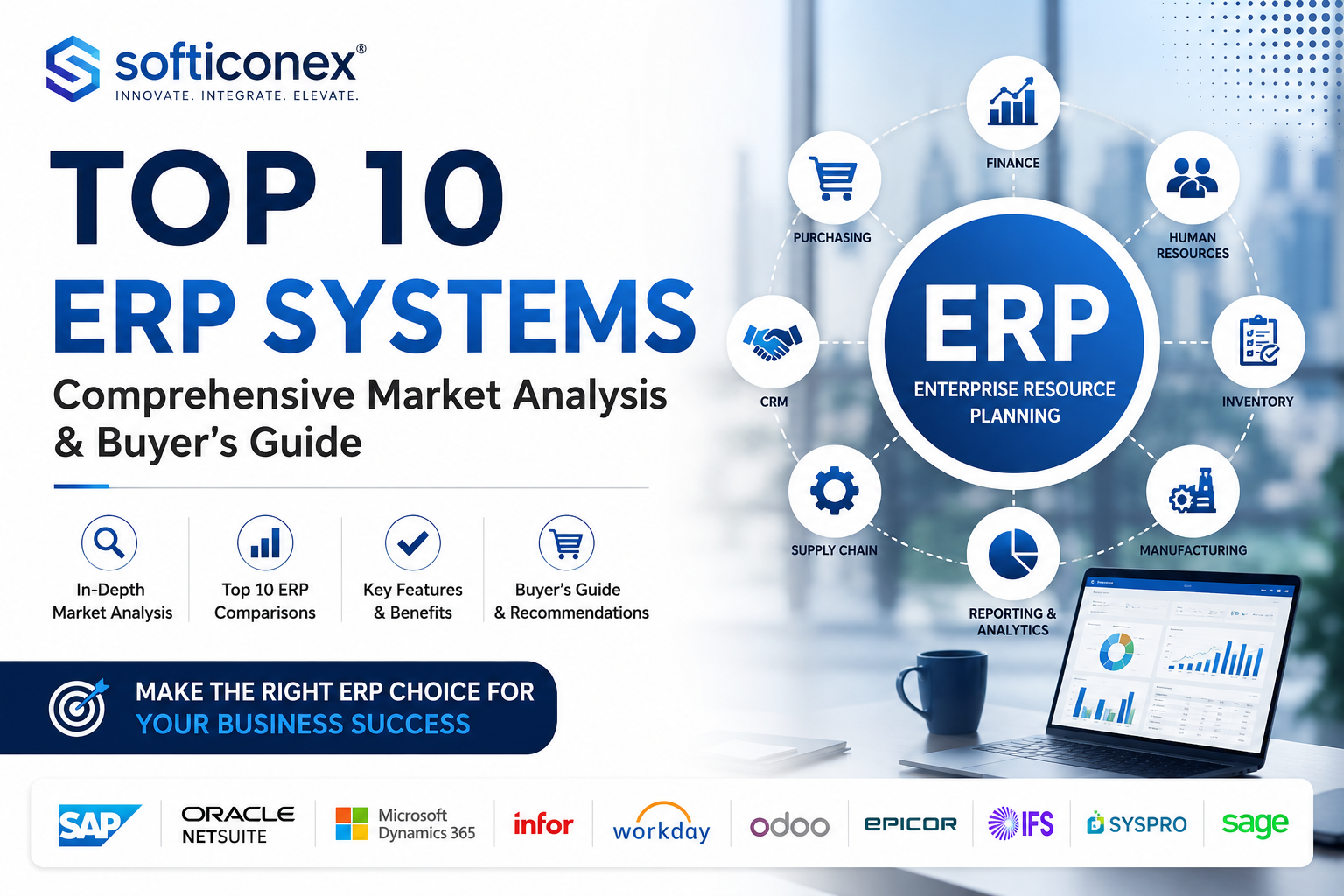
Enterprise Resource Planning (ERP) software has become the backbone of modern business operations. In 2025, the global ERP market stands at approximately $73 billion more than doubling from $44 billion in 2022 and is projected to reach $157 billion by 2033. This explosive growth is fuelled by the accelerating shift to cloud-native deployments, the integration of artificial intelligence across all major platforms, and the expanding adoption among small and mid-sized businesses worldwide.
This report analyses the ten leading ERP platforms by feature depth, market position, deployment flexibility, AI capability, pricing model, and overall suitability across business segments. Each platform has been assessed against real-world deployment data, vendor revenue, customer count, and independent analyst rankings from Gartner, IDC, and Apps Run The World.
Key findings from the 2025 analysis:
- Oracle overtook SAP as the #1 ERP vendor by revenue in 2024 for the first time, generating $8.7B vs SAP’s $8.6B in core ERP revenue.
- Cloud ERP is growing at 14.5% CAGR more than 7× faster than on-premise ERP (2% CAGR).
- SaaS ERP solutions are growing at 17.4% annually, making cloud-first selection the dominant strategy.
- Manufacturing accounts for 32% of the total ERP market and 47% of new ERP implementations.
- Asia-Pacific is the fastest-growing region at 14% CAGR double North America’s rate.
- 92% of high-performing SMBs use or plan to use an ERP system within 24 months.
Platform Comparison Overview
The following table provides a high-level comparison of the ten leading ERP platforms evaluated in this report. Scores reflect an aggregated assessment across functional depth, cloud maturity, AI capability, mobile experience, global compliance, implementation complexity, and total cost of ownership.
| # | ERP System | Vendor | Segment | Deployment | Cloud | AI | Mobile | Score /10 |
|---|---|---|---|---|---|---|---|---|
| 1 | SAP S/4HANA | SAP | Enterprise | Cloud / On-prem | Yes | Yes | Yes | 9.4 |
| 2 | Oracle Fusion Cloud ERP | Oracle | Enterprise | Cloud | Yes | Yes | Yes | 9.1 |
| 3 | Microsoft Dynamics 365 | Microsoft | Mid / Enterprise | Cloud / Hybrid | Yes | Yes | Yes | 8.8 |
| 4 | Infor CloudSuite | Infor | Mid / Enterprise | Cloud | Yes | Yes | Yes | 8.3 |
| 5 | Workday | Workday Inc. | Mid / Enterprise | Cloud | Yes | Yes | Yes | 8.2 |
| 6 | IFS Cloud | IFS | Mid / Enterprise | Cloud / On-prem | Yes | Partial | Yes | 7.9 |
| 7 | NetSuite ERP | Oracle NetSuite | SMB / Mid-market | Cloud | Yes | Partial | Yes | 7.7 |
| 8 | Epicor Kinetic | Epicor Software | SMB / Mid-market | Cloud / On-prem | Yes | Partial | Partial | 7.4 |
| 9 | Sage Intacct X3 | Sage Group | SMB / Mid-market | Cloud / On-prem | Yes | Partial | Partial | 7.1 |
| 10 | Odoo | Odoo SA | SMB | Cloud / On-prem | Yes | Partial | Yes | 7.0 |
Legend: Yes = Full native support | Partial = Limited or module-specific support | Scores rated out of 10 by independent analyst assessment (2025).
Detailed Platform Profiles
1. SAP S/4HANA — Score: 9.4 / 10
| Vendor | SAP SE |
| Overall Score | 9.4 / 10 |
| Market Share (ERP) | 10.04% (ERP installs) |
| Approx. Customers | 141,399 total SAP ERP customers |
| ERP Revenue (2024) | ~$8.6B (2024, core ERP) |
| Founded | 1972 |
SAP S/4HANA is the world’s most comprehensive enterprise ERP suite, built on SAP’s proprietary in-memory HANA database. Launched in 2015 as the successor to SAP ECC, S/4HANA has become the gold standard for large enterprise deployments. SAP’s total cloud ERP suite revenue surged 34% recently as the company accelerates its transition from legacy on-premise licenses to cloud subscriptions. SAP’s “Joule” AI copilot, launched in 2023–2024, provides generative AI assistance across core ERP functions including financial close, procurement automation, and supply chain planning.
Key Capabilities
- Real-time analytics powered by in-memory HANA database eliminates batch processing windows
- Joule AI copilot with generative AI across finance, supply chain, procurement, and HR modules
- Supply chain digital twin real-time visibility across end-to-end supply network
- 25+ industry-specific vertical solutions (Automotive, Oil & Gas, Retail, Utilities, Pharma, etc.)
- Advanced manufacturing execution system (MES) integration
- SAP Fiori UX providing role-based, consumer-grade user experience
- S/4HANA Cloud public and private editions; RISE with SAP managed cloud programme
- Embedded SAP BTP (Business Technology Platform) for extensions and integration
Market Position & Financials
SAP holds a 10.04% share of ERP installations globally and ranked second by revenue in 2024 at approximately $8.6 billion in core ERP revenue. SAP has 141,399 known ERP customers worldwide, the largest enterprise-focused customer count of any single vendor. The majority of S/4HANA customers fall in the 1,000–4,999 employee range, though S/4HANA also dominates among 10,000+ employee organisations.
Strengths
- Most comprehensive module and process coverage of any ERP platform
- Deep global regulatory compliance across 190+ countries
- Largest partner ecosystem 22,000+ certified SAP partners globally
- Proven scalability for the most complex multi-entity, multi-currency operations
Limitations
- Implementation costs typically range from $1M to $100M+ depending on scale and complexity
- Steep learning curve; heavy dependency on specialist SAP consultants
- Legacy SAP ECC to S/4HANA migration remains challenging and expensive for existing customers
2. Oracle Fusion Cloud ERP — Score: 9.1 / 10
| Vendor | Oracle Corporation |
| Overall Score | 9.1 / 10 |
| Market Share (ERP) | 6.63% (by revenue share, #1 globally) |
| Approx. Customers | 14,000+ large enterprise customers |
| ERP Revenue (2024) | $8.7B (2024, #1 by ERP revenue) |
| Founded | 1977 |
Oracle Fusion Cloud ERP is the industry’s top-ranked platform by revenue, having surpassed SAP for the first time in 2024 with $8.7 billion in core ERP revenue. Oracle’s cloud-first, autonomous database-backed architecture delivers industry-leading performance, and its unified suite covering ERP, HCM, and EPM (Enterprise Performance Management) in a single platform remains a competitive differentiator. Oracle’s investment in sovereign cloud infrastructure and distributed cloud regions underscores its intent to deliver AI-native ERP at global scale.
Key Capabilities
- Oracle Autonomous Database backend self-tuning, self-patching for maximum performance
- AI-driven spend analytics, smart contract automation, and predictive forecasting
- Adaptive intelligent applications across all modules embedded ML models
- Unified platform spanning ERP, HCM, and EPM single source of truth for Finance + HR + Planning
- Generative AI for business reports, smart invoice matching, and supply chain risk sensing
- Global payroll across 200+ countries and territories
- Real-time reporting and interactive dashboards via Oracle Analytics Cloud
Market Position & Financials
Oracle leads the ERP market by revenue in 2024 with $8.7B, holding a 6.63% share of the $131B+ total ERP applications market tracked by Apps Run The World. Oracle’s 100,000 total ERP customers include 14,000+ large enterprise users of Oracle Fusion Cloud ERP, plus 41,000+ NetSuite customers (growing 25% annually in 2024).
Strengths
- Best-in-class Finance and HR modules consistently ranked #1 by Gartner in cloud ERP
- Native cloud-first architecture no technical debt from legacy on-premise codebase
- Powerful embedded analytics engine with real-time reporting
Limitations
- Premium pricing model among the highest per-user subscription costs in the market
- Complex data migration from legacy systems; significant implementation investment
- Vendor lock-in risk due to proprietary Oracle technology stack
3. Microsoft Dynamics 365 — Score: 8.8 / 10
| Vendor | Microsoft Corporation |
| Overall Score | 8.8 / 10 |
| Market Share (ERP) | 4.0% by revenue; 23.85% of ERP installs (#1) |
| Approx. Customers | ~100,000 organisations |
| ERP Revenue (2024) | $5.4B (2024, ERP-specific) |
| Founded | 1975 (Microsoft) |
Microsoft Dynamics 365 is the world’s most widely installed ERP platform by number of organisations, with a 23.85% share of ERP installations. Microsoft generated approximately $5.4 billion in ERP-specific revenue from Dynamics 365 in 2024, with overall Dynamics 365 revenue exceeding $7 billion and growing 16% year-over-year. Microsoft’s singular competitive advantage is its native integration with the world’s most widely used productivity ecosystem: Microsoft 365, Teams, Power Platform, and Azure. Its $80 billion investment in AI-capable data centres in 2025 underscores the company’s AI-first strategy.
Key Capabilities
- Copilot AI assistant embedded across all Dynamics 365 modules generative AI for every workflow
- Deep native integration with Microsoft 365, Teams, SharePoint, and Power BI
- Power Platform (Power Apps, Power Automate, Power BI) for low-code customisation and automation
- Azure-native scalability with enterprise-grade security and compliance
- CRM and ERP in a single ecosystem Dynamics 365 Sales, Service, Finance, Supply Chain, HR
- Dataverse common data model enabling seamless data sharing across applications
- Dual deployment: Dynamics 365 Business Central (SMB/Mid-market) + Finance & Supply Chain (Enterprise)
Market Position & Financials
Dynamics 365 is used by approximately 100,000 organisations worldwide. Its 23.85% share of ERP installations makes it the most widely deployed ERP platform by count, though its per-customer revenue is lower than SAP or Oracle due to its strong SMB and mid-market presence via Business Central. Microsoft does not separately report ERP customer counts.
Strengths
- Deepest productivity suite integration Microsoft 365 familiarity reduces adoption friction
- Flexible modular pricing organisations buy only the applications they need
- Largest global implementation partner network after SAP
Limitations
- Module fragmentation Business Central vs Finance & Operations can confuse buyers
- Complex licensing structure with numerous add-ons and capacity units
- Performance variability at very large transaction volumes compared to Oracle or SAP
4. Infor CloudSuite — Score: 8.3 / 10
| Vendor | Infor (Koch Industries subsidiary) |
| Overall Score | 8.3 / 10 |
| Market Share (ERP) | Top 10 globally by revenue |
| Approx. Customers | 68,000+ customers globally |
| ERP Revenue (2024) | Part of $3.2B+ Infor total revenue |
| Founded | 2002 |
Infor CloudSuite is a purpose-built, industry-specific cloud ERP platform that stands apart from SAP and Oracle by offering micro-vertical solutions tailored for discrete manufacturing, food and beverage, fashion, healthcare, and distribution. As a subsidiary of Koch Industries since 2020, Infor benefits from significant private investment and a stable ownership structure. Infor’s GT Nexus network, one of the world’s largest supply chain networks with 65,000+ connected trading partners is a unique differentiator unavailable from any other ERP vendor.
Key Capabilities
- Industry-specific micro-vertical solutions pre-configured for 13+ distinct industries
- Infor Coleman AI platform embedded AI across procurement, supply chain, and financials
- GT Nexus global supply chain network 65,000+ trading partner connections
- Multi-tenant SaaS cloud architecture with continuous delivery updates
- Birst embedded analytics and BI for operational and financial reporting
- Hook & Loop modern UX design layer for consumer-grade user experience
- Global financials with multi-ledger, multi-currency, and multi-entity support
Strengths
- Best-in-class for asset-intensive manufacturing and distribution companies
- Pre-built industry processes reduce customisation cost and implementation time
- Modern multi-tenant SaaS architecture avoids the technical debt issues of older platforms
Limitations
- Brand recognition significantly lower than SAP, Oracle, or Microsoft among general buyers
- Smaller global partner ecosystem fewer independent consultants available
- Support quality and consistency can vary by region
5. Workday — Score: 8.2 / 10
| Vendor | Workday, Inc. |
| Overall Score | 8.2 / 10 |
| Market Share (ERP) | 12.52% of ERP installs (#2 globally) |
| Approx. Customers | 5,000+ large enterprise customers |
| ERP Revenue (2024) | $3.3B (2024, ERP-specific) |
| Founded | 2005 |
Workday is the clear market leader for combined Human Capital Management (HCM) and Financial Management in a unified cloud platform. With 12.52% of ERP installations, Workday ranks second only to Microsoft Dynamics in deployment breadth among the vendors tracked. Workday’s customer base is exclusively a large enterprise; its 5,000+ customers include the majority of Fortune 500 companies using Workday for HR. Workday generated $3.3 billion in ERP-specific revenue in 2024, representing approximately 45.6% of its $7.3 billion total subscription revenue.
Key Capabilities
- Finance and HR unified in a single platform no integration required between the two
- Workday AI and ML embedded across all applications workforce planning, spend analysis, forecasting
- Adaptive planning and budgeting tools via Workday Adaptive Planning (acquired 2018)
- People Analytics with industry benchmarking workforce insights vs external peer data
- Skills Cloud AI-powered talent management and skills intelligence
- Highly configurable business process framework 850+ pre-built integrations
- Workday Extend developer platform for custom application development
Strengths
- Best-in-class combined HCM and Financial Management unrivalled for HR-led organisations
- Excellent modern user experience consistently rated #1 for ease of use in enterprise ERP
- Frequent product innovation with bi-annual feature releases and strong customer advisory programmes
Limitations
- Limited manufacturing, MRP, and complex supply chain capabilities not suited for product companies
- Higher total cost for smaller organisations with limited resources to leverage the full platform
- Constrained customisation compared to SAP or Oracle opinionated platform design
6. IFS Cloud — Score: 7.9 / 10
| Vendor | IFS AB (EQT Private Equity) |
| Overall Score | 7.9 / 10 |
| Market Share (ERP) | Strong in asset-intensive niches |
| Approx. Customers | 10,000+ customers in 170+ countries |
| ERP Revenue (2024) | Part of $1B+ IFS annual revenue |
| Founded | 1983 |
IFS Cloud is a highly specialised ERP platform designed for asset-intensive industries aerospace and defence, energy and utilities, construction and engineering, and field service-heavy organisations. While less well-known than the top three vendors, IFS is consistently recognised by Gartner as a leader in field service management and asset lifecycle management. IFS Cloud’s component-based modular architecture allows organisations to deploy exactly the capabilities they need, and the IFS.ai layer brings embedded intelligence to predictive maintenance, work order optimisation, and project planning.
Key Capabilities
- End-to-end asset lifecycle management from procurement to decommission
- Project-centric ERP core designed around project execution, not just GL management
- Field Service Management (FSM) Gartner Magic Quadrant Leader for FSM
- Aviation, defence, and MRO (Maintenance, Repair & Overhaul) specific modules
- IFS.ai embedded intelligence predictive maintenance, workforce optimisation
- Component-based modular architecture deploy modules independently
Strengths
- Best-in-class for asset-intensive industries where lifecycle management is critical
- Strong project management and project accounting capabilities
- Agile deployment model faster time-to-value vs SAP or Oracle in supported industries
Limitations
- Smaller global market presence and brand awareness outside industrial sectors
- Fewer third-party ISV integrations compared to SAP, Oracle, or Microsoft
- Not well-suited for retail, financial services, or consumer goods companies
7. NetSuite ERP — Score: 7.7 / 10
| Vendor | Oracle NetSuite |
| Overall Score | 7.7 / 10 |
| Market Share (ERP) | Dominant in SMB cloud ERP |
| Approx. Customers | 41,000+ customers (25% YoY growth in 2024) |
| ERP Revenue (2024) | Part of Oracle total $55B revenue |
| Founded | 1998 |
NetSuite is the world’s first and most widely adopted cloud ERP platform, having launched its multi-tenant SaaS architecture in 1998 decades before most competitors began their cloud transitions. Acquired by Oracle in 2016 for $9.3 billion, NetSuite remains operated as an independent business unit targeting SMBs and growing mid-market companies. Its 41,000+ customer base grew 25% year-over-year in 2024, making it one of the fastest-growing ERP platforms in the market. NetSuite’s OneWorld module supports true multi-entity, multi-currency, multi-subsidiary operations, a capability normally reserved for enterprise platforms.
Key Capabilities
- True multi-tenant cloud since 1998 longest-running SaaS ERP with proven scalability
- Financial management with multi-entity consolidation via OneWorld
- SuiteAnalytics built-in reporting and business intelligence
- SuiteScript (JavaScript) and SuiteFlow for deep platform customisation
- Integrated e-commerce, CRM, and professional services automation (PSA)
- Multi-currency and multi-subsidiary support for international expansion
Strengths
- Fast implementation timelines typically 3–6 months vs 12–24+ months for SAP/Oracle
- Affordable entry point for SMBs seeking genuine cloud ERP functionality
- Oracle backing provides financial stability, R&D investment, and global support infrastructure
Limitations
- Limited manufacturing depth MRP and shop floor capabilities lag Epicor or SAP
- Module add-on costs accumulate quickly total cost of ownership can exceed initial estimates
- User interface remains dated compared to Workday or Microsoft Dynamics
8. Epicor Kinetic — Score: 7.4 / 10
| Vendor | Epicor Software Corporation |
| Overall Score | 7.4 / 10 |
| Market Share (ERP) | Strong in discrete manufacturing SMBs |
| Approx. Customers | 20,000+ customers worldwide |
| ERP Revenue (2024) | Part of ~$900M Epicor annual revenue |
| Founded | 1972 |
Epicor Kinetic (formerly Epicor ERP) is purpose-built for discrete and batch manufacturing companies, particularly in the SMB and lower mid-market segments. Epicor’s deep manufacturing DNA job costing, shop floor control, material requirements planning, and quality management — makes it a preferred choice for industrial manufacturers that do not need the full breadth of SAP or Oracle. Epicor’s REST API integration framework and industry-specific implementation templates accelerate deployment, and the platform’s strong value proposition has made it a consistent choice for precision manufacturers, metal fabricators, and industrial distributors.
Key Capabilities
- Manufacturing-focused ERP with job costing, shop floor control, and production scheduling
- Material Requirements Planning (MRP) and Advanced Planning & Scheduling (APS)
- Quality Management System (QMS) in-process inspection, supplier quality, CAPA
- Customer and supplier self-service portals for order visibility and collaboration
- REST API integration framework for connecting to CAD, MES, IoT, and eCommerce systems
- Industry-specific implementation templates for aerospace, automotive, and industrial
Strengths
- Deep discrete manufacturing expertise unmatched for job-shop and make-to-order environments
- Quick configurability industry templates reduce project risk and timeline
- Strong value for money for manufacturers who need depth over breadth
Limitations
- Limited HCM capabilities organisations need a separate HR and payroll software
- User interface less modern than cloud-native competitors
- Analytics and reporting capabilities less sophisticated than Oracle or SAP
9. Sage Intacct X3 — Score: 7.1 / 10
| Vendor | Sage Group plc |
| Overall Score | 7.1 / 10 |
| Market Share (ERP) | Market leader in SMB financial management |
| Approx. Customers | 6.1M customers (all Sage products) |
| ERP Revenue (2024) | Part of Sage $3.1B total revenue |
| Founded | 1981 |
Sage Group is the world’s largest ERP vendor by customer count, serving 6.1 million businesses globally across its portfolio. Sage Intacct, its cloud financial management platform, leads the AICPA-endorsed accounting software market and is particularly strong for multi-entity organisations in professional services, nonprofits, and SaaS businesses. Sage X3 addresses the manufacturing and distribution mid-market. Together, the combined Sage Intacct X3 suite provides a comprehensive offering for growing businesses that require multi-entity financial consolidation, project accounting, and revenue recognition without enterprise-level complexity.
Key Capabilities
- Dimensional accounting engine flexible financial reporting across entities, projects, and cost centres
- Multi-entity financial consolidation GAAP and IFRS compliant across subsidiaries
- Project accounting and billing management time and expense, milestone billing, retainer management
- Subscription billing and revenue recognition (ASC 606 / IFRS 15 compliance)
- Open API integration platform 300+ pre-built connectors to payroll, CRM, and fintech
- Distribution and warehouse management in Sage X3
Strengths
- Excellent multi-entity financial management AICPA preferred for accounting professionals
- Strong for professional services firms, nonprofits, and SaaS businesses with complex revenue models
- Clean, intuitive interface with lower adoption friction than enterprise platforms
Limitations
- Limited manufacturing modules not suitable for complex production environments
- Fewer global regulatory capabilities compared to SAP, Oracle, or Infor in emerging markets
- Scalability ceiling organisations with 500+ employees typically outgrow the platform
10. Odoo — Score: 7.0 / 10
| Vendor | Odoo SA (Belgium) |
| Overall Score | 7.0 / 10 |
| Market Share (ERP) | Fastest growing open-source ERP |
| Approx. Customers | 12M+ users globally (community + enterprise) |
| ERP Revenue (2024) | Estimated $500M+ ARR (2024) |
| Founded | 2005 |
Odoo is the world’s most popular open-source ERP platform, with over 12 million users across its community and enterprise editions. Unlike any other platform in this report, Odoo offers a genuinely open-source community edition free to use and supported by a global developer community alongside a paid enterprise subscription. Its modular architecture of 30+ integrated business applications spans ERP, CRM, eCommerce, POS, HR, manufacturing, and marketing automation, making it an extraordinary all-in-one platform for startups and growing SMBs. The Odoo.sh managed cloud hosting platform and Studio no-code customisation tool lower the barrier to entry significantly.
Key Capabilities
- 30+ integrated modular business applications covering all core business functions
- Open-source Community Edition free to deploy, self-hosted, 40,000+ community add-on apps
- Built-in website builder and eCommerce integrated with inventory, so no middleware required
- Point of Sale and retail management integrated with central inventory
- Manufacturing MRP and production module for SMB manufacturers
- Odoo Studio no-code application customiser for non-developers
- Odoo.sh managed cloud platform for simplified hosting and deployment
Strengths
- Extremely affordable pricing Community Edition free; Enterprise from ~$24/user/month
- Highly modular and flexible start with one app, expand to the full suite as needed
- Best value proposition for startups and growing SMBs needing an integrated business platform
Limitations
- Enterprise support can be inconsistent highly dependent on local Odoo partner quality
- Performance issues with large datasets not suited for enterprises with millions of transactions
- Community Edition lacks key features (e.g., advanced reporting, SLAs) available only in Enterprise
ERP Selection Guide
Selecting the right ERP platform is one of the most consequential technology decisions any organisation will make. The following framework maps business profile to platform recommendation based on size, industry, budget, and strategic priority.
By Organisation Size
| Organisation Size | Recommended Platforms | Key Rationale |
|---|---|---|
| Startup / <50 employees | Odoo, NetSuite | Low cost, fast deployment, modular growth path |
| SMB / 50–250 employees | NetSuite, Sage Intacct, Odoo Enterprise | Cloud-native, financial management depth, affordable per-user pricing |
| Mid-market / 250–2,000 | Microsoft Dynamics 365 BC, Epicor Kinetic, IFS Cloud | Functional depth with manageable implementation cost |
| Enterprise / 2,000–10,000 | Microsoft Dynamics F&O, Infor CloudSuite, Workday | Scalability, industry fit, multi-entity support |
| Large Enterprise / 10,000+ | SAP S/4HANA, Oracle Fusion Cloud ERP | Maximum functional breadth, global compliance, AI capability |
By Industry Vertical
- Manufacturing (discrete): Epicor Kinetic, SAP S/4HANA, Infor CloudSuite
- Manufacturing (process / food & beverage): Infor CloudSuite, SAP S/4HANA
- Professional Services: Workday, NetSuite, Sage Intacct
- Retail & Distribution: Microsoft Dynamics 365, NetSuite, Odoo
- Healthcare & Life Sciences: Oracle Fusion, Workday, SAP S/4HANA
- Asset-Intensive / Field Service: IFS Cloud, SAP S/4HANA
- Aerospace & Defence: IFS Cloud, SAP S/4HANA
- Nonprofit & Education: Sage Intacct, Workday, NetSuite
- Technology / SaaS: Workday, NetSuite, Microsoft Dynamics 365
Key Evaluation Criteria
When evaluating ERP platforms, organisations should assess the following dimensions systematically:
- Total Cost of Ownership (TCO): Include licence/subscription, implementation, customisation, training, support, and ongoing upgrade costs not just per-user pricing
- Implementation Timeline: SAP/Oracle typically require 12–36 months; NetSuite/Odoo can deploy in 3–6 months
- Integration Ecosystem: Assess native connectors, API quality, and middleware requirements for existing systems
- AI & Automation Roadmap: Evaluate the vendor’s AI investment trajectory platforms without credible AI roadmaps will fall behind by 2027
- Vendor Stability: Consider financial health, ownership structure, and market trajectory
- Partner Ecosystem: The quality and proximity of certified implementation partners often determines project success more than the platform itself
- Upgrade Path: Cloud SaaS platforms (Oracle, Workday, NetSuite) deliver continuous updates; on-premise deployments require planned upgrade projects
The AI Revolution in ERP (2024–2025)
Artificial intelligence has moved from a differentiating feature to a baseline expectation in enterprise ERP. All ten platforms in this report have embedded AI capabilities, though the depth, maturity, and use-case coverage vary significantly. The following developments define the AI landscape in enterprise resource planning(ERP) as of mid-2025:
Generative AI & Copilot Features
- SAP Joule: SAP’s natural language copilot spans S/4HANA, SuccessFactors, Ariba, and BTP. Joule can draft business documents, explain financial variances, guide procurement decisions, and answer HR policy questions in conversational language.
- Microsoft Dynamics 365 Copilot: Powered by Azure OpenAI, Copilot assists with invoice processing, sales forecasting, supply chain disruption alerts, and meeting summaries in Teams. Microsoft’s $80B AI infrastructure investment in 2025 is the largest in the industry.
- Oracle AI Agents: Oracle’s pre-trained domain agents automate financial close, sustainability compliance, invoice matching, and supply chain risk sensing without additional licensing costs.
- Workday AI: Workday embeds ML across planning, talent management, spend analysis, and financial close. Its Skills Cloud uses AI to infer skills from job histories and recommend learning pathways.
Agentic AI: The Next Frontier
Microsoft CEO Satya Nadella has reorganised the company to prioritise “agentic AI” AI that autonomously executes multi-step workflows. Oracle, SAP, and Workday are all building agent frameworks that will allow ERP systems to autonomously handle procurement approvals, financial reconciliations, and workforce scheduling with minimal human intervention. This shift from AI-assisted to AI-autonomous workflows will define the ERP competitive landscape through 2030.
Pricing Overview
ERP pricing is notoriously opaque. Vendors rarely publish list prices, and total cost of ownership depends heavily on implementation complexity, customisation scope, data migration, and ongoing support. The following provides indicative ranges based on publicly available and analyst-reported data as of 2025:
| Platform | Subscription (per user/month) | Implementation Cost | Notes |
|---|---|---|---|
| SAP S/4HANA | $150–$350+ | $500K–$100M+ | Highly variable by scale; RISE with SAP bundles cloud + support |
| Oracle Fusion | $625–$1,250+ | $1M–$50M+ | Premium pricing; per-user model with module add-ons |
| Microsoft D365 | $70–$210 | $150K–$10M+ | Modular pricing; Business Central starts ~$70/user/month |
| Infor CloudSuite | Custom quote | $250K–$5M+ | Industry-specific; contact Infor for pricing |
| Workday | $100–$500+ | $300K–$15M+ | Per-user negotiated; HCM + Finance bundled |
| IFS Cloud | Custom quote | $200K–$5M+ | Component-based; subscription or licence options |
| NetSuite ERP | $99–$249+ | $50K–$1M+ | Base licence + per-user + module add-ons |
| Epicor Kinetic | $175–$350+ | $75K–$2M+ | Manufacturing-focused; cloud or on-premise options |
| Sage Intacct X3 | $400–$600+ | $30K–$500K | Financial management focus; competitive for SMBs |
| Odoo | Free–$48+ | $10K–$250K | Community Edition free; Enterprise from ~$24/user/month |
Note: All prices are indicative and based on publicly reported or analyst-estimated data as of 2025. Actual pricing requires vendor quotation. Implementation costs are highly variable and depend on scope, complexity, data migration, and partner rates.
Conclusion & Outlook
The global ERP market is entering its most transformative decade since the shift to client-server architecture in the 1990s. Three forces are reshaping the competitive landscape through 2030:
- AI Integration: Platforms that cannot demonstrate credible, embedded AI not bolted-on features will lose deals to those that can. SAP, Oracle, Microsoft, and Workday are investing billions annually in AI R&D. The gap between AI-native and AI-lagging platforms will widen significantly by 2027.
- Cloud Consolidation: The migration from on-premise to cloud is irreversible. Organisations still running on-premise SAP ECC, Oracle E-Business Suite, or legacy platforms face an accelerating obsolescence clock as vendors sunset support. Cloud-first strategy is no longer optional.
- SMB Democratisation: ERP is no longer exclusively for large enterprises. NetSuite’s 25% customer growth, Odoo’s 12M+ user base, and the proliferation of affordable SaaS ERPs have extended ERP capability to businesses of all sizes. The 92% adoption rate among high-performing SMBs confirms that ERP is now a competitive necessity at every scale.
For organisations beginning an ERP selection process in 2025, the recommendation is clear: prioritise cloud-native platforms with proven AI roadmaps, validate total cost of ownership beyond licence fees, and invest in partner selection as rigorously as platform selection. The best ERP system is the one your organisation will successfully adopt and leverage not merely the one with the highest analyst ranking.