How to combine Meta’s targeting options with the right bidding strategy so your budget reaches real buyers, not the auction’s average click.
Most Meta ads fail for one of two silent reasons: the ad reaches the wrong person, or it costs too much to reach the right one. Targeting solves the first problem, bidding solves the second, and in 2026 the rules for both changed enough that 2023-era tactics quietly stopped working.
Meta removed thousands of detailed targeting interests, pushed most objectives toward Advantage+ Audience, and tightened what advertisers can do with anyone under 18. This guide treats Meta ads targeting and bidding strategies as one connected system, because that is how Meta’s delivery algorithm treats them, covering current targeting options, a bidding framework, a rollout checklist, and the mistakes that quietly drain budget even in “optimized” accounts.
What Changed in Meta Ads Targeting in 2026 (Read This First)
Before picking any targeting option, understand the shift underneath Ads Manager; it changes almost every decision below.
- Detailed targeting is now a suggestion, not a filter: For most conversion objectives, your interest and behavior selections act as a starting hint. Meta can serve your ad outside that selection if it predicts a conversion.
- Old detailed-targeting setups quietly stopped delivering: Campaigns built on discontinued interest categories saw delivery drop to zero. If spend that used to be consistent suddenly flatlines with no policy rejection, check for a targeting warning banner first.
- Advantage+ Audience is now the default for Sales, Leads, and App Promotion objectives. Full manual restriction is rarely available for these anymore.
- Only two things remain hard rules: location and minimum age: Everything else gender, interests, lookalike sources is a signal the algorithm can override.
Practical takeaway: stop locking an audience down to prove you understand your customer. Feed the algorithm your best first-party signal and let it search the wider pool. Accounts that resisted this shift in early 2026 generally paid more for the same result.
Meta Ads Targeting Options in 2026 (Full List)
Every targeting method in Ads Manager falls into one of four groups. Knowing which group you are in tells you how much control you actually have.
Core (Detailed) Targeting
Demographics, interests, and behaviors selected manually. Still visible in Ads Manager and useful as a starting signal, but no longer a hard filter for most objectives. Use it to give the algorithm direction, not as a wall around your audience.
Custom Audiences (First-Party Data)
Built from customer lists, website pixel and Conversions API events, app activity, and engagement (video views, profile visits, Page messages). This is the single most valuable targeting input in 2026 because it does not depend on Meta’s shrinking interest categories and survives iOS tracking limits better than any other signal.
- Website Custom Audiences: Segment by event completed (add-to-cart vs. purchase), not just “all visitors.”
- Customer list uploads: Hashed CRM data, refreshed weekly for active retargeting.
Lookalike Audiences
Modeled from a Custom Audience source, so source quality decides output quality a lookalike built from your top 500 highest-LTV buyers outperforms one built from everyone who ever clicked. A tighter match (1–3 percent) targets closer resemblance; a broader match (4–10 percent) trades precision for scale.
Advantage+ Audience (AI-Driven Targeting)
Meta’s machine-learning system searches the full eligible population instead of a pre-defined segment. You provide a conversion goal, optional suggestions, and hard limits (location, minimum age); the system decides the rest from hundreds of signals. This is what most people mean by “meta ads targeting ai” today it is the default operating mode, not a separate product.
Location Targeting
Still a genuine hard constraint. Target by country, region, city, or radius, and choose whether to reach people who live in, recently visited, or currently are in that location.
- Hyper-local radius (under 5 miles) often starves small budgets. Unless you need physical foot traffic, city or regional targeting usually wins on cost simply because more people compete in the auction.
- Country-level targeting often outperforms city-level once you have 50+ weekly conversions, because it gives Advantage+ more room to find demand pockets you would not have picked manually.
Meta Ads Targeting for Under-18 Audiences (Compliance You Cannot Skip)
This is one of the most-searched and most misunderstood parts of Meta targeting, so it deserves its own section.
- Teen accounts are automatic. Meta classifies anyone identified as under 18 into a protected account type across Facebook and Instagram by default.
- Targeting under-18 users is limited to age and location only. Interest, behavior, and engagement-based targeting toward this age group is unavailable, regardless of objective.
- Special ad categories (housing, employment, credit, financial services) must target an 18–65-plus range across the board, due to separate anti-discrimination rules.
- Age-restricted products (alcohol, gambling, tobacco, certain financial products) must exclude under-18 users at account level, and the legal minimum age varies by country.
If your product is not age-restricted, do not try to manually work around these limits. Meta enforces them automatically, and attempts to route around age controls are a fast way to get an account flagged. Focus your targeting energy on the 18-plus audience instead, where you still have real, controllable levers.
The Right Meta Ads Targeting Tool for the Job
“Meta ads targeting tool” gets searched often, but the real question is which system to trust for which task.
- Ads Manager (native): The source of truth for audience setup and delivery diagnostics. Start here before any third-party layer.
- Events Manager: Where you configure the Conversions API; CAPI event quality directly feeds the Advantage+ model, more than any interest-targeting tool.
- Meta Ad Library: Free competitor research; see live creative and estimated targeting logic for any advertiser.
- Third-party budget tools: Useful for rule-based automation, but treat “unlock hidden targeting” claims with suspicion; no tool overrides Meta’s own auction rules.
Prioritize whichever tool improves your first-party data quality over whichever promises more granular manual targeting.
A Practical Meta Ads Targeting Strategy Framework
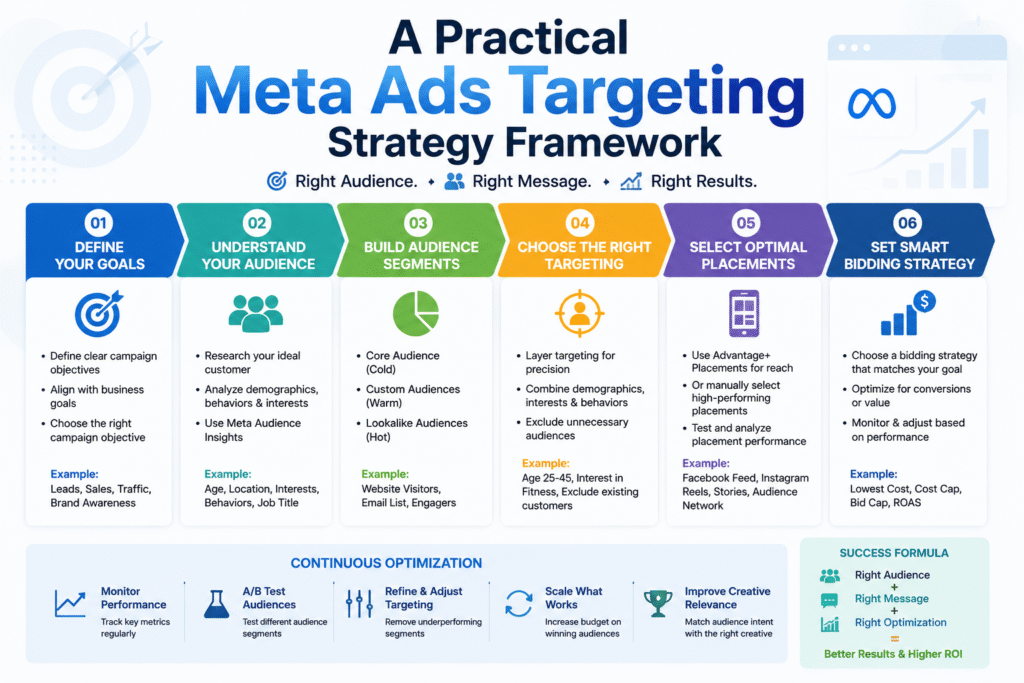
The sequence experienced media buyers actually follow, in order:
- Start with your best first-party signal; build a Custom Audience from purchasers or top leads before touching interest targeting.
- Feed Advantage+ 3 to 5 audience suggestions, not fifteen; overloading suggestions dilutes the signal.
- Set only the hard constraints that genuinely matter, usually location and age minimum for restricted products.
- Let the ad set reach roughly 50 conversions in a week before changing targeting.
- Add lookalikes only after your Custom Audience source has at least 1,000 quality events.
- Review, don’t rebuild, every two weeks, pause the worst ad set, keep the structure.
Meta Ads Bidding Strategies Explained
Bidding tells Meta how aggressively to compete for you in each auction. Four strategies cover almost everything you’ll need; everything else in Ads Manager is a variation of one of these.
Highest Volume (formerly “Lowest Cost”)
No cost target set: Meta spends your full budget chasing the largest number of results it can find. The right default for a new campaign, since it gathers data fastest and shows a realistic cost range before you commit to a target.
- Use it when: you’re under 20–30 weekly conversions or testing new creative. Judge results on a 7-day average, never a single day.
Cost per Result Goal (Cost Cap)
You set the average cost you want per result, and Meta manages the auction to land near that number over time. This is where most mature accounts settle.
- Common error: Setting the cap at or below your current average. Give it 10–15 percent breathing room above your benchmark, then tighten gradually.
Bid Cap
A hard ceiling on what Meta can bid in any single auction is the most restrictive option, and the least forgiving. Set it too low, and delivery drops off a cliff instead of gradually.
- Use it when: You have strong historical auction data and a fixed-margin product. Avoid it while you’re still learning what a realistic cost looks like.
ROAS Goal (Highest Value)
Optimizes for revenue efficiency instead of conversion count, prioritizing users predicted to spend more. Requires reliable purchase-value data through the pixel and CAPI.
- Use it when: You sell products with varied price points, and revenue matters more than order count. Skip it for lead gen or brand-new accounts without clean purchase data.
How Targeting and Bidding Interact (What Most Guides Skip)
Targeting and bidding are usually explained as two separate chapters, but they constrain each other in the auction, and mismatching them is a common hidden cause of underdelivery.
- Broad Advantage+ Audience + a too-tight Cost Cap: A wide pool to search but a narrow price it’s allowed to pay, so delivery is slow or stalls. Widen both together, not one at a time.
- Narrow Custom Audience + Bid Cap: Often works well, since you already told the algorithm exactly who to find; it doesn’t need to search far.
- New audience + Highest Volume: The correct pairing for the first two to three weeks. Don’t introduce a cost target until you know what a normal result actually costs.
- Mature audience + ROAS Goal: Pair these only once your Custom Audience and lookalike sources are proven. Asking a ROAS goal to also discover a new audience usually starves the ad set.
Mistakes Advertisers Keep Making
These patterns show up constantly in agency audits, and they’re the recurring themes you’ll see discussed in advertiser communities on forums like Reddit’s paid-media boards. The details differ, but the root cause is almost always one of these:
- Changing targeting and bidding in the same week, so you never know which change caused the result. Change one variable, wait a full learning cycle, then change the other.
- Setting a Cost Cap from a gut feeling instead of a Highest Volume benchmark; guessed targets are either too loose to matter or too tight to deliver.
- Rebuilding the ad set every time performance dips, which resets learning and makes short-term results worse before the original setup even had a chance to recover.
- Treating detailed targeting as a lock instead of a suggestion, wasting management time fighting expansion behavior that would be better spent on creative testing.
- Ignoring quality score and the landing page. A slow page or irrelevant offer raises effective cost no matter how well bidding is configured; bidding cannot fix a broken funnel.
Final Takeaway
Meta ads targeting and bidding strategies work best when you stop treating them as separate settings and treat them as one system that has to agree with itself. Feed the algorithm strong first-party signal, keep manual restrictions to what genuinely matters, benchmark cost honestly before setting a target, and give every change enough time to show a result. That sequence beats any single “best” targeting option or bidding hack found in isolation.
Frequently Asked Questions
What is the best Meta ads targeting strategy for 2026?
Lead with first-party Custom Audiences, give Advantage+ Audience a small set of suggestions rather than a long interest list, and keep manual restrictions limited to location and, where legally required, minimum age.
Should I use detailed targeting or Advantage+ Audience?
Use detailed targeting as suggestions inside Advantage+ rather than a separate restrictive setup. For most conversion campaigns, it now underperforms the AI-driven approach once you have enough weekly conversions to let it learn.
Can I target people under 18 on Meta?
Only within strict limits: age and location, with no interest, behavior, or gender-based targeting. Age-restricted products and special ad categories carry additional rules, and requirements vary by country.
Which Meta ads bidding strategy should beginners use?
Start with Highest Volume for two to three weeks to establish a real cost benchmark, then move to Cost Cap once you have enough conversion data for a realistic target.
What Meta ads targeting tool should I use in 2026?
Start inside Ads Manager and Events Manager rather than a third-party platform. The biggest gains come from improving pixel and Conversions API data quality, not from adding another targeting tool.