Most enterprises do not have a data governance tooling problem. They have a data governance trust problem, and the tooling decision sits downstream of it. A regional bank we might describe as typical for this market generates data across forty or more systems, three cloud platforms, and a dozen business units, and almost nobody in that organization can confidently answer a simple question: where did this number actually come from, and can I trust it for a regulatory filing? That uncertainty is the real cost of weak governance, and it compounds every year as data volume grows.
Three forces have made this problem sharper in 2026 than it was even two years ago. Data volumes keep climbing as organizations adopt more SaaS platforms and IoT sources. Artificial intelligence systems now consume that data directly to make decisions, which means governance failures no longer just produce bad reports, they produce bad automated decisions at scale. And regulatory scrutiny has intensified, with privacy and AI-specific regulations adding new categories of risk on top of long-standing financial and healthcare compliance requirements.
Data governance tools exist to close this gap between data volume and data trust. The right platform gives an organization a single, reliable source of truth about what data exists, where it lives, who owns it, whether it can be trusted, and who is allowed to use it. The wrong platform, or the right platform poorly implemented, becomes expensive shelfware that governance teams build once and nobody adopts.
This guide covers fifteen leading data governance tools in 2026, the features that actually separate strong platforms from weak ones, a detailed comparison table, and a practical framework for matching a platform to your organization’s size, budget, and compliance requirements. You will also find the implementation mistakes that most commonly derail governance programs and the best practices that experienced governance teams use to avoid them.
What Are Data Governance Tools?
Data governance tools are software platforms that help organizations discover, catalog, classify, and control their data assets so that information remains accurate, secure, compliant, and trustworthy across its entire lifecycle. They combine metadata management, data lineage tracking, data quality monitoring, access control enforcement, and compliance reporting into a single operational layer that sits across an organization’s databases, data warehouses, and applications.
The core functions of a data governance tool typically include a searchable data catalog, automated lineage tracking that shows how data moves and transforms across systems, data quality scoring and monitoring, policy and access management, and reporting designed to satisfy regulatory audits. Modern platforms increasingly add AI-powered classification, which automatically identifies sensitive data types such as personal information or financial records without requiring a person to tag every field manually.
The business value of these tools comes from converting governance from a manual, spreadsheet-driven activity into an automated, auditable system. An organization with mature governance tooling can answer questions about data ownership, quality, and compliance in minutes rather than weeks, which directly supports faster analytics, safer AI adoption, and lower regulatory risk.
Why Data Governance Matters in 2026
Several converging pressures have pushed data governance from a back-office compliance function to a board-level priority.
AI governance. As organizations connect AI models and copilots directly to their data, ungoverned data becomes ungoverned AI behavior. Regulators have responded directly. Frameworks such as the EU AI Act now require organizations to demonstrate lineage and quality controls over the data used to train and operate AI systems, and analyst firms have begun treating AI model governance as a mandatory evaluation criterion for governance platforms rather than an optional add-on.
Data privacy regulations. GDPR in the European Union and CCPA in California require organizations to know precisely what personal data they hold, where it lives, and who can access it, with substantial fines for failures and potential requirements to issue a public notice when certain incidents or disclosures occur. GDPR enforcement actions have continued to total well over a billion euros annually in recent years, which makes automated, demonstrable compliance far cheaper than the alternative.
Data security: Governance and security increasingly overlap, since a platform that cannot tell you where sensitive data lives cannot protect it. Strong governance tooling reduces the attack surface by ensuring sensitive data is classified and access-controlled by default, not discovered after a breach.
Cloud migration: As organizations spread data across multiple cloud providers and hybrid environments, the absence of a unifying governance layer creates fragmented visibility. A platform that can govern data consistently across Azure, AWS, Google Cloud, and on-premises systems prevents governance from becoming yet another silo.
Data democratization: Organizations want more employees making data-informed decisions without funneling every request through a central analytics team. That self-service model only works safely when a governance platform ensures the data being self-served is accurate, current, and appropriately access-controlled.
Regulatory compliance: Beyond GDPR and CCPA, industry-specific frameworks including HIPAA in healthcare and SOX in financial reporting impose detailed audit trail and access control requirements that are extremely difficult to satisfy manually at enterprise scale.
Key Features Every Data Governance Tool Should Have

Vendor feature lists tend to look similar on paper. These ten capabilities are the ones that actually separate a governance platform teams adopt from one they abandon after the pilot.
Data catalog: A searchable, centralized inventory of data assets across all systems, with business-friendly descriptions that let non-technical users find and understand data without needing to query a database directly.
Metadata management: Consistent capture and organization of technical and business metadata, including definitions, ownership, and classification, so that the same data asset means the same thing everywhere it appears.
Data lineage: Visual tracing of how data moves and transforms from its original source through every pipeline and report, which is essential for impact analysis, audit response, and root-cause investigation when numbers look wrong.
Data quality monitoring: Automated profiling and scoring that flags missing values, duplicate records, and inconsistent formats before they reach a report or an AI model rather than after a stakeholder notices the error.
Access controls: Role-based and attribute-based permissions that ensure sensitive data is visible only to people with a legitimate business need, ideally enforced consistently across every connected system.
Policy management: A central place to define, version, and enforce governance policies, such as data retention rules or approved usage guidelines, so policy does not live only in a document nobody reads after the kickoff meeting.
Compliance reporting: Pre-built or configurable reports mapped to specific regulatory requirements, allowing a compliance team to produce an audit-ready record without manually assembling evidence from multiple systems.
Workflow automation: Automated routing for tasks like data quality issue remediation, access requests, and policy approvals, which keeps governance moving without depending entirely on manual follow-up.
AI-powered classification: Machine learning models that automatically detect sensitive data types, such as personal identifiers or payment information, across large data estates faster and more consistently than manual tagging.
Risk management: Visibility into where governance gaps create the highest exposure, so limited governance resources get directed at the data assets and processes that carry the most regulatory or operational risk.
The 15 Best Data Governance Tools in 2026
These fifteen platforms span the full range of enterprise needs, from Microsoft-stack-native compliance to modern AI-ready metadata platforms to open-source foundations for organizations building custom governance layers.
1. Microsoft Purview
Microsoft Purview unifies data cataloging, classification, data loss prevention, and compliance management into a single portfolio built natively into the Microsoft ecosystem. It enforces policy automatically across Azure Synapse, Azure Data Lake Storage, Power BI, and Microsoft 365, making it the most frictionless option for organizations already standardized on Microsoft infrastructure.
Best for: Organizations already running Azure, Microsoft Fabric, or Microsoft 365 E5 licensing that want governance and compliance unified in one portfolio.
Key features:
- Native, automatic policy enforcement across Azure Synapse, ADLS, and Power BI
- AI-powered sensitive data classification integrated with Microsoft 365 compliance tools
- Audit logging tied directly into Azure Active Directory access records
- Growing integration with Azure AI Foundry for AI model lineage tracking
Pros: Extremely fast time to value for Microsoft-standardized environments since enforcement happens automatically rather than requiring custom integration work; cost predictability improves for organizations already managing Azure spend through existing budgeting processes.
Cons: Governance outside the Microsoft ecosystem requires custom connector and orchestration work that frequently does not ship complete; consumption-based pricing means costs scale with the number of governed assets, which can incentivize organizations to artificially limit governance scope to control spend.
Pricing: Purview uses a consumption-based pricing model billed per governed asset per day, commonly cited around fifty cents per asset per day. A data estate of roughly one million assets can approach $180,000 annually in platform charges alone, separate from implementation and staffing costs.
Ideal organization size: Mid-market to large enterprise, with the strongest fit for organizations already holding Microsoft Enterprise Agreements or E5 licensing.
Why we recommend it: For Azure-centric enterprises, Purview’s native enforcement and existing licensing relationship typically make it the most cost-effective and fastest-to-deploy option, even though it is not the deepest standalone governance platform on this list.
2. Collibra
Collibra is a governance orchestration platform built around centralized policy stewardship, formal workflow automation, and structured accountability models that map governance responsibilities to specific people and roles across the organization. It remains a long-standing analyst-recognized leader for large, regulation-heavy enterprises.
Best for: Large, regulated enterprises in financial services, healthcare, and pharmaceuticals that need deep, policy-heavy governance workflows and formal stewardship structures.
Key features:
- Highly configurable governance workflows mapped to formal accountability chains
- Strong support for federated governance models across business units, with additional customization
- AI model governance integrations with MLflow and Microsoft Azure AI Foundry
- ISO 42001 and EU AI Act compliance tooling for regulated AI use cases
Pros: Genuinely comprehensive governance depth that handles complex, multi-cloud regulatory requirements better than most alternatives; strong analyst recognition as a Magic Quadrant Leader reflecting proven enterprise-scale deployments.
Cons: Implementation complexity and total cost of ownership run high, with some analyses estimating total cost of ownership at six to eight times the base subscription once staffing, implementation, and connector costs are included; initial setup and configuration is widely reported as complex and time-consuming for large, diverse data landscapes.
Pricing: Base licensing commonly starts around $170,000 per year for mid-market deployments, with realistic mid-market totals landing between $170,000 and $225,000 annually in licensing alone. Add-on modules such as AI governance and data quality are sold separately and can each add over $100,000 annually. Fortune 500 rollouts regularly exceed $1.5 million per year before staffing costs.
Ideal organization size: Large enterprise with dedicated, well-staffed governance teams and the organizational maturity to sustain a multi-month implementation.
Why we recommend it: Collibra earns its place because no platform on this list matches its depth for complex, policy-heavy governance at scale, but it only delivers strong return on investment for organizations with the regulatory complexity and staffing to fully use what it offers.
3. Alation
Alation pioneered the data catalog market and built its reputation on behavioral analytics, understanding how people actually use data, not just documenting what exists, which has historically driven stronger organic user adoption than competitors that approach governance purely as policy enforcement.
Best for: Organizations prioritizing data discovery, business-user adoption, and a lighter-weight path to governance compared to heavier policy-first platforms.
Key features:
- Behavioral analytics that surface how data is actually used across the organization
- Agentic Data Intelligence Platform with AI agents that classify data and suggest policies
- Strong, platform-agnostic search and discovery across diverse data sources
- Recognized Leader status in recent Forrester Wave evaluations for data governance
Pros: Genuinely strong user adoption in practice, since the platform was designed around how analysts actually search for and use data rather than around compliance workflows alone; deploys and administers faster than heavier governance-first platforms.
Cons: Compliance depth for heavily regulated industries lags behind Collibra and Purview, so highly regulated organizations may need to supplement Alation with additional compliance tooling; mid-market deployment costs including connectors and integrations have been estimated around $400,000 in independent analyses.
Pricing: Pricing is not publicly listed and requires a custom quote. Independent analyst estimates place mid-market deployment costs, including connectors and integrations, at approximately $413,000.
Ideal organization size: Mid-market to large enterprise, particularly organizations where broad business-user adoption matters as much as formal compliance workflow depth.
Why we recommend it: Alation is the strongest choice when the primary governance failure mode you are trying to avoid is low adoption, since its discovery-first design consistently produces a platform that business users actually choose to open.
4. Informatica Data Governance and Catalog
Informatica offers its Cloud Data Governance and Catalog capability as part of a broader Intelligent Data Management Cloud that spans extract-transform-load processing, data quality, master data management, and cataloging under a single vendor relationship, powered by its CLAIRE AI engine.
Best for: Organizations already invested in Informatica’s broader data integration ecosystem that want governance, data quality, and ETL unified under one vendor.
Key features:
- CLAIRE AI engine automating data discovery, classification, and quality tasks
- Tight integration with Informatica’s existing ETL and master data management tools
- Strong hybrid environment support across on-premises and multi-cloud architectures
- Consistent analyst leadership recognition for broad enterprise use cases
Pros: A genuinely unified data management stack reduces the integration overhead of stitching together separate governance, quality, and ETL vendors; mature professional services networks support complex hybrid deployments.
Cons: The Informatica Processing Unit consumption pricing model makes costs harder to predict than a fixed subscription, which complicates budgeting compared to platforms with clearer licensing tiers.
Pricing: Informatica uses an IPU consumption-based pricing model rather than fixed per-seat licensing, which scales with processing volume and makes upfront cost estimation more difficult without a vendor-specific usage analysis.
Ideal organization size: Large enterprise, especially organizations with an existing Informatica ETL or master data management footprint.
Why we recommend it: Informatica makes the most sense when you are not buying a standalone governance tool but consolidating governance into a broader data management platform you already rely on for integration and quality.
5. IBM Watson Knowledge Catalog
IBM Watson Knowledge Catalog delivers cloud-native data governance with embedded data quality scoring, automatic business term suggestions, and deep integration with IBM Cloud Pak for Data, positioning it specifically for organizations investing in AI governance alongside traditional cataloging.
Best for: Enterprises running IBM Cloud infrastructure or investing heavily in Watsonx and broader IBM AI governance tooling.
Key features:
- Embedded data quality profiling and scoring within the catalog itself
- Automatic business term suggestion to reduce manual metadata entry
- Native integration with IBM Cloud Pak for Data and watsonx data intelligence
- AI model governance support for organizations building on IBM’s AI stack
Pros: Strong fit for organizations already committed to the IBM ecosystem, since governance, AI tooling, and infrastructure share a common vendor relationship; embedded quality scoring reduces the need for a separate data quality product.
Cons: Some users report a steeper learning curve and usability friction compared to newer, more consumer-grade interfaces from modern catalog vendors; value is most pronounced for IBM Cloud customers and less compelling for organizations on other cloud platforms.
Pricing: Pricing is quote-based and tied to IBM Cloud Pak for Data licensing structures, varying by deployment scale and module selection. Organizations should request a tailored quote rather than expecting transparent public list pricing.
Ideal organization size: Mid-market to large enterprise, with the clearest fit for existing IBM Cloud and Watson customers.
Why we recommend it: Watson Knowledge Catalog earns its place specifically for IBM-aligned enterprises that want governance, AI tooling, and infrastructure managed under a single, integrated vendor relationship.
6. Atlan
Atlan positions itself as an active metadata platform, a metadata lakehouse that treats metadata as queryable and actionable rather than static documentation, with automated lineage capture and AI-enriched descriptions purpose-built for modern data stacks built on Snowflake, dbt, and Databricks.
Best for: Organizations running modern cloud-native data stacks that want fast time-to-value governance with strong AI-readiness and domain-based ownership models.
Key features:
- Automatic AI-enriched documentation that covers a majority of the data estate without manual input
- Deep native integrations with Snowflake, dbt, and Tableau, including in-context metadata via browser extension
- Domain-based governance constructs, including domain glossaries and domain data products, as native features
- Recognized as a Leader in the 2026 Gartner Magic Quadrant for Data and Analytics Governance Platforms
Pros: Notably faster time-to-value than legacy governance platforms, since automated metadata enrichment reduces the manual cataloging burden that slows down most implementations; strong architectural fit for teams already standardized on the modern Snowflake and debt analytics stack.
Cons: As a newer entrant compared to Collibra or Informatica, its compliance workflow depth for the most heavily regulated industries is still maturing relative to longer-established platforms; pricing is not transparently published and requires direct vendor engagement.
Pricing: Mid-market deployments are commonly cited in the range of $50,000 to $150,000 per year including implementation, though Atlan does not publish detailed tier pricing publicly and final cost depends on a custom proposal.
Ideal organization size: Mid-market to large enterprise, particularly organizations with modern, cloud-native data architectures rather than legacy on-premises estates.
Why we recommend it: Atlan is the strongest choice for data teams that want governance to feel like part of their existing modern data stack rather than a separate, bolted-on compliance system, with genuinely fast adoption as a result.
7. Talend Data Fabric
Talend Data Fabric combines data integration, data quality, and cataloging capabilities in one platform, automatically documenting a substantial share of metadata through machine learning so that governance work does not depend entirely on manual tagging.
Best for: Organizations that want governance bundled with their existing data integration and ETL workflows rather than purchased as a separate product.
Key features:
- Automated metadata documentation covering a large share of the data estate without manual input
- Integrated data lineage and version tracking tied to Talend’s broader pipeline tools
- Strong native integration with Talend’s existing data integration and transformation suite
- Data profiling capabilities embedded directly into the cataloging workflow
Pros: Genuinely useful for organizations that already run Talend pipelines, since governance and integration share the same metadata layer rather than requiring synchronization between separate tools; automated documentation reduces the manual cataloging burden significantly.
Cons: Some users find it less favorable for pure data engineering workflows compared to specialist alternatives, and organizations without an existing Talend footprint may find better-focused governance options elsewhere.
Pricing: Talend offers tiered plans ranging from core data management capabilities to advanced high-volume processing and analytics tiers, with pricing available through direct vendor quote rather than public list pricing.
Ideal organization size: Mid-market to large enterprise, especially organizations already using Talend for data integration and transformation.
Why we recommend it: Talend Data Fabric makes sense as a consolidation play, bundling governance into a pipeline you already operate rather than adding a separate standalone catalog to manage.
8. SAP Data Intelligence
SAP Data Intelligence provides metadata discovery and pipeline orchestration tightly coupled with the broader SAP ecosystem, including visual pipeline modeling and machine learning operations support for organizations whose core systems already run on SAP.
Best for: Enterprises heavily invested in SAP ERP and analytics systems that need governance tightly integrated with that existing environment.
Key features:
- Metadata discovery spanning both SAP and selected non-SAP data sources
- Visual pipeline modeling for data transformation and orchestration
- Machine learning operations support embedded within the governance workflow
- Native alignment with broader SAP data and analytics architecture
Pros: Strong, near-seamless fit for organizations whose core transactional systems already run on SAP, reducing integration friction for the majority of governed data; visual modeling lowers the technical barrier for governance configuration.
Cons: Users report meaningful difficulty integrating SAP Data Intelligence with non-SAP systems such as PostgreSQL, which limits its value for organizations with significant non-SAP infrastructure.
Pricing: Pricing is quote-based and typically bundled within broader SAP licensing agreements, varying significantly based on existing SAP contract structure and deployment scale.
Ideal organization size: Large enterprise, specifically organizations with SAP as a core system of record.
Why we recommend it: SAP Data Intelligence is the right call almost exclusively for SAP-centric enterprises, where its native integration outweighs the friction it introduces for governing systems outside the SAP ecosystem.
9. Oracle Enterprise Data Management
Oracle’s data governance and catalog offering provides lineage and impact analysis across Oracle databases and analytics tools, with end-to-end lineage tracking purpose-built for organizations running Oracle as a primary data platform.
Best for: Enterprises with significant Oracle database and analytics infrastructure that need governance native to that environment.
Key features:
- End-to-end data lineage across Oracle products and connected systems
- Impact analysis tooling for understanding downstream effects of data changes
- Native metadata discovery across Oracle database and analytics environments
- Integration with Oracle’s broader enterprise data management portfolio
Pros: Reliable, native governance for organizations already standardized on Oracle infrastructure, avoiding the integration overhead of layering a third-party catalog on top; strong lineage and impact analysis specifically for Oracle-native data flows.
Cons: Coverage and depth outside the Oracle ecosystem is more limited than platform-agnostic alternatives, making it a weaker fit for organizations running substantial non-Oracle infrastructure.
Pricing: Pricing is quote-based and generally tied to existing Oracle enterprise licensing agreements, with cost varying by deployment scale and module selection.
Ideal organization size: Large enterprise, particularly organizations with Oracle as a core database and analytics platform.
Why we recommend it: Oracle Enterprise Data Management is worth shortlisting specifically when your core data infrastructure is already Oracle-based and you want governance without introducing an additional vendor relationship.
10. Apache Atlas
Apache Atlas is an open-source metadata and governance framework, originally built for the Hadoop ecosystem, that provides data classification, lineage, and metadata management for organizations that want a self-hosted, customizable governance foundation rather than a commercial platform.
Best for: Technically sophisticated organizations with engineering capacity to self-host and customize an open-source governance framework, particularly those running Hadoop-based or big data infrastructure.
Key features:
- Open-source metadata classification and tagging framework
- Data lineage tracking across integrated big data and analytics tools
- Extensible architecture that can be customized to specific organizational needs
- No licensing cost, since the project is freely available and community-maintained
Pros: No licensing fees, which removes a significant cost barrier for organizations with the engineering capacity to self-host and maintain the platform; full source-code access enables customization that commercial platforms do not allow.
Cons: Requires dedicated engineering resources for deployment, maintenance, and feature development that commercial vendors would otherwise provide, and lacks the polished business-user interface, vendor support, and compliance reporting templates that regulated enterprises typically need out of the box.
Pricing: Free and open source, though organizations should budget meaningfully for the internal engineering time required to deploy, customize, and maintain the platform, which often exceeds the cost of a commercial license over time.
Ideal organization size: Organizations with strong internal data engineering teams, often technology companies or organizations with existing Hadoop ecosystem investments.
Why we recommend it: Apache Atlas belongs on this list as the credible open-source option for technically capable teams who want full control over their governance architecture and are willing to trade licensing costs for engineering investment.
11. DataGalaxy
DataGalaxy offers a data catalog and governance platform with a strong focus on business glossary management and collaborative metadata curation, designed to be approachable for governance teams without deep technical resources.
Best for: Mid-market organizations that want a business-friendly governance platform with strong glossary and collaboration features without the implementation complexity of larger enterprise suites.
Key features:
- Collaborative business glossary management with cross-team contribution workflows
- Data lineage visualization designed for business-user comprehension
- Metadata management spanning both technical and business definitions
- Lighter-weight implementation profile compared to large enterprise suites
Pros: Generally faster and less resource-intensive to implement than the largest enterprise platforms, making it accessible for governance teams without extensive technical support; strong emphasis on business-user collaboration rather than purely technical cataloging.
Cons: Lacks the deepest compliance workflow automation and AI governance capabilities found in top-tier platforms like Collibra or Purview, which may matter for the most heavily regulated industries.
Pricing: Pricing is quote-based and generally positioned below the largest enterprise suites, making it a relatively accessible mid-market option, though exact figures require direct vendor engagement.
Ideal organization size: Mid-market organizations building their first formal governance program without a large dedicated governance team.
Why we recommend it: DataGalaxy is a sensible choice for organizations that need real governance and a usable business glossary without committing to the cost and complexity of a top-tier enterprise platform.
12. OneTrust Data Governance
OneTrust approaches governance from a privacy and compliance-first angle, building its data governance capabilities around regulatory frameworks such as GDPR and CCPA, with strong native support for data subject request handling and privacy impact assessments.
Best for: Organizations where privacy regulation compliance, rather than broad data cataloging, is the primary governance driver.
Key features:
- Built-in workflows for data subject access requests and privacy impact assessments
- Data mapping specifically oriented toward regulatory compliance obligations
- Pre-built compliance frameworks aligned to GDPR, CCPA, and related regulations
- Consent and preference management integrated with broader privacy operations
Pros: Strongest privacy-specific compliance tooling on this list, since the platform was built around regulatory workflows from the outset rather than adding compliance features to a general catalog later; reduces manual effort for recurring privacy obligations like data subject requests.
Cons: Less suited as a general-purpose data catalog or lineage tool compared to platforms like Collibra or Atlan, so organizations needing broad metadata management may need to pair it with a separate cataloging tool.
Pricing: Pricing is quote-based and typically scales with the number of data subjects, jurisdictions, and privacy workflows an organization needs to support.
Ideal organization size: Organizations of any size with significant consumer privacy compliance obligations, particularly those operating across the European Union or California.
Why we recommend it: OneTrust earns its place specifically for organizations whose primary governance pain point is privacy regulation compliance rather than general data cataloging, where its purpose-built workflows outperform general governance platforms.
13. OvalEdge
OvalEdge is a data governance platform positioned as a more affordable, faster-to-implement alternative to legacy enterprise suites, combining cataloging, lineage, and access governance with a pricing structure aimed at organizations priced out of top-tier platforms.
Best for: Mid-market organizations that need genuine governance and compliance capability but cannot justify the cost or implementation timeline of platforms like Collibra or Informatica.
Key features:
- Data cataloging and business glossary management with collaborative workflows
- Access governance tools for managing who can view or modify sensitive data
- Data lineage tracking across connected systems and pipelines
- Regulatory compliance support for common frameworks at a lower overall cost
Pros: Meaningfully more affordable and faster to deploy than top-tier enterprise platforms, making real governance accessible to organizations without seven-figure software budgets; covers the core governance functions most mid-market organizations actually need.
Cons: Depth of AI-era features, such as automated active metadata enrichment, lags behind newer platforms like Atlan, and the analyst recognition and reference customer base is smaller than the most established enterprise vendors.
Pricing: OvalEdge is generally positioned as a lower-cost alternative to enterprise suites, with quote-based pricing typically falling well below Collibra or Informatica for comparable core functionality.
Ideal organization size: Small to mid-market organizations and divisions of larger enterprises that need solid governance fundamentals without enterprise-tier cost.
Why we recommend it: OvalEdge belongs on this list as the practical choice for organizations that need genuine governance capability now, without the budget or timeline required for the largest enterprise platforms.
14. Ataccama
Ataccama combines data quality management, master data management, and governance into a unified platform, with a particular strength in automated data quality profiling and remediation that integrates directly into governance workflows rather than operating as a separate discipline.
Best for: Organizations where data quality issues, rather than cataloging or compliance reporting alone, are the primary governance pain point.
Key features:
- Automated data quality profiling, scoring, and anomaly detection
- Master data management capabilities integrated with governance policy enforcement
- AI-assisted data matching and deduplication across source systems
- Unified platform spanning quality, governance, and master data management
Pros: Strong, genuinely differentiated data quality automation that goes beyond what most catalog-first governance platforms offer; useful consolidation for organizations that would otherwise need separate master data management and governance tools.
Cons: Catalog and business glossary capabilities are less mature than dedicated cataloging platforms like Alation or Atlan, so organizations prioritizing discovery and search may find the experience less polished.
Pricing: Pricing is quote-based and varies by module selection, with organizations typically licensing data quality, master data management, and governance capabilities as separate but integrated components.
Ideal organization size: Mid-market to large enterprise, particularly organizations with significant data quality or master data management challenges alongside governance needs.
Why we recommend it: Ataccama is the right shortlist addition specifically when poor data quality, not just poor cataloging, is the root problem your governance initiative needs to solve.
15. Quest Erwin Data Intelligence
Erwin Data Intelligence, from Quest Software, combines data modeling heritage with governance and cataloging capabilities, appealing to organizations that value formal data modeling discipline as a foundation for governance rather than treating cataloging as a standalone activity.
Best for: Organizations with mature data modeling practices that want governance built on top of formal data architecture rather than layered on as a separate initiative.
Key features:
- Strong data modeling capabilities integrated directly with cataloging and governance
- Business glossary and metadata management tied to formal data architecture artifacts
- Data lineage tracking that reflects modeled relationships across systems
- Governance workflow tools for policy management and stewardship assignment
Pros: Particularly strong for organizations that already maintain formal data models, since governance and modeling share a consistent source of truth rather than existing as disconnected efforts; long product heritage in data architecture disciplines.
Cons: The platform’s strength in formal modeling can feel like overhead for organizations that have not invested in data modeling discipline and simply want lightweight cataloging and discovery.
Pricing: Pricing is quote-based and varies depending on module selection across modeling, cataloging, and governance capabilities.
Ideal organization size: Mid-market to large enterprise with established data architecture and modeling practices.
Why we recommend it: Erwin Data Intelligence is worth shortlisting specifically for organizations that want governance grounded in formal data modeling discipline rather than treated as a separate, disconnected layer.
Data Governance Tools Comparison Table
Use this table for a fast side-by-side view before reading the full profiles above.
| Tool | Best For | Deployment | Data Catalog | Data Lineage | AI Features | Compliance |
| Microsoft Purview | Azure-centric enterprises | Cloud (Azure-native) | Strong | Strong | Strong | Strong |
| Collibra | Large regulated enterprises | Cloud / Hybrid | Strong | Strong | Growing | Very Strong |
| Alation | Discovery and adoption | Cloud / Hybrid | Very Strong | Moderate | Strong (Agentic) | Moderate |
| Informatica | Existing Informatica stack | Cloud / Hybrid / On-prem | Strong | Strong | Strong (CLAIRE) | Strong |
| IBM Watson Knowledge Catalog | IBM Cloud / watsonx users | Cloud / Hybrid | Strong | Moderate | Strong | Strong |
| Atlan | Modern cloud data stacks | Cloud | Very Strong | Strong | Very Strong | Moderate |
| Talend Data Fabric | Talend pipeline users | Cloud / Hybrid | Strong | Moderate | Moderate | Moderate |
| SAP Data Intelligence | SAP-centric enterprises | Cloud / On-prem | Moderate | Moderate | Moderate | Moderate |
| Oracle Enterprise Data Management | Oracle-centric enterprises | Cloud / On-prem | Moderate | Strong | Moderate | Moderate |
| Apache Atlas | Technical teams, self-hosted | Self-hosted / Open source | Moderate | Strong | Limited | Limited |
| DataGalaxy | Mid-market business glossary needs | Cloud | Moderate | Moderate | Moderate | Moderate |
| OneTrust | Privacy-first compliance | Cloud | Limited | Limited | Moderate | Very Strong |
| OvalEdge | Budget-conscious mid-market | Cloud / On-prem | Moderate | Moderate | Moderate | Moderate |
| Ataccama | Data quality-first programs | Cloud / Hybrid | Moderate | Moderate | Strong | Moderate |
| Quest Erwin Data Intelligence | Modeling-driven governance | Cloud / On-prem | Moderate | Strong | Moderate | Moderate |
Ratings reflect relative capability based on vendor documentation, analyst commentary, and independent comparisons available as of June 2026, not a formal benchmark score. Always validate specific feature claims against your own proof-of-concept before purchasing.
How to Choose the Right Data Governance Tool
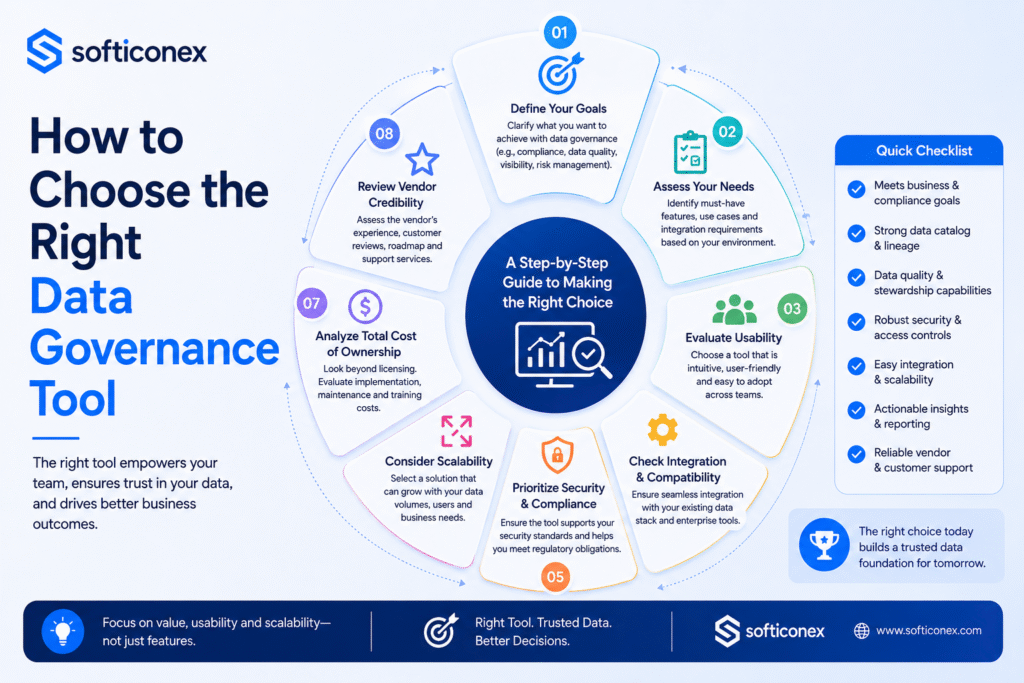
With fifteen credible platforms to consider, selection should be driven by eight factors specific to your organization, not by which vendor has the most polished demo.
Company size. A two-thousand-person mid-market company rarely needs Collibra’s full workflow depth, and a Fortune 100 bank will usually outgrow a lightweight catalog within a year. Match platform scale to organizational scale, not aspirational scale.
Budget. Total cost of ownership for enterprise governance platforms commonly runs several times the base license once implementation, connectors, and staffing are included. Budget realistically for the full cost, not just the subscription line item.
Compliance requirements. An organization facing HIPAA, SOX, or GDPR exposure should weigh compliance reporting depth heavily, since retrofitting compliance workflows onto a discovery-first platform is harder than starting with a compliance-strong one.
Data complexity. Organizations with data spread across dozens of source systems and formats need strong automated metadata enrichment, since manual cataloging simply will not keep pace with that scale.
Cloud environment. Match the platform to where your data actually lives. An Azure-standardized organization gets disproportionate value from Purview’s native enforcement, while a Snowflake and debt-based stack tends to favor Atlan’s deeper modern-stack integrations.
Integration requirements. Confirm the platform has mature, tested connectors for your specific source systems before purchasing, since custom connector development is one of the most common sources of implementation delay and cost overrun.
Scalability. Consider not just your current data volume but your projected volume in three years, since migrating governance platforms after deep adoption is significantly more disruptive than choosing carefully upfront.
AI readiness. If your organization is building or expanding AI initiatives, prioritize platforms with mature AI model lineage and governance features now, since retrofitting AI governance onto a platform that was not designed for it is a growing source of compliance risk.
Common Data Governance Challenges and Solutions
Poor data quality. Inconsistent, duplicated, or outdated data undermines trust in every downstream report and AI model. Solution: implement automated data quality profiling and scoring at the point of ingestion, not after data has already spread across multiple systems, so issues are caught before they propagate.
Data silos. Different business units maintain their own definitions and systems, making organization-wide analysis unreliable. Solution: deploy a centralized data catalog with a shared business glossary, and assign cross-functional data stewards with explicit authority to resolve definitional conflicts.
Lack of ownership. When no specific person is accountable for a dataset’s accuracy, quality decays silently until someone outside the data team notices a problem. Solution: formally assign data stewards to every critical dataset, with clear, documented responsibility for accuracy and access decisions.
Regulatory risk. Manual compliance processes cannot reliably keep pace with evolving regulations across multiple jurisdictions. Solution: adopt automated compliance reporting mapped directly to specific regulatory frameworks, so audit evidence is generated continuously rather than assembled under deadline pressure.
Inconsistent metadata. When the same field means different things in different systems, automated analysis produces silently wrong results. Solution: establish a single authoritative metadata management process, enforced through the governance platform rather than left to informal team conventions.
Security gaps. Sensitive data that has not been properly classified cannot be properly protected, creating breach exposure that often goes unnoticed until an incident occurs. Solution: deploy AI-powered classification to continuously identify sensitive data across the estate, paired with access controls that update automatically as new sensitive data is discovered.
Data Governance Implementation Best Practices
Most failed governance programs do not fail because the chosen tool was wrong. They fail because the organization skipped the foundational work a tool cannot do on its own. Follow this sequence.
- Assess your current data landscape, including every major system, data flow, and known quality or compliance gap, before evaluating any vendor.
- Define specific, measurable governance goals tied to business outcomes, such as reducing audit preparation time or improving a specific data quality metric, rather than a vague goal of “better governance.”
- Assign data stewards with real authority and dedicated time, not an informal responsibility added on top of an already full role.
- Establish clear governance policies covering data quality standards, access rules, and retention requirements before configuring any platform around them.
- Select a tool based on the factors covered earlier in this guide, validated through a proof-of-concept on your actual data, not a generic vendor demo.
- Automate governance processes progressively, starting with the highest-risk or highest-volume workflows rather than attempting to automate everything simultaneously.
- Monitor key performance indicators such as data quality scores, policy compliance rates, and time to resolve governance issues, reviewing them on a consistent cadence.
- Continuously improve by treating governance as an ongoing operational program rather than a one-time implementation project, revisiting policies and tooling as the business and regulatory landscape change.
Benefits of Using Data Governance Software
Better data quality. Automated profiling and monitoring catch quality issues before they reach decision-makers or AI models, rather than after the damage is done.
Improved compliance. Automated reporting mapped to specific regulations turns audit preparation from a weeks-long scramble into a continuously maintained record.
Reduced risk. Clear visibility into where sensitive data lives and who can access it directly reduces both regulatory exposure and breach risk.
Faster analytics. A searchable catalog with reliable metadata means analysts spend less time hunting for and validating data and more time actually analyzing it.
Stronger security. Governance and security increasingly share infrastructure, and a platform that classifies sensitive data automatically strengthens access control enforcement across the board.
Better collaboration. A shared business glossary and centralized catalog reduce the friction and miscommunication that come from different teams using different definitions for the same concepts.
AI readiness. Organizations with mature lineage and quality tracking can adopt AI systems with far more confidence, since they can demonstrate exactly what data trained or informed a given model.
Cost savings. Industry research has linked robust governance platforms to measurably faster decision-making and meaningfully lower compliance costs compared to organizations without formal governance tooling.
Future Trends in Data Governance
AI-powered governance. Governance platforms are increasingly using AI not just to classify data but to actively suggest policies, flag anomalies, and remediate quality issues with limited human intervention, shifting governance teams toward oversight rather than manual execution.
Automated data discovery. Active metadata platforms now document large portions of an organization’s data estate automatically, reducing the historically massive manual cataloging burden that has slowed governance programs for years.
Data fabric. Organizations are increasingly adopting architectures that weave governance, integration, and access management into a unified layer spanning hybrid and multi-cloud environments, rather than treating governance as a separate bolt-on system.
Data mesh. Domain-oriented ownership models, where individual business units govern their own data products under shared organizational standards, are gaining traction as an alternative to fully centralized governance for large, complex organizations.
Real-time governance. Governance is shifting from periodic audits toward continuous, real-time policy enforcement and quality monitoring, driven by the need to govern data the moment AI systems consume it rather than after the fact.
Privacy-first architectures. Privacy considerations are increasingly being designed into data architecture from the start, rather than addressed through governance controls layered on afterward, reducing both compliance risk and remediation cost.
Cloud-native governance. As more organizations complete cloud migrations, governance platforms are being built and optimized specifically for cloud-native data warehouses and modern analytics stacks rather than retrofitted from on-premises architectures..
Conclusion
Choosing among data governance tools is ultimately a decision about how much trust your organization needs in its data, and how much complexity it can realistically sustain to get there. The fifteen platforms covered in this guide span that entire range, from Microsoft Purview’s frictionless fit for Azure-native enterprises to Apache Atlas’s fully open-source flexibility for technically capable teams willing to build their own governance layer.
If you are an Azure-standardized enterprise, Microsoft Purview will likely deliver the fastest time to value given your existing licensing relationship. If you operate in a heavily regulated industry with a dedicated governance team, Collibra’s workflow depth justifies its cost. If your priority is business-user adoption and discovery, Alation remains the strongest choice, and if your data stack is built around Snowflake and dbt, Atlan’s modern architecture will feel like a natural extension of tools your team already uses.
Whichever data governance tools you ultimately select, remember that the platform is only as effective as the program built around it. Assign real data stewards, define policies before you configure software around them, and treat governance as a continuous operational discipline rather than a project with an end date. Organizations that follow that order consistently see better adoption and faster return on investment than organizations that purchase a platform first and figure out the program afterward.
Your next step should be concrete. Map your current data landscape against the eight features covered earlier in this guide, identify your two or three biggest governance gaps, and use that gap analysis, not a generic feature checklist, to build your shortlist from the fifteen tools above. A focused, well-scoped pilot on your actual data will tell you more in six weeks than another vendor demo ever will.
Frequently Asked Questions
What are data governance tools?
Data governance tools are software platforms that help organizations discover, catalog, classify, and control data assets to keep information accurate, secure, and compliant. They combine metadata management, data lineage tracking, data quality monitoring, and access control into a single operational layer across an organization’s systems.
Which data governance tool is best?
There is no single best data governance tool for every organization, since the right choice depends on the cloud environment, regulatory requirements, and budget. Microsoft Purview suits Azure-centric enterprises, Collibra suits large regulated organizations needing deep workflow control, and Atlan suits modern cloud-native data teams prioritizing fast adoption.
Why is data governance important?
Data governance is important because it ensures data is accurate, secure, and compliant as organizations face rising data volumes, stricter privacy regulations, and growing reliance on AI systems that depend directly on the quality of the data feeding them. Without governance, organizations face higher regulatory risk, slower analytics, and untrustworthy AI outputs.
How much does data governance software cost?
Costs range from free for self-hosted open-source platforms like Apache Atlas to over $500,000 annually for large enterprise deployments of platforms like Collibra or Informatica. Mid-market platforms such as Atlan or OvalEdge typically cost between $50,000 and $150,000 per year including implementation, while Microsoft Purview uses consumption-based pricing tied to governed asset volume.
Why is AI Transformation Is a Problem of Governance becoming a critical concern for organizations adopting AI?
AI Transformation Is a Problem of Governance because the biggest challenges in AI adoption are not the technologies themselves, but the policies, accountability, risk management, compliance, and decision-making frameworks that guide their use. Organizations that establish strong governance structures are better positioned to manage AI risks, ensure ethical implementation, maintain regulatory compliance, and achieve sustainable business value from their AI initiatives.
Are open-source governance tools reliable?
Open-source tools like Apache Atlas can be reliable for technically sophisticated organizations with dedicated engineering resources to deploy, customize, and maintain the platform. They lack the polished interfaces, vendor support, and out-of-the-box compliance reporting that commercial platforms provide, so the true cost is engineering time rather than licensing fees.
What is the difference between data governance and data management?
Data governance defines the policies, ownership, and standards that determine how data should be controlled, classified, and used across an organization. Data management is the broader operational discipline of storing, processing, integrating, and maintaining that data day to day. Governance sets the rules; data management carries them out.
What is a data catalog?
A data catalog is a searchable, centralized inventory of an organization’s data assets, including business-friendly descriptions, ownership information, and classification labels, that helps both technical and non-technical users find, understand, and trust available data without needing to query source systems directly.
What is data lineage?
Data lineage is the traceable record of how a piece of data moves and transforms from its original source through every pipeline, transformation, and report it touches. It allows teams to perform impact analysis, investigate the root cause of incorrect figures, and demonstrate compliance during regulatory audits