Cyberattacks no longer wait for business hours, and neither can defense. Ransomware crews, phishing operators, and state-linked intrusion groups now probe networks around the clock, while most internal security teams are stretched across ten or more disconnected tools and thousands of daily alerts. That gap between “always-on threats” and “9-to-5 defense” is exactly why MDR SOC services exist.
MDR SOC services combine managed detection and response (MDR) with the round-the-clock discipline of a security operations center (SOC) pairing human threat hunters and incident responders with automated detection technology to watch your environment 24/7, catch what your tools miss, and act before an intrusion becomes a breach.
This guide breaks down what MDR SOC services actually are, how they work, what they cost in 2026, how they compare to MSSPs, SIEM, EDR, and in-house SOCs, and how to choose a provider that will actually move the needle on your security posture.
Quick Comparison: MDR vs SOC vs MSSP vs SIEM vs EDR
| Category | What It Is | Primary Focus | Human-Led? | Best For |
| MDR (Managed Detection and Response) | A service combining technology + human analysts to detect, investigate, and respond to threats | Active threat detection and response | Yes analysts drive investigation and response | Organizations wanting outsourced, proactive protection without building a team |
| SOC (Security Operations Center) | A team (in-house or outsourced) and facility dedicated to monitoring and managing security | Continuous monitoring and alert triage | Yes | Organizations needing a dedicated monitoring function, in any delivery model |
| MSSP (Managed Security Service Provider) | A broader outsourced provider managing security infrastructure and devices | Device management, monitoring, compliance reporting | Partially often alert-forwarding, less investigation | Organizations wanting infrastructure management plus baseline monitoring |
| SIEM (Security Information and Event Management) | A software platform that aggregates and correlates log data | Data collection, correlation, alerting | No it’s a tool, not a team | Organizations that already have (or are buying) analysts to run it |
| EDR (Endpoint Detection and Response) | Software that monitors and records endpoint activity for suspicious behavior | Endpoint visibility and containment | No it’s a tool, though often bundled into MDR | Organizations needing endpoint-level telemetry and automated containment |
In short: SIEM and EDR are tools. SOC is a team and function. MSSP is a service model focused mostly on infrastructure management. MDR is an outcome-driven service that typically combines EDR/XDR technology with a SOC team to deliver active detection and response — which is why “MDR SOC services” has become the umbrella term buyers search for.
What Are MDR SOC Services?
MDR SOC services are outsourced cybersecurity offerings that deliver 24/7 security monitoring, threat detection, threat hunting, and incident response through a combination of a dedicated SOC team and MDR technology and processes. Rather than just alerting you that something looks wrong, a genuine MDR SOC provider investigates the alert, determines whether it’s a real threat, and takes action isolating a compromised endpoint, blocking malicious traffic, or walking your team through remediation often within minutes.
The “SOC” part refers to the operational backbone: analysts working in shifts (or a follow-the-sun model across time zones) who watch dashboards, triage alerts, and coordinate response. The “MDR” part refers to the service model itself: managed detection and response, built around outcomes (stopping threats) rather than just tools (collecting logs).
Put together, MDR SOC services give small and mid-sized businesses and even large enterprises supplementing their own teams access to enterprise-grade security operations without the cost and complexity of building one internally.
How Do MDR SOC Services Work?
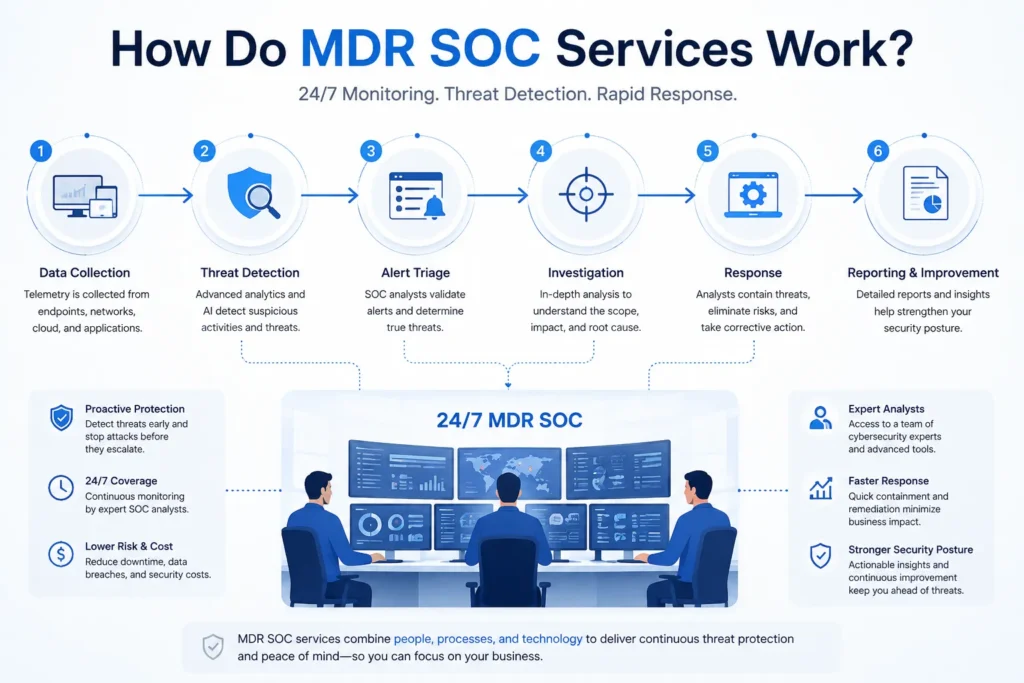
A typical MDR SOC engagement follows a repeatable cycle:
- Onboarding and asset discovery: The provider deploys lightweight agents (for EDR/XDR telemetry), connects to your cloud environments, identity providers, firewalls, and email gateway, and maps your attack surface.
- Continuous data collection: Endpoint, network, cloud, identity, and log data streams into the provider’s detection platform around the clock.
- Detection and correlation: Behavioral analytics, machine learning models, and curated detection rules flag anomalies, unusual logins, lateral movement, suspicious process execution, data exfiltration patterns.
- Human triage and threat hunting: SOC analysts review flagged activity, filter out false positives, and proactively hunt for threats that automated tools alone would miss.
- Investigation. Analysts pull together context device history, user behavior, threat intelligence to confirm whether an alert represents a genuine incident.
- Response and containment: Depending on the contract, the provider isolates the affected host, kills malicious processes, disables compromised accounts, or blocks network traffic, either automatically or with client approval.
- Reporting and remediation guidance: The client receives incident reports, root-cause analysis, and recommendations to close the gap that allowed the intrusion in the first place.
- Continuous tuning: Detection rules and playbooks are refined based on new threat intelligence and lessons from prior incidents.
This loop is what separates MDR SOC services from a passive monitoring tool: the service is judged on how fast and how completely it detects, contains, and helps you recover from real threats, not just how many alerts it generates.
What Do MDR SOC Services Include?
While packages vary by provider and tier, most MDR SOC services include some combination of:
- 24/7/365 security monitoring across endpoints, network, cloud workloads, identity, and email
- Managed EDR/XDR technology for endpoint visibility and automated containment
- Threat detection and alert triage to separate real incidents from noise
- Proactive threat hunting for threats that evade automated detection
- Incident response, ranging from guided remediation to fully managed containment
- Digital forensics to understand how an intrusion happened and what was accessed
- Threat intelligence integration, mapping detections to known attacker tactics (often via the MITRE ATT&CK framework)
- Vulnerability and attack surface insights, sometimes bundled as vulnerability management
- Compliance-ready reporting for frameworks like SOC 2, HIPAA, PCI DSS, and ISO 27001
- A named security team or “concierge” contact, in higher-tier offerings, for direct escalation
Entry-level tiers often stop at monitoring and alerting; mid and premium tiers add full incident response, dedicated analysts, and breach warranties.
Benefits of MDR SOC Services
- 24/7 coverage without the staffing burden: Threats don’t stop at 5 p.m., and MDR SOC services eliminate the coverage gaps that come with a single in-house shift.
- Faster detection and response times: Providers cite meaningfully faster breach detection compared to unmanaged environments, which directly reduces the cost and blast radius of an incident.
- Access to specialized expertise: Threat hunters, forensic analysts, and incident responders are expensive and hard to hire; MDR SOC services give you a fractional share of that expertise.
- Reduced alert fatigue: Automated correlation plus human triage filters out the noise that overwhelms internal teams managing thousands of daily alerts.
- Lower total cost versus building in-house: A fully staffed internal SOC can run well over a million dollars a year in salaries and tooling; MDR SOC services deliver similar coverage at a fraction of that cost.
- Predictable, scalable pricing: Per-endpoint or per-user pricing models scale with your organization instead of requiring lump-sum capital investment.
- Stronger compliance posture: Continuous monitoring, documented response processes, and audit-ready reporting help satisfy regulatory and cyber-insurance requirements.
- Improved cyber insurance terms: Insurers increasingly expect evidence of 24/7 monitoring and a documented incident response capability before offering favorable premiums.
MDR vs SOC
“MDR vs SOC” is a common but slightly misleading comparison, because a SOC is a function and MDR is a service model that includes one.
- A SOC is the team, processes, and (sometimes) physical or virtual space dedicated to monitoring security events. It can be built in-house, outsourced, or hybrid.
- MDR is a specific type of outsourced service that bundles SOC-style monitoring with managed technology and outcome-driven response.
In practice, when people say “MDR vs SOC,” they usually mean outsourced MDR vs. in-house SOC see that comparison below. A modern MDR provider effectively is a SOC-as-a-service, which is why the two terms increasingly blend into “MDR SOC services.”
MDR vs MSSP
MSSPs (Managed Security Service Providers) predate MDR and originally focused on managing security infrastructure firewalls, VPNs, patch management and forwarding alerts, often with limited investigation depth. MDR emerged specifically to close that gap.
| Parameters | MSSP | MDR |
| Core focus | Device/infrastructure management, alert forwarding | Active threat detection and response |
| Investigation depth | Often limited alerts are passed to the client | Deep analysts investigate before escalating |
| Response actions | Usually client-driven | Provider-driven or provider-assisted containment |
| Reporting style | Compliance and operational reporting | Compliance reporting plus incident-level detail |
| Threat hunting | Rarely included | Core part of the service |
Many providers today blur the line; some MSSPs have added MDR-style response capabilities, and some MDR vendors offer MSSP-style infrastructure management. When evaluating a vendor, ask specifically what they do when they detect a threat, not just what they call themselves.
MDR vs SIEM
A SIEM is a technology platform: it ingests logs from across your environment, correlates events, and generates alerts based on rules or analytics. It doesn’t investigate or respond on its own; it needs analysts behind it, and those analysts need time to tune it properly.
MDR typically includes detection technology (sometimes a SIEM, sometimes XDR) plus the human team that operates it, investigates alerts, and responds to confirmed threats.
The practical distinction: buying a SIEM gives you a very capable engine with no driver. MDR gives you the engine and the driver which is why many organizations that previously self-managed a SIEM eventually move to MDR to get the analyst coverage they were missing.
MDR vs EDR
EDR (Endpoint Detection and Response) is software installed on devices that records process activity, flags suspicious behavior, and can isolate a compromised endpoint. It’s powerful, but it’s a tool someone still has to watch the console, interpret alerts, and decide what to do.
MDR frequently uses EDR (or XDR, which extends the same idea across endpoints, network, and cloud) as its underlying technology, wrapped with 24/7 human monitoring and response. Self-managed EDR without a dedicated internal team often means alerts pile up unreviewed outside business hours precisely the gap MDR is built to close.
If budget-constrained, some organizations run EDR alone and staff it internally; most eventually find that the labor cost of properly monitoring EDR nights, weekends, holidays included approaches or exceeds the cost of an MDR contract that includes the same technology plus a live team.
MDR SOC vs In-House SOC
Building an internal SOC means hiring and retaining a rotating team of analysts (to cover 24/7 shifts), a SOC manager, a threat hunter, an incident responder, and often a forensics specialist plus licensing a SIEM/XDR platform, threat intelligence feeds, and case management tooling. Realistic first-year costs for a minimally viable in-house SOC commonly run from roughly $1.4 million to well over $1.75 million once salaries, tooling, and overhead are included, and that’s before accounting for the ongoing cybersecurity talent shortage, which leaves millions of security roles unfilled worldwide.
| Factor | In-House SOC | Outsourced MDR SOC |
| Time to operational | 6 to 18 months to hire and tune | Days to weeks |
| Annual cost (typical) | $1.4M+ for minimal 24/7 coverage | Tens of thousands to low hundreds of thousands, scaling with endpoints |
| Staffing risk | High turnover, burnout, hiring difficulty | Low provider absorbs staffing risk |
| Coverage | Often gaps nights/weekends unless fully staffed | True 24/7/365 by design |
| Threat intel breadth | Limited to your own environment | Cross-customer visibility across the provider’s client base |
| Control and customization | Full control | Varies by provider; negotiate SLAs and scope |
Large enterprises with mature security programs sometimes run a hybrid model: an internal SOC for context-heavy, business-specific decisions, supported by an MDR provider for 24/7 coverage, surge capacity, and specialized threat hunting. This hybrid approach is increasingly common as organizations try to balance control with coverage.
Who Needs MDR SOC Services?
MDR SOC services fit almost any organization that handles sensitive data or can’t tolerate downtime, but demand is strongest among:
- Small and mid-sized businesses (SMBs) that can’t justify or staff a full internal SOC
- Healthcare organizations managing PHI under HIPAA, where breach costs and regulatory exposure are severe
- Financial services and fintech (BFSI) facing high-value fraud and compliance obligations historically the largest vertical by market share
- Retail and e-commerce companies protecting payment data under PCI DSS
- Manufacturing and critical infrastructure operators facing rising OT/IT convergence risk
- Government and public sector agencies, which report tens of thousands of security incidents annually
- Enterprises with lean internal security teams who need 24/7 coverage or surge capacity during major incidents
- Organizations required to demonstrate continuous monitoring for cyber insurance or regulatory audits
Common Threats Detected by MDR SOC Services
- Ransomware encryption and extortion attacks that remain one of the top drivers of MDR adoption
- Phishing and business email compromise (BEC) credential theft and fraudulent wire transfers, still involved in a large share of reported breaches
- Lateral movement and privilege escalation attackers pivoting from an initial foothold toward critical systems
- Insider threats malicious or negligent activity from employees and contractors
- Cloud misconfigurations and account takeover exploited identity and access weaknesses in SaaS and cloud infrastructure
- Zero-day and known exploited vulnerabilities attacks against unpatched or newly disclosed flaws
- Cryptojacking unauthorized use of compute resources for cryptocurrency mining
- Supply chain and third-party compromise attacks that enter through vendors, contractors, or software dependencies
- Living-off-the-land techniques attackers abusing legitimate admin tools to avoid detection by traditional antivirus
Technologies Used in MDR SOC Services
- EDR/XDR platforms: For endpoint and cross-layer telemetry and containment
- SIEM and log aggregation: For centralized event correlation
- Network detection and response (NDR): For traffic-based anomaly detection
- Cloud detection and response (CDR): For AWS, Azure, and GCP workload monitoring
- Identity threat detection and response (ITDR): For credential and privilege abuse
- Threat intelligence platforms: Often mapped to the MITRE ATT&CK framework
- SOAR (Security Orchestration, Automation, and Response): To automate repetitive containment and triage steps
- AI and machine learning models: For behavioral anomaly detection and false-positive reduction increasingly central to how providers keep pace with alert volume
- Case management and reporting platforms: For incident tracking, SLAs, and compliance documentation
MDR SOC Incident Response Process
- Detection: An alert fires from EDR, network sensors, or log correlation
- Triage: An analyst determines severity and whether it’s a false positive
- Investigation: Scope is established: which systems, accounts, and data are affected
- Containment: The affected host is isolated, credentials are disabled, or traffic is blocked
- Eradication: Malicious artifacts, persistence mechanisms, and backdoors are removed
- Recovery: Systems are restored and validated as clean before returning to production
- Post-incident review: Root cause, timeline, and lessons learned are documented, and detection rules are updated to prevent recurrence
Response speed here is the metric that matters most; the difference between a contained incident and a full-blown breach is often measured in minutes, not hours.
How Much Do MDR SOC Services Cost?
Pricing depends heavily on scope, endpoint count, and service tier, but general 2026 benchmarks look like this:
- Entry-level / endpoint-only MDR: Roughly $7–$25 per endpoint per month
- Full MDR with active response (containment, forensics, remediation guidance): Roughly $15–$50 per endpoint per month
- Premium MDR with a dedicated analyst and deep threat hunting: $50–$100+ per endpoint per month
- Per-user pricing (for organizations with multiple devices per employee): Roughly $20–$60 per user per month
For context, a 200-endpoint organization on a standard plan typically budgets somewhere in the $24,000–$72,000 annual range, while enterprise deployments of 10,000+ endpoints can run from the low hundreds of thousands to over $1 million annually depending on scope. Expanding coverage beyond endpoints to cloud workloads, identity, and SaaS commonly pushes the total bill higher, sometimes close to double the endpoint-only price.
Watch for costs that aren’t in the headline per-endpoint number:
- Incident response retainers: For deep forensics beyond basic containment, often billed at $250–$400 per hour if not pre-negotiated
- Extended data retention: Required for cyber insurance, which can add 20–50% to base cost
- Minimum seat requirements: That push small organizations into a higher pricing tier than they actually need
- Multi-year contract discounts: (Often 10–20%) that come with reduced flexibility
Whatever the sticker price, most analyses find MDR meaningfully cheaper than building and staffing an equivalent capability in-house, often 30–50% less once salaries, tooling, and around-the-clock staffing are factored in.
How to Choose an MDR SOC Provider
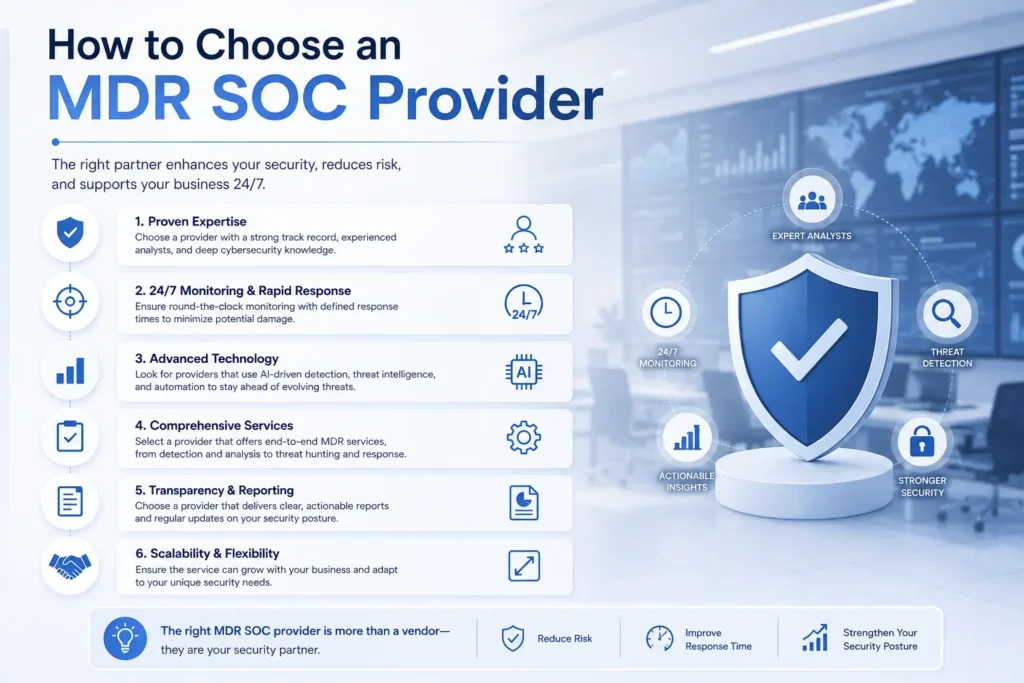
- Verify true 24/7/365 human coverage: Not just automated alerting with business-hours analyst review
- Confirm response scope: Does the provider actually contain threats, or only notify you?
- Check detection and response time SLAs in writing, not marketing claims
- Assess technology fit: Can they work with your existing EDR/SIEM stack, or do you have to rip and replace?
- Look for transparent pricing and a clear breakdown of what’s included at each tier
- Ask about threat hunting cadence: Is it continuous, or only reactive to alerts?
- Review compliance support: Do their reports map directly to your regulatory obligations?
- Evaluate breach warranties or guarantees, and read the fine print on what’s actually covered
- Request references or sample incident reports from existing clients in your industry
- Consider cultural and communication fit you’ll be working with this team during your worst days
Questions to Ask an MDR Provider
- What is your guaranteed time to detect and time to respond, and is it contractual?
- Do your analysts take direct containment action, or only recommend it?
- What does your escalation path look like at 3 a.m. during a confirmed breach?
- What’s included in the base price versus billed as an add-on (retention, IR retainer, forensics)?
- Which data sources and platforms do you natively support (cloud, identity, email, OT)?
- How do you handle false positives, and what’s your historical false-positive rate?
- Can you provide a redacted sample of a real incident report?
- What threat intelligence sources feed your detections, and how often are they updated?
- What happens contractually if you fail to detect a breach you should have caught?
- How do you support compliance audits (SOC 2, HIPAA, PCI DSS, ISO 27001)?
MDR SOC Best Practices
- Integrate MDR with existing security tools rather than running it in isolation
- Define clear escalation and communication protocols before an incident happens, not during one
- Maintain an accurate, current asset inventory so the provider can monitor everything that matters
- Run periodic tabletop exercises with your MDR provider to test the response process
- Review monthly and quarterly reports: Not just incident alerts, to catch trends
- Close remediation gaps promptly: Detection without follow-through leaves the same door open again
- Align MDR scope with your actual risk profile, expanding from endpoints into cloud and identity as your environment grows
- Treat the provider as a partner, not a black box request visibility into detection logic and decision-making
MDR SOC KPIs and Metrics
- Mean Time to Detect (MTTD): How quickly a threat is identified after it enters the environment
- Mean Time to Respond (MTTR): How quickly containment begins after detection
- Dwell time: Total time an attacker had access before being detected and removed
- False positive rate: The share of alerts that turn out not to be real threats
- Alert-to-incident ratio: How effectively raw alerts are filtered into genuine incidents
- Coverage rate: Percentage of assets, cloud workloads, and identities actively monitored
- SLA adherence: How consistently the provider meets contracted response times
- Number of threats hunted proactively: Versus reactively triggered by alerts
- Compliance audit pass rate: How well provided reporting supports regulatory requirements
MDR SOC Challenges
- Integration friction with legacy or highly customized IT environments
- Alert fatigue and tuning time, especially in the first 60–90 days of a new deployment
- Limited visibility into provider decision-making, if reporting is thin or infrequent
- Vendor lock-in around proprietary EDR/XDR agents
- Scope creep in pricing, where cloud, identity, and SaaS coverage aren’t clearly included upfront
- Coordination gaps between the MDR provider and internal IT teams during an active incident
- Talent shortage on the provider side too not every “24/7 SOC” claim reflects genuinely deep staffing
- Data residency and privacy concerns, particularly for regulated industries and cross-border operations
MDR SOC Services and Compliance
MDR SOC services can materially support though not by themselves guarantee compliance with major frameworks:
- SOC 2: Continuous monitoring and documented incident response support the security and availability trust principles
- HIPAA: 24/7 monitoring of systems handling protected health information helps satisfy technical safeguard requirements
- PCI DSS: Continuous log monitoring and intrusion detection map directly to several PCI DSS requirements
- GDPR: Faster breach detection and documented response processes support the tight breach-notification windows GDPR requires
- ISO 27001: MDR reporting can feed directly into the continuous monitoring and incident management controls the standard expects
- NIST Cybersecurity Framework (CSF): MDR services map naturally to the Detect and Respond functions, and often support Identify and Recover as well
- Cyber insurance requirements: Insurers increasingly require evidence of 24/7 monitoring and a documented incident response capability as a condition of coverage or favorable premiums
Compliance-minded buyers should confirm upfront that a provider’s reporting format aligns with their specific framework, since audit-readiness varies significantly between vendors.
How Softiconex Manages MDR and SOC Services
Softiconex runs managed SOC services built around the same idea this guide has covered: enterprise-grade coverage without the 12–18 months it normally takes to hire, train, and staff an in-house team. Client logs, endpoints, cloud trails, firewalls, and identity events feed into a SIEM layer where tuned correlation rules, ML baselines, and analyst judgment separate real threats from noise, backed by proactive threat hunting rather than alert-only monitoring. The service is stack-agnostic. Softiconex works with tools organizations already run (Splunk, Microsoft Sentinel, Elastic, Google Chronicle, CrowdStrike, SentinelOne, and others) or helps stand up the right toolset for teams starting from scratch. Onboarding is structured to move fast, with most clients fully monitored within two to four weeks, and ongoing visibility comes through weekly dashboards and monthly executive briefs rather than static compliance paperwork. On the compliance side, Softiconex maintains continuous posture monitoring and audit-ready evidence for frameworks like SOC 2, HIPAA, PCI DSS, ISO 27001, and CIS benchmarks, so reporting is ready when an auditor or insurer asks for it rather than assembled after the fact.
Ready to close the coverage gap in your security operations? Contact Softiconex for a free consultation and see how a managed SOC tailored to your environment can be up and running in weeks, not months.
Future of MDR SOC Services
The MDR market has been growing rapidly, with most industry forecasts projecting the global market to expand from roughly $3–6 billion in 2026 into the double-digit billions by the early 2030s, driven by rising attack volumes, cloud adoption, and the ongoing shortage of skilled security professionals. Several trends are shaping where the category goes next:
- AI-driven detection and triage is accelerating how fast providers separate real threats from noise, and is increasingly used to predict emerging attack patterns rather than just flag known ones
- Cloud-native MDR continues to gain share as workloads shift away from on-premises infrastructure
- Convergence with XDR is blurring the line between “MDR” and “extended detection and response,” with more providers bundling both under one roof
- Identity-centric detection is expanding as credential-based attacks continue to rise
- Autonomous response capabilities are maturing, letting providers contain certain threats without waiting for human sign-off, while still keeping humans in the loop for higher-stakes decisions
- Zero-trust alignment is pushing MDR providers to monitor continuously against zero-trust policies rather than perimeter-based assumptions
- Consolidation among vendors is likely as the market matures, with larger platform players acquiring specialized MDR and threat-hunting boutiques
FAQs
What’s the difference between MDR and a traditional SOC?
A traditional SOC is the team and function; MDR is an outsourced service that typically packages SOC-style monitoring with managed detection technology and outcome-driven response.
Is MDR the same as antivirus or EDR?
No. Antivirus and EDR are software tools. MDR adds the 24/7 human team, threat hunting, and active response process around that technology.
How fast can MDR SOC services detect a breach?
It varies by provider and environment, but leading providers commonly cite detection and initial response within minutes to a few hours for confirmed threats, compared to days or weeks for organizations without active monitoring.
Can small businesses afford MDR SOC services?
Yes SMB-focused tiers exist specifically because per-endpoint pricing scales down, often starting in the single digits per endpoint per month for basic coverage.
Does MDR replace the need for an internal IT or security team?
Not entirely. MDR handles detection, monitoring, and response, but organizations still need internal staff to manage day-to-day IT operations, patching, and vendor coordination.
What happens if my MDR provider misses a real threat?
This is exactly why SLAs, breach warranties, and detailed incident reporting matter ask providers directly what contractual recourse exists if detection or response fails to meet agreed standards.
Final Verdict
MDR SOC services have become the practical middle ground between doing nothing and building a million-dollar internal security operations center. For most small and mid-sized organizations and even many enterprises supplementing an internal team outsourced MDR delivers 24/7 coverage, faster detection, and real incident response at a fraction of the cost of staffing it alone.
The category isn’t one-size-fits-all, though. Pricing, response depth, and reporting quality vary widely between providers, so the real work is in vetting SLAs, confirming what “response” actually means in the contract, and making sure the provider’s reporting lines up with your compliance obligations. Done right, MDR SOC services turn security from a reactive scramble into a continuously managed function which, in a threat landscape that never clocks out, is no longer optional for most organizations.