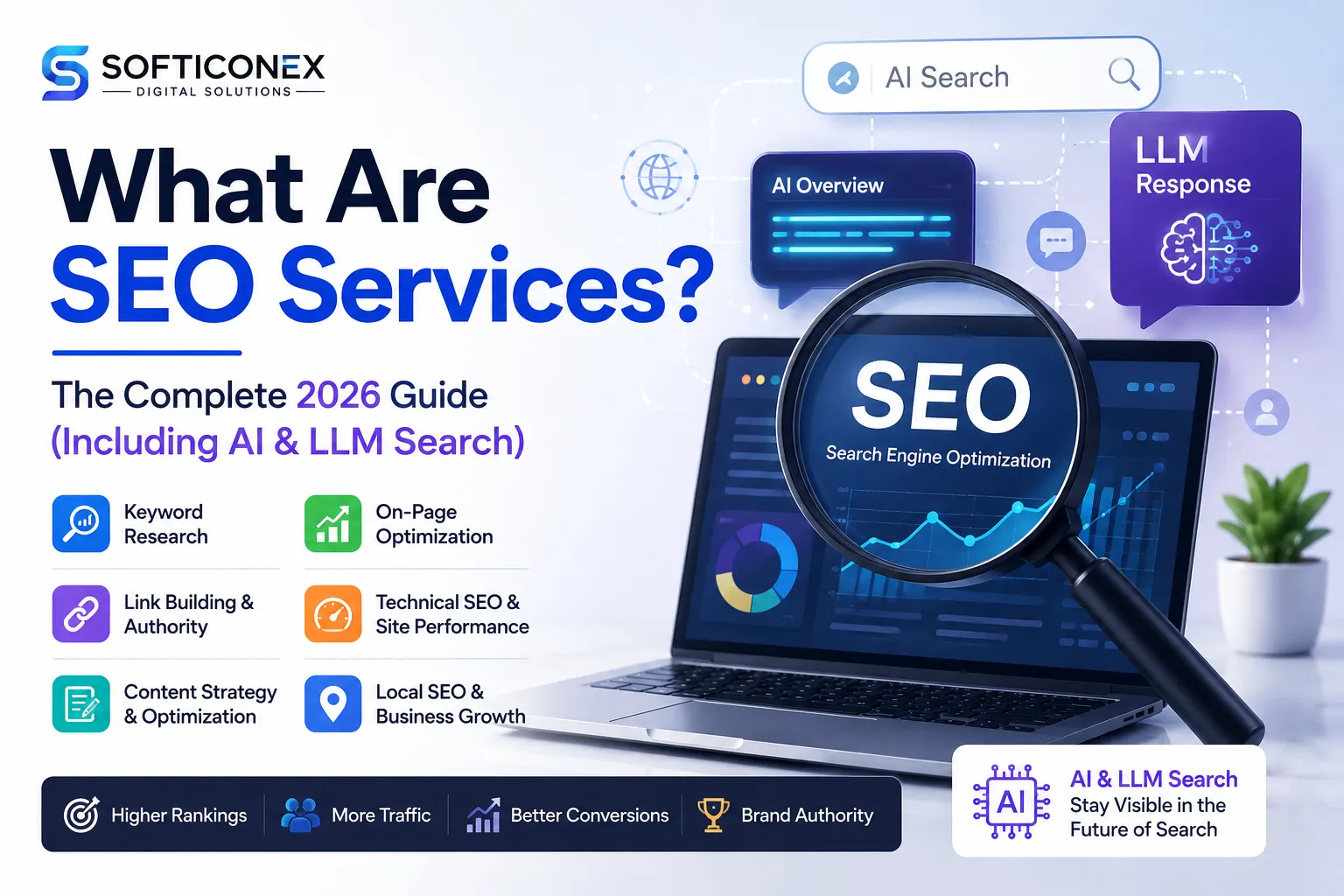
SEO services are the strategies, tasks, and ongoing work that a specialized agency, freelancer, or in-house team performs to improve how visible your website is not just on Google, Bing, and Yahoo, but increasingly inside AI answer engines like ChatGPT, Google AI Overviews, Perplexity, and Gemini.
A strategic SEO plan typically includes keyword research, on-page optimization, technical SEO, content creation, link building, and as of 2026 AI/LLM search optimization, sometimes called Generative Engine Optimization (GEO) or Answer Engine Optimization (AEO).
The end goal hasn’t changed: get found by the right people at the right moment, and turn that visibility into traffic, leads, and revenue. What has changed is where people are searching and how those platforms decide what to show them.
In this guide, we’ll cover what SEO services actually include, how traditional search engines and AI search engines each rank content, what a great SEO provider does month to month, what it costs, and how to tell a legitimate SEO company from a scam.
What Is SEO, and How Do Search Engines Work?
SEO (Search Engine Optimization) is the practice of improving a website so it ranks higher in search results for relevant queries, driving organic (unpaid) traffic.
Search engines use crawlers automated bots to discover pages by following links, then run those pages through an indexing process that evaluates whether the content is unique, useful, and trustworthy enough to serve to users. Pages that pass get added to the index; pages that are thin, duplicate, or spammy typically don’t.
Once indexed, a ranking algorithm decides the order pages appear in for a given search, weighing hundreds of signals: content relevance, page experience, site speed, mobile-friendliness, backlink authority, and alignment with Google’s E-E-A-T framework (Experience, Expertise, Authoritativeness, Trustworthiness).
Quick breakdown of how SEO works:
- Understanding user intent: Figuring out what someone actually wants when they type a query, not just matching keywords
- Optimizing content: Using relevant terms naturally, writing genuinely useful content, and keeping the site fast and mobile-friendly
- Building authority through backlinks: Links from other credible sites act as trust signals
How AI and LLM Search Are Changing SEO in 2026
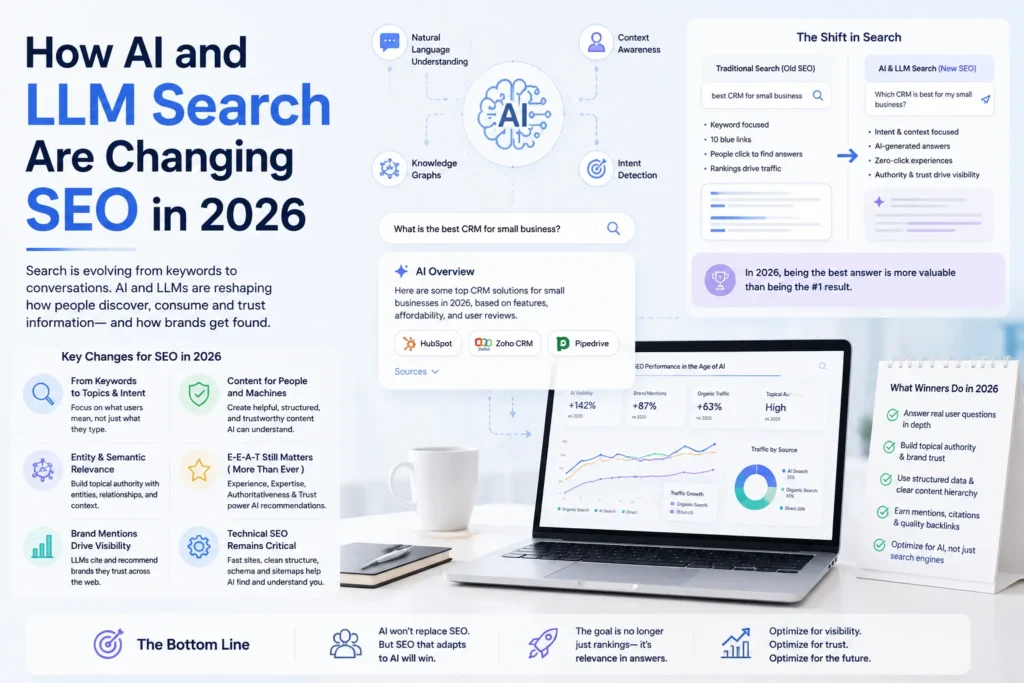
This is the part most “what are SEO services” guides still ignore and it’s now one of the biggest shifts in how people find businesses online.
Search behavior has split into two parallel systems:
- Traditional search (Google, Bing): A list of ranked blue links
- AI/LLM search (Google AI Overviews and AI Mode, ChatGPT, Perplexity, Claude, Gemini): A synthesized answer, often with zero clicks, pulled from a small number of sources the model trusts enough to cite
What is AI Search Optimization (GEO / AEO)?
Generative Engine Optimization (GEO) and Answer Engine Optimization (AEO) refer to the practice of structuring content so large language models can easily parse, understand, trust, and cite it when generating an answer. It sits alongside traditional SEO rather than replacing it. Most of the same fundamentals (authority, clarity, structure) matter to both, but the tactics diverge in important ways.
How LLMs decide what to cite:
- Clear, extractable answers: LLMs favor content that states a direct answer early, in plain language, rather than burying it under marketing copy
- Structured data and schema markup: FAQ schema, HowTo schema, and Organization schema help models parse what a page is actually saying
- Consistent entity signals: Your business name, services, and claims need to match across your site, Google Business Profile, directories, and third-party mentions; LLMs cross-reference this for trust
- Original data and expertise: Models tend to favor content with unique insights, real numbers, and named expertise over generic, reworded summaries of other articles
- Crawlability by AI bots: This means allowing (not blocking) crawlers like GPTBot, ClaudeBot, PerplexityBot, and Google-Extended in your robots.txt, and increasingly, maintaining an llms.txt file that gives models a clean summary of your site
- Third-party mentions and citations: LLMs weigh how often and how favorably a business is mentioned across the web (reviews, forums, press, comparison articles), not just your own site’s backlinks
Why this matters for your business
If someone asks ChatGPT or Google’s AI Mode “what’s the best SEO agency for a small business” or “how do I choose an SEO company,” the model is going to synthesize an answer from whatever sources it trusts most on that topic. If your content isn’t structured to be understood and cited by AI systems, you’re invisible in a growing share of searches even if you rank well in classic Google results.
A modern SEO service should now include:
- AI visibility audits (are you appearing in AI Overviews, ChatGPT, and Perplexity answers for your key terms?)
- Structured data and schema implementation
- llms.txt setup and AI crawler access review
- Content formatted for extractability (clear headers, direct answers, FAQ blocks)
- Brand entity consistency across the web
- Ongoing monitoring of AI-driven referral traffic, separate from traditional organic traffic
Why SEO Is Important for Businesses
1. Free and Sustainable Traffic
Unlike paid ads, SEO traffic doesn’t disappear the moment you stop paying. Well-optimized, fast, mobile-first sites tend to hold their rankings over time.
2. It Targets the Right Audience
SEO lets you show up for the specific terms people use when they’re already looking for what you sell which converts better than broad, interruptive advertising.
3. Builds Brand Authority and Trust
Ranking near the top of organic results (or being cited in an AI answer) signals credibility. People trust earned visibility more than an ad.
4. Long-Term Compounding Value
SEO improvements site speed, UX, content depth, authority keep paying off long after the work is done, unlike PPC spend.
The top 3 organic results capture more than two-thirds of all clicks, and that concentration is intensifying as AI Overviews now answer many queries before a user even scrolls to organic results making it more important, not less, to be one of the few sources a search engine or AI model trusts.
Types of SEO Services
Local SEO
Focused on ranking for “near me” and location-based searches. Includes Google Business Profile optimization, citation management, localized content, review management, and map pack rankings. Best for businesses with a physical location or service area restaurants, clinics, contractors, retail.
National SEO
Targets high-volume, competitive keywords across a broad audience with no geographic limit. Involves deep keyword research, content marketing at scale, and authoritative link building. Best for SaaS, financial services, e-commerce, education, and media companies.
E-commerce SEO
Optimizes product and category pages to rank for transactional searches. Combines technical SEO, UX, keyword-driven product content, and conversion-focused site architecture to turn search traffic directly into sales.
AI Search Optimization
A newer, distinct service line: optimizing specifically for visibility inside AI Overviews, ChatGPT, Perplexity, and other LLM-driven answer engines, using the structured-data and entity-consistency tactics outlined above.
B2B vs. B2C SEO: What’s Actually Different
Both B2B and B2C SEO rely on the same technical foundation but the keyword strategy, content approach, and conversion path differ sharply because the buyer, the sales cycle, and the decision-making process are different.
B2C SEO (Business-to-Consumer)
B2C SEO targets individual consumers making faster, often emotionally-driven purchase decisions.
- Keyword focus: High-volume, short-tail and transactional keywords (“buy running shoes online,” “best coffee maker under $100”)
- Content style: Visual, benefit-driven, scannable product pages, comparison content, gift guides, reviews
- Conversion path: Short and direct, often a single visit from search to purchase
- Search intent: Dominated by transactional and commercial-investigation intent
- Key ranking factors: Page speed, mobile UX, product schema, reviews/ratings, image optimization
- Typical channels: E-commerce category and product pages, local SEO for retail locations, video/visual search
Example: A DTC skincare brand targets “best moisturizer for dry skin” with a product page optimized for that exact phrase, rich snippets showing star ratings, and fast mobile load times to reduce cart abandonment.
B2B SEO (Business-to-Business)
B2B SEO targets other businesses and professional decision-makers working through a longer, higher-stakes evaluation process often involving multiple stakeholders.
- Keyword focus: Longer-tail, often lower search volume but higher intent and higher value (“enterprise HR software for 500+ employees,” “SOC 2 compliant marketing automation platform”)
- Content style: In-depth whitepapers, case studies, comparison guides, ROI calculators, technical documentation
- Conversion path: Long and multi-touch, often spanning weeks or months and multiple decision-makers (procurement, department heads, executives)
- Search intent: Dominated by informational and evaluative intent early in the funnel, narrowing to commercial intent later
- Key ranking factors: Topical depth and authority (E-E-A-T), demonstrated expertise, structured data for organizations/authors, strong internal linking across a topic cluster
- Typical channels: Blog content targeting the full buyer journey, LinkedIn-amplified content, gated resources (whitepapers, reports), category/solution pages built around specific use cases
Example: A cybersecurity SaaS company targets “how to choose a SOC provider” with a detailed comparison guide, then nurtures that same visitor toward a bottom-funnel page like “managed SOC services for mid-market companies.”
| Parameter | B2C SEO | B2B SEO |
| Buyer | Individual consumer | Multiple stakeholders / committee |
| Sales cycle | Minutes to days | Weeks to months |
| Keyword intent | Transactional, high volume | Informational → commercial, lower volume, higher value |
| Content type | Product pages, visual content, reviews | Whitepapers, case studies, in-depth guides |
| Primary goal | Direct purchase / conversion | Lead generation, trust-building, demo requests |
| Success metric | Conversion rate, revenue per visit | Marketing qualified leads (MQLs), pipeline influenced |
A great SEO provider tailors strategy, content format, and even technical priorities (like schema type) based on which model your business fits and many businesses, especially B2B2C companies, need elements of both.
The Core Pillars of SEO Services: Technical, On-Page, Off-Page & Semantic SEO
Every SEO strategy local, national, e-commerce, B2B, or B2C is built on four core pillars. Understanding what each one actually involves is the difference between hiring a provider who checks boxes and one who moves rankings.
Technical SEO Services
Technical SEO is the foundation everything else sits on. If search engines and AI crawlers can’t efficiently access, render, and understand your site, no amount of great content will rank. Technical SEO focuses entirely on the backend health and structure of your website, not the words on the page.
What technical SEO services typically include:
- Crawlability & indexability audits: Reviewing robots.txt, XML sitemaps, canonical tags, and crawl budget to make sure search engines (and AI crawlers like GPTBot and ClaudeBot) can find and index your important pages
- Site speed & Core Web Vitals optimization: Improving Largest Contentful Paint, Interaction to Next Paint, and Cumulative Layout Shift, since page experience is a confirmed ranking factor
- Mobile responsiveness: Ensuring the site performs flawlessly on mobile, given Google’s mobile-first indexing
- Site architecture & URL structure: Building a logical, shallow site hierarchy so link equity flows efficiently and both users and crawlers can navigate easily
- Structured data (schema markup): Implementing Organization, Product, FAQ, Article, LocalBusiness, and Review schema so search engines and AI models can parse exactly what a page is about
- HTTPS & security: Securing the site, fixing mixed-content issues, and resolving security warnings
- Duplicate content & canonicalization: Resolving thin or duplicate pages that dilute ranking signals
- Broken link & redirect audits: Fixing 404s and cleaning up redirect chains that waste crawl budget
- International/multilingual SEO (hreflang): For businesses targeting multiple countries or languages
- Log file analysis: Reviewing how search engine bots actually crawl the site to spot wasted crawl budget or blocked resources
Why it matters: A technically broken site is like a beautifully written book with missing pages no matter how good the content is, search engines can’t fully read or trust it. Technical SEO issues are also one of the most common reasons a site plateaus despite ongoing content and link-building work.
On-Page SEO Services
In On-page SEO services covers everything you control directly on a given page to make it more relevant, useful, and easier to rank for a specific topic or keyword.
What on-page SEO services typically include:
- Keyword mapping & targeting: Assigning primary and secondary keywords to each page based on search intent and search volume, avoiding keyword cannibalization across the site
- Title tags & meta descriptions: Writing compelling, keyword-informed tags that improve both rankings and click-through rate
- Header structure (H1–H6): Organizing content logically so both users and search engines/AI models can scan and understand the page hierarchy
- Content optimization: Ensuring the page thoroughly answers the query, matches search intent, and is structured for readability (short paragraphs, bullet points, clear answers up top)
- Internal linking: Connecting related pages to distribute authority and help both users and crawlers discover more relevant content
- Image optimization: Compressing images, adding descriptive alt text and file names for both accessibility and image search visibility
- URL optimization: Clean, descriptive, keyword-relevant URLs
- E-E-A-T signals: Author bios, credentials, citations, and original data that demonstrate real experience and expertise
- Featured snippet & AI-answer formatting: Structuring direct answers, definition boxes, numbered steps, and tables so the page is more likely to be pulled into a featured snippet or an AI-generated answer
Why it matters: On-page SEO is where relevance is proven. It tells search engines and AI models, in the clearest possible way, exactly what a page is about and why it deserves to rank or be cited.
Off-Page SEO Services
Off-page SEO services covers everything that builds a site’s authority, trust, and reputation from outside the website itself, primarily backlinks, but also brand mentions and digital PR.
What off-page SEO services typically include:
- Link building: Earning backlinks from relevant, authoritative websites through outreach, guest content, digital PR, and resource link campaigns
- Digital PR: Securing coverage, mentions, and links from news outlets, industry publications, and journalists
- Citation building: Listing your business consistently across directories (critical for local SEO)
- Brand mention monitoring: Tracking unlinked mentions of your brand and converting them into links where possible
- Influencer & partnership outreach: Collaborating with industry voices to expand reach and earn authoritative links
- Review generation & management: Actively building a strong review profile on Google, industry-specific platforms, and review aggregators, since reviews influence both local rankings and AI trust signals
- Social signals: While not a direct ranking factor, social distribution amplifies content and increases the odds of organic link acquisition
- Guest posting & content syndication: Placing content on reputable third-party sites to build both authority and referral traffic
Why it matters: Search engines treat backlinks and mentions as votes of confidence from the rest of the internet. A page can be perfectly optimized on-page and still fail to rank in a competitive space without sufficient off-page authority and AI models weigh third-party mentions heavily when deciding what sources to trust.
Semantic SEO Services
Semantic SEO is a more advanced, modern discipline focused on topics and meaning rather than isolated keywords and it’s become significantly more important as both Google’s algorithm and AI/LLM systems have moved toward understanding concepts, not just matching exact phrases.
What semantic SEO services typically include:
- Topic cluster & content hub strategy: Building a pillar page (like this guide) supported by multiple related, interlinked articles that comprehensively cover a subject, signaling depth and authority on the entire topic rather than a single keyword
- Entity optimization: Helping search engines and AI models correctly identify your business, people, products, and services as distinct, well-defined “entities” connected to a topic (often tied to Google’s Knowledge Graph and schema markup)
- Natural Language Processing (NLP) alignment: Writing content that naturally covers related terms, synonyms, and subtopics a real expert would mention, rather than repeating one exact-match keyword
- Search intent mapping: Matching content format to what searchers actually want (a comparison, a how-to, a definition, a product page) rather than guessing based on keyword volume alone
- Contextual internal linking: Linking between semantically related pages using descriptive anchor text, reinforcing topical relationships across the site
- Question-based content structuring: Building content around the actual questions people (and AI models) ask, often validated through “People Also Ask” data and AI query analysis
Why it matters: Modern search engines and virtually all LLMs use semantic understanding not exact keyword matching to interpret content. A page built around genuine topical depth and clear entity relationships ranks for dozens or hundreds of related queries, and is far more likely to be cited by AI answer engines that are synthesizing responses from concepts, not phrases.
What a Great SEO Service Actually Includes
A comprehensive engagement pulls together everything covered above into one coordinated program:
- SEO Audit & Discovery: Full analysis of current performance, technical health, and business goals
- Competitor Analysis: What competitors rank for, and where the gaps are
- Custom Strategy & Roadmap: A plan built for your business, not templated
- Technical SEO: The crawlability, speed, and structural foundation
- On-Page SEO: Keyword targeting, content, and page-level optimization
- Off-Page SEO: Link building, digital PR, and authority signals
- Semantic SEO: Topic clusters, entity optimization, and intent mapping
- AI/LLM Visibility Work: Schema, llms.txt, entity consistency, AI Overview and AI answer tracking
- Reporting: Transparent tracking of rankings, organic traffic, AI citation visibility, and lead generation
- Lead Monitoring & Feedback: Closing the loop between traffic and actual revenue
How Much Do SEO Services Cost in 2026?
Pricing varies by scope and market, but common models include:
- Monthly retainers: roughly $700–$5,000+/month depending on competitiveness, content volume, and market size
- Project-based pricing: for one-off work like a technical audit or site migration
- Hourly rates: for smaller, ad hoc optimizations
The budget should scale with how competitive your industry is and how fast you want to grow. SEO is a compounding investment result typically built over 4–6 months and continues accelerating from there.
SEO vs. PPC: A Detailed Comparison
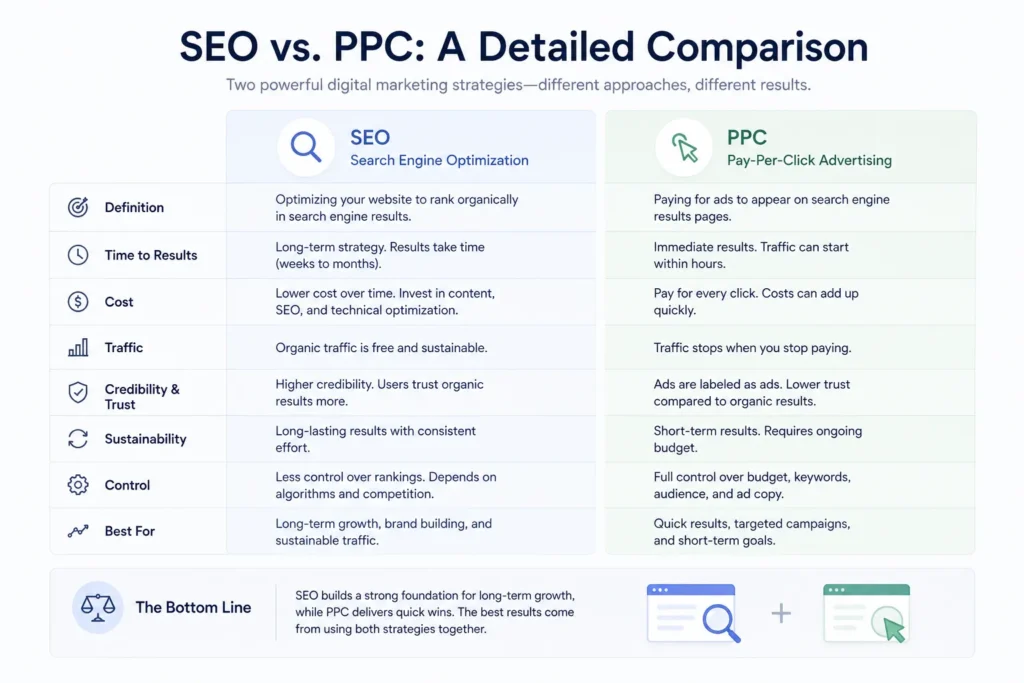
SEO and PPC (Pay-Per-Click) are the two dominant paths to search visibility, and they work in fundamentally different ways. Neither replaces the other but understanding exactly how they differ helps you decide where to invest, and when.
How Each One Works
SEO earns placement through relevance, authority, and technical quality. You don’t pay for the click you invest in the ongoing work (content, technical fixes, link building) that earns the ranking. Once a page ranks well, it can continue generating traffic for months or years without additional per-click cost.
PPC buys placement. You bid on keywords in platforms like Google Ads, and your ad appears clearly marked as an ad for as long as you keep paying. The moment the budget stops, the traffic stops immediately.
Detailed Comparison
| Factor | SEO | PPC |
| Time to results | 4–6+ months to build momentum | Immediate live within hours of launch |
| Cost structure | Ongoing service/content investment; no per-click fee | Pay per click, cost rises with keyword competitiveness |
| Traffic longevity | Continues after active work slows, if rankings hold | Stops the instant spend stops |
| Click-through trust | Higher users tend to trust organic results over ads | Lower many users actively skip or distrust ads |
| Click cost over time | Decreases as authority builds (compounding ROI) | Stays constant or rises with competition |
| Targeting precision | Broad relevance-based targeting via content and keywords | Highly precise bid on exact keywords, demographics, retargeting, dayparting |
| Testing speed | Slow algorithm changes and indexing take time to show effects | Fast you can test messaging, offers, and audiences in days |
| Scalability | Scales with content/authority investment, has a ceiling based on competition | Scales instantly with budget, until diminishing returns on bid costs |
| Best for | Long-term brand visibility, sustainable lead flow, content-driven industries | Product launches, time-sensitive promotions, immediate lead generation, testing new markets |
| Risk if paused | Rankings usually erode gradually | Traffic disappears immediately |
| Data ownership | You own the asset (the ranking page) indefinitely | You rent visibility for as long as you pay |
When to Prioritize SEO
- You’re building a sustainable, long-term source of leads or sales
- Your industry has strong search demand and you can compete on content/authority
- You want compounding ROI that improves the longer you invest
- Trust and credibility matter heavily to your buyers (which is nearly always true in B2B)
When to Prioritize PPC
- You need visibility immediately a launch, a promotion, or a seasonal push
- You’re testing which keywords or offers actually convert before committing to long-term SEO content around them
- You’re entering a brand-new market and haven’t built organic authority yet
- You’re in an extremely competitive niche where organic ranking would take too long to be viable on its own
The Smartest Approach: Use Both Together
In practice, the strongest digital strategies rarely pick one over the other. PPC data (which keywords actually convert, which ad copy resonates) can directly inform your SEO content strategy. Meanwhile, SEO content can support PPC campaigns by improving Quality Score and lowering cost-per-click, since Google rewards landing pages that are already relevant and well-optimized.
Where AI Search Visibility Fits In
A third layer now sits alongside both: visibility inside AI answer engines (Google AI Overviews, ChatGPT, Perplexity, Gemini). Unlike PPC, you can’t currently buy your way into an AI-generated answer. Like SEO, it’s earned through structured, trustworthy, well-cited content but it behaves differently enough that it deserves its own strategy layer rather than being treated as a subset of either SEO or PPC.
| Parameters | SEO | PPC | AI Search Visibility |
| Speed | Slower, builds over months | Immediate | Slower, builds via authority + citation signals |
| Cost model | Ongoing service investment | Pay per click | Ongoing service investment |
| Longevity | Long-term, compounding | Stops when spend stops | Long-term, compounding |
| Trust signal | High earned placement | Lower known as an ad | Very high cited as a trusted source inside an answer |
Most effective digital strategies now run all three in parallel: PPC for immediate visibility and fast testing, SEO for sustainable organic growth, and AI search optimization to capture the fast-growing share of zero-click, AI-generated answers.
Calculating the ROI of SEO
Formula:
(Revenue from organic traffic − SEO cost) / SEO cost × 100%
Example: A business closes a $75,000 deal from an organic lead and spent $28,800 on SEO that year:
(75,000 − 28,800) / 28,800 × 100% = 160%
For every $1 spent, they generated $1.60 in return. E-commerce businesses often benchmark toward a $2.75-per-dollar (275%) ROI target. Track this using Google Analytics and Search Console, and where possible, an AI-referral tracking setup to capture traffic coming from ChatGPT, Perplexity, and AI Overview citations.
How to Spot a Fake or Low-Quality SEO Provider
Red flags include:
- Guaranteed #1 rankings (no legitimate provider can promise this)
- Claims of “secret” insider access to Google’s algorithm
- Vague, non-transparent reporting
- Prices dramatically below market rate
- No visibility strategy for AI search a sign the provider hasn’t kept pace with how search actually works in 2026
A trustworthy provider is transparent about tactics, reports clearly on both traditional rankings and AI visibility, and never promises overnight results.
Frequently Asked Questions
What are SEO services?
SEO services are professional strategies including technical SEO, content, link building, and increasingly AI/LLM search optimization designed to improve a website’s visibility in both traditional search engines and AI answer engines.
How is AI search optimization different from traditional SEO?
Traditional SEO optimizes for ranking in a list of links. AI search optimization (GEO/AEO) optimizes for being understood, trusted, and directly cited inside a synthesized AI answer which relies more heavily on structured data, entity consistency, and extractable, clearly-stated content.
How long does SEO take to work?
Most businesses see meaningful results in 4 to 6 months, though highly competitive industries can take longer. AI search visibility often follows a similar or slightly longer timeline, since it depends on broader authority signals across the web.
Can I guarantee a #1 ranking?
No ethical provider can guarantee a specific ranking or AI citation algorithms update constantly. Be cautious of anyone who promises this.
How much should I budget for SEO?
Typically a few hundred to several thousand dollars per month, depending on competition, content volume, and whether AI search optimization is included.
Do I need AI search optimization if I already do SEO?
Increasingly, yes. A growing share of queries are now answered directly by AI Overviews and chatbots without a click to any website. If your content isn’t structured for AI extraction and citation, you’re losing visibility in that segment even while ranking well traditionally.
What’s the difference between on-page and off-page SEO?
On-page SEO covers everything you control directly on your website content, title tags, headers, internal links, and site structure. Off-page SEO covers everything that builds authority from outside your site, primarily backlinks, digital PR, and brand mentions. Both are required; strong on-page work with no off-page authority (or vice versa) rarely ranks well in competitive spaces.
What is technical SEO and why does it matter so much?
Technical SEO is the backend foundation of crawlability, site speed, mobile performance, structured data, and indexing health. If search engines and AI crawlers can’t efficiently access and understand your site, even great content and strong backlinks won’t be enough to rank.
What is semantic SEO?
Semantic SEO focuses on topics, meaning, and entity relationships rather than isolated keywords building topic clusters, aligning with natural language search intent, and helping search engines and AI models understand your business as a distinct, authoritative entity on a subject. It’s become essential as both Google and AI models have shifted from keyword matching to concept understanding.
Should I do SEO myself or hire a service?
DIY SEO is possible but requires significant time and expertise, especially now that it spans both classic search and AI search mechanics. A professional provider typically accelerates results and covers ground a business owner doesn’t have time to master alone.
The Bottom Line
SEO services in 2026 are no longer just about ranking in a list of blue links; they’re about being the source that both search engines and AI models trust enough to recommend. A modern SEO strategy needs to cover the fundamentals (technical health, content, authority) while also building visibility inside the AI search layer that’s reshaping how people find businesses.
How Can Softiconex Help?
At Softiconex, we handle every layer of SEO covered in this guide technical, on-page, off-page, and semantic SEO plus dedicated AI/LLM search optimization to get your business cited in Google AI Overviews, ChatGPT, and Perplexity, not just ranked in classic search. We start with a full audit, build a custom strategy for your industry, and report transparently every month. Contact us for a free SEO audit.