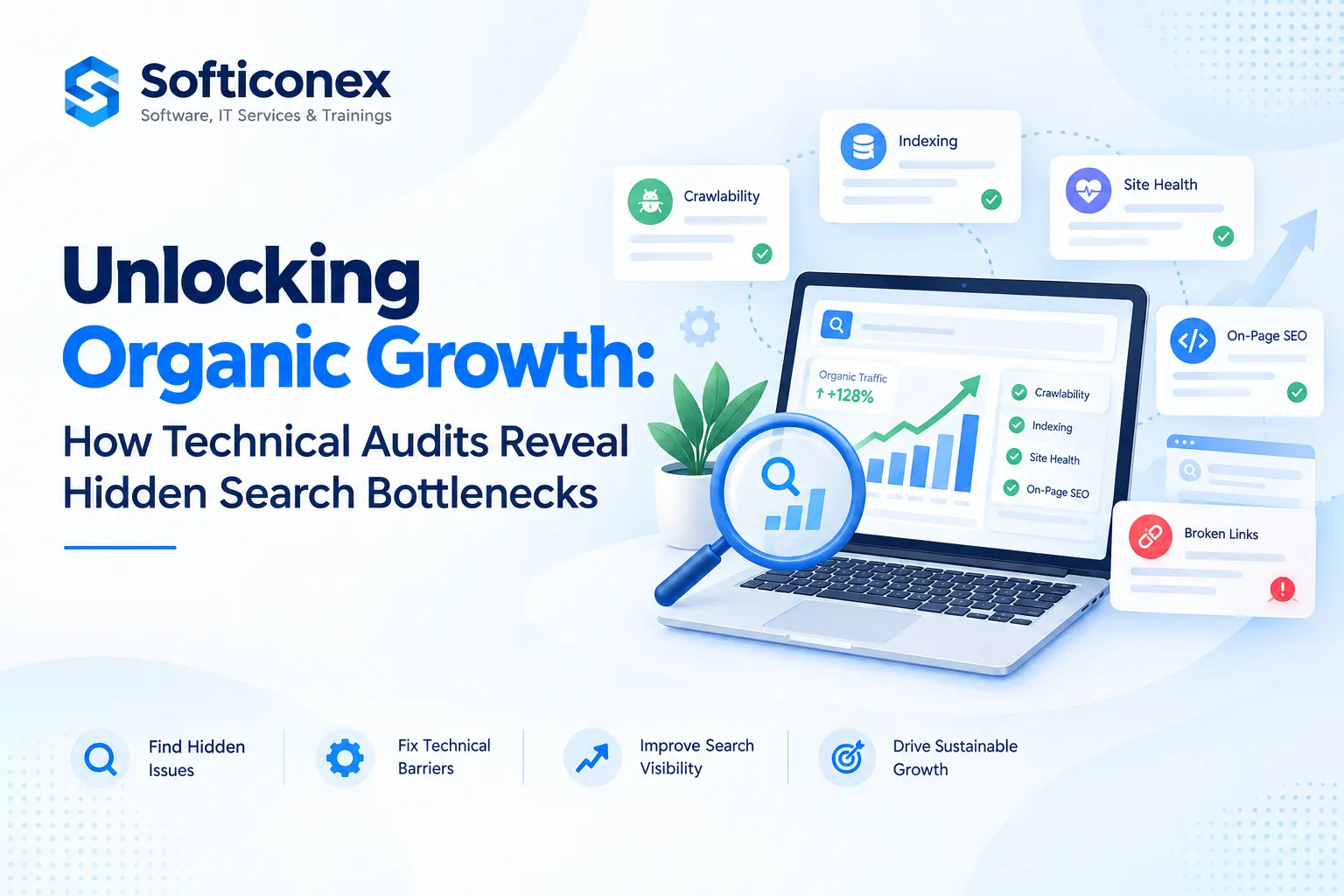
A technical SEO agency is a team of specialists that audits, fixes, and monitors the structural and performance elements of a website so that search engines can crawl, index, and rank its pages effectively. This includes site speed, architecture, Core Web Vitals, structured data, crawl budget, canonicalization, redirects, and mobile usability. Unlike general SEO agencies, technical SEO agencies focus specifically on the behind-the-scenes infrastructure that determines how well a site performs in organic search.
Why Technical SEO Matters for Organic Growth
Content and links receive most of the attention in SEO conversations, but neither delivers results if the technical foundation underneath them is broken. A page blocked by an incorrect robots.txt entry will never rank, regardless of how strong its content is. A site that takes five seconds to load will lose rankings to a competitor that loads in one second, even if the slower site covers the topic better.
Search engines depend on crawlability and indexability to discover and evaluate pages. If a bot cannot crawl a page efficiently, or if that page fails to enter the search engine index, no amount of content or link building will compensate for the gap.
Technical SEO agencies exist specifically to close that gap. They identify every structural barrier between a website and its full ranking potential, then work systematically to remove each one. The result is stronger organic traffic, better keyword rankings, and measurable SEO ROI over time.
What Are Technical SEO Agencies
A technical SEO agency is a specialist firm that focuses on the infrastructure layer of search engine optimization. While a general SEO agency often handles content, backlinks, and strategy alongside technical work, a technical SEO agency concentrates its expertise on the systems that govern how a site communicates with search engines.
Core Responsibilities
The agency runs complete website technical audits, identifies crawl errors and indexation problems, optimizes site speed and Core Web Vitals, manages structured data and schema markup, and monitors ongoing site health through regular reporting and log file analysis.
Difference From a General SEO Agency
A general SEO agency covers keyword research, content production, link building, and technical fixes as part of a broad service. A technical SEO agency goes deeper on infrastructure, often working directly with development teams to implement changes that require coding knowledge, such as JavaScript SEO, structured data deployment, or server response optimization.
Services Offered by Technical SEO Agencies
Technical SEO Audit
A website technical audit is the starting point for every engagement. The agency crawls the entire site, analyzes server logs, reviews Search Console data, and produces a prioritized list of issues. The audit covers architecture, speed, indexability, structured data, mobile usability, and security in one comprehensive report.
Website Speed Optimization
Slow websites lose both rankings and users. Agencies reduce server response times, optimize image delivery, implement caching strategies, and remove render-blocking resources so pages load faster on every device and connection type.
Core Web Vitals Optimization
Core Web Vitals are Google’s three page experience metrics. Agencies improve Largest Contentful Paint by optimizing how the main visual element loads, improve Interaction to Next Paint by reducing JavaScript execution delays, and improve Cumulative Layout Shift by preventing unexpected movement of page elements after initial load.
Crawl Budget Optimization
For large sites, search engine bots can only crawl a limited number of pages per day. Agencies manage crawl budgets by blocking low-value pages from bots, fixing redirect chains that waste crawl resources, and consolidating duplicate content so bots spend their time on pages that matter most for rankings.
XML Sitemap Optimization
An accurate XML sitemap guides search engines to all priority pages. Agencies audit the sitemap for errors, remove pages that should not be indexed, ensure the sitemap reflects the current site structure, and verify that it is submitted and accepted in Search Console.
Robots.txt Management
An incorrectly written robots.txt file can accidentally block entire sections of a site from search engines. Agencies review and correct the file to ensure it blocks only the right resources, such as admin areas and staging environments, while leaving all ranking pages accessible.
Structured Data and Schema Markup
Structured data tells search engines exactly what a page contains, which enables rich results such as star ratings, product details, FAQ dropdowns, and breadcrumb paths in search listings. Agencies implement schema markup correctly, test it for errors, and monitor it over time as page content changes.
Canonical Tag Management
Duplicate content is one of the most common technical issues on large websites. Canonical tags signal to search engines which version of a duplicated or similar page should be ranked. Agencies audit all canonical tags, correct self-referencing and cross-domain errors, and prevent duplicate content from splitting ranking authority.
Redirect Management
Broken links and long redirect chains both damage site health and waste crawl budget. Agencies identify and fix 404 errors, collapse multi-step redirect chains into single direct redirects, and ensure that any page removed or moved permanently passes its full ranking value to the correct destination.
HTTPS and Security
A site without HTTPS sends a trust warning to both search engines and visitors. Agencies verify SSL implementation across all pages, resolve mixed content warnings where HTTP resources load on HTTPS pages, and confirm that security certificates renew without interruption.
Mobile Optimization
Google uses mobile-first indexing, which means the mobile version of a site is what search engines primarily evaluate. Agencies test and fix mobile rendering issues, ensure content parity between desktop and mobile versions, and confirm that all interactive elements work correctly on touch screens.
JavaScript SEO
Many modern websites use JavaScript frameworks to render content. Search engines sometimes struggle to process JavaScript-rendered content correctly, which can leave key pages unindexed. Agencies diagnose rendering issues and recommend server-side or hybrid rendering approaches that ensure critical content reaches search engines reliably.
Log File Analysis
Server log files reveal exactly how search engine bots interact with a site, which pages they visit most, which pages they skip, and how often they return. Agencies analyze these logs to identify crawl inefficiencies that standard auditing tools cannot detect.
International SEO
Businesses operating in multiple languages or regions need hreflang tags implemented correctly so the right language version of a page appears in each country’s search results. Agencies set up, test, and maintain international SEO configurations to prevent content from cannibalizing its own rankings across regions.
Top Technical SEO Agencies Compared
Choosing the right technical SEO agency can have a significant impact on your website’s search performance, user experience, and long-term organic growth. The table below compares some of the leading technical SEO agencies based on key capabilities such as technical SEO audits, Core Web Vitals optimization, international SEO, enterprise SEO, and their ideal use cases. Use this comparison to evaluate which agency best aligns with your business goals, budget, and technical requirements.
| Agency | Country | Technical SEO Audit | Core Web Vitals | International SEO | Enterprise SEO | Best For |
| Softiconex | Global | ✅ Yes | ✅ Yes | ✅ Yes | ✅ Yes | SMEs, Startups & Enterprises |
| WebFX | USA | ✅ Yes | ✅ Yes | ✅ Yes | ✅ Yes | Enterprise Businesses |
| Victorious | USA | ✅ Yes | ✅ Yes | ✅ Yes | ✅ Yes | Organic SEO Growth |
| Ignite Visibility | USA | ✅ Yes | ✅ Yes | ✅ Yes | ✅ Yes | Large Brands |
| OuterBox | USA | ✅ Yes | ✅ Yes | ✅ Yes | ✅ Yes | eCommerce Businesses |
| Straight North | USA | ✅ Yes | ✅ Yes | ✅ Yes | ✅ Yes | Small & Medium Businesses |
| Delante | Poland | ✅ Yes | ✅ Yes | ✅ Yes | ✅ Yes | International SEO |
| Skale | United Kingdom | ✅ Yes | ✅ Yes | ✅ Yes | ✅ Yes | SaaS Companies |
| SEO.com | USA | ✅ Yes | ✅ Yes | ✅ Yes | ✅ Yes | Enterprise Websites |
| The SEO Works | United Kingdom | ✅ Yes | ✅ Yes | ✅ Yes | ✅ Yes | Growing Businesses |
| Pearl Lemon | United Kingdom | ✅ Yes | ✅ Yes | ✅ Yes | ✅ Yes | SEO Consulting |
| Incrementors | USA | ✅ Yes | ✅ Yes | ✅ Yes | ✅ Yes | Small Businesses |
| Funnel Boost Media | USA | ✅ Yes | ✅ Yes | ✅ Yes | ❌ No | Local Businesses |
| Bird Marketing | United Kingdom | ✅ Yes | ✅ Yes | ✅ Yes | ✅ Yes | Digital Marketing |
| SEO Discovery | India | ✅ Yes | ✅ Yes | ✅ Yes | ✅ Yes | Affordable SEO Solutions |
How a Technical SEO Agency Works: Step by Step
Step 1: Website Discovery
The agency gathers information about the site’s platform, hosting, previous SEO work, development processes, and business goals before beginning any technical work.
Step 2: Complete Technical Audit
The team runs a full crawl, reviews Search Console and analytics data, analyzes server logs, and checks structured data to build a complete picture of every technical issue affecting the site.
Step 3: Issue Prioritization
Not all issues carry equal weight. The agency ranks problems by their impact on crawlability, indexability, and organic traffic, so the most damaging issues receive attention first regardless of how difficult they are to fix.
Step 4: Implementation
The agency delivers detailed fix recommendations and either implements changes directly through a development team or guides the client’s developers through each fix with technical specifications.
Step 5: Testing
Every fix is tested before and after implementation. Agencies verify that changes achieved the intended result without creating new issues, using tools such as crawl simulators, Search Console, and page experience tests.
Step 6: Monitoring
Technical SEO is not a one-time task. Sites change frequently, and new issues appear after every content update, platform migration, or server change. Agencies monitor site health continuously and flag emerging problems before they affect rankings.
Step 7: Reporting
Monthly reports translate technical data into plain language so stakeholders can see exactly what was fixed, how site health has changed, and how technical improvements have affected organic traffic, search visibility, and keyword rankings.
How to Choose the Best Technical SEO Agency
Experience and Track Record
Ask how long the agency has handled technical SEO work and whether they have worked on sites that use the same platform as yours. A Shopify site and a large JavaScript-rendered SaaS product require very different technical knowledge.
Case Studies With Measurable Results
Any credible agency can share specific examples showing organic traffic growth, crawl error reduction, or Core Web Vitals improvement after their work. Agencies that can only offer vague testimonials have not yet built a verifiable track record.
Communication and Reporting
Confirm how the agency explains its work to non-technical stakeholders. The best agencies translate complex findings into clear, jargon-free reports that business owners can actually act on.
Pricing Transparency
Reputable agencies explain exactly what each fee covers, what happens if additional issues appear, and how pricing changes as the scope of work grows.
Hiring Checklist
- Request a sample audit or audit summary from a previous client engagement.
- Ask which tools the team uses and why those tools are appropriate for your site size.
- Confirm whether implementation is included or delivered as recommendations only.
- Verify that the team can communicate directly with your development team if needed.
- Establish clear KPIs and agree on a reporting schedule before signing anything.
Experience-Based Advice for Hiring a Technical SEO Agency
- Ask for a sample audit before committing to a full engagement. A strong agency will show you the depth of its analysis even on a short demonstration.
- Request measurable KPIs from the start. Metrics like crawl error reduction, Core Web Vitals pass rate, indexed page count, and organic traffic growth give you an objective basis for evaluating results.
- Verify that the agency understands your specific technology stack, since the technical fixes for a WordPress blog differ significantly from those needed by a React-rendered e-commerce platform.
- Avoid any agency that guarantees specific keyword ranking positions within a fixed time frame. Ranking outcomes depend on many factors outside any agency’s direct control.
- Review how past clients describe the agency’s communication style, not just their technical results. Clear, consistent communication is what keeps a complex technical engagement on track.
Common Technical SEO Problems Agencies Fix
Crawl Errors
Crawl errors occur when a search engine bot attempts to visit a page and receives an unexpected response. Agencies identify 404 errors, server errors, and redirect loops, then fix each one to restore clean crawl paths across the entire site.
Duplicate Pages
Duplicate content dilutes ranking authority because search engines cannot determine which version of a page to rank. Agencies consolidate duplicates through canonical tags, redirects, or parameter management depending on what caused the duplication.
Slow Website Speed
Pages that fail Core Web Vitals thresholds rank faster than competitors below in Google search results. Agencies trace speed problems to their root causes, whether that is oversized images, slow servers, unoptimized JavaScript, or inefficient caching.
Broken Internal Links
Broken internal links prevent bots from following navigation paths and leave users at dead ends. Agencies audit every internal link, fix broken destinations, and confirm that the site’s internal linking structure distributes authority to the pages that matter most.
Redirect Chains
A redirect chain occurs when a URL redirects to a second URL, which then redirects to a third. Each additional step wastes the crawl budget and dilutes the authority passed through the redirect. Agencies collapse these chains into direct single-step redirects.
Orphan Pages
An orphan page has no internal links pointing to it, which means search engine bots may never discover it during a crawl. Agencies identify orphan pages, determine whether they need indexing, and connect them to the site’s navigation structure where appropriate.
Thin Content Pages
Pages with very little meaningful content often suppress overall site quality signals. Agencies identify thin pages and recommend whether to consolidate them, expand their content, or remove them from the index entirely to improve overall site health.
Indexing Issues
Sometimes important pages fail to enter the search index due to incorrect noindex tags, blocked resources, or crawl budget limits. Agencies trace each indexation problem to its specific cause and confirm that the fix has worked by checking Search Console data after implementation.
Complete Technical SEO Checklist
Use this checklist to evaluate your site’s current technical health or to assess the scope of work a new agency engagement will need to cover.
| Category | Key Checks |
| Crawlability | Robots.txt is correct, no key pages are blocked, and crawl budget is allocated to priority URLs |
| Indexability | Canonical tags point to correct URLs, no accidental noindex directives, XML sitemap is submitted, and current |
| Site Architecture | Logical URL structure, no orphan pages, internal linking distributes authority to key pages |
| Structured Data | Schema markup is valid, product and article markup passes rich result tests, no errors in Search Console |
| Performance | Core Web Vitals pass on mobile and desktop, images are compressed, and server response time is under 200ms |
| Security | HTTPS is active sitewide, mixed content warnings are resolved, the SSL certificate is valid and renewed |
| Mobile Usability | Pages render correctly on small screens, tap targets are large enough, no mobile-specific errors in Search Console |
| Internal Linking | No broken internal links, redirect chains are resolved, and anchor text is descriptive and varied |
Page Experience Optimization: INP and CLS Explained
Two of the three Core Web Vitals directly affect how users experience a page after it loads. Both influence rankings, and both require specific approaches to optimize correctly.
Interaction to Next Paint
Interaction to Next Paint measures how quickly a page responds after a user clicks, taps, or types. A slow response makes a page feel broken even if it is loaded quickly. Technical SEO agencies reduce this delay by minimizing the amount of JavaScript that runs on the main thread, breaking large tasks into smaller ones, and ensuring that event handlers respond without waiting for unrelated code to finish.
Cumulative Layout Shift
Cumulative Layout Shift measures how much visible content moves unexpectedly after initial loading. A page that shifts layout while someone is reading or clicking frustrates users and signals poor quality to Google. Agencies prevent layout shifts by reserving space for images and embeds before they load, specifying width and height attributes on all media elements, and loading fonts in a way that prevents text from reflowing after the page appears.
Both metrics contribute directly to page experience signals that Google incorporates into its ranking algorithm. Improving them benefits both organic rankings and user satisfaction at the same time.
Technical SEO Agency Versus Freelancer
The right choice depends on the size and complexity of the site, the depth of technical work needed, and the budget available for ongoing support.
| Factor | Technical SEO Agency | SEO Freelancer |
| Cost | A higher monthly fee that reflects a full team of specialists | A lower rate that covers one person’s time and skills |
| Expertise | Access to auditors, developers, analysts, and strategists at once | Expertise limited to the individual’s core strengths |
| Availability | Team coverage means work continues even when one person is away | Sole dependence on one person’s schedule and capacity |
| Scalability | Handles enterprise websites and large crawl volumes without disruption | Capacity limits make large or complex projects difficult |
| Reporting | Structured monthly reports with team-reviewed data and insights | Reporting quality varies widely between individuals |
| Enterprise Support | Built for large site architectures, international SEO, and JavaScript-heavy platforms | Better suited to smaller sites with straightforward technical needs |
Conclusion
Technical SEO is the foundation that determines whether every other investment in content and links actually pays off. Without it, even the best-written pages on the internet can sit invisible in search results simply because a bot cannot reach them or a slow load time pushes them below a faster competitor.
A skilled technical SEO agency brings the expertise to audit a site thoroughly, prioritize fixes by real impact, and monitor site health continuously so new issues never build up unnoticed. The right agency communicates clearly, reports on measurable outcomes, and works as a long-term partner rather than a one-time vendor.
Start by running a basic site crawl to identify the most obvious technical issues on your site today. Then use the hiring checklist in this guide to evaluate two or three agencies before making a decision. Choose the team that demonstrates the deepest understanding of your specific platform and can show you clear examples of measurable results from past work.
Fix the technical foundation first, and every other SEO investment you make will work harder and deliver results faster.
Frequently Asked Questions
What does a technical SEO agency do?
A technical SEO agency audits, fixes, and continuously monitors the technical foundation of a website so search engines can crawl, index, and rank it effectively. This includes site speed, architecture, structured data, crawl budget, Core Web Vitals, and error resolution.
Is technical SEO different from on-page SEO?
Yes. On-page SEO focuses on the content and keywords within individual pages. Technical SEO focuses on the underlying infrastructure that determines whether search engines can access, read, and index those pages at all. Both are necessary for strong organic performance.
How much do technical SEO services cost?
Pricing varies by project scope and site size. A one-time technical audit may range from a few hundred to several thousand dollars, depending on how large and complex the site is. Ongoing monthly technical SEO services are typically priced as a retainer that covers continuous monitoring, fixes, and reporting.
How long does a technical SEO audit take?
A basic audit of a small site can take a few days. A thorough audit of a large enterprise or ecommerce site with thousands of pages may take two to four weeks to complete accurately and document properly.
What tools do technical SEO agencies use?
Common tool categories include crawl simulators that map site architecture, log file analyzers that show how search engine bots interact with the server, page speed testing tools that identify performance bottlenecks, and Search Console data for indexation and Core Web Vitals monitoring.
Can technical SEO directly improve keyword rankings?
Yes. Fixing crawl errors, improving page speed, resolving indexation issues, and implementing structured data all directly influence how search engines evaluate and rank a site. Many websites see measurable ranking improvements within weeks of completing a thorough technical audit and fix cycle.
How often should a website run a technical SEO audit?
Most websites benefit from a thorough audit at least once every six months. Large ecommerce sites or platforms that update frequently benefit from continuous automated monitoring combined with quarterly manual reviews.
Should small businesses hire technical SEO agencies?
Small businesses with a website that generates revenue or leads can benefit from at least a one-time technical audit, since even simple technical errors can suppress organic traffic significantly. Ongoing monthly retainers make more sense once the site reaches a level of complexity that requires continuous attention.
What are Core Web Vitals and why do they matter?
Core Web Vitals are three page experience metrics that Google uses as ranking signals: Largest Contentful Paint measures loading speed, Interaction to Next Paint measures responsiveness, and Cumulative Layout Shift measures visual stability. Pages that pass these thresholds receive a page experience advantage in search rankings.
How do I choose the best technical SEO agency for my site?
Ask for a sample audit or case study that demonstrates measurable results. Verify that the team understands your specific platform, whether that is WordPress, Shopify, a custom build, or JavaScript-rendered content. Confirm what their reporting process looks like and how they communicate progress throughout the engagement.
What is a crawl budget and why does it matter?
Crawl budget is the number of pages a search engine bot will crawl on a site within a given time window. Large sites with thousands of pages need to guide bots toward their most important content, since a poor crawl budget allocation means valuable pages get crawled less frequently and rank more slowly.