Search behavior has fundamentally shifted. Featured snippets, knowledge panels, and voice assistants now deliver instant answers directly on the results page, and users increasingly find what they need without ever visiting a website. This evolution is forcing a hard rethink of how businesses measure the value of SEO management services.
Below is a look at why zero-click searches are reshaping traditional ROI calculations, which new metrics are replacing traffic as the primary signal, and what forward-thinking agencies are doing to stay relevant.
Understanding Zero-Click Searches
Zero-click searches occur when a user finds their answer directly on the search engine results page without clicking through to any website. According to a 2023 SparkToro study analyzing 1.2 million search terms, zero-click searches now account for 65% of all Google desktop queries and 51% of mobile queries.
The patterns driving this are familiar. A weather query surfaces a widget with live conditions. A question about a public figure pulls up a knowledge panel. A unit conversion request triggers a built-in calculator. The answer is right there. No click required.
These patterns reduce organic click-through rate by an average of 34% for affected queries. That is not a rounding error. It is a structural change in how information reaches people, and it changes what SEO management services are actually delivering.
Why Traditional SEO ROI Metrics Are Breaking Down
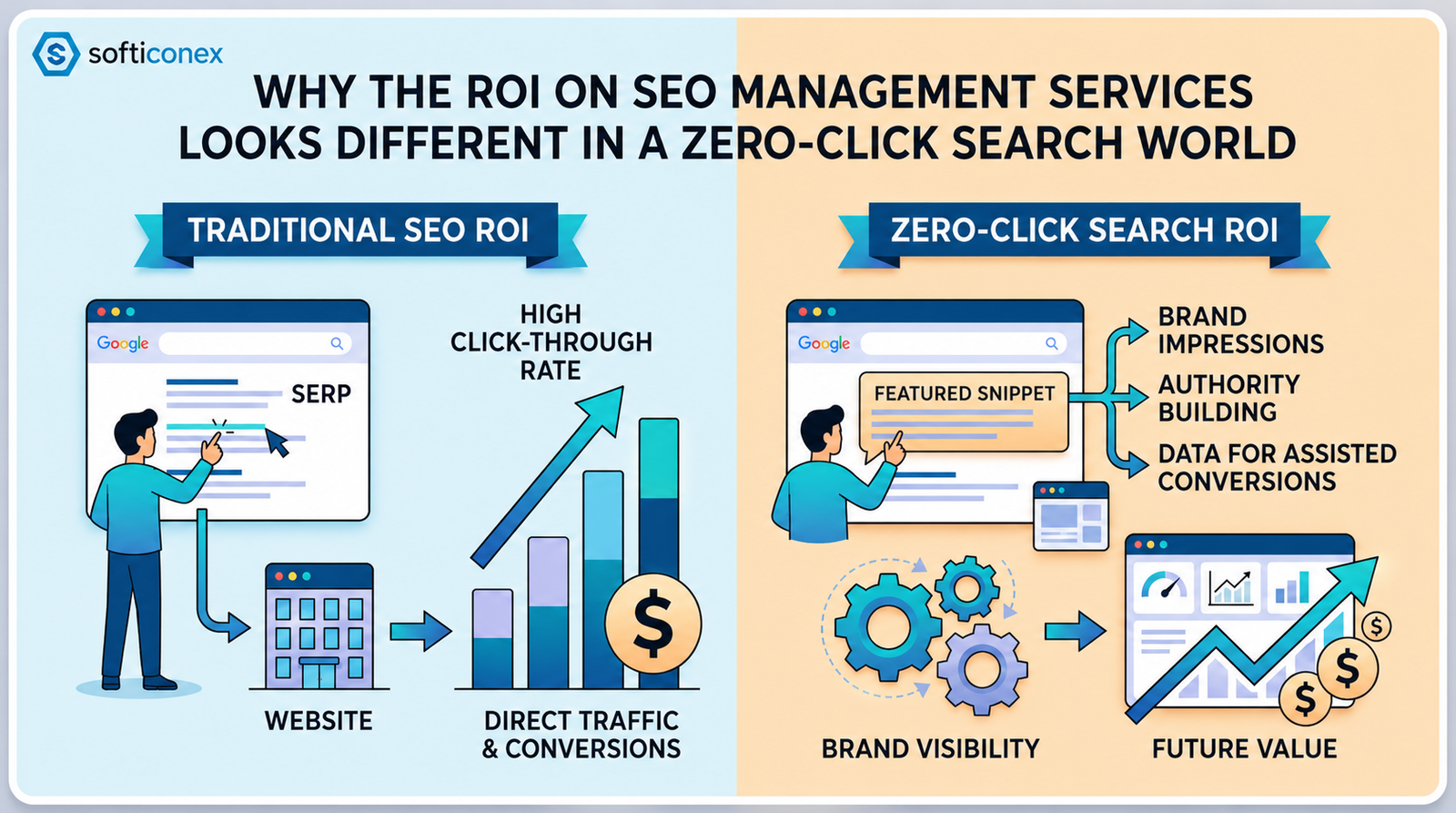
Traditional SEO measurement centers on three signals tracked through Google Search Console and analytics platforms: impressions, average position, and click-through rate. Conversion tracking follows users from search results to completed actions. The model works cleanly when clicks represent the main path to value.
Zero-click searches break that model.
Answer boxes and knowledge panels deliver information without requiring anyone to visit the source. Search engine results pages now satisfy many queries entirely on their own. Traditional dashboards show declining traffic even as brand exposure increases.
Organic Traffic as a Standalone KPI No Longer Works
Organic traffic as a primary KPI measures sessions from search engines but ignores 65% of queries resolved in SERPs without clicks. Featured snippets capture attention before users ever scroll to the organic listings below them.
The CTR data makes this concrete. Position one average click-through rate dropped from 31.7% to 19.8% when a featured snippet is present, according to 2023 benchmarks. Ahrefs data shows that pages ranking first with a featured snippet get an 8.6% CTR, versus 31.7% without.
Run the numbers on 1,000 impressions: 8.6% CTR equals 86 clicks. Historical benchmarks without snippets would show 317 clicks. That is a 73% loss in traffic despite a ranking improvement. The metric is moving in the opposite direction of actual visibility.
Conversion Attribution Breaks in Multi-Touch Journeys
Conversion attribution becomes unreliable when users complete their research with zero-click answers and then convert via branded or direct searches days later.
The typical scenario: a user searches “best CRM for startups,” views HubSpot data in an answer box, then searches “HubSpot pricing” four days later and converts. Google Analytics 4’s last-click model credits direct traffic. The answer box exposure goes completely untracked.
A Moz study found that 41% of zero-click-influenced conversions are incorrectly attributed to direct traffic. Multi-touch attribution is not optional anymore. Implement GA4 enhanced conversions with first-touch plus last-touch modeling, and track micro-conversions like email signups before major purchases. That is how you start connecting early research to final outcomes.
The Real Impact of Featured Snippets on SEO Management Services
Featured snippets appear in 19.6% of all search queries, according to Ahrefs analysis of 2.8 million keywords, and capture 35.1% of total clicks for those queries.
Position zero gets 35.1% CTR. Organic position one, when pushed down by a snippet, drops to 15.7% CTR. Visibility no longer guarantees traffic. The zero-click economy rewards SERP presence even when clicks decline.
How Teams Are Optimizing for Snippets
The tactics that consistently perform:
- Target answers in the 40 to 60 word range
- Match H2 and H3 headers to actual question keywords users type
- Implement FAQ schema, which creates a 28% higher snippet capture rate per industry benchmarks
SEMrush data shows pages with FAQ schema appear in featured snippets 2.3x more often than pages without structured data. This requires new methods for tracking ROI since traditional click metrics no longer capture full value. Marketing teams are measuring success through brand exposure, assisted conversions, and influence on customer journeys rather than direct traffic alone.
Knowledge Panels, Answer Boxes, and Entity Optimization
Knowledge panels appear for 36% of branded searches and 19% of informational queries, sourced from the Google Knowledge Graph, which contains over 500 billion facts. These panels create a results page where users get direct answers without ever having to click through.
Entity optimization is the practice of ensuring Google correctly identifies and represents a business or person within its knowledge systems. The steps that move the needle:
- Claim and verify your Google Business Profile
- Maintain consistent NAP citations across directories
- Add structured data markup to improve panel appearance rates
- Build and maintain a Wikipedia presence, which significantly increases knowledge panel probability according to Search Engine Journal analysis
People also ask boxes to compound the effect. Each expanded question displays a brief answer, reducing the number of clicks on traditional organic results even further. Track branded search volume growth as a proxy metric for knowledge panel value, even when direct clicks decline.
New Success Metrics Beyond Clicks
Zero-click environments require a different measurement framework. The focus shifts to visibility, brand recognition, and assisted conversions rather than direct traffic.
Companies like NetReputation, which operates across multiple reputation and privacy-focused domains, track how often their brand appears in knowledge panels and answer boxes even when users never visit the website. That kind of SERP presence signals growing topical authority and sustained search demand across informational queries.
Brand Visibility and Share of Voice
Brand visibility tracks mention frequency across SERPs even when users do not click. Tools like SEMrush and Ahrefs measure share of voice across featured snippets, answer boxes, and knowledge panels.
Branded query volume growth is a leading indicator worth watching closely. When branded searches increase, it often means users are recognizing the brand name after seeing it in a snippet or panel. People Also Search For sections reveal brand associations and competitive positioning that pure traffic data misses entirely.
ROI calculations now attribute revenue to increases in branded search resulting from consistent SERP presence. The value materializes when users later search the brand directly and complete transactions through organic or paid channels.
Voice Search as a Visibility Channel
Voice search accounts for a significant share of mobile device queries and delivers answers from position zero most of the time. Optimization for voice requires targeting natural language questions with conversational phrasing. Local intent queries need formatting that matches how people speak to their devices.
Voice-optimized content builds recognition that surfaces in later searches. Users who hear a brand name via a voice answer often follow up with queries that drive conversions through other channels. The click never comes directly from the voice result, but the attribution chain is real.
Authority, Trust, and Long-Term Ranking Signals
Zero-click visibility builds E-E-A-T signals that improve rankings over 6 to 12 months, even when immediate clicks do not follow. Consistent presence of answer boxes signals expertise to Google’s algorithms and strengthens domain authority over time.
Publishing 3,000-plus-word pillar content that targets 15 or more related questions increases answer box capture. Target a domain rating of 45 or above in Ahrefs for competitive featured snippet wins. Track progress through Google Search Console and SEMrush to monitor average position changes and SERP feature gains.
One B2B SaaS company increased answer box presence from 12 to 47 queries. The result: a 23% domain rating improvement and a 41% increase in organic click-through rate for non-answer queries. Visibility in zero-click formats lifted performance across the board, not just in branded search.
Local SEO in a Zero-Click Environment
Local pack results capture 44% of mobile searches with “near me” intent, delivering directional information that often satisfies user needs without a website visit. Local SEO measurement now centers on Google Business Profile actions as the primary success indicator: calls, direction requests, and profile clicks.
Average local pack CTR for position one sits at 7.2%, compared to 18.4% for organic position one. That gap illustrates why SEO management services must specifically adjust their value calculations for local clients.
Profile optimization that actually moves the needle:
- Upload 25 or more photos
- Respond to 90% of reviews within 24 hours
- Publish weekly updates
Use LocalFalcon to measure local pack rankings across 50 or more locations. A law firm appearing in the “personal injury lawyer near me” pack can receive 340 calls monthly despite generating only 12 website clicks from that query. Business value and website traffic are no longer the same thing.
How SEO Agencies Are Restructuring Around These Realities
Agencies that still report primarily on traffic numbers are creating a perception problem. Clients see declining sessions and assume the work is not performing. The issue is the measurement, not the results.
Agencies now track SERP feature performance instead of raw visitor counts. SEMrush Position Tracking monitors 200 keywords across featured snippets, answer boxes, and knowledge panels. GA4 data-driven attribution connects visibility gains to assisted conversions across the customer journey.
Pricing models are shifting to reflect new deliverables. Monthly retainers are moving from traffic-focused packages at around $2,500 to visibility packages at $3,200 that include answer box optimization and knowledge panel management. Clients pay for measurable SERP presence, not click volume.
The communication language is changing too. Progress gets framed as: “We captured 15 featured snippet wins this quarter and project 28% branded search growth.” That language aligns with the zero-click economy in a way that a sessions report simply cannot.
Agencies that report SERP visibility metrics retain more clients than those focused solely on traffic, according to industry observations. The shift rewards agencies that measure what actually moves the business forward, not just what is easy to pull from a dashboard.