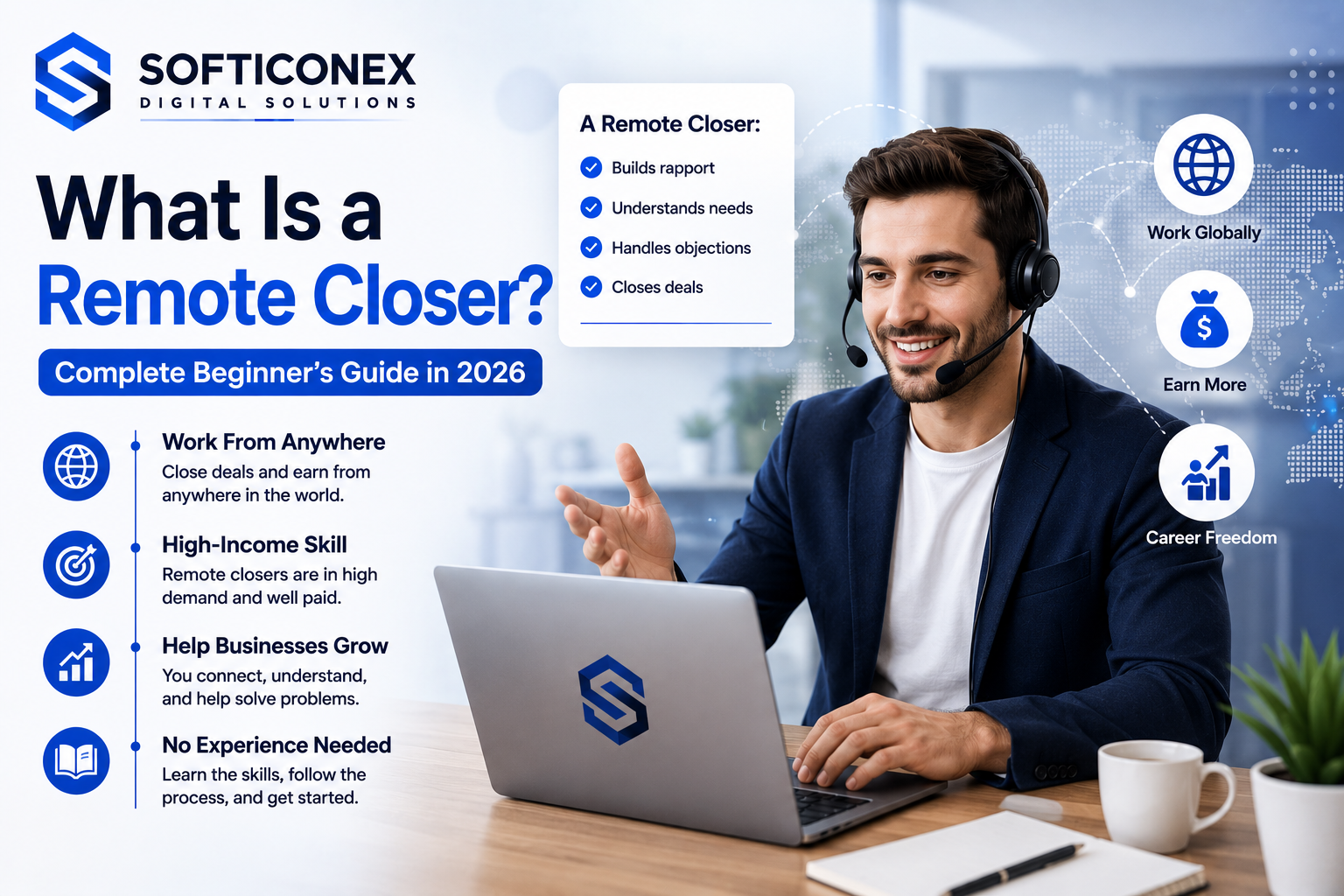
A remote closer is a sales professional who finalizes deals with prospects entirely over the phone or video call, without ever meeting them in person. This role has grown quickly as more companies move their entire sales process online.
Remote closing appeals to people who want flexible, commission driven work without a traditional office job. Skilled closers can earn a strong income, and many started with no formal sales background at all.
This guide explains exactly what a remote closer does, how much the role pays, what skills matter most, and the clear steps you can take to break into remote closing, even if you are starting from zero experience.
What Is a Remote Closer?
A remote closer is a salesperson whose main job is to take a scheduled call with a prospect and guide that conversation toward a paid decision. Unlike a general sales representative, a closer usually focuses on the final stage of the sales process rather than the earlier outreach steps.
Remote closers commonly work with high ticket offers, meaning products or services priced high enough that a single sale can generate a meaningful commission. This makes the role attractive to people who enjoy performance based pay over a fixed salary.
What Does a Remote Closer Do?
• Conducting sales calls with prospects who already expressed interest
• Handling objections calmly and addressing genuine concerns
• Building trust quickly during a single call or a short series of calls
• Closing deals by guiding the prospect toward a clear decision
• Updating CRM systems with call notes and deal status
• Following up with prospects who need more time before deciding
How Remote Closing Works
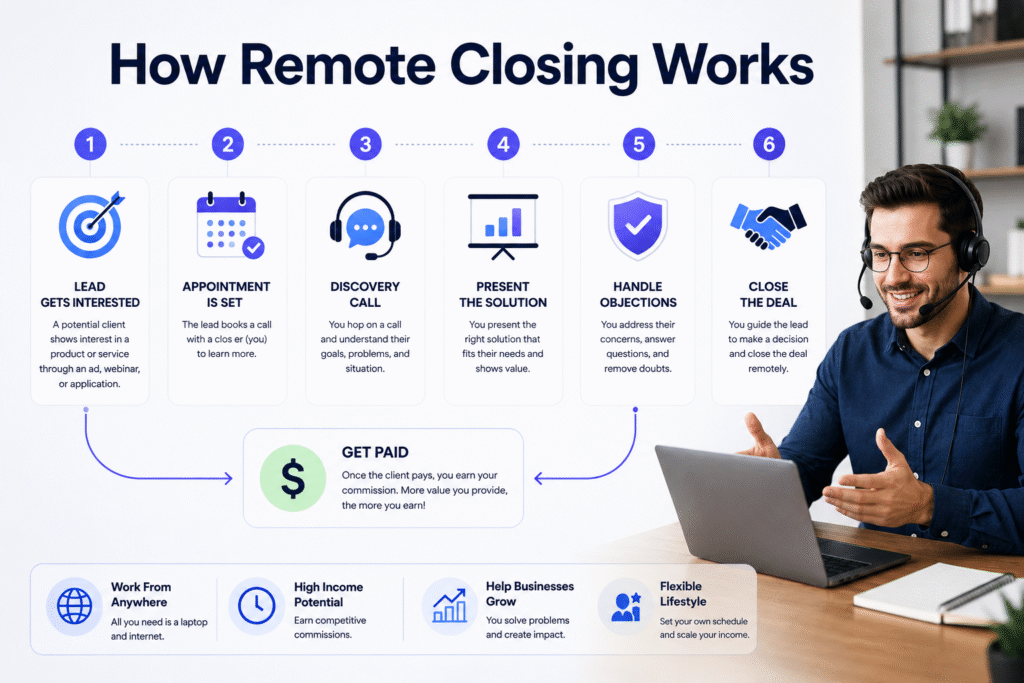
Lead Generation
A marketing team or appointment setter first attracts interested prospects through ads, content, or outreach.
Appointment Setting
A setter qualifies the lead and books a call directly onto the closer’s calendar.
Discovery Calls
The closer asks questions to understand the prospect’s goals, budget, and readiness to buy.
Sales Presentations
The closer explains how the offer solves the prospect’s specific problem, tailored to what was learned during discovery.
Negotiation
The closure addresses pricing concerns, objections, and any hesitation the prospect raises.
Closing
The call ends with a clear decision, either a completed sale, a scheduled follow up, or an honest no.
Skills Every Successful Remote Closer Needs
• Communication skills that keep a call clear, natural, and easy to follow
• Active listening to catch what a prospect truly needs, not just what they say
• Negotiation skills for handling pricing pushback with confidence
• CRM knowledge to track deals and follow up at the right time
• Objection handling that addresses concerns without sounding defensive
• Emotional intelligence to read tone and adjust approach mid call
• Product knowledge deep enough to answer detailed questions confidently
How Much Do Remote Closers Earn?
Income for remote closers depends heavily on experience, the offer being sold, and the commission structure in place. Most closers earn through commission alone or a small base salary combined with commission per closed deal.
Entry Level Income
New closers often earn a modest income in their first few months while learning the sales process and building confidence on calls.
Experienced Closer Income
Closers with a proven track record and strong close rates can earn a substantial full time income, especially when working with premium offers.
Commission Models
Common structures include a flat percentage of each sale, tiered commission that increases with performance, or a hybrid of base pay plus commission.
High Ticket Closing Opportunities
Closers who specialize in high ticket coaching, consulting, or software offers often see the highest earning potential due to larger commission amounts per sale.
How to Become a Remote Closer
Follow these steps in order to build a genuine path into remote closing, even without prior sales experience.
1. Learn sales fundamentals through free or paid training resources covering the full sales process
2. Practice objection handling using real scripts and role play scenarios
3. Understand high ticket sales, including how premium offers are positioned and priced
4. Build communication skills through daily practice on calls, videos, or recorded pitches
5. Create a professional profile highlighting any relevant experience, even from unrelated customer facing roles
6. Apply for remote closing jobs through job boards, sales communities, and direct outreach to companies hiring closers
Best Industries for Remote Closers
• Coaching, where closers sell personal or business coaching programs
• Consulting, covering business, financial, or strategic advisory services
• SaaS, selling software subscriptions to business or individual customers
• Marketing agencies, closing deals for advertising or growth services
• Online education, selling courses and certification programs
• Real estate, closing deals for property investment or related services
Tools Used by Remote Closers
• CRM software to track leads, deals, and follow up tasks
• Zoom or similar video platforms for conducting live sales calls
• Calendly or similar scheduling tools to manage a full calendar of calls
• Email automation tools for follow up sequences after a call
• Sales tracking tools to monitor close rates and personal performance
Advantages and Disadvantages of Remote Closing
Advantages
• Flexible schedule with the ability to work from anywhere
• High income potential through commission based pay
• Low barrier to entry compared with many other sales careers
• Transferable skills that apply across many industries
Disadvantages
• Income can be inconsistent, especially in the first few months
• Commission based pay means slow periods directly affect earnings
• Requires strong self discipline without a traditional office structure
• Handling frequent rejection can be mentally demanding for beginners
Common Mistakes New Remote Closers Make
• Talking too much during a call instead of listening to the prospect’s needs
• Rushing to close before properly addressing genuine objections
• Failing to update CRM records, which creates confusion during follow up
• Taking rejection personally instead of learning from each call
• Skipping practice and role play, which slows skill development significantly
Remote Closer vs Appointment Setter
These two roles work closely together but involve very different daily tasks and skill sets. The table below breaks down the key differences.
| Category | Remote Closer | Appointment Setter |
| Main Responsibility | Conducting the sales call and closing the deal | Booking qualified calls for a closer |
| Typical Pay Structure | Higher commission, often tied to deal value | Lower base pay plus a smaller commission per booked call |
| Skill Focus | Negotiation, objection handling, and closing | Outreach, qualification, and scheduling |
| Experience Needed | Often requires prior sales or closing experience | Beginner friendly entry point into remote sales |
| Income Potential | Can be significantly higher for skilled closers | Steady but generally lower than closing roles |
Future of Remote Closing
Remote closing continues to grow as more companies shift entirely to online sales processes. Video call platforms and CRM tools keep improving, making it easier for closers to manage a full pipeline without ever working from a physical office.
As AI tools take over more repetitive tasks like scheduling and basic follow up, remote closers will likely spend more of their time on the parts of selling that still require genuine human judgment, such as building trust and handling nuanced objections.
Conclusion
A remote closer finalizes sales deals over the phone or video call, often working with high ticket offers in industries like coaching, consulting, and SaaS. The role rewards strong communication, objection handling, and consistent practice with real income potential tied directly to performance.
Beginners should focus first on learning sales fundamentals and practicing objection handling before applying for remote closing jobs. Experienced sales professionals can often transition into high ticket closing faster by highlighting past results and refining their approach to premium offers.
Whichever stage you start from, consistent call practice and a genuine focus on solving the prospect’s problem will matter far more than any script alone.
Frequently Asked Questions
Is remote closing a real job?
Yes. Remote closing is a genuine sales role where a closer conducts calls with prospects and finalizes deals for a company, often working entirely from home.
How much can remote closers make?
Earnings vary widely based on experience and the offer being sold, ranging from a modest supplemental income for beginners to a substantial full time income for experienced high ticket closers.
Do I need experience to become a remote closer?
Experience helps, but many companies hire beginners who show strong communication skills and are willing to train on their specific sales process and offer.
Is remote closing difficult?
It can be challenging at first, since handling objections and closing deals over a call requires practice, but the skill improves quickly with consistent call volume.
What industries hire remote closers?
Coaching, consulting, SaaS companies, marketing agencies, online education, and real estate all commonly hire remote closers for their sales teams.
What is the difference between a remote closer and an appointment setter?
A remote closer runs the sales call and finalizes the deal, while an appointment setter handles outreach and books qualified calls for the closer to take.
Can I become a remote closer with no sales background at all?
Yes, though it takes extra effort to learn sales fundamentals and objection handling quickly, since many training programs assume at least basic communication comfort.
What tools do remote closers typically use?
Most remote closers rely on CRM software, video call platforms like Zoom, scheduling tools like Calendly, and basic email or text follow up automation.
How long does it take to become a successful remote closer?
Many new closers see their first consistent results within two to three months of steady practice, though mastering objection handling often takes longer.
Is remote closing a stable career path?
It can be stable once a closer builds a strong track record, though income often fluctuates more than a traditional salaried role due to its commission based structure.