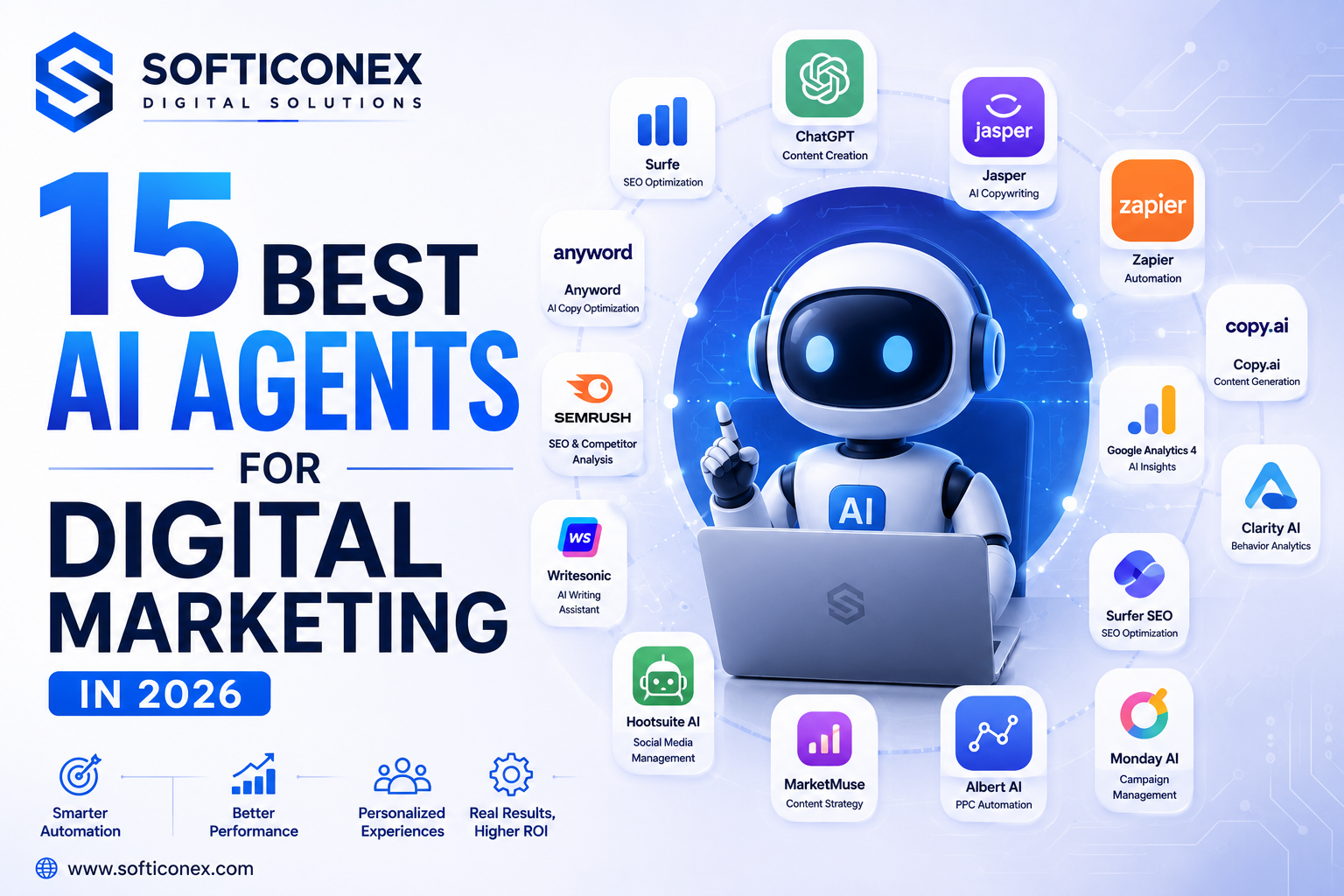
Marketing teams no longer ask whether to use AI. The real question now is which AI agent fits their workflow, budget, and goals. Choosing the wrong one wastes both time and money, while the right one can quietly handle hours of repetitive work every week.
An AI agent goes beyond a simple chat tool. Instead of only answering a question, it can plan steps, complete a task, and carry work forward with far less supervision than a standard AI assistant needs. This shift explains why adoption among marketers has grown so quickly over the past year.
This guide breaks down 15 of the strongest AI agents available today, tested against real marketing tasks rather than marketing claims alone. You will find honest pros, cons, pricing, and a real use case for each tool, plus guidance on picking the right one for your specific situation.
What Are AI Agents for Digital Marketing?
AI agents for digital marketing are software systems that can plan and carry out marketing tasks with minimal human input. They combine language understanding with the ability to take action, such as drafting a campaign, updating a spreadsheet, or triggering a workflow.
This differs from a standard AI tool, which usually responds to one request at a time. An AI agent can chain several steps together toward a larger goal, which is why marketers increasingly rely on them for full workflows rather than single tasks.
How AI Agents Are Transforming Modern Marketing
Content Marketing
AI agents now draft, edit, and repurpose content across formats automatically, turning one long piece into blog posts, emails, and social captions within minutes rather than hours.
SEO
Agents built for SEO generate content briefs, track keyword performance, and flag technical issues, cutting research time significantly for content and SEO teams.
Social Media
Scheduling, caption writing, and even basic community response tasks now run through AI agents connected directly to social platforms.
Email Marketing
AI agents personalize subject lines, segment audiences, and trigger follow up sequences based on real time customer behavior.
Lead Generation
Agents research prospects, enrich lead data, and score leads automatically, helping sales teams focus on the contacts most likely to convert.
Customer Support
Support focused agents answer common questions instantly and hand off complex issues to a human agent only when needed.
Analytics
AI agents summarize campaign data into plain language reports, helping teams spot trends without manually digging through dashboards.
15 Best AI Agents for Digital Marketing
Each tool below was reviewed using real marketing tasks, not demo accounts alone, to give you an honest picture of where it excels and where it falls short.
1. ChatGPT
Overview: ChatGPT is the most widely used AI assistant among marketers today, handling everything from brainstorming to full drafts. Its newer agent features let it browse, analyze files, and complete multi step tasks without constant prompting.
Key Features:
• Conversational content drafting and editing
• Custom instructions for consistent brand tone
• File and data analysis within a chat
• Browsing and research support for current information
Best For: A solo content marketer used ChatGPT to turn a single webinar transcript into five blog posts, three email sequences, and ten social captions in one afternoon.
Pros: Extremely flexible, easy to learn, useful across nearly every marketing task.
Cons: General purpose design means it lacks deep, built in marketing specific data.
Pricing: A free plan is available, with Plus starting near $20 per month.
Real World Use Case: A solo content marketer used ChatGPT to turn a single webinar transcript into five blog posts, three email sequences, and ten social captions in one afternoon.
Expert Recommendation: Start here if you are new to AI agents. Its flexibility makes it a strong foundation before adding specialized tools.
2. Claude
Overview: Claude is known for handling long documents and nuanced writing with strong accuracy. Marketing teams often use it for detailed content review, research summaries, and complex campaign planning documents.
Key Features:
• Strong performance with long documents and large data sets
• Careful, accurate writing style for sensitive topics
• Project based memory for ongoing campaigns
• Artifact creation for shareable drafts and reports
Best For: An agency team used Claude to review and restructure a 40 page brand guideline document into a clear, usable reference for new writers within a single session.
Pros: Handles complex, detailed content exceptionally well and tends to stay accurate on nuanced topics.
Cons: Less focused on native marketing integrations compared with dedicated marketing platforms.
Pricing: A free plan is available, with Pro starting near $20 per month.
Real World Use Case: An agency team used Claude to review and restructure a 40 page brand guideline document into a clear, usable reference for new writers within a single session.
Expert Recommendation: Choose Claude when accuracy and depth matter more than speed, especially for detailed reports or sensitive brand content.
3. Jasper AI
Overview: Jasper focuses on brand consistent content production for teams managing multiple campaigns and voices. It includes workflow tools built specifically for marketing departments.
Key Features:
• Brand voice training across multiple profiles
• Campaign based content workflows
• Team collaboration and approval steps
• Integrations with major marketing platforms
Best For: A digital marketing agency used Jasper to maintain five distinct brand voices across client accounts without writers accidentally mixing tone between projects.
Pros: Strong brand consistency controls, good for teams managing several clients or product lines.
Cons: Higher cost than general assistants, with a learning curve for full workflow setup.
Pricing: Plans start near $49 per month.
Real World Use Case: A marketing agency used Jasper to maintain five distinct brand voices across client accounts without writers accidentally mixing tone between projects.
Expert Recommendation: Best suited for agencies and larger teams that need strict brand consistency across many writers.
4. Copy.ai
Overview: Copy.ai specializes in fast copy generation for ads, product descriptions, and social posts. Its workflow builder also supports simple marketing automation sequences.
Key Features:
• Template library for ads and social copy
• Workflow automation for repetitive content tasks
• Chat based content assistant
• Team workspace for shared projects
Best For: An ecommerce store used Copy.
Pros: Fast output for short form copy, approachable for beginners, useful free plan.
Cons: Long form content often needs heavier editing compared with other tools.
Pricing: A free plan is available, with paid plans starting near $49 per month.
Real World Use Case: An ecommerce store used Copy.ai to generate product descriptions for over 200 items in a single week during a catalog expansion.
Expert Recommendation: A solid pick for small businesses that need quick, high volume short form copy.
5. HubSpot AI
Overview: HubSpot built AI features directly into its CRM and marketing suite, connecting content generation with real customer and campaign data already stored in the platform.
Key Features:
• AI content assistant tied to CRM data
• Automated email and workflow suggestions
• Lead scoring supported by predictive signals
• Campaign reporting with AI generated summaries
Best For: A small business used HubSpot AI to automatically draft follow up emails based on how leads interacted with previous campaigns, cutting manual email writing time significantly.
Pros: Deep integration with existing customer data, useful for teams already inside the HubSpot ecosystem.
Cons: Full value only appears if you already use HubSpot for CRM and marketing, not as a standalone tool.
Pricing: Included within HubSpot plans starting near $20 per month.
Real World Use Case: A small business used HubSpot AI to automatically draft follow up emails based on how leads interacted with previous campaigns, cutting manual email writing time significantly.
Expert Recommendation: Ideal for teams that already run their marketing and sales through HubSpot.
6. Salesforce Einstein
Overview: Salesforce Einstein brings predictive intelligence into sales and marketing workflows, helping teams anticipate customer behavior and personalize outreach at scale.
Key Features:
• Predictive lead scoring
• Personalized email and content recommendations
• Customer behavior analytics
• Integration across the full Salesforce ecosystem
Best For: An enterprise retail brand used Einstein to identify which customer segments were most likely to respond to a seasonal campaign, improving conversion rates on targeted sends.
Pros: Powerful predictive capabilities, deep enterprise integration, strong data security.
Cons: Complex setup and higher cost make it impractical for small teams.
Pricing: Custom enterprise pricing based on organization size and features.
Real World Use Case: An enterprise retail brand used Einstein to identify which customer segments were most likely to respond to a seasonal campaign, improving conversion rates on targeted sends.
Expert Recommendation: Reserved for enterprise teams with existing Salesforce infrastructure and dedicated technical support.
7. Semrush AI Toolkit
Overview: Semrush added AI features across its SEO suite, helping marketers generate content briefs, track AI Overview visibility, and identify optimization opportunities faster.
Key Features:
• AI generated content briefs and outlines
• AI Overview and search visibility tracking
• Keyword clustering by search intent
• Site audit recommendations powered by AI
Best For: An SEO agency used the AI toolkit to generate content briefs for twenty client articles in a single day instead of the usual multi day research process.
Pros: Combines traditional SEO data with newer AI visibility tracking in one place.
Cons: Full feature access requires a higher tier plan, which adds cost for smaller teams.
Pricing: Plans start near $139 per month.
Real World Use Case: An SEO agency used the AI toolkit to generate content briefs for twenty client articles in a single day instead of the usual multi day research process.
Expert Recommendation: A strong choice for SEO focused teams that want AI features built on top of trusted ranking data.
8. Surfer AI
Overview: Surfer AI combines content writing with the same natural language scoring used in its popular content editor, aiming to produce drafts that are already optimized for search intent.
Key Features:
• AI drafting tied directly to SEO scoring
• Automatic outline generation from top ranking pages
• Built in readability and structure checks
• One click publishing to WordPress
Best For: A niche blog used Surfer AI to publish fifteen optimized articles in one month while maintaining consistent structure across every post.
Pros: Speeds up the path from research to a publish ready draft, useful for high volume blogging.
Cons: Drafts still need a human editing pass for voice and factual accuracy.
Pricing: Plans start near $89 per month.
Real World Use Case: A niche blog used Surfer AI to publish fifteen optimized articles in one month while maintaining consistent structure across every post.
Expert Recommendation: Good for bloggers and content teams that already trust Surfer for onpage optimization.
9. Zapier AI Agents
Overview: Zapier extended its automation platform with AI agents that can trigger actions across thousands of connected apps, reducing manual work in marketing workflows.
Key Features:
• AI agents that trigger multi step workflows
• Connections across thousands of marketing and business apps
• Natural language workflow building
• Conditional logic for complex automation paths
Best For: A marketing team used Zapier AI agents to automatically move new leads from a form into their CRM, send a welcome email, and notify the sales team within seconds.
Pros: Massive app library, flexible automation, useful for connecting tools that do not natively integrate.
Cons: Complex workflows require some trial and error to configure correctly.
Pricing: A free plan is available, with paid plans starting near $30 per month.
Real World Use Case: A marketing team used Zapier AI agents to automatically move new leads from a form into their CRM, send a welcome email, and notify the sales team within seconds.
Expert Recommendation: Excellent for teams juggling several disconnected tools that need to work together automatically.
10. Relevance AI
Overview: Relevance AI lets teams build custom AI agents and connect them into coordinated workflows, appealing to marketers who want more control than prebuilt tools allow.
Key Features:
• Custom agent building without heavy coding
• Multi agent workflow coordination
• Data enrichment and lead research automation
• Integration with common marketing data sources
Best For: A growth marketing team built a custom research agent that automatically enriched new lead records with company size and industry data before handing them to sales.
Pros: High flexibility for custom use cases, useful for teams with specific automation needs.
Cons: Requires more setup time and technical comfort than plug and play tools.
Pricing: A free plan is available, with paid plans based on usage.
Real World Use Case: A growth marketing team built a custom research agent that automatically enriched new lead records with company size and industry data before handing them to sales.
Expert Recommendation: Best for technical marketing teams ready to build tailored automation rather than use a fixed template.
11. Lindy AI
Overview: Lindy AI acts as a personal assistant for repetitive marketing tasks, handling scheduling, email drafting, and simple research without complex setup.
Key Features:
• Automated email drafting and scheduling
• Meeting notes and follow up generation
• Simple no code automation builder
• Calendar and inbox management support
Best For: A solo consultant used Lindy AI to automatically draft follow up emails after every client call, saving close to an hour of administrative work each day.
Pros: Very approachable setup, useful for solo marketers managing many small tasks.
Cons: Less suited for large scale campaign automation compared with enterprise platforms.
Pricing: Plans start near $50 per month.
Real World Use Case: A solo consultant used Lindy AI to automatically draft follow up emails after every client call, saving close to an hour of administrative work each day.
Expert Recommendation: A practical choice for freelancers and small teams that need daily task support rather than complex workflows.
12. AgentGPT
Overview: AgentGPT lets users assign a goal and watch an autonomous agent break it into steps and attempt to complete them directly in the browser.
Key Features:
• Goal based autonomous task execution
• Browser based operation with no installation
• Step by step task visibility
• Simple setup for quick experiments
Best For: A marketer used AgentGPT to research and summarize five competitor pricing pages automatically, though the output still needed manual verification.
Pros: Easy way to experiment with autonomous agents without technical setup.
Cons: Still prone to mistakes on complex or multi step marketing tasks without close supervision.
Pricing: A free plan is available, with paid tiers for expanded usage.
Real World Use Case: A marketer used AgentGPT to research and summarize five competitor pricing pages automatically, though the output still needed manual verification.
Expert Recommendation: Best treated as an experimentation tool rather than a core part of a production marketing workflow.
13. AutoGPT
Overview: AutoGPT is an open source framework that lets developers build autonomous agents capable of completing multi step goals with minimal supervision.
Key Features:
• Open source and fully customizable
• Chained task execution toward a defined goal
• Memory management across long tasks
• Active developer community and plugin support
Best For: A technical marketing team built a custom AutoGPT workflow to monitor competitor websites daily and flag pricing or messaging changes automatically.
Pros: Full control and customization, no licensing cost for the core framework.
Cons: Requires technical setup and ongoing maintenance, not beginner friendly.
Pricing: Free and self hosted, though server and API costs still apply.
Real World Use Case: A technical marketing team built a custom AutoGPT workflow to monitor competitor websites daily and flag pricing or messaging changes automatically.
Expert Recommendation: Suited for developers or technical marketers comfortable maintaining their own automation infrastructure.
14. CrewAI
Overview: CrewAI focuses on coordinating multiple specialized AI agents working together on one project, similar to assigning different roles to a small team.
Key Features:
• Multi agent role assignment and coordination
• Task handoff between specialized agents
• Open source core with cloud hosting options
• Flexible integration with other AI models
Best For: A content operations team set up a crew of agents where one researched topics, another drafted outlines, and a third checked SEO structure before human review.
Pros: Strong fit for complex projects needing multiple specialized steps handled by different agents.
Cons: Steeper learning curve, best suited for teams with development resources.
Pricing: Free and open source, with paid cloud tiers available for hosted use.
Real World Use Case: A content operations team set up a crew of agents where one researched topics, another drafted outlines, and a third checked SEO structure before human review.
Expert Recommendation: A strong option for teams ready to build a genuine multi agent content pipeline.
15. Microsoft Copilot
Overview: Microsoft Copilot embeds AI assistance directly inside Word, Excel, Outlook, and Teams, making it a natural fit for marketing teams already working inside Microsoft 365.
Key Features:
• AI drafting inside Word and Outlook
• Data analysis and chart creation inside Excel
• Meeting summaries inside Teams
• Presentation drafting inside PowerPoint
Best For: A marketing coordinator used Copilot inside Excel to automatically summarize a quarter of campaign performance data into a clear chart for a leadership meeting.
Pros: Seamless integration across everyday business tools, minimal learning curve for existing Microsoft users.
Cons: Most valuable only within the Microsoft ecosystem, less useful for teams on other platforms.
Pricing: Included in many Microsoft 365 business plans.
Real World Use Case: A marketing coordinator used Copilot inside Excel to automatically summarize a quarter of campaign performance data into a clear chart for a leadership meeting.
Expert Recommendation: A smart default for any team already relying on Microsoft 365 for daily operations.
Comparison Table of the Best AI Marketing Agents
| Tool Name | Best Use Case | Pricing | Ease of Use | Ideal User |
| ChatGPT | General content and research assistant | Free plan available, Plus near $20 per month | Very easy | Marketers of every skill level |
| Claude | Long form writing and detailed analysis | Free plan available, Pro near $20 per month | Very easy | Content teams handling detailed documents |
| Jasper AI | Brand consistent marketing copy at scale | Starts near $49 per month | Easy | Marketing teams with multiple brand voices |
| Copy.ai | Quick ad and social copy generation | Free plan available, paid near $49 per month | Very easy | Small teams needing fast copy |
| HubSpot AI | AI built into a full CRM and marketing suite | Included in HubSpot plans from near $20 per month | Moderate | Teams already using HubSpot |
| Salesforce Einstein | Predictive sales and marketing intelligence | Custom enterprise pricing | Moderate to advanced | Enterprise sales and marketing teams |
| Semrush AI Toolkit | AI assisted SEO and content research | Starts near $139 per month | Easy to moderate | SEO teams and agencies |
| Surfer AI | AI content writing tied to SEO scoring | Starts near $89 per month | Easy | Bloggers and content marketers |
| Zapier AI Agents | Automating workflows between apps | Free plan available, paid near $30 per month | Moderate | Teams automating repetitive tasks |
| Relevance AI | Building custom AI agent teams | Free plan available, paid plans vary | Moderate to advanced | Technical marketing teams |
| Lindy AI | Personal AI assistant for daily marketing tasks | Starts near $50 per month | Easy | Solo marketers and small teams |
| AgentGPT | Autonomous task completion in the browser | Free plan available, paid tiers vary | Moderate | Experimenters and early adopters |
| AutoGPT | Open source autonomous agent framework | Free, self hosted | Advanced | Developers and technical marketers |
| CrewAI | Coordinating multiple AI agents on one project | Free open source, paid cloud tiers available | Advanced | Teams building multi agent systems |
| Microsoft Copilot | AI embedded across Office and business apps | Included in many Microsoft 365 plans | Easy | Teams already using Microsoft 365 |
Best AI Agent by Use Case
Best Overall: ChatGPT, for its flexibility across nearly every marketing task and skill level.
Best for SEO: Semrush AI Toolkit, since it pairs AI drafting with real ranking and visibility data.
Best for Small Teams: Copy.ai or Lindy AI, both deliver fast value without a large budget.
Best for Enterprise: Salesforce Einstein or HubSpot AI, thanks to deep CRM and data integration.
Best for Automation: Zapier AI Agents, for connecting tasks across thousands of existing tools.
Best for Technical Teams: CrewAI or AutoGPT, both support fully custom, multi agent workflows.
How to Choose the Right AI Agent for Your Marketing Goals
Budget
Free tools like ChatGPT and Claude work well for testing before committing to a paid platform.
Team Size
Solo marketers often need simpler tools, while larger teams benefit from platforms with collaboration features.
Automation Requirements
Simple content tasks need less than a full multi agent system built for complex, ongoing workflows.
Integrations
Choose a tool that connects directly with the CRM, email platform, and analytics tools you already use.
Scalability
Consider whether a tool can handle growing content volume or lead numbers without a major cost jump.
Learning Curve
Open source and developer focused tools offer power but require more time and technical comfort to set up properly.
Benefits of Using AI Agents in Digital Marketing
• Significant time savings on repetitive research and drafting tasks
• Faster campaign execution across content, email, and social channels
• More consistent output across large teams and multiple brands
• Better use of human time for strategy, creativity, and relationship building
• Improved ability to personalize outreach at scale
Common Mistakes Marketers Make When Using AI Agents
• Publishing AI generated content without a human review for accuracy
• Choosing a complex, technical agent before mastering simpler tools first
• Ignoring integration needs, which creates disconnected, manual workarounds
• Automating tasks without regularly checking output quality over time
• Expecting AI agents to replace strategy instead of supporting it
Future of AI Agents in Digital Marketing
Expect AI agents to handle increasingly complex, multi step campaigns with less human setup over the next few years. Coordination between multiple specialized agents, similar to what CrewAI already offers, will likely become standard rather than an advanced technique.
As AI search engines continue shaping how people find information, marketing teams that build strong workflows around AI agents now will have a clear advantage over those that wait to adopt them later.
Conclusion
The right AI agent depends entirely on your goals, budget, and team size. Solo marketers and small businesses should start with ChatGPT, Claude, or Copy.ai to build confidence before adding specialized tools.
SEO focused teams get the most value from Semrush AI Toolkit and Surfer AI, while agencies managing multiple brands benefit from Jasper AI. Enterprise teams with existing CRM investments should prioritize Salesforce Einstein or HubSpot AI, and technical teams ready to build custom automation should explore CrewAI or AutoGPT.
Start with one or two tools that solve your biggest current bottleneck, measure the time saved, and expand your AI agent stack gradually as your team gets comfortable with the workflow.
Frequently Asked Questions
What is an AI agent in digital marketing?
An AI agent is software that can complete multi step marketing tasks on its own, such as researching a topic, drafting content, and scheduling it, rather than only responding to a single prompt like a basic AI tool.
Which AI agent is best for SEO?
Semrush AI Toolkit and Surfer AI are the strongest choices for SEO specifically, since both combine content generation with real search data and optimization scoring.
Are AI agents better than traditional marketing tools?
AI agents are not a full replacement. They work best alongside traditional tools, automating repetitive tasks while marketers focus on strategy, creativity, and decisions that require human judgment.
Can AI agents replace marketers?
No. AI agents handle repetitive execution well, but they still lack the strategic thinking, brand judgment, and relationship building that experienced marketers provide.
How much do AI marketing agents cost?
Costs range widely, from free plans for tools like ChatGPT and Claude to enterprise pricing for platforms like Salesforce Einstein, so budget and team size should guide the choice.
Do AI agents work well for small businesses?
Yes. Tools like Copy.ai, Lindy AI, and the free tiers of ChatGPT and Claude give small businesses meaningful automation without a large budget or technical team.
What is the difference between an AI tool and an AI agent?
An AI tool typically responds to a single request, while an AI agent can plan, execute, and complete a sequence of tasks toward a larger goal with less ongoing supervision.
Is it safe to let AI agents run marketing tasks automatically?
It is safe when supervised properly. Marketers should review AI generated content and automated actions regularly, especially for anything customer facing or tied to spending.
How long does it take to see results from AI agents?
Many teams notice time savings within the first few weeks, though measurable improvements in campaign performance usually take a few months of consistent use and refinement.
Can AI agents integrate with existing marketing software?
Most modern AI agents, including Zapier AI Agents, HubSpot AI, and Relevance AI, connect directly with popular marketing and sales platforms already in common use.