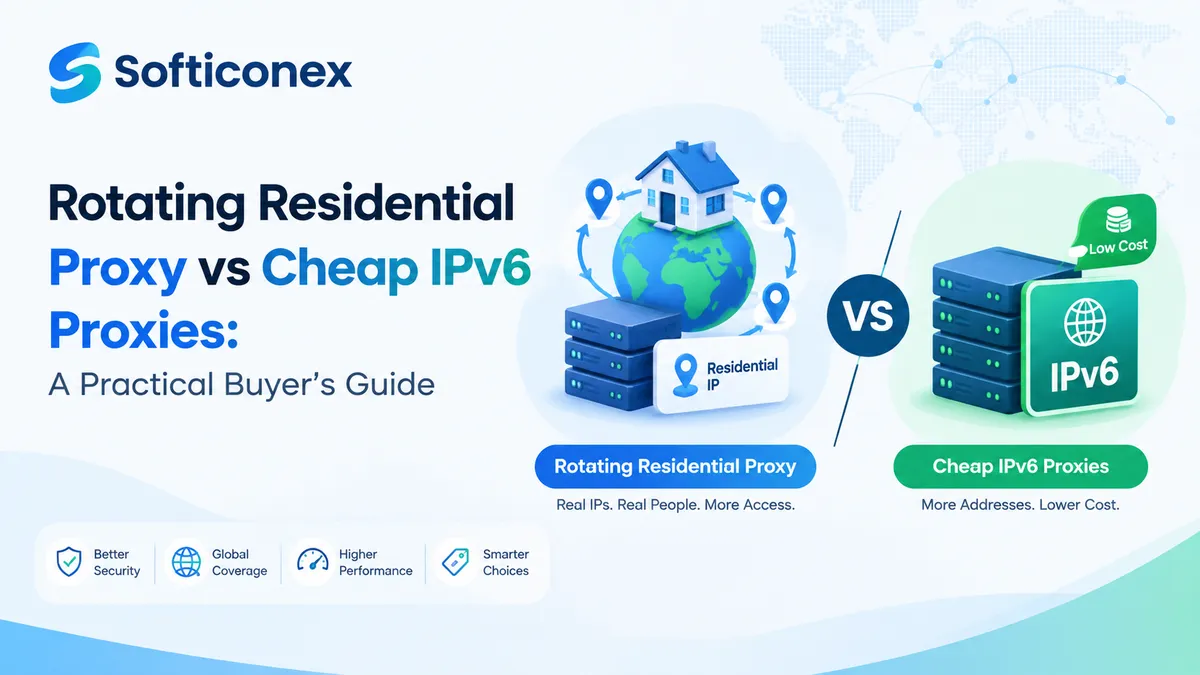
Businesses depend on proxies to collect public data, test how their websites appear in different regions, and protect their privacy online. Two options come up more than any others: a rotating residential proxy and cheap IPv6 proxies. They solve different problems, and picking the wrong one can mean wasted budget or blocked requests. This guide explains how each works, where each performs best, and how to choose.
What Is a Rotating Residential Proxy?
A rotating residential proxy routes your traffic through IP addresses that internet service providers have assigned to real households. Your IP changes automatically, either on every request or at intervals you set.
Because these addresses belong to ordinary home connections, websites tend to treat the traffic as coming from regular visitors. Rotation adds a second layer of protection. No single address makes enough requests to trigger rate limits or blocks.
Common Uses
- Large-scale public data collection: Gathering product, listing, or search data without tripping anti-bot filters
- Ad verification: Confirming that ads display correctly in different countries and on different devices
- Price monitoring: Tracking competitor pricing across regional markets
- Market research: Collecting location-specific insights
- SEO tracking: Checking search rankings as users in different cities would see them
What Are Cheap IPv6 Proxies?
IPv4 addresses are running out, which keeps their prices high. IPv6 uses a 128-bit format with an enormous address space, so providers can hand out large blocks of addresses at very low cost. That is why cheap IPv6 proxies have become popular for projects that need many unique IPs on a modest budget.
Main Advantages
- Low cost per IP: An abundant supply keeps pricing down
- Easy scaling: Thousands of addresses can run at the same time
- Strong speed: Performance is usually fast for supported destinations
- Good fit for high-volume technical work: Load testing, API testing, and automation
One caveat matters here. Not every website supports IPv6, and some platforms scrutinize IPv6 ranges more closely because they make up a smaller share of everyday consumer traffic. Test your target sites before committing.
Side-by-Side Comparison
| Feature | Rotating Residential Proxy | Cheap IPv6 Proxies | IPv4 Datacenter Proxy |
|---|---|---|---|
| IP source | Real ISP-assigned home addresses | IPv6 address blocks | Cloud and hosting providers |
| Detection risk | Low | Moderate | High |
| Cost | Higher | Low | Moderate |
| Speed | Moderate | Fast | Very fast |
| Site compatibility | Excellent | Limited to IPv6-ready sites | Good, but easily flagged |
| Pool size | Millions of IPs | Virtually unlimited | Limited by provider |
| Location targeting | Precise (country and city) | Basic | Moderate |
| Best for | Data collection, ad checks, geo-testing | Testing, automation, high-volume tasks | General, non-sensitive browsing |
How to Choose the Right Option
- Set your budget: If you need many IPs at the lowest price, cheap IPv6 proxies are the economical route.
- Judge how strict the target site is: Search engines, large marketplaces, and social platforms usually have advanced bot protection. A rotating residential proxy gives much better success rates there.
- Estimate your request volume: Repetitive, high-volume jobs that don’t need to look like organic traffic often run well on IPv6.
- Consider location needs: If you need city-level or country-level accuracy, residential IPs are the stronger choice.
- Check IPv6 support: Confirm your destination handles IPv6 traffic properly before you buy.
Which Proxy for Which Task?
| Task | Recommended option | Why |
|---|---|---|
| Retail price monitoring | Rotating residential proxy | Major retailers use strict bot defenses |
| SEO rank tracking | Rotating residential proxy | Results reflect real local searches |
| Ad verification | Rotating residential proxy | Accurate regional and device views |
| API and load testing | Cheap IPv6 proxies | Low-cost source of many unique addresses |
| High-volume automation | Cheap IPv6 proxies | Budget-friendly at scale |
The Hybrid Approach
Many teams use both. A rotating residential proxy handles the sensitive, detection-prone work where success rate matters most. Cheap IPv6 proxies handle the heavy, lower-risk workloads where cost matters most. Splitting tasks this way controls spending without sacrificing reliability.
Best Practices for Responsible Proxy Use
- Follow each website’s terms of service and robots.txt guidelines
- Space out requests so you don’t strain target servers
- Rotate user agents along with IPs to keep sessions consistent and natural
- Monitor proxy health and replace failing IPs quickly
- Use sticky sessions when a task needs the same identity across several requests
- Work with providers that source their IPs ethically, especially for residential networks
- Collect only data you are legally permitted to use
Frequently Asked Questions
Is a rotating residential proxy worth the higher price?
Yes, when your targets have strong anti-bot systems or you need precise location data. The higher success rate often offsets the cost.
Are cheap IPv6 proxies safe to use?
They are safe when they come from a reputable provider, but check that your destination supports IPv6 and confirm the provider’s sourcing and support policies first.
Can I use both proxy types together?
Yes. A hybrid setup is common, with residential IPs for sensitive tasks and IPv6 for high-volume, low-risk ones.
Which proxy is faster?
IPv6 and datacenter proxies are generally faster. Residential proxies trade some speed for a lower chance of being blocked.
Final Thoughts
A rotating residential proxy offers reliability, realism, and precise targeting. cheap IPv6 proxies offer scale and low cost. Match the proxy to the task, test on a small batch first, and combine both where it makes sense.