Run a fleet or a warehouse for long enough, and you learn that compliance rarely fails in one big dramatic moment. It fails quietly, in the gap between a medical card that lapsed on the 3rd and the audit that lands on the 5th. A driver’s CDL endorsement expires while he is out on a two-week run. A forklift operator’s three-year evaluation comes due, and nobody flags it until an OSHA inspector asks for the record. The federal crash statistics put the stakes plainly: in 2022, there were 5,936 people killed in traffic crashes involving large trucks, which is why regulators treat driver files and operator training as non-negotiable paperwork rather than nice-to-have admin.
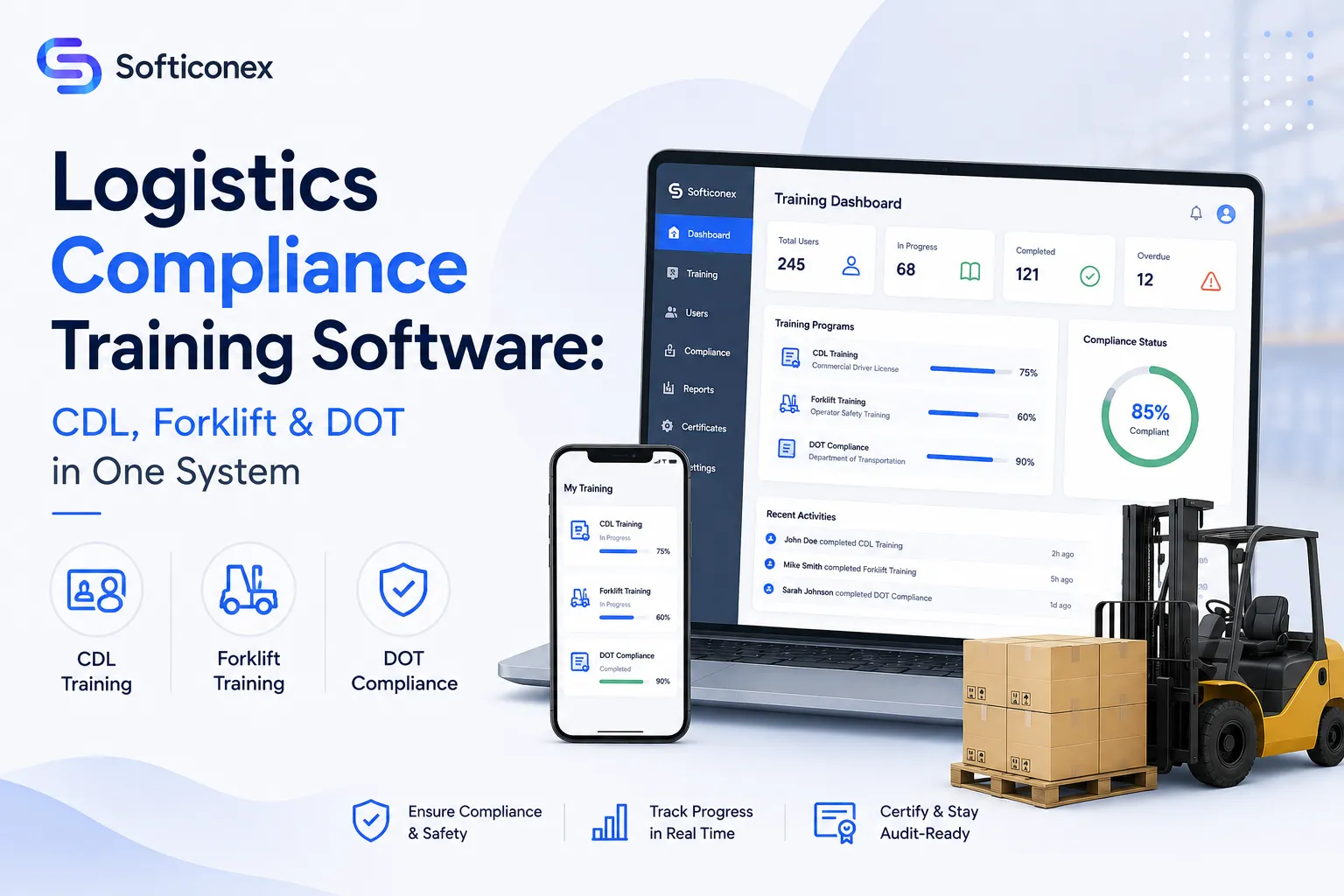
The problem for most logistics operations is that the tracking lives everywhere at once. Driver licenses sit in one spreadsheet, forklift certifications in a binder near the dock, safety training in whatever the LMS remembers, and DOT records in a filing cabinet that the safety manager guards with his life. Logistics compliance training software exists to pull all of that into a single place, so that CDL, forklift, and DOT certification tracking runs off one dashboard with renewal reminders that actually reach the person who needs them.
We compared the platforms that transportation and warehouse teams shortlist most, and we ranked them on how well each one handles the real job: tracking every credential type, validating licenses in real time, and firing renewal alerts before a lapse becomes a violation. Below are the seven that hold up.
How we compared these platforms
We looked at each tool through the eyes of a fleet safety or compliance manager who has to survive an audit, not a demo. Four things mattered most. First, breadth of credential tracking: does it cover driver licenses, forklift and other equipment certifications, safety training completions, and DOT records, or only one slice? Second, renewal automation: does it send tiered reminders (commonly at 90, 60, and 30 days) to the driver and the terminal manager, or does someone still watch a calendar? Third, how it handles frontline workers who never touch a company email. Fourth, the audit trail: how fast can you produce clean proof when someone officially asks? Ratings quoted below come from public review sites as noted; pricing reflects each vendor’s stated model. No vendor paid for its position.
| Platform | Best for | License & cert tracking | Renewal alerts | Pricing model |
|---|---|---|---|---|
| iTacit | Deskless crews with no company email | Licenses, certs, training, DOT records | Real-time mobile, 90/60/30-day | Custom per-user, quote-based |
| J.J. Keller Encompass | Carriers wanting deep DOT recordkeeping | DQ files, MVR, drug & alcohol, ELD | Automated expiration alerts | Quote-based, modular |
| Samsara | Telematics-led fleets | ELD, HOS, DVIR, driver coaching | In-app and dashboard alerts | Per-vehicle subscription |
| Motive | Mixed fleets wanting safety plus ELD | ELD, HOS, driver docs, coaching | Document expiration alerts | Per-vehicle subscription |
| Cloud Assess | Skills and competency assessment | Training, competencies, evidence | Reassessment reminders | Per-user, quote-based |
| Infinit-I Workforce Solutions | Trucking-specific safety training | Training, certifications, records | Assignment and due-date alerts | Quote-based, free trial |
| Coggno | Buying off-the-shelf OSHA courses | Course completions, certificates | Recertification reminders | Per-seat courses, plans quote-based |
1. iTacit
Picture the worker this software is actually for: a driver in a truck stop parking lot with four minutes before he rolls, or a forklift operator on a warehouse floor who has never had a company email address in his life. iTacit was built for that person first. It is an all-in-one frontline platform that folds communications, training, forms, and compliance tracking into a single mobile app, and workers sign in with verified credentials instead of a corporate login they do not have.
For logistics compliance specifically, the compliance module keeps a real-time dashboard of who is current and who is lapsing, with automated renewal reminders, role-based access, and a full audit trail behind it. Because the same app carries safety training, digital forms, and two-way messaging, a renewal alert is not a dead-end notification; the driver can complete the refresher, sign the acknowledgement, and clear the flag without waiting to reach a desktop.
- Certification and license tracking with real-time status and 90/60/30-day renewal reminders
- LMS supporting SCORM, video, PDF, and microlearning, with role-based learning paths
- Digital forms and workflows that replace clipboards and shared drives
- Audit trail plus RBAC for clean, exportable compliance proof
One transportation customer, Seaboard Transport, reported 100% safety training attendance and zero training-related incidents after moving onto the platform, a number that only means anything because the training reached drivers who are seldom at a desk. Rating: 4.6 on Capterra. Pricing: custom per-user monthly pricing, quote and demo based, with no public list price. Most teams go live in about two to four weeks using a train-the-trainer model.
Where it is not the obvious pick: iTacit is a broad frontline suite, not a single-purpose DOT driver-file tool. If all you want is a bare-bones driver qualification file cabinet with instant MVR pulls and nothing else, a dedicated point tool will feel lighter, and the quote-based pricing takes longer to evaluate than a published price list. It is also cloud-based, so a site with genuinely no connectivity has to sync once devices are back in coverage.
2. J.J. Keller Encompass
If a name has been synonymous with DOT paperwork for decades, this is it. J.J. Keller Encompass is the recordkeeping heavyweight, and carriers pick it precisely because compliance is the whole point rather than a feature bolted onto a GPS box. Driver qualification files, motor vehicle record monitoring, drug and alcohol program management, and electronic logs all live under one roof, with the regulatory content kept current by a company that essentially writes the reference manuals for the industry.
- Electronic driver qualification file management aligned to 49 CFR Part 391
- MVR monitoring and automated expiration alerts on licenses and med cards
- Drug and alcohol clearinghouse and program administration
- ELD and hours-of-service logging
Rating: It carries a small but generally positive public review sample, roughly four out of five across a handful of G2 reviews. Pricing is quote-based and modular, typically an ELD hardware cost plus a per-vehicle monthly service fee, so you assemble the pieces you need. The limitation is the scope of a different kind: Encompass is aimed at drivers and DOT records, so warehouse-side needs, like forklift operator certifications or general frontline communications, sit outside its lane, and the interface reflects its compliance-first heritage more than a modern consumer app.
3. Samsara
Samsara comes at compliance from the vehicle. It is a telematics platform first, so the ELD, hours-of-service, and driver-vehicle inspection reports are genuinely strong, and the safety camera and coaching workflows are what fleets tend to rave about. If your compliance risk is concentrated in how vehicles are driven and logged, this is a serious contender.
- ELD and automated hours-of-service compliance
- DVIR and maintenance tracking tied to the vehicle
- AI dashcam with driver coaching and safety scoring
- Document storage with in-app and dashboard expiration alerts
Rating: 4.5 on G2, backed by one of the largest review counts in the category. Pricing is a per-vehicle subscription billed on multi-year contracts, with hardware on top, quoted per fleet. Two honest caveats for this specific use case: the value is tied to hardware in every vehicle, which is overkill if your problem is warehouse certifications rather than trucks, and credential tracking for non-driving staff (a forklift crew, a dock team) is not really what it is designed to hold.
4. Motive
Formerly KeepTruckin, Motive lands in similar territory to Samsara but tends to appeal to fleets that want strong safety tooling without feeling locked into the priciest tier. The ELD and hours-of-service engine is solid, driver app adoption is good, and the safety coaching features have matured fast.
- ELD, hours-of-service, and IFTA support
- AI dashcam and driver safety scoring
- Driver document storage with expiration alerts
- Fuel and spend visibility alongside compliance
Rating: 4.5 on G2. Pricing follows the per-vehicle subscription model, hardware plus a software license on an annual contract, quoted per fleet. The trade-off mirrors the category: it is a vehicle-centric platform, so the moment your compliance question moves off the truck (forklift recertification, a safety course for warehouse hires, credentialing a worker with no email) you are outside its core. Contract length also catches some smaller fleets off guard, so read the term before you sign.
5. Cloud Assess
Cloud Assess is the odd one out here in a useful way. Rather than watching trucks, it watches skills. It is a training and competency-assessment platform aimed squarely at frontline and deskless workers, which makes it a strong fit for the “did this person actually demonstrate they can operate the equipment” side of compliance that a document tracker ignores.
- Skills and competency assessments with evidence capture
- Mobile-first delivery for deskless workers
- Training records, checklists, and reassessment reminders
- Digital sign-off and observation workflows
Rating: 4.7 on Capterra across roughly 96 reviews, which is a healthier sample than most compliance-specific tools carry. Pricing is per user with a free trial, and specific plans are quote-based. The gap for a logistics buyer: Cloud Assess is built around assessment and skills, not DOT recordkeeping, so it will not maintain a driver qualification file or manage a drug and alcohol program. Pair it with a compliance tool, or accept that the DOT-file side is not its job.
6. Infinit-I Workforce Solutions
Infinit-I earns its place by knowing exactly who it serves. This is a safety learning management system built for trucking, with a course library and workflows shaped around driver onboarding, recurring safety training, and the documentation a carrier needs when the FMCSA comes calling. For a training-first compliance program, the specialization shows.
- Trucking-specific safety training library
- Automated course assignment with due date and completion alerts
- Certification and training record tracking
- Reporting geared to DOT audit documentation
Rating: 4.0 on Capterra, though on a thin review count, so weigh it as directional rather than definitive. Pricing is quote-based with a free trial available. Its boundary is the flip side of its focus: Infinit-I is a training and records system, so it is not going to run your telematics, your ELD, or a warehouse forklift program. Buyers who want one platform for both driver training and equipment certifications across a mixed workforce will find it narrower than a full frontline suite.
7. Coggno
Coggno solves a different piece of the puzzle: getting the actual course content fast. It is an LMS and course marketplace with a large catalog of off-the-shelf compliance training, including OSHA forklift and powered-industrial-truck courses you can buy and assign today rather than build from scratch. When the bottleneck is content, not tracking, it earns a look.
- Marketplace of ready-made OSHA and safety courses
- Forklift, HAZMAT, and general safety training available per seat
- Course assignment, completion tracking, and certificates
- Recertification reminders for completed courses
Rating: 4.8 on Capterra, though on a small number of reviews. Pricing is flexible: individual courses start in the low single digits per seat, while team and enterprise LMS plans move to subscription or quote-based pricing. The limitation is that Coggno’s strength is the course catalog, not a unified compliance command center. It tracks the training it delivers well, but it will not hold your driver qualification files or validate a CDL against a licensing authority, so it tends to sit alongside a dedicated compliance system rather than replace one.
What logistics compliance training software actually tracks
The phrase covers more ground than it first appears, because “compliance” in a logistics operation spans two very different regulators and several credential types. Here is what a genuine one-system tool has to keep straight.
CDL and the driver qualification file: Every commercial driver needs a valid commercial driver’s license with the right class and endorsements, but the license is only the visible part. Federal rules require a driver qualification file for each driver, and the federal recordkeeping rule spells out what goes in it: the employment application, motor vehicle records from each licensing authority, the road-test certificate, the annual review of driving record, and the medical examiner’s certificate. Retention is strict. As the regulation states, “Each driver’s qualification file shall be retained for as long as a driver is employed by that motor carrier and for three years thereafter.” A compliance platform should store each of those documents, tie them to the driver, and know when a component is about to expire.
Forklift and powered-industrial-truck certification: On the warehouse side, OSHA’s powered industrial truck standard (29 CFR 1910.178) governs forklift operator training. It is not a one-and-done certificate. The standard requires periodic re-evaluation on a roughly three-year cycle, as stated in the rule this way: “An evaluation of each powered industrial truck operator’s performance shall be conducted at least once every three years.” Good software tracks the initial certification, the refresher triggers, and the evaluation date so an operator never quietly ages out of compliance.
DOT compliance records: Beyond the license, DOT compliance pulls in the medical examiner’s certificate (the med card), the drug and alcohol testing program, including clearinghouse queries, and hours-of-service logs. A platform earns the “DOT” label by storing proof of each of these, keeping the medical card renewal on a countdown, and producing the records on demand when an auditor asks.
Real-time license validation: Tracking an expiry date is table stakes. Real-time validation means the system checks a license or credential against its current status rather than trusting a date typed in months ago, so a suspension or a downgrade surfaces quickly instead of at the next annual review.
Automated renewal reminders: The feature that quietly prevents most violations is tiered reminders. The strong pattern is alerted at 90, 60, and 30 days before expiry, sent to both the credential holder and the manager responsible, escalating as the date closes in. For a deskless workforce, the delivery channel matters as much as the timing: a reminder buried in an email inbox nobody checks is not a reminder, which is why mobile-first alerts to the worker’s phone tend to close the loop.
How to choose the right platform for your fleet?
Start with where your risk actually concentrates, because that decides the category more than any feature checklist. If your exposure is on the road (hours-of-service, ELD accuracy, driving behavior) a telematics-led platform earns its hardware cost. If your exposure is in the paperwork (driver qualification files, med cards, drug and alcohol records) a DOT recordkeeping specialist will go deeper than a generalist. If your exposure is in training and demonstrated competency, a frontline LMS or an assessment tool is a better spend.
Then ask the question most buyers skip until it bites them: Can the people who need these credentials actually receive the reminders? In trucking and warehousing, a large share of the workforce has no company email and no desk, so a system that assumes both will leave the highest-risk workers uncovered, no matter how good the dashboard looks. If you are a fleet safety or compliance manager shopping for logistics compliance training software that reaches drivers and forklift crews on their phones and keeps CDL, forklift, and DOT records in one auditable place, iTacit was built for exactly that deskless, email-free workforce. Weigh it against the point tools on the axis that matters to you, then confirm the renewal alerts, the audit export, and the real-time validation all work the way your next audit will demand.
Finally, pressure-test the audit trail before you buy. Ask each vendor to show you how fast it produces a clean, timestamped record for a single driver or operator, because that two-minute demo tells you more about your next inspection than any feature list.
Frequently asked questions
Can one platform really track driver licenses, forklift certifications, safety training and DOT records together?
Yes, though the breadth varies a lot by vendor. Broad frontline and compliance suites are designed to hold all four credential types with one dashboard and one set of renewal rules. Point tools (a telematics ELD platform, a driver-file specialist, a course marketplace) each cover a slice deeply and leave the rest to another system. Map your credential types first, then match the tool to the full list rather than the loudest feature.
Which platforms send automatic reminders for license and certification renewals?
Most compliance-focused tools do, but the timing and the delivery channel differ. Look for tiered alerts at 90, 60 and 30 days rather than a single warning, and confirm the reminders reach the worker directly, not just an administrator. For deskless drivers and forklift operators, mobile delivery to the person’s phone is what actually prevents a lapse.
What is a driver qualification file, and how long do I keep it?
It is the federally required file of documents proving a commercial driver is qualified: the application, motor vehicle records, road-test certificate, annual review, and medical examiner’s certificate. Under federal rules, the file must be retained for as long as the driver is employed, plus three years after they leave, with some component records removable three years after their date.
How often does a forklift operator need to be recertified?
OSHA’s powered industrial truck standard requires each operator’s performance to be evaluated at least once every three years, plus refresher training whenever there is an incident, a near miss, a new truck type, or observed unsafe operation. A tracking system should watch both the three-year clock and those event triggers.
What does real-time license validation add over a simple expiry date?
An expiry date only tells you when a credential is scheduled to end. Real-time validation checks the credential’s current standing, so a suspension, downgrade, or revocation that happens mid-term shows up promptly instead of surviving until the next manual review. For CDLs, where a status can change between annual checks, that difference is meaningful.
Do these tools keep up with changing DOT regulations?
The compliance-first vendors invest heavily in keeping their content and rules current, since that is their core promise, and they tend to update med-card, drug and alcohol, and hours-of-service logic as the rules move. General LMS or telematics tools update their own domain well but may lag on pure regulatory recordkeeping, so if staying current with DOT rules is a top priority, weigh it heavily in your shortlist.
The bottom line
There is no single winner for every logistics operation, because the right tool depends on whether your compliance risk sits on the road, in the filing cabinet, or on the training floor. A telematics platform like Samsara or Motive is the answer for road-centric risk. A recordkeeping specialist like J.J. Keller Encompass goes deepest on DOT paperwork. A training-first tool like Infinit-I Workforce Solutions or Coggno solves the course-and-certification side. What ties an operation together is a system that reaches the whole workforce, including the drivers and operators who never open a company email, and keeps every credential type current in one auditable place. Start from where your next audit is most likely to catch you, and choose accordingly.
“Content published by Softiconex helping businesses grow through SEO, web design, and digital marketing.”