Overview
On August 18, 2026, Google began rolling out the August 2026 Spam Update, its third confirmed spam-focused algorithm action of the year. According to Google’s Search Status Dashboard, the rollout began at approximately 9:27 a.m. Pacific Time and was logged as an incident affecting ranking. Google published the corresponding release note a minute later and confirmed on its Search Central social channels that the update had gone live.
The update is global in scope and applies to all languages, consistent with how Google has framed every general spam update in recent years. Google has said the rollout could take a few days to complete fully, meaning the ranking movement tied to this update may continue to settle through the rest of the week.
Notably, Google did not publish an accompanying blog post or announce any new spam policy categories alongside this rollout. That means the same spam policies that have governed previous updates covering things like cloaking, scaled content abuse, expired domain abuse, and site reputation abuse remain the operative rules for this cycle. Google also has not confirmed whether this update specifically targets manipulation of AI-generated search features (AI Overviews and AI Mode), a category of abuse formally folded into its spam policies in a May 15, 2026 policy clarification.
This is different in nature from a broad Google core update, which recalibrates ranking systems across the board rather than targeting specific policy violations; see our full guide to Google core updates for how the two update types compare.
What the Update Targets and What It Doesn’t
Based on Google’s own framing of general spam updates, the August 2026 update is understood to:
Likely in scope:
- Scaled, low-value content designed to game rankings rather than serve users
- Cloaking and deceptive redirects
- Keyword stuffing and other over-optimization signals
- Abuse of expired or auction-bought domains to inherit ranking authority
- Automated or mass-produced content that fails to provide genuine value
Explicitly out of scope (per Google’s standard spam-update disclaimers):
- Link spam (covered by separate, dedicated link spam updates)
- Site reputation abuse (“parasite SEO”), which Google also treats as a separate enforcement track
- Other narrowly defined policy areas Google addresses through standalone actions
This is an important distinction for site owners: a ranking drop during this window does not automatically mean a site was penalized for buying links or hosting third-party content abuse those issues fall under different Google systems. If you suspect a link-based issue rather than a content-spam issue, see our guide to diagnosing link spam penalties instead.
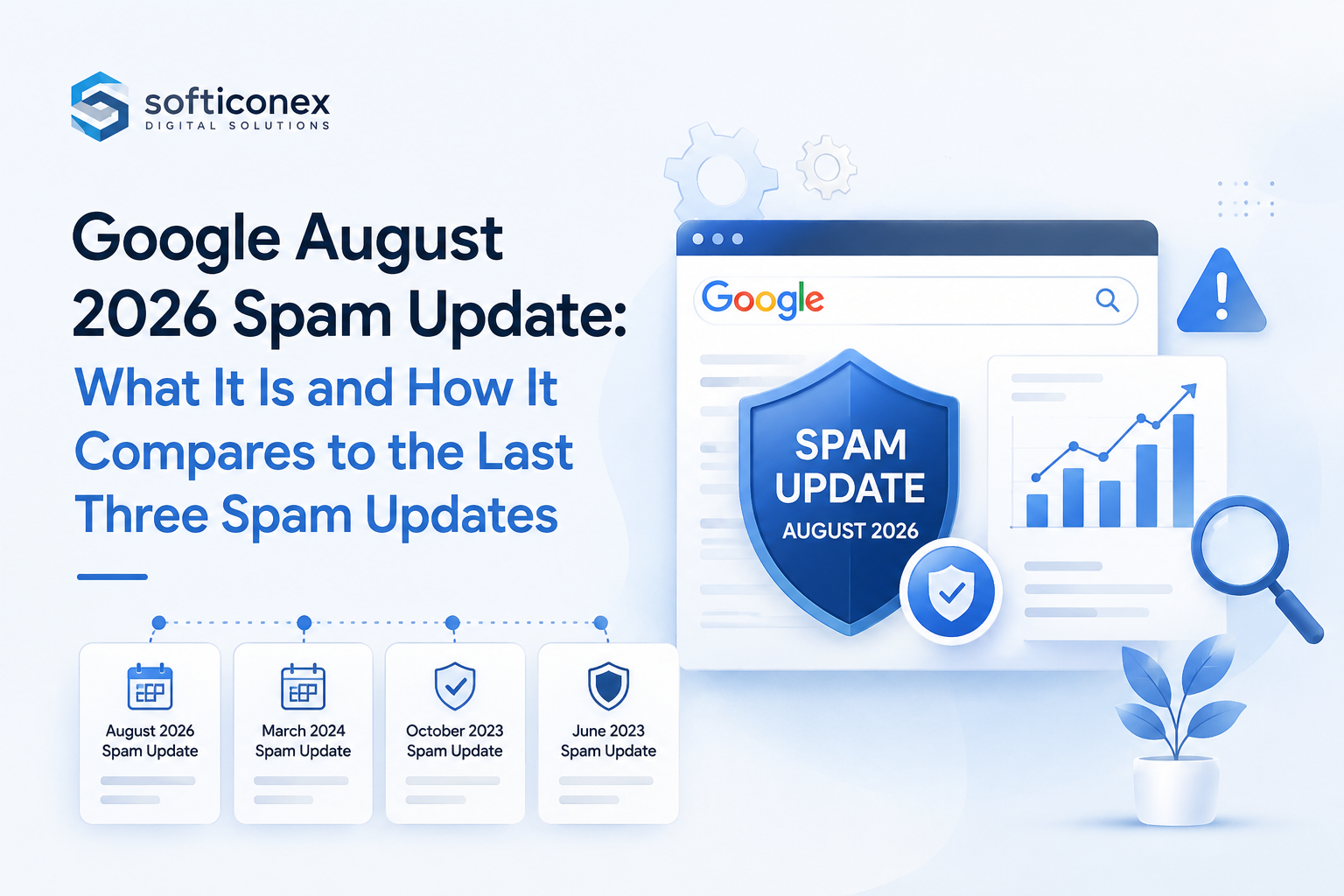
How August 2026 Compares to the Last Three Spam Updates
Google has significantly increased the cadence of spam updates since late 2023, moving from rare, occasional actions to a recurring “rhythm” of two to three per year. Here is how the August 2026 update stacks up against the three spam updates that preceded it. For a deeper look at any individual rollout, see our dedicated write-ups on the June 2026 spam update, the March 2026 spam update, and the August 2025 spam update.
| Update | Rollout Dates | Duration | Key Characteristics |
| August 2025 Spam Update | Aug 26 – Sep 22, 2025 | ~27 days (longest recent rollout) | Rolled out in waves; long duration made it hard for site owners to isolate cause and effect; no new policies announced |
| March 2026 Spam Update | Mar 24 – Mar 25, 2026 | ~19.5 hours (fastest confirmed rollout on record) | Extremely fast, single-day rollout; described as “muted” in immediate impact but seen as a signal of larger changes to come; preceded the March 2026 core update by two days |
| June 2026 Spam Update | Jun 24 – Jun 26, 2026 | ~2 days | Followed Google’s May 15, 2026 clarification extending spam policies to cover manipulation of AI Overviews and AI Mode; explicitly did not target link spam or site reputation abuse |
| August 2026 Spam Update | Aug 18, 2026 (ongoing) | Expected: a few days | Third spam update of 2026; no new policies announced; unclear yet whether it builds on the AI Overview/AI Mode manipulation language introduced in May |
Key Trends Across the Four Updates
- Rollout speed varies wildly and doesn’t predict severity: The August 2025 update took nearly a month, while March 2026 finished in under a day. A short rollout is not necessarily a “light” update SpamBrain, Google’s AI-driven spam detection system, can identify and demote violating content almost immediately once retrained, while longer rollouts often reflect staged deployment across data centers and regions rather than a gentler impact.
- 2026 has accelerated the pace of spam enforcement: After only one spam update in 2025 (August), Google has now run three in 2026 alone (March, June, August) on top of two core updates and a Discover-specific core update. This reflects a broader pattern of more frequent, narrower interventions rather than infrequent, sweeping ones.
- Scope is narrowing over time, even as frequency increases: Both the June and August 2026 updates explicitly exclude link spam and site reputation abuse, which Google now appears to handle through separate, dedicated systems rather than folding them into general spam updates.
- AI-generated search surfaces are an emerging enforcement frontier: The May 2026 policy clarification stating that manipulating AI Overviews and AI Mode counts as a spam violation sets the stage for future spam updates to explicitly target this behavior, even though Google has not confirmed this for either the June or August 2026 rollouts.
- No new named policies in three of the last four updates: Only the August 2025 update carried meaningfully new enforcement framing; March, June, and August 2026 have all been framed as standard SpamBrain refreshes against Google’s existing rulebook.
What Site Owners Should Do
- Don’t overreact to single-day data: Google itself has cautioned that one day’s Search Console numbers may not reflect the full picture while a rollout is in progress.
- Audit against existing policies now: Because no new policy categories were announced, the relevant checklist is unchanged: avoid thin or auto-generated content, ensure content matches user intent, and confirm there’s no cloaking or deceptive redirection happening on the site. Our spam policy compliance checklist walks through each of these.
- Separate spam issues from link or reputation issues: If a site was hit by August 2026 but its issue is guest-post link schemes or hosting third-party sponsored content that isn’t editorially controlled, this update is not the relevant lens that are handled separately. See how link spam updates work.
- Expect a slow recovery timeline if affected: Historically, recovery from a confirmed spam action has taken Google many months to reflect once a site brings itself into compliance, since SpamBrain needs to relearn a site’s trustworthiness over time. Read our guide to recovering from a Google spam penalty for a step-by-step approach.
- Watch for AI Overview/AI Mode-related guidance: Given the May 2026 policy expansion, sites that rely heavily on tactics to influence AI-generated answers should review those practices even though this update hasn’t been confirmed to target them directly. See our breakdown of Google’s AI Overview spam policy.
Conclusion
The August 2026 spam update fits squarely into the pattern Google has settled into over the past year: frequent, narrowly scoped SpamBrain refreshes rather than sweeping policy overhauls. Like June and March 2026 before it, this rollout introduces no new spam policies, explicitly excludes link spam and site reputation abuse, and applies globally across all languages. What has changed is the pace of three spam updates in 2026 alone, compared to just one in all of 2025 signaling that Google is leaning on smaller, more frequent enforcement actions to keep spam detection current, especially as AI-generated content and AI-powered search surfaces create new avenues for manipulation.
For site owners, the practical takeaway hasn’t shifted much from update to update: there’s no new checklist to memorize, just the existing spam policies to keep honoring. Sites built around genuine user value have historically weathered these updates with little disruption, while those relying on thin content, cloaking, or manipulative shortcuts continue to be the ones affected. As Google’s May 2026 clarification on AI Overview and AI Mode manipulation suggests, the next frontier of spam enforcement is already taking shape and it’s worth watching whether future updates, possibly even this one as it finishes rolling out, begin to explicitly reflect that shift.
Frequently Asked Questions (FAQs)
1. When did the August 2026 spam update start?
Google began rolling it out on August 18, 2026, at approximately 9:27 a.m. Pacific Time, as logged on the Search Status Dashboard.
2. How long will the August 2026 spam update take to fully roll out?
Google has said the rollout may take a few days to complete, consistent with most of its recent general spam updates.
3. Is this a global update, or does it target specific countries?
It is a global update that applies to all languages and regions, not a region- or language-specific rollout.
4. Did Google announce any new spam policies with this update?
No. Unlike some past updates (such as March 2024), Google has not introduced new spam policy categories alongside the August 2026 rollout, meaning existing spam policies remain the standard to check compliance against.
5. Does this update target link spam or site reputation abuse?
No. Google’s standard disclaimer for general spam updates repeated for this rollout excludes link spam and site reputation abuse, which are addressed through separate, dedicated enforcement actions.
6. How is this different from a Google core update?
Core updates recalibrate how Google evaluates content quality broadly across the entire ranking system and aren’t tied to policy violations. Spam updates are narrower: they specifically target sites and pages that violate defined spam policies, functioning more like a targeted cleanup than a full ranking recalibration. See our core update vs. spam update comparison for more detail.
7. Is this the same as the June 2026 spam update?
No, it’s a separate, distinct rollout. The June 2026 spam update ran from June 24,26, 2026, and this August update is a new action roughly two months later Google’s third spam-related rollout of 2026.
8. Does the August 2026 update target AI Overviews or AI Mode manipulation?
Google hasn’t confirmed this. The company clarified on May 15, 2026 that manipulating AI-generated search responses counts as a spam violation, but it has not stated whether this specific update was built to enforce that particular guidance.
9. My rankings dropped around August 1–6, 2026 was that this update?
Not necessarily. Google’s Search Status Dashboard logged no ranking incidents between August 1 and August 6, so any volatility during that window predates the confirmed August 18 spam update and may stem from unrelated ranking fluctuations, a quiet algorithmic refresh, or overlapping factors that haven’t been officially attributed.
10. How can I tell if my site was hit by this update, and what should I do if it was?
Compare your Search Console performance data from on and after August 18, 2026, against the weeks prior, focusing on organic clicks and impressions. If you see a clear, sustained decline aligned with the rollout window, review your site against Google’s spam policies particularly around thin or auto-generated content, cloaking, and deceptive practices and make corrections. Recovery is typically gradual and tied to Google reassessing the site over subsequent months, not an immediate bounce-back. For a structured approach, see our Google spam update recovery playbook.
This article reflects publicly available information as of August 19, 2026. Because the rollout was still in progress at the time of writing, some details including final scope and duration may be updated by Google as the update completes.