Every website you visit, every app you use on your phone or computer, and every online service you sign up for was built by developers. Some developers build only what you see on the screen. Others work only on the parts that run behind the scenes. But a full stack web developer does both and that is exactly why they are in such high demand right now.
This guide explains full stack web development in simple, clear language. You will learn what it means, how it works, what skills are involved, which technologies matter, and why businesses everywhere are looking for full stack developers. Whether you are someone looking to hire a developer or someone who wants to become one, this article gives you everything you need to know.
What Is Full Stack Web Development?
Full stack web development means building and managing all parts of a web application from the visual interface that users interact with, to the logic running on the server, to the database storing all the information.
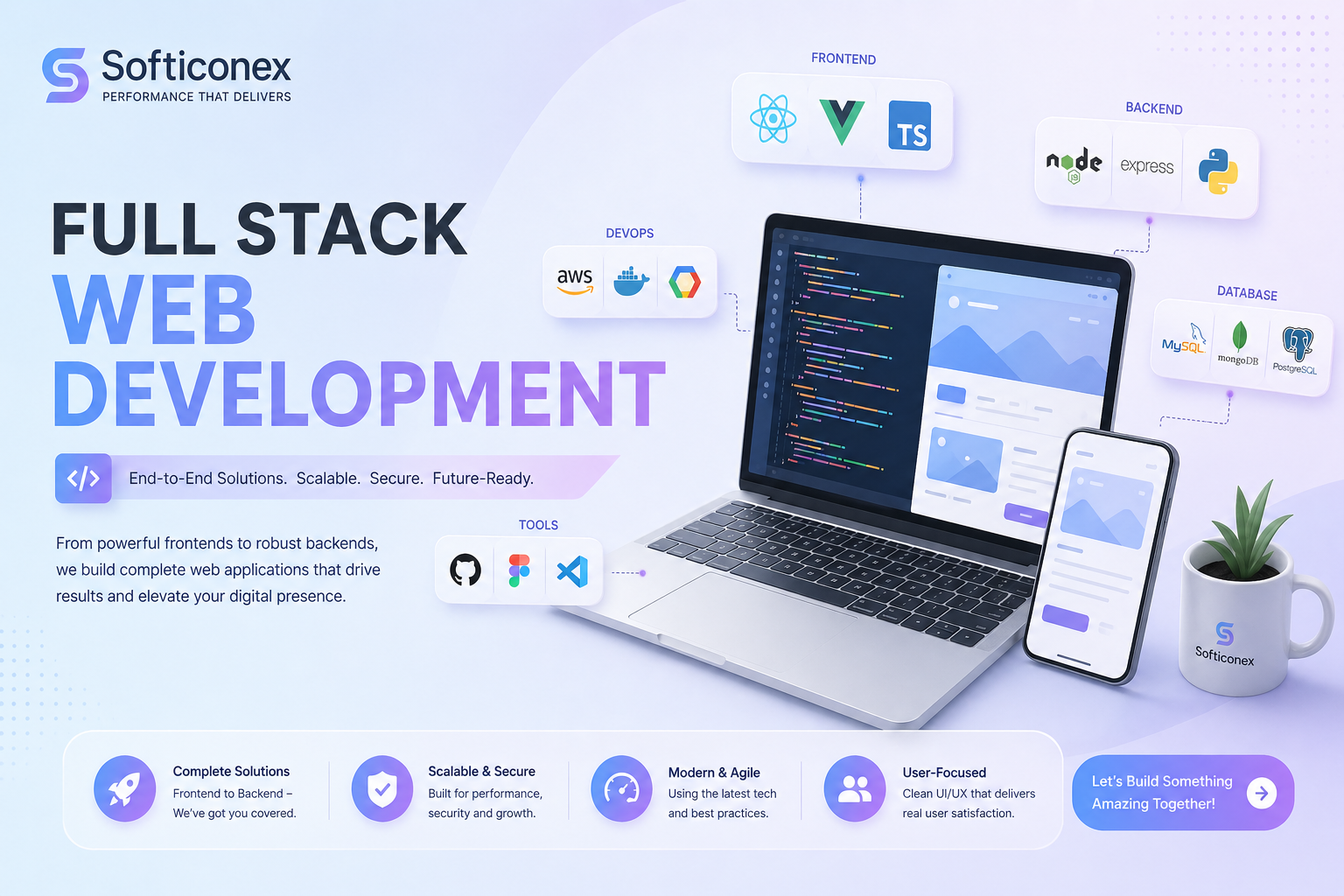
The word “stack” refers to the collection of technologies used to build a web application. It includes three main layers:
• The Frontend the part users see and interact with directly.
• The Backend is the part that processes requests, applies logic, and communicates with the database.
• The Database is the storage system that holds all the data the application needs.
They can design a login screen, write the code that verifies the password, and manage the database where user accounts are stored all as part of one complete project.
This is very different from a frontend developer, who only builds the visual parts, or a backend developer, who only manages the server-side logic. Full stack developers understand the entire picture, and that makes them incredibly valuable.
The Three Layers of Full Stack Web Development
Layer 1: The Frontend
The frontend is everything a user experiences directly: the layout, the buttons, the colors, the forms, the animations, and the overall design. When a page loads in your browser, that is the frontend doing its job.
HTML gives the page its structure. CSS controls how everything looks, the fonts, spacing, colors, and layout. JavaScript makes the page interactive, so buttons respond, forms validate, and content updates without refreshing the page.
Modern frontend development also uses frameworks and libraries. It helps developers build fast, reusable components. Other widely used options include Vue, which is great for smaller projects, and Angular, which is built by Google and used heavily in enterprise applications.
Layer 2: The Backend
It runs on a server and handles all the logic that users never see directly. When you submit a contact form, the backend receives the data, checks it, processes it, and sends you a confirmation. When you log in, the backend checks your username and password and decides whether to let you in.
Backend developers write this logic using server-side programming languages. Node.js is popular because it uses JavaScript, the same language used on the frontend making it easy for full stack developers to work across both sides. Python with Django or Flask is another strong choice, especially for data-heavy applications. PHP has been used for decades and still powers a large portion of the web, including WordPress. Java with Spring Boot is common in large enterprise environments.
The backend also handles APIs Application Programming Interfaces. An API is the bridge that allows the frontend and the backend to talk to each other, and also allows different systems to share data.
Layer 3: The Database
Every web application needs to store data somewhere. User accounts, product listings, blog posts, orders, messages all of it lives in a database. The backend reads from and writes to the database as needed.
There are two main types of databases. Relational databases like MySQL and PostgreSQL store data in organized tables with rows and columns, similar to a spreadsheet. They are great for structured data with clear relationships. Non-relational databases like MongoDB store data in a more flexible format, which works well for applications with frequently changing data structures. Full stack developers need to understand how to design databases, write queries to retrieve data efficiently, and keep the data secure.
The Most Popular Full Stack Technology Combinations
In real projects, developers group technologies together into what is called a “tech stack.” Here are the most commonly used full stack combinations in 2026:
MERN Stack
This is currently one of the most popular stacks in the industry. It uses JavaScript on both the frontend and backend, which means developers only need to master one programming language. It is fast, flexible, and well-supported by a large developer community.
MEAN Stack
Angular is a more structured framework and is often preferred by teams building large, complex web applications.
LAMP Stack
This is one of the oldest and most stable stacks in web development. It powers a huge number of websites worldwide and is still widely used for content-heavy websites and legacy systems.
Django + React (Python Stack)
For developers who prefer Python, Django as the backend combined with React on the frontend is a very popular choice. Python is known for its readability and is especially strong for applications that involve data analysis, machine learning, or AI features.
Key Skills Every Full Stack Web Developer Needs
Full stack development covers a wide range of skills. Here is what a well-rounded full stack developer should know:
• HTML, CSS, and JavaScript: These are non-negotiable. They are the foundation of all frontend development.
• A frontend framework: React, Vue.js, or Angular. React is the most in-demand option right now.
• A backend language and framework: Node.js with Express, Python with Django, or PHP with Laravel.
• Database management: SQL for relational databases (MySQL, PostgreSQL) and NoSQL for flexible databases (MongoDB).
• API development: Building and consuming RESTful APIs and, increasingly, GraphQL APIs.
• Version control with Git: Every professional developer uses Git to track changes and collaborate with teams.
• Deployment and cloud basics: Understanding how to deploy an application to platforms like AWS, Google Cloud, or Vercel.
• Basic security knowledge: Protecting user data, handling authentication properly, and preventing common vulnerabilities.
You do not need to be an expert in all of these from day one. Real full stack development experience is built over time, project by project. Every project teaches you something new about how the frontend, backend, and database need to work together.
Why Full Stack Web Development Is So Valuable for Businesses
Hiring a full stack developer or working with a full stack development team offers clear advantages for businesses of all sizes.
One Developer, Full Coverage
A full stack developer can handle both sides of a project without waiting on another team. This speeds up development significantly, especially for startups and small businesses that need to move fast.
Lower Costs
Hiring one full stack developer is more cost-effective than hiring a separate frontend developer and a separate backend developer. For businesses with tight budgets, this matters a great deal.
Better Communication
When one developer or one team understands the entire application, there are fewer miscommunications. Problems are spotted faster because the developer can see how a frontend issue is caused by a backend bug, or how a database design is affecting page speed.
Faster Problem Solving
Full stack developers can trace problems from the browser all the way down to the database. They do not need to hand off issues between teams. They fix the problem at the source, which saves hours and sometimes days of back-and-forth.
Flexibility in Fast-Changing Environments
Modern businesses change their requirements often. A full stack developer can adapt quickly redesigning a page, updating an API, or modifying a database schema without involving multiple specialists every time a small change is needed.
Full Stack Web Development Trends to Know in 2025
The field of full stack web development evolves quickly. Here are the most important trends shaping the industry right now:
AI-Assisted Development: Tools like GitHub Copilot are changing how developers write code. They do not replace developers, but they do help write repetitive code faster and catch basic errors. Full stack developers who know how to use AI tools effectively are more productive than those who do not.
Serverless Architecture: Instead of managing physical servers, many applications now run on serverless platforms like AWS Lambda or Vercel Edge Functions. The server logic runs automatically in response to requests, which reduces costs and makes scaling much easier.
TypeScript Over Plain JavaScript: TypeScript adds strict data types to JavaScript, which catches errors before the code even runs. Most large projects now use TypeScript on both the frontend and backend. It is quickly becoming the standard, not an option.
Progressive Web Apps (PWAs): PWAs are web applications that behave like native mobile apps. They work offline, send push notifications, and can be installed on a home screen. Full stack developers increasingly need to understand PWA architecture.
Security First: Cybersecurity is no longer optional. Every full stack developer today needs to understand how to protect user data, implement proper authentication and authorization, and defend against common attacks like SQL injection and cross-site scripting.
What Real Full Stack Development Experience Teaches You
There are things you learn from building real projects that no tutorial will teach you. Here are honest, experience-based insights that most articles leave out:
First, the database design you choose at the beginning will affect everything else. A poorly designed database creates performance problems that are very hard to fix later. Spend real time on database planning before writing a single line of application code.
Second, APIs break more than you expect. When the frontend and backend communicate through APIs, small changes on one side often break something on the other side. Good documentation and disciplined versioning save a lot of trouble.
Third, security mistakes are easy to make and expensive to fix. The most common security issues — exposed API keys, unsecured endpoints, and missing input validation happen because developers rush. Building secure habits from the start is much easier than patching vulnerabilities after launch.
Fourth, performance optimization is a real skill. Writing code that works is one thing. Writing code that works fast under real traffic is another. Learning how to optimize database queries, use caching, and reduce page load times separates average developers from great ones.
Conclusion
Full stack web development is the practice of building complete web applications from start to finish. It covers the frontend that users interact with, the backend that processes all the logic, and the database that stores the data. Full stack developers are some of the most versatile and valuable professionals in the technology world today.
Whether you are a business looking to build a web application, a professional thinking about switching careers, or someone simply curious about how the web works, understanding full stack development gives you a clear advantage. The tools are better than ever. The resources to learn are more accessible than they have ever been. And the demand for skilled full stack developers continues to grow year after year.The web is not slowing down. Neither is the need for the people who build it.
FAQs:
What is the difference between full stack, frontend, and backend development?
Frontend development focuses only on what users see the visual design, layout, and interactivity of a website. Backend development focuses only on the server side the logic, data processing, and database management. Full stack web development covers both. A full stack developer can design a user interface, write the server logic, and manage the database all on their own.
How long does it take to learn full stack web development?
It depends on your starting point. If you are completely new to programming, a dedicated bootcamp or self-study program typically takes 6 to 12 months to reach a job-ready level. If you already have frontend or backend experience, you can add the missing side in 3 to 6 months. The key is consistent practice and building real projects. Reading about development is not the same as actually building things.
Which programming language should I learn first for full stack development?
JavaScript is the best starting point for most people. It is the only programming language that runs natively in the browser, which means you can use it for frontend development from day one. With Node.js, you can also use JavaScript on the backend. This lets you focus on learning one language deeply before introducing others. Once you are comfortable with JavaScript, you can add TypeScript, Python, or other languages based on the kind of projects you want to build.
How much does it cost to hire a full stack web developer?
The cost varies widely depending on experience, location, and project complexity. A freelance full stack developer in the United States typically charges between $75 and $150 per hour. Senior developers at established agencies may cost more. In regions like South Asia or Eastern Europe, rates are often lower while maintaining good quality. For a complete web application, a simple project might cost $5,000 to $20,000, while a complex platform with custom features, integrations, and a content management system can cost $50,000 or more.
Is full stack web development still a good career in 2025?
Absolutely. Full stack web development remains one of the strongest career paths in the technology industry. Demand for full stack developers continues to grow because businesses want versatile professionals who can move between frontend and backend work without needing separate specialists for every task. Entry-level salaries in the United States start around $70,000 per year, and experienced senior full stack developers regularly earn over $130,000. Remote work opportunities are abundant, and the skills transfer well across industries from healthcare and finance to e-commerce and entertainment.