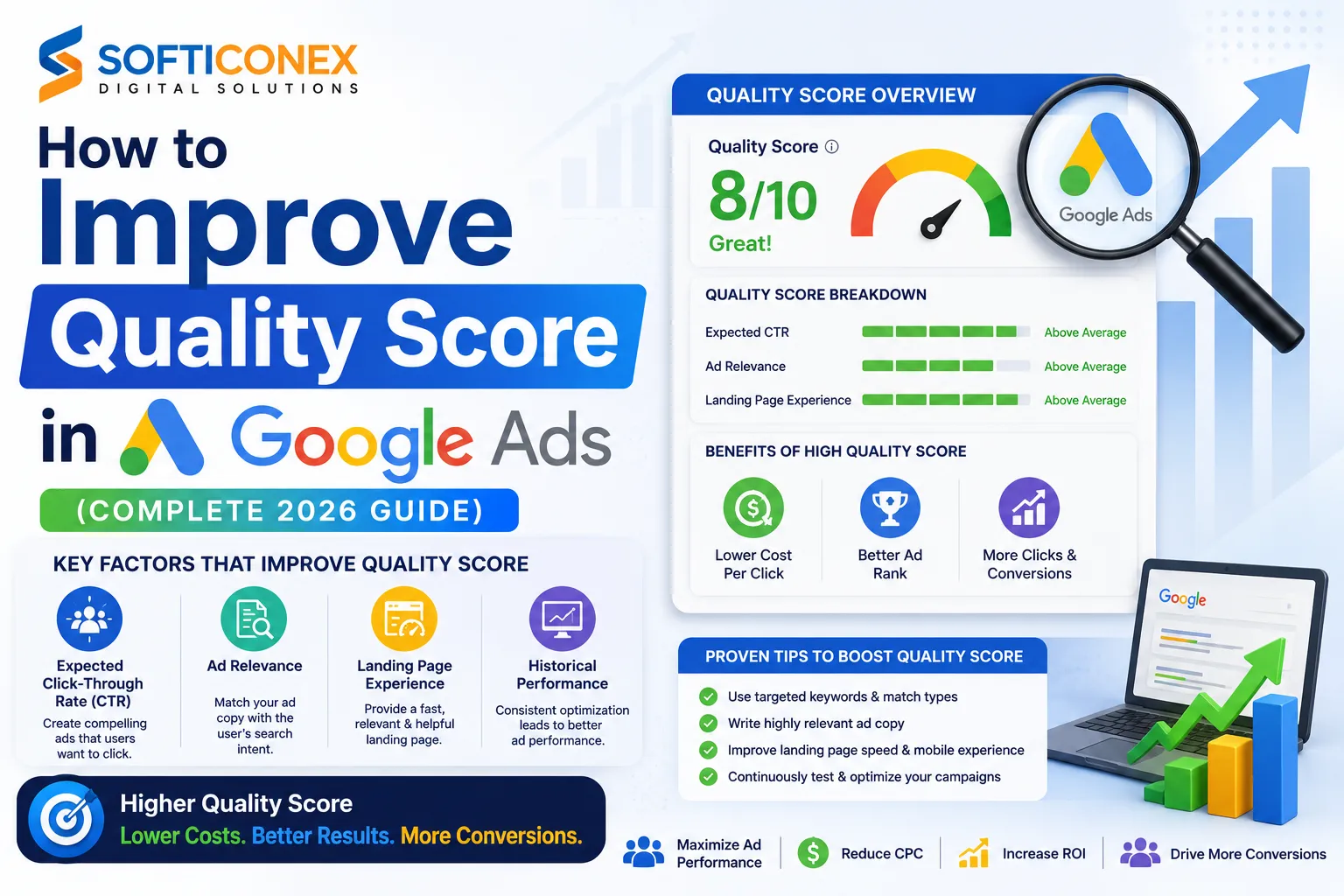
If you want to know how to improve Quality Score in Google Ads, the short answer is that you need to strengthen three things together: expected click through rate, ad relevance, and landing page experience. Quality Score is Google’s way of measuring how useful and relevant your ad, keyword, and landing page are to the person searching.
A higher Quality Score generally leads to a lower cost per click and better ad positions, while a low score can quietly drain your budget even when your campaigns look fine on the surface. This matters just as much for a small local business testing its first campaign as it does for a large agency managing dozens of accounts.
Modern AI PPC tools now play a growing role in this process, helping advertisers spot weak keywords, generate ad copy variations, and flag wasted spend faster than manual review alone. This guide walks through exactly how Quality Score works, ten proven ways to improve it, and how to use AI tools responsibly to support that work rather than replace good strategy.
Quick Tip: Quality Score is a diagnostic signal, not a goal to chase directly. Improve the three factors behind it and the score follows naturally.
What Is Google Ads Quality Score?
Google Ads Quality Score is a diagnostic metric, scored from 1 to 10, that estimates the quality and relevance of your keywords, ads, and landing pages compared to other advertisers. Google uses this score to help decide ad rank and actual cost per click, alongside your bid and the expected impact of ad extensions and formats.
The score is not fixed. It updates continuously based on real auction data, so it can shift as your CTR, ad copy, and landing page experience change over time. A score of 7 or higher is generally considered solid, while anything at 5 or below usually signals a specific, fixable problem in one of the three core components.
Why Quality Score Matters
Quality Score is not just a vanity number inside your dashboard. It has a direct, measurable impact on campaign performance.
• Lower CPC: Advertisers with stronger Quality Scores often pay less for the same ad position.
• Higher Ad Rank: A better score can help your ad outrank competitors even with a similar or lower bid.
• Better ROI: Lower costs combined with more relevant traffic typically improve overall return on ad spend.
• Higher Impression Share: Relevant, well optimized ads are more likely to show for valuable search queries.
• Improved Conversion Rate: A strong landing page experience, which feeds Quality Score, also tends to convert visitors more effectively.
How Google Calculates Quality Score
Quality Score is built from three core components, each rated as below average, average, or above average.
Expected Click Through Rate
This component estimates how likely people are to click your ad when it appears for a given keyword, independent of position. It considers the historical performance of your keyword and ad combination in similar auctions.
Ad Relevance
This measures how closely your ad copy matches the intent behind the keyword it is triggered by. Tightly themed ad groups, where every keyword closely relates to the ad text, tend to score better on this factor.
Landing Page Experience
This evaluates whether your landing page is relevant, transparent, and easy to use once someone clicks through. Google looks at factors like page relevance, clear navigation, mobile usability, and load speed, which connects directly to Core Web Vitals and PageSpeed Insights data.
10 Proven Ways to Improve Quality Score
Based on industry best practices and common patterns seen across Google Ads audits, these ten actions consistently move Quality Score in the right direction.
1. Improve keyword targeting by grouping closely related terms and removing broad, unrelated keywords from each ad group.
2. Write a compelling ad copy that speaks directly to the searcher’s intent and includes the keyword naturally in the headline.
3. Increase CTR by testing multiple headlines and descriptions, then keeping the combinations that consistently perform best.
4. Improve landing page speed by compressing images, minifying code, and reducing unnecessary scripts that slow down load time.
5. Match user intent by aligning each keyword, ad, and landing page around the same specific search need.
6. Optimize the mobile experience, since a large share of search traffic now comes from mobile devices.
7. Use negative keywords to filter out irrelevant traffic that hurts both CTR and conversion rate.
8. Improve ad relevance by keeping ad groups tightly themed instead of mixing unrelated products or services.
9. Organize ad groups clearly so each one targets a single, specific theme rather than a broad mix of keywords.
10. Continuously test ads, since Quality Score responds to ongoing performance data rather than a single setup.
How AI PPC Tools Help Improve Quality Score
AI PPC tools have become a practical layer on top of manual strategy rather than a replacement for it. Used well, they help advertisers act on data faster and catch issues that are easy to miss in large accounts.
• Suggest keywords based on search intent and existing account performance data.
• Generate ad copy variations to support ongoing testing without starting from a blank page every time.
• Optimize bids using machine learning models that respond to auction signals in real time.
• Predict CTR trends so advertisers can prioritize which ads or keywords need attention first.
• Detects wasted spend by flagging underperforming keywords, placements, or audience segments.
• Improve campaign structure by recommending how to split or consolidate ad groups for better relevance.
• Recommend landing page improvements based on load speed, mobile usability, and engagement signals.
A common mistake advertisers make is treating AI PPC tools as fully automatic solutions. In practice, these tools work best when a knowledgeable marketer reviews their suggestions and applies the ones that fit the account’s actual goals.
Best AI PPC Tools
The table below compares several well known AI PPC tools. Pricing and features change frequently, so always confirm current details directly on each provider’s website before making a decision.
| Tool | Best For | Key Features | Pricing | Pros | Cons |
| Optmyzr | Agencies managing many accounts | Rule based automation, bid management, reporting | Paid subscription, tiered plans | Deep automation, strong reporting | Learning curve for new users |
| Adalysis | Ad testing and account audits | Automated ad testing, quality checks, alerts | Paid subscription | Strong audit and testing features | Interface feels less modern |
| Google Ads AI Features | Advertisers already inside Google Ads | Smart Bidding, Performance Max, automated recommendations | Included with Google Ads | Native integration, no extra cost | Less transparency into automated decisions |
| WordStream | Small businesses and beginners | Account grading, keyword suggestions, alerts | Paid subscription | Beginner friendly, simple dashboard | Less depth for advanced PPC managers |
| Opteo | Ongoing account optimization | Automated recommendations, performance tracking | Paid subscription | Clear, actionable suggestions | Fewer features for very large accounts |
| Semrush PPC Toolkit | Keyword research and competitor analysis | Keyword gap analysis, ad copy insights, tracking | Part of Semrush subscription | Strong research and competitor data | Not a full campaign management platform |
Common Quality Score Mistakes
| Myth | Reality |
| A higher budget automatically improves Quality Score. | The budget has no direct effect. Quality Score depends on relevance and performance, not spend. |
| Quality Score is fixed once it is calculated. | Quality Score updates continuously based on ongoing auction and performance data. |
| Broad keyword lists help you reach more people and improve results. | Broad, loosely related keywords typically lower ad relevance and hurt Quality Score. |
| AI PPC tools alone will fix a low Quality Score. | AI tools support optimization, but strategy, ad copy, and landing page quality still require human judgment. |
Real Optimization Example
This example reflects a common pattern seen across Google Ads audits and is meant to illustrate the process, not to represent a specific client.
Initial Quality Score
An ecommerce account started with an average Quality Score of 4 across its main search campaign, driven by broad ad groups that mixed several unrelated product categories under the same ads.
Changes Made
• Split broad ad groups into tightly themed groups organized by specific product categories.
• Rewrote ad copy to match the exact intent of each new, narrower ad group.
• Added negative keywords to remove irrelevant search traffic.
• Improved landing page load speed by compressing images and reducing unused scripts.
Results Achieved
Within a few weeks, average Quality Score across the campaign rose from 4 to 7, cost per click dropped, and conversion rate improved as landing pages matched ad intent more closely.
Lessons Learned
Campaigns with tightly themed ad groups often see the fastest Quality Score gains, since ad relevance responds quickly to better keyword and ad alignment, while landing page and CTR improvements tend to compound over a longer period.
Google Ads Optimization Checklist
Use this practical checklist before launching a new campaign or auditing an existing one.
• Group keywords into tightly themed ad groups around a single topic or intent.
• Confirm ad copy directly reflects the keywords in each ad group.
• Check landing page relevance against the ad and keyword messaging.
• Test landing page speed using PageSpeed Insights and address major issues.
• Add negative keywords to filter out irrelevant search terms.
• Review expected CTR, ad relevance, and landing page experience status inside Google Ads.
• Set up conversion tracking correctly through Google Analytics 4 or Google Tag Manager.
• Test at least two to three ad variations per ad group on an ongoing basis.
• Review Quality Score and key metrics on a regular schedule rather than only after launch.
Conclusion
Improving Quality Score in Google Ads comes down to strengthening three connected factors: expected click through rate, ad relevance, and landing page experience. Tightly themed ad groups, relevant ad copy, and a fast, relevant landing page consistently produce better results than trying to manipulate the score directly.
AI PPC tools can speed up this process by suggesting keywords, generating ad copy, and flagging wasted spend, but they work best alongside sound strategy rather than in place of it. Focus on user intent, relevance, and continuous optimization, and a stronger Quality Score will follow as a natural result rather than the primary goal.
Frequently Asked Questions
How do I improve Quality Score in Google Ads fast?
Focus first on tightly themed ad groups and closely matched ad copy, since ad relevance often improves quickly, followed by ongoing CTR testing and landing page speed improvements.
Why is my Google Ads Quality Score low?
A low score usually points to one specific issue, such as broad ad groups, mismatched ad copy, weak click through rate, or a slow or irrelevant landing page.
What are the best ways to increase Quality Score?
Tightening ad group themes, writing relevant ad copy, improving landing page speed, and using negative keywords are among the most reliable ways to increase Quality Score.
What is Google Ads Quality Score explained simply?
Quality Score is a 1 to 10 rating that estimates how relevant and useful your keyword, ad, and landing page are to a searcher, based on expected CTR, ad relevance, and landing page experience.
How do I improve landing page experience?
Improve page load speed, ensure content matches the ad and keyword, and make navigation clear and mobile friendly, since these all feed directly into landing page experience.
How do I improve ad relevance?
Keep each ad group focused on a single theme and make sure your headlines and descriptions closely match the keywords inside that group.
What are the best AI PPC tools for Google Ads?
Tools such as Optmyzr, Adalysis, WordStream, Opteo, and Semrush PPC Toolkit are commonly used, alongside the AI features built directly into Google Ads.
How does AI improve Google Ads campaigns?
AI PPC tools can suggest keywords, generate ad variations, optimize bids, and flag wasted spend, which helps advertisers act on performance data more efficiently.
Does Quality Score directly affect cost per click?
Yes. Quality Score is one of the core inputs into Ad Rank, which directly influences the actual cost per click you pay in the auction.
Can I check Quality Score for every keyword?
Yes. Quality Score and its three status components are visible at the keyword level inside the Google Ads dashboard and Google Ads Editor.