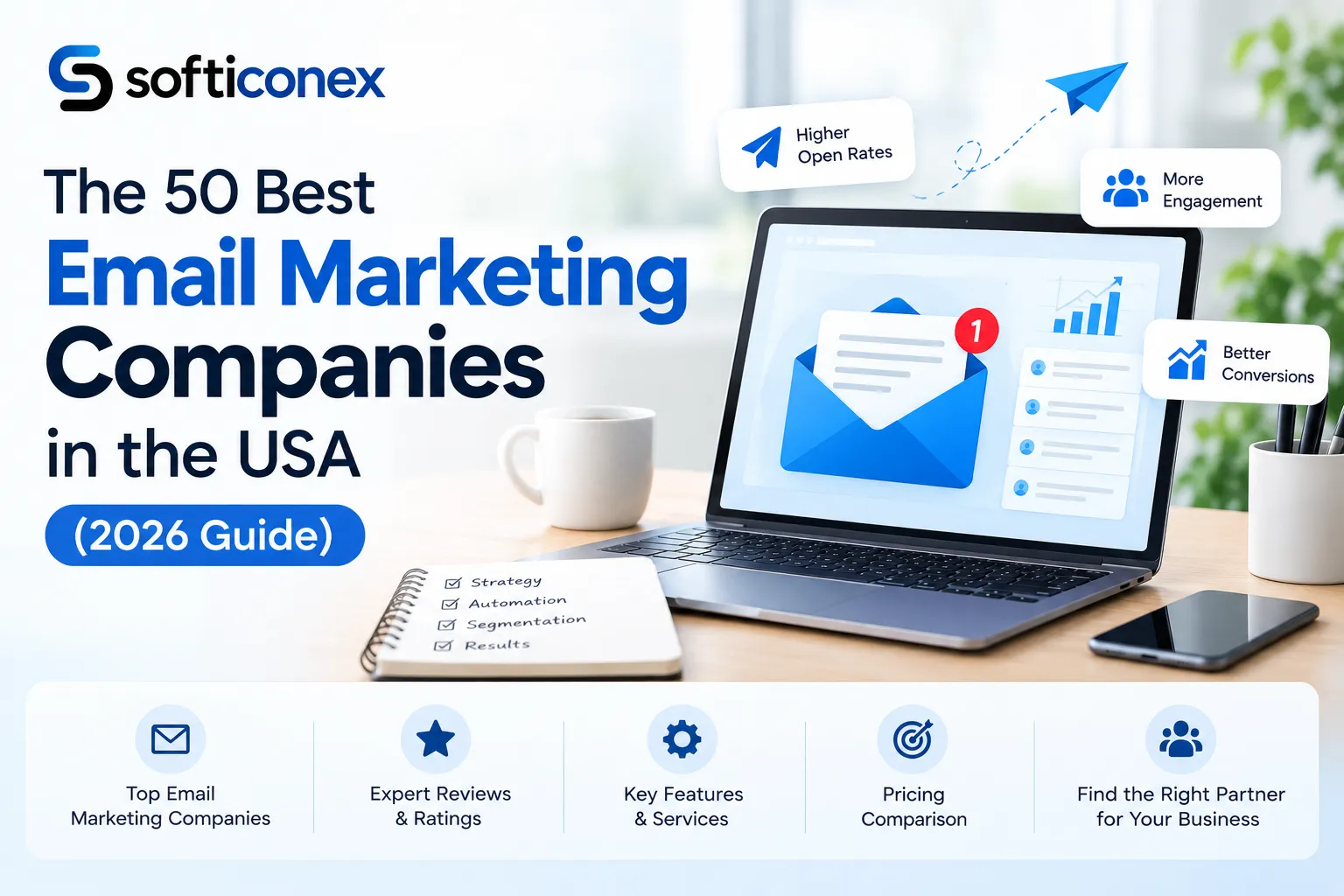
Email remains one of the highest-ROI marketing channels available to businesses of any size. But choosing the right platform or agency to run your campaigns can be overwhelming. The market is crowded with tools that all promise “better open rates” and “more revenue.” This guide breaks down what email marketing companies actually do, how they help your business grow, and profiles 50 of the most established platforms and agencies serving the U.S. market today, so you can compare them side by side and make an informed decision.
Note: Ratings, pricing, and feature sets in this guide reflect publicly available information and third-party review platforms (G2, Capterra, TrustRadius) as of 2026. Software pricing and features change frequently and always confirm current details directly on the provider’s website before making a final decision.
What Is Email Marketing?
Email marketing is the practice of sending targeted, permission-based messages, newsletters, promotions, product updates, transactional receipts, and automated sequences to a list of subscribers who have opted in to hear from a business. Unlike social media, where a company is renting attention on someone else’s platform, email marketing gives a business a direct, owned line of communication to its audience. Done well, it builds relationships over time, nurtures leads through a sales funnel, drives repeat purchases, and keeps a brand top-of-mind without relying on paid advertising.
Modern email marketing goes far beyond the plain newsletter. It typically includes:
- Broadcast campaigns: One-time sends to a list or segment (announcements, sales, newsletters)
- Automated sequences: Welcome series, abandoned cart flows, re-engagement campaigns, post-purchase follow-ups
- Behavioral and lifecycle triggers: Emails sent based on what a subscriber does (or doesn’t do)
- Segmentation and personalization: Tailoring content to specific groups based on demographics, purchase history, or engagement
- A/B testing and analytics: Measuring subject lines, send times, and content to continuously improve results
What Does an Email Marketing Company Do?
An “email marketing company” can mean two different things, and it’s important to understand which one you need:
- Software platforms (ESPs – Email Service Providers): These are the tools like Mailchimp, Klaviyo, or ActiveCampaign that give you the technology to build lists, design emails, automate workflows, and track performance. You (or your team) do the strategy and execution using their software.
- Full-service email marketing agencies: These companies manage the entire process for you strategy, list segmentation, copywriting, design, automation setup, deliverability management, and reporting often using one of the ESPs above as their underlying tool. This is a better fit for businesses that don’t have the internal time or expertise to run campaigns themselves.
Both types of companies generally offer:
- Drag-and-drop or custom-coded email template design
- List management, segmentation, and hygiene (removing invalid or unengaged contacts)
- Marketing automation and behavioral trigger workflows
- Deliverability optimization (authentication, sender reputation, inbox placement)
- A/B and multivariate testing
- Analytics dashboards and performance reporting
- Integrations with CRMs, e-commerce platforms, and other marketing tools
- Compliance support for regulations like CAN-SPAM, GDPR, and CASL
How Email Marketing Companies Help Businesses
- Direct, owned communication: Unlike social media reach, an email list is an asset a business controls not subject to a platform’s algorithm changes.
- Higher ROI than most channels: Email consistently ranks among the highest-return marketing channels because it targets people who have already expressed interest.
- Automation saves time and captures revenue passively: Welcome sequences, cart-abandonment flows, and re-engagement campaigns run in the background, converting customers without manual effort.
- Personalization at scale: Segmentation and dynamic content let a business send the right message to the right person, improving engagement instead of blasting a generic message to everyone.
- Measurable performance: Every open, click, and conversion is trackable, allowing continuous optimization.
- Customer retention and lifetime value: Post-purchase and loyalty sequences keep existing customers engaged, which is typically far cheaper than acquiring new ones.
- Deliverability expertise: A good provider or agency manages technical authentication (SPF, DKIM, DMARC) and sending reputation so emails land in the inbox instead of spam.
Comparison Table: 50 Best Email Marketing Companies in the USA
| # | Company | Best For | Standout Feature | Approx. Rating* |
| 1 | Mailchimp | Small businesses & creators | All-in-one marketing suite | 4.3/5 |
| 2 | Constant Contact | Beginners & nonprofits | Ease of use, event marketing | 4.0/5 |
| 3 | HubSpot Marketing Hub | All-in-one CRM + marketing | Native CRM integration | 4.4/5 |
| 4 | ActiveCampaign | Automation-heavy businesses | Advanced automation builder | 4.5/5 |
| 5 | Klaviyo | E-commerce (Shopify/BigCommerce) | Deep e-commerce data sync | 4.6/5 |
| 6 | Brevo (formerly Sendinblue) | Budget-conscious growing teams | Email + SMS + CRM in one | 4.5/5 |
| 7 | GetResponse | Webinars + automation | Built-in webinar hosting | 4.3/5 |
| 8 | Omnisend | E-commerce | Omnichannel (email/SMS/push) | 4.5/5 |
| 9 | Drip | DTC e-commerce brands | Visual workflow builder | 4.4/5 |
| 10 | Kit (formerly ConvertKit) | Creators & bloggers | Simple automation for creators | 4.4/5 |
| 11 | MailerLite | Small businesses on a budget | Affordable, clean editor | 4.7/5 |
| 12 | Campaign Monitor | Agencies & design-focused teams | Polished template design | 4.3/5 |
| 13 | AWeber | Small business newsletters | Long-standing reliability | 4.3/5 |
| 14 | Moosend | Startups & small teams | Affordable automation | 4.6/5 |
| 15 | Twilio SendGrid | Developers & transactional email | API-first email infrastructure | 4.2/5 |
| 16 | Zoho Campaigns | Zoho ecosystem users | Native Zoho CRM integration | 4.3/5 |
| 17 | Salesforce Marketing Cloud | Large enterprises | Enterprise-grade personalization | 4.0/5 |
| 18 | Iterable | Mid-market & enterprise growth teams | Cross-channel orchestration | 4.3/5 |
| 19 | Braze | Enterprise consumer apps | Real-time customer engagement | 4.4/5 |
| 20 | Adobe Marketo Engage | Enterprise B2B marketing | Lead scoring & nurturing | 4.1/5 |
| 21 | Sailthru (CM Group) | Media & retail enterprises | Predictive personalization | 4.0/5 |
| 22 | Emma by Marigold | Mid-size marketing teams | User-friendly campaign builder | 4.2/5 |
| 23 | Dotdigital | Enterprise e-commerce | Omnichannel automation | 4.3/5 |
| 24 | SharpSpring (by Constant Contact) | Agencies & SMB marketing automation | Marketing automation + CRM | 4.5/5 |
| 25 | Benchmark Email | Small business simplicity | Easy drag-and-drop editor | 4.3/5 |
| 26 | iContact | Small & mid-size businesses | Strong customer support | 4.0/5 |
| 27 | VerticalResponse | Small businesses & nonprofits | Simple campaign creation | 4.0/5 |
| 28 | Salesforce Account Engagement (Pardot) | B2B lead nurturing | Deep Salesforce CRM integration | 4.0/5 |
| 29 | Keap (Infusionsoft) | Small business sales + email | CRM + email + payments combo | 4.2/5 |
| 30 | Ontraport | Solopreneurs & coaches | Business automation suite | 4.5/5 |
| 31 | SendPulse | Multichannel budget teams | Email + SMS + chatbot | 4.6/5 |
| 32 | Mailjet | Developers & transactional email | Real-time collaboration on templates | 4.2/5 |
| 33 | Elastic Email | High-volume senders on a budget | Low-cost sending infrastructure | 4.2/5 |
| 34 | EmailOctopus | Budget-conscious small lists | Generous free tier | 4.5/5 |
| 35 | Sender.net | Startups & small e-commerce | Generous free plan | 4.6/5 |
| 36 | Systeme.io | Course creators & funnels | Email + funnels + courses bundled | 4.5/5 |
| 37 | Instantly | Cold email & outbound sales | Deliverability tools for outbound | 4.8/5 |
| 38 | lemlist | Sales teams & agencies | Multichannel outreach (email/LinkedIn/calls) | 4.5/5 |
| 39 | Smartlead | Agencies running cold outreach | Unlimited email account warmup | 4.7/5 |
| 40 | Woodpecker | B2B sales outreach | Deliverability-focused cold email | 4.6/5 |
| 41 | Freshmarketer (Freshworks) | Small teams wanting CRO + email | Built-in A/B testing & heatmaps | 4.0/5 |
| 42 | ActiveTrail | International SMBs | Automation + SMS combo | 4.4/5 |
| 43 | Cakemail | Canadian/US small business | Simple compliance-friendly sending | 4.3/5 |
| 44 | MailUp | Mid-size businesses | Email + SMS marketing automation | 4.2/5 |
| 45 | Listrak | Retail & e-commerce enterprise | Predictive segmentation | 4.2/5 |
| 46 | Bronto (by NetSuite/Oracle) | NetSuite-based retailers | Deep NetSuite e-commerce integration | 4.0/5 |
| 47 | Yesware | Sales reps & individual outreach | Email tracking for sales teams | 4.3/5 |
| 48 | Customer.io | SaaS & product-led growth companies | Behavioral, data-driven messaging | 4.4/5 |
| 49 | Mailercloud | Budget-conscious SMBs | Affordable automation & templates | 4.5/5 |
| 50 | Softiconex | Businesses wanting a full-service agency | Managed strategy, design & execution | N/A (agency) |
*Ratings are approximate composites drawn from public review platforms and are subject to change. Always check current scores on G2, Capterra, or TrustRadius directly.
In-Depth Profiles of the 50 Best Email Marketing Companies
1. Mailchimp
Mailchimp is one of the most recognized names in email marketing, originally built for small businesses and creators before expanding into a full marketing platform with landing pages, CRM-lite features, and social ad integration. Its drag-and-drop editor is beginner-friendly, and its free tier still makes it a common starting point for new businesses. Strengths include a huge template library, solid reporting, and broad third-party integrations. Common criticisms include pricing that climbs quickly as your list grows and automation that’s less sophisticated than dedicated automation platforms like ActiveCampaign. It’s best suited for small businesses, solopreneurs, and anyone who wants an easy on-ramp into email marketing without a steep learning curve.
2. Constant Contact
Constant Contact has been in the email marketing space since the late 1990s and remains a go-to choice for small businesses, local shops, and nonprofits. It’s known for its simplicity, event marketing tools (built for webinars and in-person events), and strong customer support, including live phone support, which is rare in this category. Its automation and segmentation capabilities are more basic compared to newer platforms, and template flexibility can feel dated. It works well for organizations that value reliability and hand-holding over cutting-edge automation.
3. HubSpot Marketing Hub
HubSpot bundles email marketing into its broader CRM and marketing automation platform, making it a strong choice for businesses that want email, sales, and customer service data unified in one system. The email builder is intuitive, and native CRM data allows for genuinely personalized sends based on deal stage, lifecycle stage, or behavior. The tradeoff is that HubSpot’s pricing scales quickly once you need more contacts or advanced automation, and some users report the platform feels bloated if you only need email. It’s best for growing businesses already using (or planning to use) HubSpot’s CRM.
4. ActiveCampaign
ActiveCampaign is widely regarded as one of the most powerful automation platforms available, offering a visual workflow builder capable of complex, branching, behavior-triggered sequences. It combines email marketing with light CRM and sales automation features, appealing to businesses that want sophisticated lifecycle marketing without full enterprise complexity. Deliverability is consistently rated highly by users. The learning curve is steeper than beginner tools like Mailchimp, so it suits businesses ready to invest time in building out detailed automation logic.
5. Klaviyo
Klaviyo has become the default choice for e-commerce brands, particularly those on Shopify and BigCommerce, due to its deep two-way data sync with store data (purchase history, browsing behavior, product catalogs). This allows for highly specific segmentation and automated flows like abandoned cart, browse abandonment, and post-purchase upsells that are difficult to replicate elsewhere. Its reporting ties directly to revenue attribution, which e-commerce marketers value highly. The tradeoff is a genuine learning curve and pricing that rises quickly with list size, making it better suited to stores with meaningful order volume than very early-stage shops.
6. Brevo (formerly Sendinblue)
Brevo positions itself as an affordable, all-in-one marketing stack combining email, SMS, chat, and a built-in CRM. It’s popular with growing businesses that want more than a basic email tool without paying enterprise prices. Deliverability and ease of use are frequently praised, though some users note the automation workflows are less flexible than more specialized platforms and templates can feel less polished. It’s a strong fit for small-to-mid-size businesses wanting to consolidate multiple marketing channels under one roof.
7. GetResponse
GetResponse differentiates itself with built-in webinar hosting alongside standard email marketing and automation tools, making it appealing to coaches, course creators, and B2B marketers who run webinars as part of their funnel. It also offers landing pages and a simple funnel builder. Automation depth is solid though not as advanced as ActiveCampaign. It’s best for businesses that want email marketing bundled with webinar and lead-generation tools in a single subscription.
8. Omnisend
Omnisend is built specifically for e-commerce, offering pre-built automation workflows for cart abandonment, order confirmations, and win-back campaigns across email, SMS, and push notification simultaneously. Its e-commerce-specific templates and segmentation (by purchase behavior, product interest, etc.) make it a strong Klaviyo alternative, often at a more accessible price point for smaller stores. It integrates natively with major platforms like Shopify, WooCommerce, and BigCommerce.
9. Drip
Drip focuses on direct-to-consumer e-commerce brands that want sophisticated, visually mapped customer journeys. Its workflow builder allows marketers to visualize entire customer lifecycles and layers in conditional logic based on purchase and engagement data. It’s often chosen by mid-size DTC brands that have outgrown basic tools but aren’t ready for enterprise platforms. Support and onboarding resources are considered strong, though the platform is exclusively focused on e-commerce use cases.
10. Kit (formerly ConvertKit)
Kit was built specifically for creators, bloggers, podcasters, and course sellers rather than traditional e-commerce or B2B companies. It emphasizes simplicity: tagging-based segmentation instead of complex lists, easy automation (“visual automations”), and integrated landing pages and paid newsletter tools. Its design templates are intentionally minimal, which some users love and others find limiting compared to more design-heavy platforms. It’s a strong choice for solo creators monetizing an audience through email.
11. MailerLite
MailerLite consistently earns high marks for combining an intuitive, modern interface with genuinely affordable pricing, making it popular with small businesses, bloggers, and startups. It offers automation, landing pages, and even basic website-building tools within the same platform. While its free plan has become more limited over time, paid plans remain competitively priced relative to feature depth. It’s a good middle ground between bare-bones tools and pricier automation platforms.
12. Campaign Monitor
Campaign Monitor is known for design-forward, agency-friendly email templates and a clean, simple builder, making it popular among marketing agencies managing multiple client accounts. It offers solid segmentation and automation, along with strong analytics. It tends to be priced a bit higher than comparable small-business tools, positioning it more toward brands and agencies that prioritize visual polish.
13. AWeber
AWeber is one of the longest-running email marketing platforms and remains popular with small businesses and solo entrepreneurs for its reliability and straightforward feature set. It offers list building, basic automation, landing pages, and a large template library. It doesn’t push the boundaries on advanced automation or AI features the way newer platforms do, but its long track record and steady support make it a dependable, low-risk choice.
14. Moosend
Moosend offers automation and segmentation capabilities that rival pricier competitors at a notably lower price point, making it attractive to startups and small teams. It includes pre-built automation recipes, AI-based product recommendations for e-commerce, and a straightforward drag-and-drop editor. It’s a strong value pick for budget-conscious teams that still want meaningful automation depth.
15. Twilio SendGrid
SendGrid is best known as developer-first email infrastructure widely used for transactional email (password resets, receipts, notifications) via its robust API, alongside a marketing campaigns product for broadcast email. It’s a strong choice for technical teams that need reliable, high-volume sending and deep API control, though its marketing-campaign interface is less polished than dedicated ESPs built for marketers.
16. Zoho Campaigns
Zoho Campaigns is part of the broader Zoho software ecosystem (CRM, Zoho Books, Zoho Desk, etc.), making it a natural fit for businesses already using Zoho tools. It offers solid segmentation, automation, and integration with Zoho CRM for lead-based email triggers. Its standalone feature depth is competitive but arguably shines most as part of the broader Zoho suite rather than as a best-in-class dedicated tool.
17. Salesforce Marketing Cloud
Salesforce Marketing Cloud is an enterprise-grade platform built for large organizations running complex, personalized, cross-channel campaigns at massive scale. It offers deep AI-driven personalization (Einstein), journey mapping, and tight integration with Salesforce CRM data. It comes with enterprise pricing and a significant implementation and learning curve, making it best suited to large companies with dedicated marketing operations teams rather than small businesses.
18. Iterable
Iterable is a cross-channel marketing automation platform (email, SMS, push, in-app) aimed at mid-market and enterprise growth teams, particularly in tech and media. It’s praised for flexible workflow building and strong data integration capabilities that let marketing and product teams orchestrate messaging based on real-time user behavior. It generally requires more technical setup than SMB-focused tools.
19. Braze
Braze is an enterprise customer engagement platform popular with consumer mobile apps and subscription businesses that need real-time, behavior-triggered messaging across push, email, SMS, and in-app channels. Its strength is speed and personalization at scale for large user bases. It’s priced and built for enterprise use, not smaller businesses running simple newsletters.
20. Adobe Marketo Engage
Marketo Engage is a long-standing enterprise marketing automation platform particularly strong in B2B lead scoring, nurturing, and account-based marketing (ABM), now part of the Adobe Experience Cloud. It’s commonly used by mid-size to large B2B organizations with dedicated marketing ops teams managing complex funnels. Implementation typically requires specialized expertise, and pricing reflects its enterprise positioning.
21. Sailthru (CM Group)
Sailthru specializes in predictive personalization for media publishers and retail enterprises, using behavioral data to automatically recommend content or products to individual subscribers. It’s part of the CM Group family of brands (which also includes Campaign Monitor and Emma). It’s best suited to larger organizations with the data volume needed to make predictive personalization worthwhile.
22. Emma by Marigold
Emma (part of Marigold, alongside Sailthru and Cheetah Digital) is aimed at mid-size marketing teams that want an easy-to-use campaign builder with solid segmentation and multi-brand account management, often used by franchises, universities, and multi-location businesses. It balances usability with enough sophistication for teams managing several distinct email programs at once.
23. Dotdigital
Dotdigital is an omnichannel marketing automation platform popular in enterprise e-commerce, particularly in the UK and increasingly in the U.S. market. It combines email, SMS, and other channels with detailed customer journey mapping and integrates well with platforms like Shopify Plus, Magento, and Salesforce. It’s positioned toward mid-market and enterprise brands with more complex customer journeys.
24. SharpSpring (by Constant Contact)
SharpSpring is a marketing automation platform (now owned by Constant Contact) built with agencies in mind, offering white-label options, CRM functionality, and behavior-based lead scoring alongside email marketing. It’s a popular pick for marketing agencies managing automation for multiple clients under one roof, combining affordability with automation depth closer to ActiveCampaign or HubSpot.
25. Benchmark Email
Benchmark Email emphasizes simplicity with an easy drag-and-drop builder, automation, and survey tools bundled together. It’s designed for small businesses that want a straightforward platform without a steep learning curve, and it offers multilingual support, which appeals to businesses with international audiences.
26. iContact
iContact has built a reputation around responsive customer support and a simple, intuitive interface, making it a solid choice for small and mid-size businesses that value hands-on help during setup and campaign management. Its automation and segmentation tools are functional but not as advanced as category leaders.
27. VerticalResponse
VerticalResponse focuses on simplicity for small businesses and nonprofits, offering an easy campaign builder alongside basic social media posting tools. It’s a lighter-weight option compared to more feature-dense platforms, appealing to organizations that need to get simple campaigns out quickly without a lot of setup.
28. Salesforce Account Engagement (formerly Pardot)
Built specifically for B2B lead nurturing, Account Engagement integrates tightly with Salesforce CRM to score leads, trigger nurture sequences, and hand qualified leads to sales teams automatically. It’s a strong fit for B2B companies with longer sales cycles that are already invested in the Salesforce ecosystem, though it’s less suited to B2C or transactional email needs.
29. Keap (formerly Infusionsoft)
Keap combines CRM, email marketing, and payment processing into one platform aimed at small businesses and solopreneurs who want sales and marketing automation without stitching together multiple tools. It’s particularly popular with service-based businesses and coaches. The interface has a steeper learning curve than pure email marketing tools, reflecting its broader feature set.
30. Ontraport
Ontraport is a business automation platform combining email marketing, CRM, membership sites, and e-commerce, aimed largely at solopreneurs, coaches, and small service businesses that want an all-in-one back office. It offers deep automation logic (similar in spirit to ActiveCampaign) layered with business management tools beyond just email.
31. SendPulse
SendPulse combines email, SMS, web push, and chatbot messaging (including WhatsApp and Telegram integrations) into one platform, appealing to businesses that want multichannel messaging under one roof at a lower price point than many competitors. It’s a strong option for budget-conscious teams expanding beyond email alone.
32. Mailjet
Mailjet offers both transactional and marketing email capabilities with a strong emphasis on real-time collaborative template editing, useful for teams that build campaigns together. It’s popular with developers thanks to its API and SMTP relay options, while still offering a usable drag-and-drop builder for marketers.
33. Elastic Email
Elastic Email is built for cost-effective, high-volume sending, appealing to businesses and developers who need to send large email volumes without the per-contact pricing of many mainstream ESPs. It offers both API-based transactional sending and a marketing campaign interface, making it a budget-friendly option for high-volume senders.
34. EmailOctopus
EmailOctopus is known for a generous free tier and straightforward pricing built on Amazon SES infrastructure, keeping costs low for growing lists. It offers essential features of automation, segmentation, and a clean editor without the extras (or the price tag) of larger all-in-one platforms, making it popular with newsletter writers and small businesses.
35. Sender.net
Sender.net has built a reputation around one of the most generous free plans in the category, giving small businesses meaningful list size and send volume before requiring a paid upgrade. It includes automation, segmentation, and SMS alongside email, making it an appealing starting point for startups and small e-commerce stores watching costs closely.
36. Systeme.io
Systeme.io bundles email marketing with sales funnels, online course hosting, and affiliate management into a single platform, targeting course creators, coaches, and info-product businesses that want to avoid stitching together separate tools. Its automation is solid for funnel-based businesses, though it’s less specialized for pure e-commerce or B2B use cases.
37. Instantly
Instantly is purpose-built for cold email outreach and outbound sales, offering email warmup, deliverability monitoring, and the ability to manage large numbers of sending accounts/inboxes simultaneously. It’s widely used by sales teams, agencies, and B2B founders running outbound lead generation rather than traditional permission-based newsletters.
38. lemlist
lemlist combines cold email with multichannel outreach across LinkedIn and phone calls, aimed at sales teams and agencies running outbound campaigns. It includes personalization features (like dynamic images) designed to improve cold email response rates, positioning it as a sales-outreach tool more than a traditional newsletter platform.
39. Smartlead
Smartlead focuses on scaling cold email outreach with unlimited email account warmup and deliverability management, popular among agencies running outbound campaigns for multiple clients. Its infrastructure is built to handle high email volume across many sending domains while protecting sender reputation.
40. Woodpecker
Woodpecker is another outbound-focused platform emphasizing deliverability and reply detection for B2B sales teams running cold email campaigns. It’s built to integrate into sales workflows rather than serve as a general marketing newsletter tool.
41. Freshmarketer (Freshworks)
Freshmarketer bundles email marketing with conversion rate optimization tools like heatmaps, session replay, and A/B testing, appealing to small teams that want marketing and on-site optimization data connected. It’s part of the broader Freshworks suite, making it a natural fit for businesses already using Freshworks CRM or support tools.
42. ActiveTrail
ActiveTrail serves international small-to-mid-size businesses with a combination of email automation and SMS marketing, along with landing page tools. It’s less well-known in the U.S. than some competitors but offers a comparable automation feature set at competitive pricing.
43. Cakemail
Cakemail is a Canadian-founded platform serving small businesses in both Canada and the U.S., emphasizing simple, compliance-friendly sending (particularly around Canada’s Anti-Spam Legislation, CASL) alongside standard email marketing features.
44. MailUp
MailUp combines email and SMS marketing automation aimed at mid-size businesses, with an emphasis on deliverability infrastructure and multichannel campaign coordination. It’s more established in the European market but serves U.S. businesses as well.
45. Listrak
Listrak focuses on retail and e-commerce enterprises, offering predictive segmentation and cross-channel personalization (email, SMS, and more) built to handle the complexity of large product catalogs and high-volume transactional data.
46. Bronto (NetSuite/Oracle)
Bronto is an e-commerce-focused email marketing platform tightly integrated with NetSuite, making it a natural choice for mid-size to large online retailers already running their operations through NetSuite’s commerce and ERP systems.
47. Yesware
Yesware is built for individual sales reps rather than marketing teams, offering email tracking, templates, and light automation inside Gmail and Outlook. It’s less a broadcast email marketing tool and more a sales productivity tool for one-to-one outreach and follow-up.
48. Customer.io
Customer.io is a data-driven messaging platform popular with SaaS and product-led growth companies that want to trigger email (and other channel) messages based on granular product usage data. It requires more technical setup than typical marketing ESPs but offers precise, behavior-based automation valued by product and growth teams.
49. Mailercloud
Mailercloud positions itself as an affordable alternative to bigger-name platforms, offering automation, segmentation, and a drag-and-drop builder at a lower price point aimed at small and mid-size businesses watching costs.
50. Softiconex
Softiconex is a full-service digital marketing agency that manages email marketing as part of a broader suite of services, including SEO, PPC, web development, and content marketing. Rather than selling software, it functions as a done-for-you partner: building and segmenting subscriber lists, designing templates, setting up automated drip and welcome sequences, and optimizing campaigns based on performance data. It’s a relevant option for businesses that would rather hand off strategy and execution entirely than manage a platform themselves though, as with any agency, it’s worth reviewing sample work, case studies, and contract terms directly before committing.
What to Know Before Choosing an Email Marketing Company
- Your list size and growth trajectory: Pricing on most platforms scales with contact count, so estimate your growth over the next 12–24 months, not just where you are today.
- Whether you need software or a managed service: A platform gives you control but requires internal time and skill; an agency costs more but removes the execution burden.
- E-commerce vs. B2B vs. content/newsletter needs: Tools built for Shopify stores (like Klaviyo or Omnisend) behave very differently from tools built for B2B lead nurturing (like Marketo or Pardot).
- Deliverability track record: A platform with cheap pricing but poor sender reputation infrastructure can hurt your ability to reach the inbox at all.
- Automation depth vs. ease of use: More powerful automation usually comes with a steeper learning curve; be honest about your team’s bandwidth to learn a complex tool.
- Integration requirements: Check that the platform connects natively with your CRM, e-commerce platform, or other core systems before committing.
- Compliance support: Confirm the provider supports CAN-SPAM, GDPR, and CASL compliance if you have international subscribers.
- Total cost at scale: Look beyond the entry-level price; check what the cost looks like once your list doubles or triples.
- Contract flexibility: Understand cancellation terms, especially with agencies, before signing longer-term contracts.
- Support quality: Live chat, phone support, and onboarding help vary significantly between providers and matter most when something breaks during a campaign.
Questions to Ask a Prospective Email Marketing Company
- What is your pricing structure as our contact list grows, and are there hidden fees?
- What is your average deliverability/inbox placement rate, and how do you monitor it?
- Can you show case studies or references from businesses similar to ours?
- What integrations do you offer with our existing CRM, e-commerce platform, or tech stack?
- Who will actually manage our account, and what is the escalation process if something goes wrong?
- What does onboarding look like, and how long until we’re fully up and running?
- How do you handle list segmentation and personalization for our specific audience?
- What reporting and analytics will we have access to, and how often will we receive performance updates?
- What is your approach to compliance (CAN-SPAM, GDPR, CASL) for our subscriber base?
- What is the contract length, and what are the terms if we want to cancel or switch providers?
10 Frequently Asked Questions (FAQs)
1. What is the difference between an email marketing software platform and an email marketing agency?
A software platform (like Mailchimp or Klaviyo) gives you the tools to build and send campaigns yourself. An agency (like Softiconex) manages strategy, design, and execution on your behalf, typically using one of these platforms behind the scenes.
2. How much does email marketing typically cost?
Software platforms range from free (for very small lists) to several hundred dollars a month as contact count and features scale up. Agency services vary widely based on scope, often ranging from a few hundred to several thousand dollars a month depending on campaign volume and complexity.
3. Is email marketing still effective in 2026?
Yes. Email remains one of the highest-ROI marketing channels because it reaches people who have already opted in, and it isn’t subject to the reach limitations and algorithm changes that affect social media.
4. What is a good email open rate and click-through rate?
Averages vary significantly by industry, but many businesses see open rates in the 20–35% range and click-through rates in the 2–5% range. Benchmarks should be compared within your specific industry, not generically.
5. Do I need a large email list to get started?
No. Many platforms offer free or low-cost entry tiers designed for small lists, and a smaller, highly engaged list often outperforms a large, unengaged one.
6. What’s the difference between a broadcast email and an automated email?
A broadcast is a one-time send to a list or segment (like a newsletter). An automated email is triggered by a specific action or timeline, such as a welcome series after signup or a cart-abandonment email after a shopper leaves items unpurchased.
7. How do I improve my email deliverability?
Use proper authentication (SPF, DKIM, DMARC), maintain list hygiene by removing inactive or invalid addresses, avoid spam-trigger language, and choose a provider with a strong sender reputation infrastructure.
8. Can email marketing work for B2B companies, not just e-commerce?
Yes. B2B companies commonly use email for lead nurturing, sales follow-up, and account-based marketing, often paired with a CRM like Salesforce or HubSpot for lead scoring and personalization.
9. How long does it take to see results from email marketing?
Basic campaigns can show results (opens, clicks) within days. Meaningful revenue or lead-generation impact from a well-built automation strategy typically takes a few months to fully mature and optimize.
10. Should I switch platforms if I’m unhappy with my current provider?
It’s possible, though list migration, automation rebuilding, and re-establishing sender reputation on a new platform take time and planning. It’s usually worth attempting to resolve issues with your current provider first, or consulting an agency to manage the transition.
What’s Missing From This Guide (Editorial Note)
In the interest of transparency, a few things are worth flagging that this guide couldn’t fully capture:
- Live, up-to-the-minute ratings and pricing: Review scores and pricing tiers change often; the numbers above are directional, not guaranteed current figures. Always verify on G2, Capterra, or TrustRadius, and on each company’s pricing page, before deciding.
- Deliverability data by provider: True inbox placement rates vary by sender reputation, list quality, and industry not just the platform and independent, standardized deliverability testing across all 50 companies wasn’t available for this guide.
- Real client testimonials for agency-side providers: For agencies like Softiconex, prospective clients should request direct case studies and references rather than relying solely on third-party summaries.
- Regional and international sending compliance details: Businesses with subscribers outside the U.S. (especially in the EU, UK, or Canada) should independently verify each provider’s compliance tooling for GDPR and CASL in more depth than this guide covers.
- Enterprise-only tools with limited public pricing: Some enterprise platforms (like Salesforce Marketing Cloud or Braze) require custom quotes, so exact cost comparisons against SMB-focused tools aren’t apples-to-apples.
Conclusion
There is no single “best” email marketing company. The right choice depends on your business size, technical resources, industry, and whether you want to run campaigns yourself or hand them off to a managed service. E-commerce brands will likely lean toward platforms like Klaviyo or Omnisend; B2B companies may prefer HubSpot, ActiveCampaign, or Marketo; budget-conscious startups often start with MailerLite, Sender.net, or Brevo; and businesses that would rather not manage a platform at all may prefer a full-service partner like Softiconex. Use the comparison table and profiles above as a starting point, but always validate current pricing, ratings, and fit with a free trial, demo, or direct conversation with the provider before committing your budget and subscriber list to a long-term platform.