You have written your first JavaScript function or compiled a Java class, and now you press “Run.” But what actually happens next?
Most beginners picture code talking directly to a computer. The reality is more layered and far more interesting. Between your source code and the machine sits a critical piece of infrastructure called the runtime environment. Understanding what a runtime environment is unlocks how modern software really works, why Node.js exists, why the JVM is so powerful, and why errors behave differently depending on when they occur.
This guide explains every dimension of the runtime environment concept: what it is, how it works, how it compares to compilers, and what real-world runtime environment examples look like in JavaScript, Java, Python, and beyond. Whether you are a CS student studying operating systems or a web developer debugging a Node.js crash, this guide gives you a clear, complete picture.
What Is a Runtime Environment in Programming?
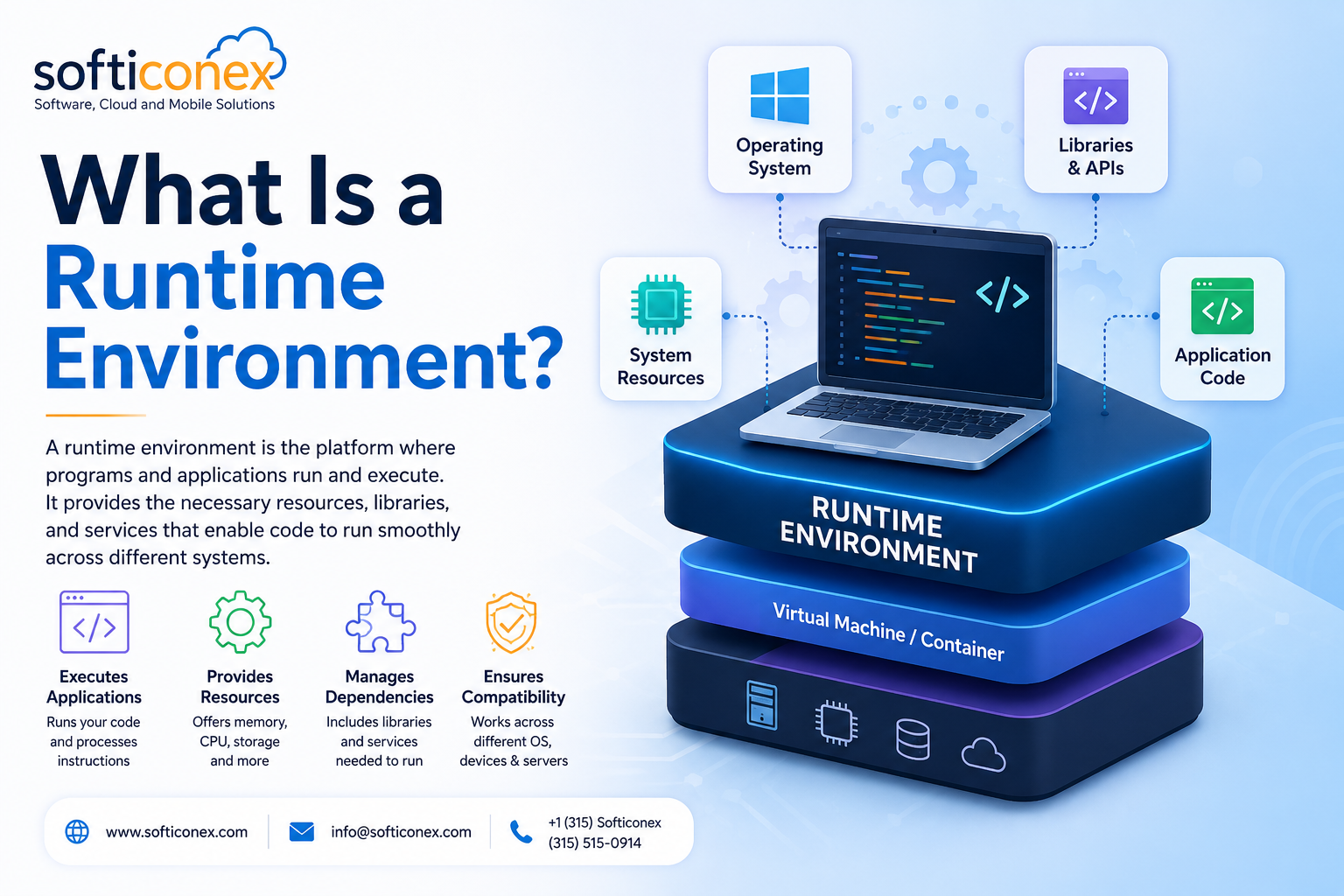
A runtime environment (also called a runtime system or execution environment) is the complete set of software infrastructure that supports a program during execution. The runtime environment handles the tasks that would otherwise require the programmer to interact with the operating system directly.
At its core, a runtime environment provides:
- Memory allocation and garbage collection: requesting RAM from the OS and freeing it when no longer needed
- Standard library access: giving programs access to pre-built functions (string manipulation, file I/O, math operations)
- Type checking and error handling: catching exceptions and type mismatches as the program runs
- Concurrency management: managing threads, event loops, or coroutines
- Security sandboxing: restricting what the program can access on the host system
The phrase “what is runtime in programming” often confuses newcomers because “runtime” serves double duty: it refers both to the period when a program runs and to the environment that makes that execution possible. In this guide, “runtime environment” always refers to the software infrastructure, not the time period.
How Does a Runtime Environment Work?
A runtime environment works by wrapping your program in a managed execution context. Here is the sequence most runtime environments follow:
- Load: The runtime loads your compiled or interpreted code into memory.
- Initialize: The runtime sets up global state, imports libraries, and allocates initial memory.
- Execute: The runtime interprets or runs compiled instructions one step at a time, managing the call stack.
- Manage resources: While execution proceeds, the runtime handles memory allocation requests, garbage collection cycles, and I/O operations.
- Handle errors: When exceptions occur, the runtime catches them, generates stack traces, and either recovers or terminates gracefully.
- Clean up: When execution ends, the runtime releases all memory and closes open file handles.
This sequence explains why a Python script runs identically on Windows, macOS, and Linux when CPython (the Python runtime) is installed; the runtime environment abstracts the OS differences.
What Does “Managed Execution” Mean?
“Managed execution” means the runtime environment, not the programmer, controls low-level details. Languages like Java, C#, Python, and JavaScript use managed runtimes. Languages like C and C++ give programmers more direct control (unmanaged execution), which increases performance but also increases the risk of memory leaks and crashes.
Runtime Environment vs. Compiler: Key Differences
The runtime environment vs. compiler distinction is one of the most commonly searched questions in this topic cluster, and for good reason. The two tools serve completely different purposes.
| Feature | Compiler | Runtime Environment |
| When it operates | Before execution (build time) | During execution (run time) |
| Primary job | Translates source code to machine code or bytecode | Executes code and manages resources |
| Output | Compiled binary or bytecode file | Program results and side effects |
| Error detection | Syntax errors, type errors (static) | Logic errors, null references (dynamic) |
| Examples | GCC, javac, TypeScript compiler | JVM, Node.js, CPython, .NET CLR |
A compiler reads your code before it runs and converts it into a form the computer (or runtime) can process. The runtime environment then takes that output and actually executes it.
In Java, for example, javac compiles .java files into .class bytecode files. The JVM (Java Virtual Machine) is the runtime environment that then reads those bytecode files and runs them. The compiler does not run your program; the runtime does.
Runtime Environment Examples: JavaScript, Java, and More
Understanding runtime environment examples across different languages makes the abstract concept concrete.
Node.js: The JavaScript Runtime Environment
Node.js is a runtime environment that allows JavaScript to run outside the browser. Before Node.js existed, JavaScript could only execute inside a web browser’s built-in runtime (like V8 in Chrome or SpiderMonkey in Firefox).
Node.js packages Google’s V8 JavaScript engine with a set of APIs for file systems, networking, and OS interaction. When a developer runs node server.js, Node.js loads the script, sets up an event loop, and begins executing JavaScript code, handling asynchronous I/O through its libuv library.
Key components of the Node.js runtime environment:
- V8 engine (compiles JavaScript to machine code)
- libuv (event loop and async I/O)
- Node.js standard library (fs, http, path modules)
JVM: The Java Runtime Environment
The Java Virtual Machine (JVM) is one of the most widely deployed runtime environments in history. The JVM executes Java bytecode, manages garbage collection, enforces security policies, and provides platform independence, “write once, run anywhere.”
The Java Runtime Environment (JRE) is the complete package a user needs to run Java applications. The JRE includes the JVM plus the Java Class Library. The Java Development Kit (JDK) adds the compiler and developer tools on top of the JRE.
CPython: The Python Runtime Environment
CPython is the default Python runtime environment. When a developer types python script.py, CPython first compiles the Python source into bytecode (stored in .pyc files), then interprets that bytecode. CPython manages Python’s Global Interpreter Lock (GIL), garbage collection, and the Python standard library.
.NET CLR The C# Runtime Environment
The Common Language Runtime (CLR) is Microsoft’s managed runtime environment for .NET languages, including C#, VB.NET, and F#. The CLR handles JIT (Just-In-Time) compilation, garbage collection, type safety, and exception handling.
From Experience Callout Box #2:
During a production deployment, a team I worked with discovered that their Python 2 application would not run on a server with only Python 3 installed. The code was identical; the problem was entirely a runtime environment mismatch. The lesson: always confirm which runtime version is installed in your deployment target. Environment mismatches cause more production failures than most developers expect.
What Is a Runtime Library and Runtime System?
Two related terms frequently appear alongside “runtime environment”: runtime library and runtime system.
Runtime Library
A runtime library is the collection of pre-compiled code that a runtime environment makes available to running programs. Runtime libraries provide standard functions, string formatting, mathematical operations, and memory allocation routines without requiring the programmer to rewrite them from scratch.
In C, the C standard library (libc) is a runtime library. In JavaScript running in Node.js, built-in modules like path and fs form part of the runtime library.
Runtime System
A runtime system is a broader term that encompasses the entire infrastructure supporting program execution, including the runtime environment, runtime library, and any OS-level services the program relies on. Some authors use “runtime system” and “runtime environment” interchangeably; others treat the runtime system as the superset.
For practical purposes, the runtime library is the collection of reusable code, the runtime environment is the execution platform, and the runtime system is the complete supporting infrastructure.
Runtime vs. Compile Time: Why the Distinction Matters
Runtime vs. compile time is a foundational distinction in programming. Understanding when an error or event occurs determines how to diagnose and fix it.
Compile-Time Events
Compile-time events occur before execution, when the compiler processes source code:
- Syntax errors (missing semicolons, unmatched brackets)
- Type errors in statically typed languages (Java, C++, TypeScript)
- Missing imports or undefined references
Compile-time errors are caught early and are generally safer, as they prevent broken programs from ever running.
Runtime Events
Runtime events occur during execution, inside the runtime environment:
- Null pointer dereferences
- Array index out of bounds
- Division by zero
- File not found errors
- Network timeouts
Runtime errors are harder to catch because they depend on the actual program state and user input. A Java class with no compile-time errors can still throw a NullPointerException at runtime if a variable is never assigned a value.
Why this matters for developers: Statically typed languages with strict compilers (Java, TypeScript, Rust) catch more errors at compile time, reducing runtime surprises. Dynamically typed languages (Python, JavaScript) defer more checks to the runtime environment, offering flexibility at the cost of more potential runtime errors.
Data & Industry Context
Node.js adoption: According to the 2023 Stack Overflow Developer Survey, Node.js is used by approximately 42.7% of professional developers, making it one of the most commonly deployed JavaScript runtime environments globally. (Source: Stack Overflow Developer Survey 2023)
- JVM ecosystem scale: The JVM ecosystem supports over 50 programming languages beyond Java, including Kotlin, Scala, Clojure, and Groovy, demonstrating how a single runtime environment can support an entire language family. (Source: JVM language ecosystem documentation)
- Memory management impact: Research by Microsoft (2019) found that approximately 70% of all security vulnerabilities in their products were caused by memory safety issues, problems that managed runtime environments (like the CLR and JVM) are specifically designed to prevent. (Source: Microsoft Security Response Center, 2019)
Note: Statistics are cited from named sources. Readers should verify figures against the latest published editions of these surveys and reports.
From Experience: Two Runtime Scenarios That Changed Everything
The Mysterious Production Crash
A Node.js API running smoothly in development began crashing in production under high load. Every log showed an ENOMEM error and not enough memory. The application code was identical in both environments.
The difference: the development machine had 16 GB of RAM; the production server had 512 MB. The Node.js runtime environment was faithfully executing the code, but the underlying system resources the runtime depended on were different. The fix required both code optimization (reducing object allocation in hot paths) and a server upgrade.
The lesson: a runtime environment does not guarantee your program will work; it guarantees your program has a platform to run on. The runtime environment’s capabilities are constrained by the hardware beneath it.
Understanding Java’s “Write Once, Run Anywhere”
A developer compiled a Java desktop application on a Mac, shipped the .jar file to a Windows user, and the application ran without modification. The Windows user had the JRE installed; the JVM handled all the OS-specific differences invisibly.
Without the JVM runtime environment, this would require recompiling the application for Windows separately. The runtime environment is what makes cross-platform promises real, not magic, but deliberate abstraction.
How Softiconex Helps Optimize Runtime Environments
Softiconex helps businesses optimize runtime environments by improving application performance, reducing server issues, configuring scalable infrastructures, and ensuring smooth software execution across web, mobile, and cloud platforms. Our experts analyze system bottlenecks, optimize resource usage, and implement reliable deployment solutions for faster and more secure applications.
Contact us today for professional runtime environment optimization and performance improvement services.
Conclusion
Understanding what a runtime environment is transforms how you think about code. Every program you write depends on one, whether that is the V8 engine powering your browser tab, the JVM running an enterprise Java application, or CPython interpreting your data science script.
The runtime environment is not just a technical curiosity; it is the reason code is portable, errors are catchable, and modern software development is manageable without writing assembly language. The more clearly you understand the runtime layer, the better you will debug, architect, and deploy software.
FAQS
What is a runtime environment in simple terms?
A runtime environment is the software that makes your code actually run. Think of it as a stage crew for a theater production, invisible to the audience, but essential. The runtime sets up the space, provides the tools, handles problems behind the scenes, and tears everything down when the show ends.
What is the difference between a runtime environment and an IDE?
An IDE (Integrated Development Environment) is a tool for writing code; it provides an editor, debugger, and file manager. A runtime environment is the infrastructure for executing code. VS Code is an IDE; Node.js is a runtime environment. Many IDEs include shortcuts to invoke runtime environments, which can blur the line for beginners.
Is a browser a runtime environment for JavaScript?
Yes. A web browser includes a built-in JavaScript runtime environment. Chrome uses the V8 engine; Firefox uses SpiderMonkey; Safari uses JavaScriptCore. Each browser runtime provides a JavaScript execution engine plus Web APIs (like fetch, setTimeout, and document) that are not part of the JavaScript language itself.
What is the difference between a runtime environment and an operating system?
An operating system (OS) manages hardware directly, including CPU scheduling, memory, and device drivers. A runtime environment sits on top of the OS and provides a managed, language-specific execution context for programs. The OS speaks hardware; the runtime environment speaks your programming language. Most runtime environments rely on the OS for underlying resources.
Can a program run without a runtime environment?
In theory, programs written in low-level languages like C or Assembly can compile directly to machine code and run with minimal runtime support. In practice, even these programs rely on a thin C runtime library (crt0) for initialization. Higher-level languages, such as Java, Python, JavaScript, and C#always requires a runtime environment. Without it, there is nothing to execute the program.
What causes runtime errors, and how do I prevent them?
Runtime errors occur when a program encounters an unexpected situation during execution: a null variable, a missing file, a network failure, or invalid input. Prevention strategies include: input validation before use, null checks and defensive programming, proper exception handling with try/catch blocks, comprehensive unit and integration tests, and using statically typed languages or type checkers (TypeScript, mypy) that catch more errors at compile time.