You Google a business before you buy from it. So does everyone else.
According to BrightLocal (2024), 97% of consumers search online before making a local purchase decision. If your business is not showing up or worse, showing up poorly you are losing revenue to competitors who have mastered online presence management.
The challenge is that simply “being online” is no longer enough. A dormant Facebook page and a five-year-old website won’t cut it. Today’s digital presence strategy requires active, consistent management across search engines, social platforms, review sites, and content channels.
This guide gives business owners, startups, marketers, and freelancers a complete framework for taking control of their digital footprint from the ground up. Whether you’re starting from zero or cleaning up an inconsistent presence, you’ll leave with a clear, actionable plan.
What Is Online Presence Management?
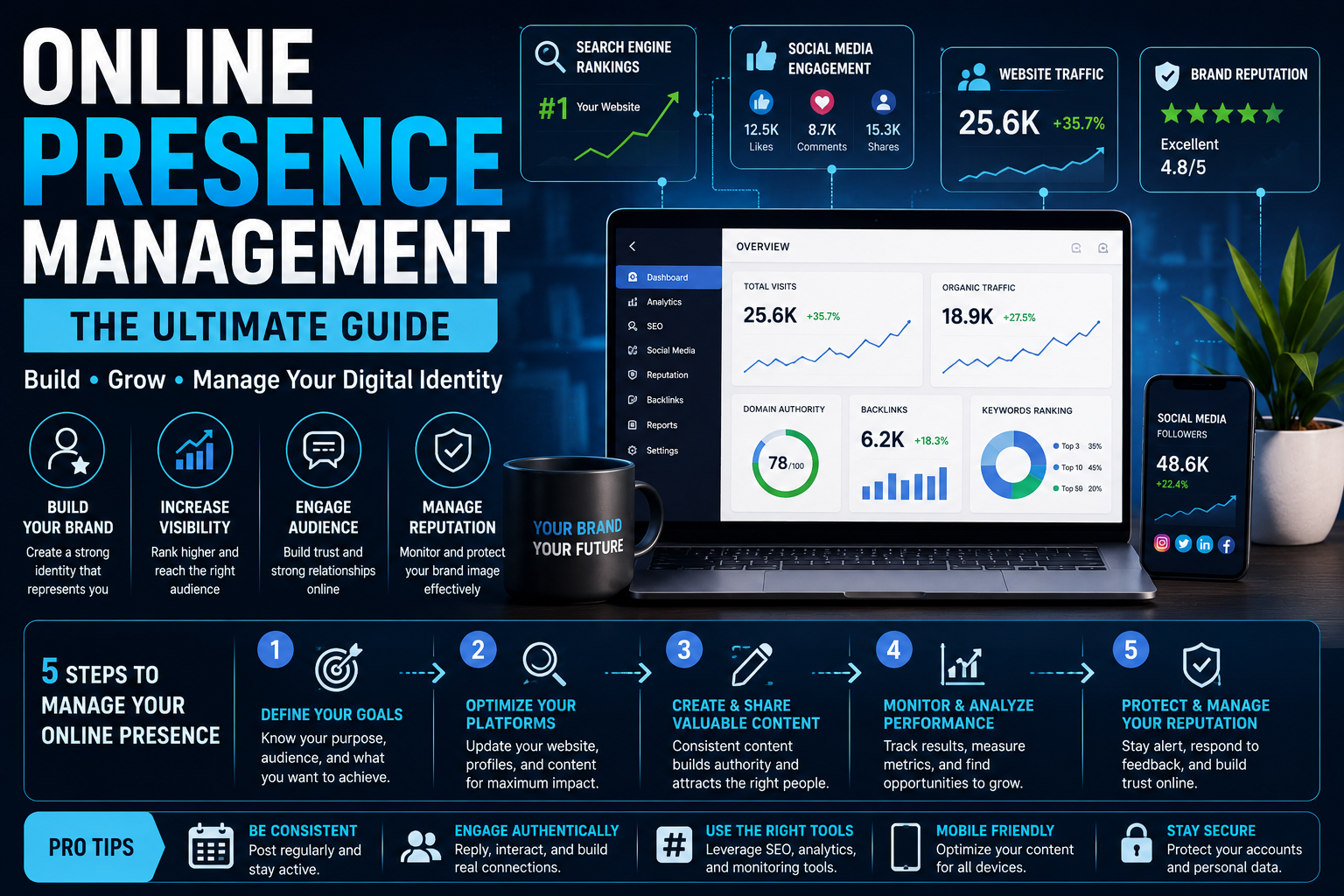
Online presence management is the strategic practice of controlling and improving how a brand appears across all digital channels. It is both proactive (building visibility and authority) and defensive (protecting your reputation from negative content and misinformation).
It encompasses four interconnected domains:
- Search visibility: Appearing in Google, Bing, and AI-generated search results for relevant queries
- Reputation management: Monitoring and responding to reviews, mentions, and public sentiment
- Content authority: Publishing credible, useful content that positions you as a trusted expert
- Social media presence: Maintaining active, on-brand profiles on platforms where your audience spends time
| Key distinction: Online presence management differs from digital marketing in one critical way: it is both offensive and defensive. You are not just promoting your brand you are protecting it. |
Why Online Presence Management Matters in 2026?
The Search Landscape Has Changed Permanently
Google now surfaces AI-generated overviews, local packs, featured snippets, and review stars before a user ever clicks a link. If your brand does not appear in these zero-click results, you are invisible to a growing share of searchers. Optimizing for these features is now a core component of any digital presence strategy.
Your Reputation Lives in Public
A single negative review on Google or Yelp can suppress customer acquisition for months. Research from Harvard Business School found that a one-star increase in Yelp rating correlates with a 5 to 9 percent increase in revenue. Managing online reputation is not optional, it is a direct revenue lever.
AI Systems Are Synthesizing Your Brand Reputation
Tools like ChatGPT, Perplexity, and Google Gemini pull information about businesses from across the web. If your digital presence is thin, inconsistent, or negative, AI models will reflect that to users who ask about your brand. Generative engine optimization (GEO) making your brand citable and authoritative across these systems is now a critical layer of online presence management.
Trust Is Won Before First Contact
According to Gartner (2024), B2B buyers complete 57 to 70 percent of their purchase decision before ever speaking to a salesperson. For B2C brands, the number is even higher. Your online presence is your first sales conversation and it is happening without you in the room.
The 5 Pillars of a Strong Digital Presence
Effective online presence management rests on five interconnected pillars. Neglect any one of them, and the others underperform.
Pillar 1: Website and Technical SEO Foundation
Your website is the center of your digital presence strategy. Everything else points back to it. A technically sound website signals credibility to both search engines and users.
Core requirements:
- Page load time under 2.5 seconds (Google Core Web Vitals benchmark)
- Clean URL structure with descriptive, keyword-rich slugs
- Schema markup implemented for Organization, LocalBusiness, Article, and FAQ
- Mobile-first design over 60% of searches occur on mobile (Statista, 2025)
- Quarterly audits for broken links, crawl errors, and outdated content
- HTTPS security certificate (required for Google trust signals)
- Clear internal linking structure connecting pillar pages to cluster content
Pillar 2: Google Business Profile and Local Listings
For any business serving a geographic area, Google Business Profile (GBP) is non-negotiable. It is the single highest-ROI asset in local online presence management.
A fully optimized GBP includes:
- Accurate NAP data (Name, Address, Phone) consistent across all directories
- Updated business hours including holidays and special hours
- High-quality photos added at least monthly
- Regular Google Posts covering events, offers, and updates
- A systematic process for requesting and responding to reviews
- Products or services listed with descriptions and pricing where applicable
- Q&A section populated with common customer questions
Beyond GBP, ensure consistent listings across Yelp, Apple Maps, Bing Places, and any industry-specific directories relevant to your niche.
Pillar 3: Content Marketing and Topical Authority
Publishing valuable content on a consistent schedule builds brand online visibility and earns search rankings over time. Google rewards websites that demonstrate expertise, authoritativeness, and trustworthiness (E-E-A-T).
An effective content strategy for online presence management includes:
- A keyword-mapped editorial calendar targeting informational, navigational, and transactional queries
- Long-form pillar pages covering core topics comprehensively (like this guide)
- Supporting cluster content shorter posts, FAQs, and how-to guides that link back to pillar pages
- Original research, case studies, or data that earn backlinks and media citations
- Author bios with credentials to strengthen E-E-A-T signals
- Regular content updates to keep existing pages fresh and accurate
Pillar 4: Review and Reputation Management
Reputation management is the most emotionally charged and most neglected element of online presence management. A proven system turns reactive damage control into a proactive brand asset.
A complete reputation management system includes:
- Monitor: Set up Google Alerts, Mention.com, or ReviewTrackers to catch every brand mention
- Respond: Reply to every review within 24 to 48 hours, positive or negative
- Request: Build a post-transaction email or SMS workflow to generate reviews from satisfied customers
- Remediate: For legitimate negative reviews, offer a direct resolution path offline. Never argue publicly.
- Audit: Review your overall rating and sentiment monthly across all platforms
Pillar 5: Social Media Presence
Social media presence does not mean being everywhere. It means being consistent and strategic where your audience actually is. An inactive profile can damage credibility more than having no profile at all.
Choose platforms based on audience demographics:
- LinkedIn: B2B, professional services, recruiting, thought leadership
- Instagram and TikTok: B2C, visual products, younger demographics, short-form video
- Facebook: Local businesses, community-driven brands, broad consumer reach
- X (Twitter): Tech, media, real-time commentary, niche thought leadership
Maintain a posting cadence you can sustain. One quality post per platform per week consistently outperforms five low-effort posts followed by two weeks of silence.
How to Build and Improve Your Online Presence: Step-by-Step
Step 1: Conduct a Digital Presence Audit
Before building, audit what you currently have. A thorough audit reveals your biggest gaps and highest-priority opportunities.
Evaluate the following:
- Google search results for your brand name (pages 1 through 3)
- Completeness and accuracy of your Google Business Profile
- NAP consistency across directories using a tool like Moz Local or BrightLocal
- Review volume, average rating, and response rate across major platforms
- Social media profile completeness and last-posted date
- Website speed (use Google PageSpeed Insights), mobile usability, and technical SEO health (use Screaming Frog or Ahrefs)
Step 2: Claim and Optimize All Key Profiles
Claim every profile associated with your brand, even platforms you do not plan to actively use. An unclaimed profile can be edited by the public, populated with incorrect information, or dominated by competitors’ ads.
Priority profiles to claim and optimize:
- Google Business Profile
- Yelp Business
- Apple Maps Connect
- Bing Places for Business
- LinkedIn Company Page
- Facebook Business Page
- Industry-specific directories (Houzz for contractors, Healthgrades for medical practices, Avvo for attorneys)
Step 3: Build a Content Calendar
Map your content to the buyer journey. Informational content (blog posts, guides) targets early-stage awareness. Comparison content and case studies serve consideration-stage searchers. Landing pages and testimonials convert decision-stage visitors.
A simple quarterly content calendar structure:
- Month 1: 2 to 4 pillar pages targeting your core service keywords
- Month 2: 4 to 8 cluster posts supporting each pillar (FAQs, how-to guides, comparisons)
- Month 3: 1 original data piece or case study plus a round of pillar page updates
Step 4: Implement a Review Generation System
A consistent flow of fresh reviews signals to both users and search algorithms that your business is active and trustworthy. Automate review requests at the peak satisfaction moment immediately after delivery, service completion, or product activation.
Review generation best practices:
- Use a short, direct link to your Google review form (generate via GBP dashboard)
- Send the request via SMS or email within 1 to 2 hours of service completion
- Personalize the message with the customer’s name and the specific service provided
- Follow up once if no review is received within 5 days do not send more than two requests
Step 5: Monitor and Iterate Monthly
Online presence management is not a one-time project. Set monthly KPIs and review them consistently:
- Average review rating across all platforms
- Google Search impressions and click-through rate (Google Search Console)
- Profile views and actions on Google Business Profile
- Domain authority or backlink growth (Ahrefs or Moz)
- Social media reach and engagement rate per platform
- Organic traffic by landing page (Google Analytics 4)
How to Manage Online Reputation Effectively
Why Reputation Is a Business Asset
Brand reputation is now measurable on a balance sheet. According to the World Economic Forum (2024), more than 25 percent of a company’s market value is attributable to its reputation. For small and mid-sized businesses, the percentage is even higher if a local business has fewer assets to offset reputational damage.
For consumers, trust is built through consistency. Businesses with a higher volume of recent, positive reviews consistently outperform competitors in both local search rankings for local businesses and conversion rates.
The Four-Part Reputation Response Framework
When a negative review or public criticism appears, use this sequence:
- Acknowledge: Thank the reviewer for their feedback. Do not lead with defensiveness.
- Empathize: Validate the experience, even if the complaint is partially inaccurate.
- Act: Offer a concrete resolution or escalation path offline.
- Close: Once resolved, invite the customer to update their review if appropriate.
| Important note:Responding publicly to negative reviews is not just good customer service, it is a trust signal for every future customer reading that review. How you handle criticism publicly defines your brand character. |
Proactive Reputation Building
The most effective reputation management is prevention. Businesses that proactively collect reviews, publish transparent content, and respond promptly to feedback rarely face reputation crises because satisfied customers outnumber and outvote the occasional dissatisfied one.
Proactive strategies include:
- Publishing customer success stories and case studies
- Responding to every positive review (not just negative ones)
- Creating a transparent “About” page with team bios and credentials
- Earning press mentions and backlinks from reputable local and industry media
Tools for Managing Online Reputation
- Google Alerts (free): Brand name mentions across the web
- ReviewTrackers: Aggregates reviews from 100+ platforms in one dashboard
- Birdeye / Podium: Full-suite reputation and messaging platforms for SMBs
- Brand24: Social listening and sentiment tracking with influencer detection
- Mention.com: Real-time brand monitoring across social, news, and web
Social Media Presence: Strategy Over Volume
The Common Mistake: Platform Overextension
Most small businesses and freelancers spread themselves across five platforms and maintain none of them effectively. A dormant Instagram with 11 followers damages brand credibility more than having no Instagram at all. Presence quality matters more than platform quantity.
The 3-Platform Rule for Early-Stage Businesses
Select no more than three platforms. For each, define:
- Audience: Who exactly is on this platform, and do they match your buyer persona?
- Content format: What does success look like here long-form posts, short video, images, or Stories?
- Posting cadence: What can you publish consistently without burning out?
- Engagement protocol: How will you respond to comments and DMs within 24 hours?
Organic vs. Paid Social for Brand Visibility
Organic social builds long-term brand equity and community. Paid social accelerates reach and drives immediate conversions. For online presence management, use organic content to establish authority and credibility, then use paid amplification to promote your best-performing content to new, targeted audiences.
A practical framework:
- Publish organic content consistently for at least 60 days before investing in paid promotion
- Identify your top 3 to 5 organic posts by engagement these become your paid ad creative
- Use retargeting to re-engage website visitors with your social content
Real-World Case Study: From Invisible to Authoritative in 6 Months
Background
Business type: Independent financial planning firm with 3 advisors in a mid-sized US city.
Baseline conditions:
- No Google Business Profile claimed
- Website last updated in 2019 with no mobile optimization
- Zero online reviews across any platform
- No active social media presence
Month 1 to 2: Presence Foundation
The team claimed and fully optimized their Google Business Profile, correcting NAP data across 14 directory listings using BrightLocal. The website was rebuilt with schema markup, updated service pages, and a mobile-responsive design that loaded in under 2 seconds.
Month 3 to 4: Content and Review Engine
A monthly blog strategy launched with four posts per month targeting local search queries (such as “financial advisor [city name]” and “retirement planning for business owners”). A post-meeting email sequence began requesting Google reviews from existing clients.
Month 5 to 6: Social Authority
A LinkedIn company page launched with weekly posts a mix of financial education tips, team highlights, and repurposed blog content. Paid LinkedIn ads targeted business owners in the metro area with lead generation campaigns.
Results at 6 Months
- Google search impressions: +312%
- Inbound leads from organic search: +87%
- Average Google rating: 4.8 stars (from 0 reviews to 41 reviews)
- LinkedIn follower count: 620 (from 0)
- Revenue attributed to digital channels: increased from less than 5% to 22% of new client acquisition
The firm did not increase its total marketing budget. Online presence management replaced inefficient print advertising with a compounding digital asset that continues to generate leads.
Generative Engine Optimization (GEO): The Emerging Layer of Online Presence
As AI-powered search tools like ChatGPT, Perplexity, and Google AI Overviews become primary research channels for consumers, a new discipline has emerged: generative engine optimization (GEO).
GEO focuses on ensuring that AI models represent your brand accurately and favorably when users ask questions related to your products, services, or industry. Unlike traditional SEO, GEO is less about ranking positions and more about being cited as an authoritative source in AI-generated answers.
Key GEO best practices for online presence management:
- Publish structured, factual content that AI systems can easily parse and cite
- Earn citations from high-authority publications in your industry
- Maintain consistent, accurate information across all web properties
- Use schema markup to provide machine-readable context about your business
- Build a Wikipedia or Wikidata presence if your brand qualifies
- Monitor what AI tools say about your brand using test queries in ChatGPT and Perplexity monthly
Conclusion
Online presence management is not a marketing tactic. It is a business infrastructure decision.
Every day your brand appears inconsistently online, has unanswered reviews, or lacks content that demonstrates expertise, you are effectively subsidizing your competitors’ growth. The businesses that dominate their markets in the coming decade will be those that treat their digital presence as a managed asset not an afterthought.
The framework in this guide gives you the foundation. Start with a digital presence audit, claim your key profiles, build a review generation process, and publish content with clear intent. From there, the compound effect of consistent online presence management will do the rest.
Frequently Asked Questions About Online Presence Management
What is the difference between online presence management and digital marketing?
Online presence management is a broader discipline that includes both proactive brand building (content, SEO, social media) and defensive reputation protection (review management, monitoring, and response). Digital marketing typically refers to the promotional and paid-acquisition side. Online presence management is the foundation; digital marketing is built on top of it.
How long does it take to see results from online presence management?
Most businesses see measurable improvements within 60 to 90 days for review ratings, local listing visibility, and website technical performance. Content authority and organic search rankings typically develop over 6 to 12 months of consistent effort. Reputation recovery from significant negative events can take 12 to 24 months, depending on the volume and severity of the original damage.
What is the best way to improve online presence for a small business?
The highest-ROI starting point is a fully optimized Google Business Profile combined with a systematic review generation process. These two actions directly influence local search rankings and consumer trust with minimal cost or technical expertise required. From there, build content and social presence incrementally.
How do I manage online reputation when I receive a negative review?
Respond publicly, promptly (within 24 hours), and professionally. Acknowledge the experience, apologize for any genuine shortfall, and invite the reviewer to contact you directly to resolve the issue. Never argue, retaliate, or ignore negative reviews. A well-handled negative review often builds more trust with future customers than a page of unchallenged five-star reviews.
Do I need to be on every social media platform to have a strong online presence?
No. Presence quality matters more than platform quantity. Two active, well-managed platforms consistently outperform five neglected ones. Choose platforms based on where your target audience is most concentrated and maintain a posting cadence that is realistic for your team.
What tools are best for tracking online presence?
For businesses just starting out: Google Search Console (free), Google Business Profile Insights (free), and Google Alerts (free) provide solid baseline monitoring. For scaling businesses: Semrush or Ahrefs for SEO and keyword tracking, BrightLocal or Moz Local for citation management, and Mention.com or Brand24 for ongoing reputation monitoring.
Can online presence management help with AI search results?
Yes. Generative AI tools like ChatGPT, Perplexity, and Google AI Overviews draw from publicly available web content. A strong digital presence, consistent brand signals, authoritative content, positive reviews, and accurate structured data increases the likelihood that AI systems will represent your brand accurately and favorably when users ask about your products or services.
How much does online presence management cost?
Costs vary significantly based on whether you manage in-house or hire an agency. DIY management using free tools (Google Search Console, Google Business Profile, Google Alerts) can be done for zero direct cost beyond staff time. Professional tools like Semrush, BrightLocal, and Brand24 range from $50 to $500 per month depending on plan. Full-service agency management typically ranges from $1,000 to $5,000+ per month for small to mid-sized businesses.