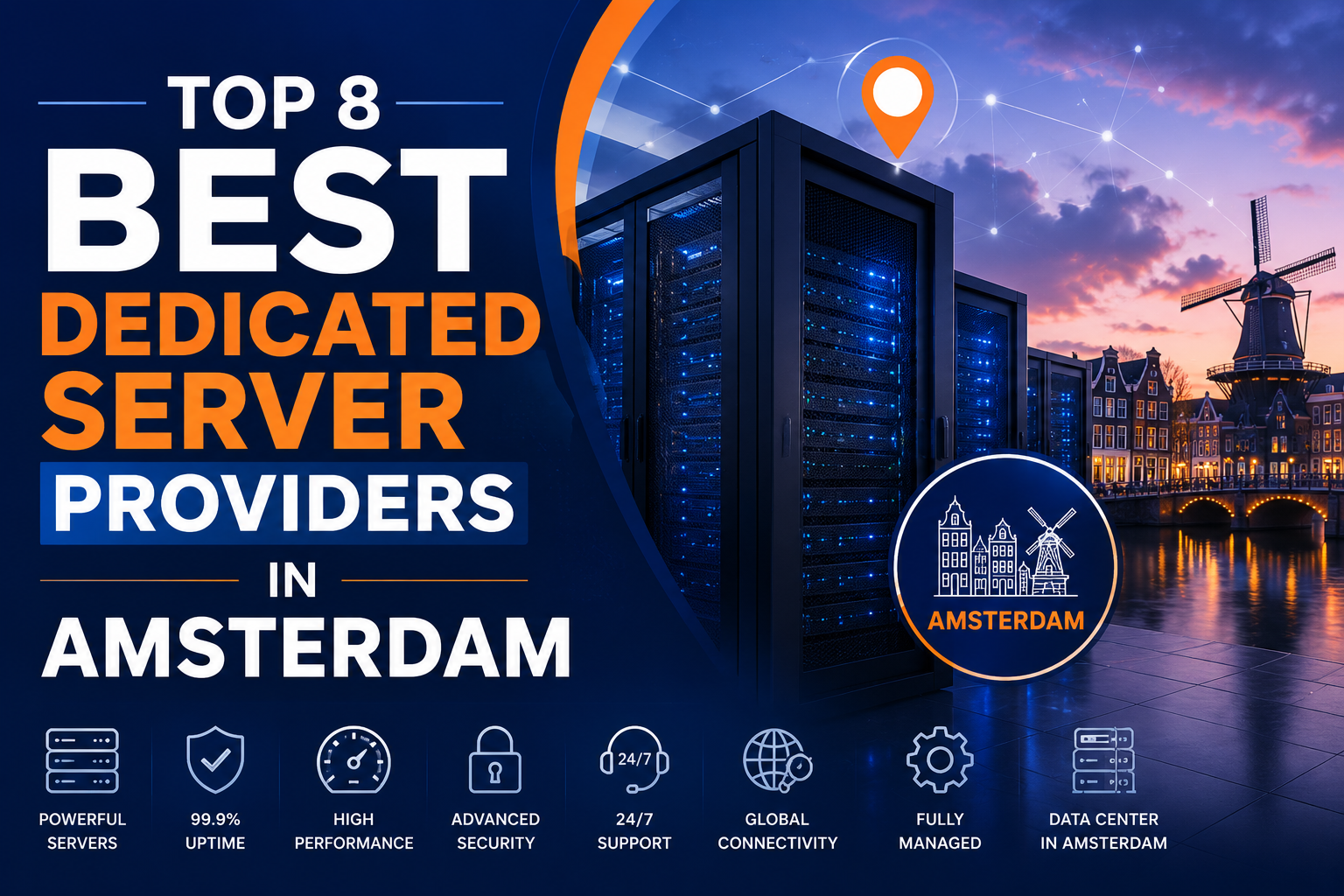
Amsterdam is the network capital of Europe. With nearly 300 data centers operating in the Netherlands and direct access to one of the world’s largest internet exchanges, it is the default choice for businesses that need fast, compliant, and reliable hosting infrastructure for European audiences.
This guide breaks down the eight best dedicated server providers in Amsterdam, with a full comparison table, detailed provider profiles, and a use case matching section to help you choose the right fit fast.
Why Amsterdam for Dedicated Servers?
| Factor | Why It Matters |
|---|---|
| AMS-IX | One of the world’s largest internet exchanges, handling 3.5 Tbps average with 5.5 Tbps peaks. Direct peering means low-latency routing across all of Europe. |
| EU Data Privacy Laws | The Netherlands enforces protections beyond baseline GDPR. Hosting here satisfies data residency requirements for EU businesses. |
| Geographic Position | Sub-10ms latency to London, Frankfurt, and Paris. Central position on European network routes. |
| Power Costs | Lower per-kilowatt rates than London or Stockholm. Competitive pricing without sacrificing infrastructure quality. |
| Market Maturity | The Netherlands ranks third in Europe for data center density. Deep ecosystem of carriers, exchanges, and interconnect options. |
What to Check Before Choosing a Provider
AMS-IX peering. Not all providers peer at AMS-IX directly. Some route through upstream transit, which adds latency and reduces routing efficiency. Ask specifically whether they have direct peering, not just proximity to the exchange.
Tier rating. Tier 3 data centers have N+1 redundancy, so scheduled maintenance happens with systems still running. Tier 1 and 2 are fine for dev environments but too risky for production.
True NVMe storage. Plenty of providers advertise fast storage and deliver SATA SSD. If I/O performance matters to your workload, get it confirmed in writing before you order.
Support response SLA. “24/7 support” is a marketing phrase. What you want is a specific, contractual response time. Ask for the SLA document.
ISO 27001 certification and DPA. Both are required for any application touching EU personal data. A provider that cannot produce these quickly is a red flag.
Total cost of ownership. Base pricing is almost never the real number. Add up bandwidth overages, setup fees, IP transit charges, and IPMI access costs before comparing providers.
Quick Comparison: Top 8 Amsterdam Dedicated Server Providers
| Provider | Starting Price | Tier | AMS-IX | Support SLA | Best For |
|---|---|---|---|---|---|
| ServerMania | Custom quote | Tier 1 | Direct (AMS-IX + NL-IX) | 15 min, 24/7 | Managed hosting, compliance workloads |
| Gcore | ~$65/mo | Tier 3 | Direct | Fast, 24/7 | Gaming, streaming, DDoS-sensitive apps |
| Hetzner | ~$39/mo | Tier 3 | Indirect | 24/7 tickets | Budget bare metal, dev teams |
| OVHcloud | ~$60/mo | Tier 3 | Direct | 24/7 | Large-scale EU infrastructure |
| Vultr | ~$175/mo | Tier 3 | Indirect | 24/7 | Hybrid cloud + bare metal setups |
| Cherry Servers | Custom quote | Tier 3 | Direct | 24/7 | Web3, AI/ML, high-compute bare metal |
| NovoServe | Custom quote | Tier 3 | Direct | 24/7 | EU data sovereignty, high-bandwidth |
| Leaseweb | Custom quote | Tier 3 | Direct | 24/7 | Enterprise scale, compliance-heavy |
The 8 Best Dedicated Server Providers in Amsterdam
1. ServerMania
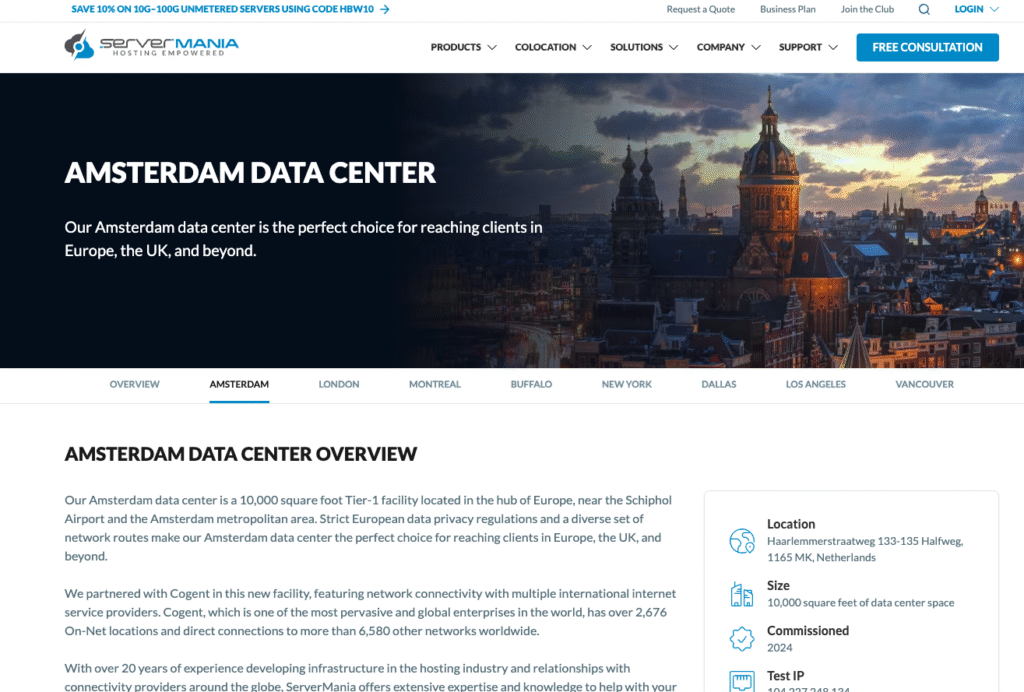
ServerMania has been building dedicated server infrastructure since 2002, and their Amsterdam expansion reflects over two decades of operational experience applied to one of Europe’s most competitive hosting markets. The facility is a 10,000 sq ft Tier-1 data center sitting between the Amsterdam metro area and Schiphol Airport, with direct connectivity to both AMS-IX and NL-IX.
Facility at a glance
- 2,000 kVA power feed supporting up to 160 server racks
- 100% uptime SLA backed by redundant power systems and dual generators
- ISO/IEC 27001 certified with regular third-party audits
- Full GDPR compliance with Data Processing Agreements available
Hardware options
- Intel Xeon E3, Xeon E5, and AMD EPYC configurations
- Fully managed, colocation, hybrid, and standard bare metal deployments
- Custom builds handled end-to-end by their engineering team
Support
This is the area where ServerMania genuinely separates from the rest of the market. Support response is guaranteed at 15 minutes or less, around the clock, which puts them in a different category from most dedicated server providers. Standard configurations deploy in as little as five minutes through their Surge platform. For teams that do not want to manage infrastructure themselves, the managed services tier delivers enterprise-grade hardware with hands-on operational support, no in-house infrastructure team required.
Best for: Businesses that need customizable hardware, ISO-certified compliance, and managed support depth without hiring for it internally.
2. Gcore
Gcore is a Luxembourg-based edge cloud company founded in 2014. They started in gaming infrastructure and built outward from there into a full enterprise hosting platform. Their Amsterdam data center has direct AMS-IX peering and delivers sub-10ms latency to major European cities, with entry configurations from around $65 per month.
Key specs
- Starting at ~$65/month with 1 Gbps unmetered bandwidth included
- Direct AMS-IX peering, sub-10ms to London, Frankfurt, and Paris
- L3 and L4 DDoS protection included on every plan, no extra charge
- Enterprise AMD and Intel configurations available across 25+ global locations
- Standard servers provisioned in under 4 hours; custom builds take 24 to 48 hours
- GDPR compliant with data processing agreements and EU-resident data guarantees
Gcore holds a Guinness World Record for simultaneous online players on a single game server. That is not a marketing footnote. It is evidence that their infrastructure holds up under real-world, high-concurrency conditions at a scale very few providers have ever tested. With 210+ global points of presence, they are a strong fit for any platform that needs Amsterdam as a European anchor alongside reach elsewhere.
Best for: Gaming, streaming, and API platforms where DDoS protection, fast provisioning, and global routing performance are the priorities.
3. Hetzner
Hetzner is a German company founded in 1997 that operates hundreds of thousands of servers across European data centers. They own their facilities rather than lease them, which is the main reason their pricing consistently undercuts most of the market. Their Netherlands presence brings that pricing to Amsterdam-area buyers.
Key specs
- Starting at ~$39/month; April 2026 price adjustments apply to new and existing orders
- AX series: AMD Ryzen processors up to the Ryzen 9 7950X3D with DDR5 ECC RAM
- AX162-R: AMD EPYC Genoa 9454P, 48 cores, 256 GB DDR5 ECC RAM, Gen4 NVMe storage
- EX series: Intel Xeon configurations suited to high-frequency, latency-sensitive workloads
- 10 Gbps uplink available as an add-on; unlimited traffic standard on most configurations
- 100% green energy across all facilities
- C5 Type 2 certified as of March 2026; Nokia Deepfield Defender DDoS protection across EU infrastructure
The trade-off with Hetzner is clear. Managed services are thin. You get serious hardware, solid connectivity, and 24/7 ticket support. Everything above the physical layer is your responsibility. For technical teams that are comfortable with that arrangement, there is no better price-to-performance option in the Amsterdam market.
Best for: Developers and technical teams who manage their own infrastructure and want maximum hardware for minimum spend.
4. OVHcloud
OVHcloud is the largest European cloud provider, running over 500,000 servers across 46 data centers on four continents and serving 1.6 million customers in more than 140 countries. In February 2026 they released their Bare Metal 2026 generation, a full hardware refresh built around AMD Ryzen and EPYC processors, available now in Amsterdam.
Key specs
- Rise 2026: AMD Zen 5, intensive workloads and light virtualization, from ~$60/month
- Game 2026: AMD Ryzen 9000 X3D series, built-in Anti-DDoS, designed for gaming and VMs
- Advance 2026: AMD EPYC 4005, up to 16 cores/32 threads, DDR5 ECC RAM, 99.95% SLA, suited for blockchain and databases
- Scale 2026: AMD EPYC 9005 dual socket, up to 384 cores, up to 3 TB DDR5 ECC, up to 92 TB NVMe, 3-AZ deployment option
- Public bandwidth 1 to 5 Gbps; private bandwidth up to 50 Gbps via vRack
- ISO 27001 certified; water-cooled facilities; European data sovereignty backed by French jurisdiction
- vRack private networking included across the full catalog
OVHcloud builds and owns its servers, data centers, and fiber network. That vertical integration is how they keep delivery timelines tight and prices predictable. The Bare Metal 2026 refresh is the most significant hardware update in their catalog in years, bringing AMD Zen 5 and EPYC 9005 performance to price points that were previously occupied by older generation silicon.
Best for: Teams that need large-scale EU infrastructure with a freshly updated hardware catalog and room to grow without switching providers.
5. Vultr
Vultr is a US-based cloud provider operating across 32 global locations including Amsterdam. Their bare metal product sits at the intersection of cloud simplicity and dedicated performance, built for engineering teams that already run cloud-native workflows and want dedicated hardware within the same control plane.
Key specs
- Starting at ~$175/month for Amsterdam bare metal configurations
- Single-tenant physical hardware with zero virtualization overhead
- Instant provisioning on standard configurations
- Remote console and out-of-band access included
- Full REST API for infrastructure automation and orchestration
- Unified control plane across Vultr cloud compute, object storage, and bare metal
- 25 Gbps networking available on high-end configurations
- Supports Kubernetes, Docker, and custom OS images
The practical advantage Vultr has over traditional bare metal providers is operational simplicity for hybrid teams. If part of your stack runs on cloud VMs and part needs dedicated hardware, managing both through a single API and a single bill is a real quality-of-life improvement. The Amsterdam node has solid intra-European routing to the UK, Germany, and Scandinavia.
Best for: Engineering teams running hybrid infrastructure who want a single API, unified billing, and fast deployment across cloud and dedicated environments.
6. Cherry Servers
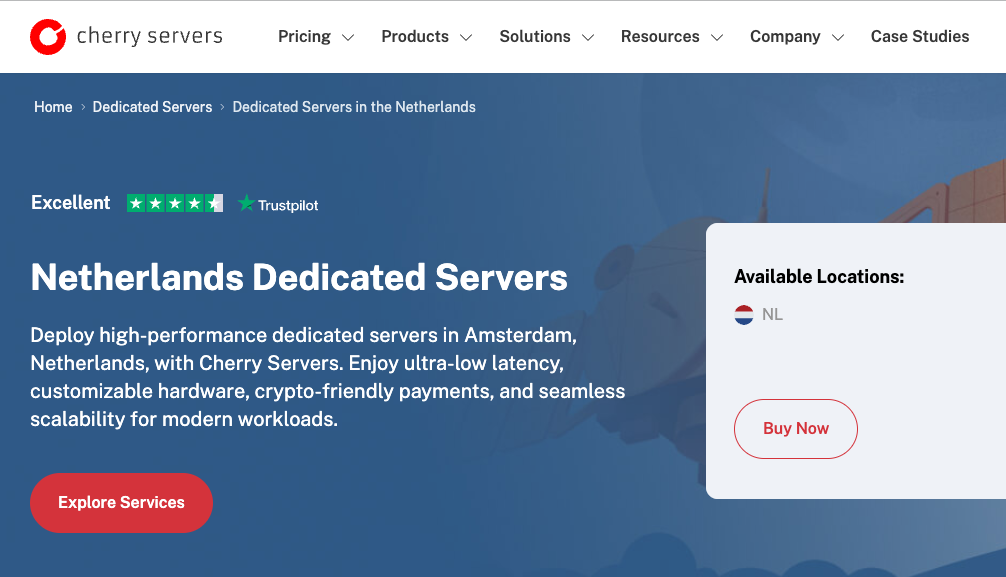
Cherry Servers is a Lithuanian bare metal provider operating in Amsterdam under ASN AS59642 with direct connectivity to Amsterdam-area exchanges. They have carved out a specific reputation in Web3, blockchain, and Solana validator infrastructure, where their high-core, high-RAM, NVMe configurations match the exact hardware profiles those workloads need.
Key specs
- AMD EPYC and Intel Gold processor options
- Up to 52 physical cores; RAM configurations up to 512 GB
- NVMe and HDD storage options; configurations up to 220 TB total storage capacity
- 10 Gbps to 25 Gbps network interfaces available
- Remote KVM access included on all servers
- Cryptocurrency payments accepted; no long-term contracts required
- Observed inventory supports Avalanche, Aptos, Polygon, and Ethereum validator profiles
- 24/7 support with fast provisioning on standard configurations
Cherry Servers does not require long-term commitments and takes crypto payments, which makes them a practical option for decentralized teams and Web3 projects that work outside standard procurement processes. Independent benchmarks of their Amsterdam configurations show sub-2ms latency to Amsterdam-area peers.
Best for: Blockchain validators, AI inference, high-frequency data processing, and Web3 infrastructure that needs raw compute, large RAM, and high-bandwidth connectivity.
7. NovoServe
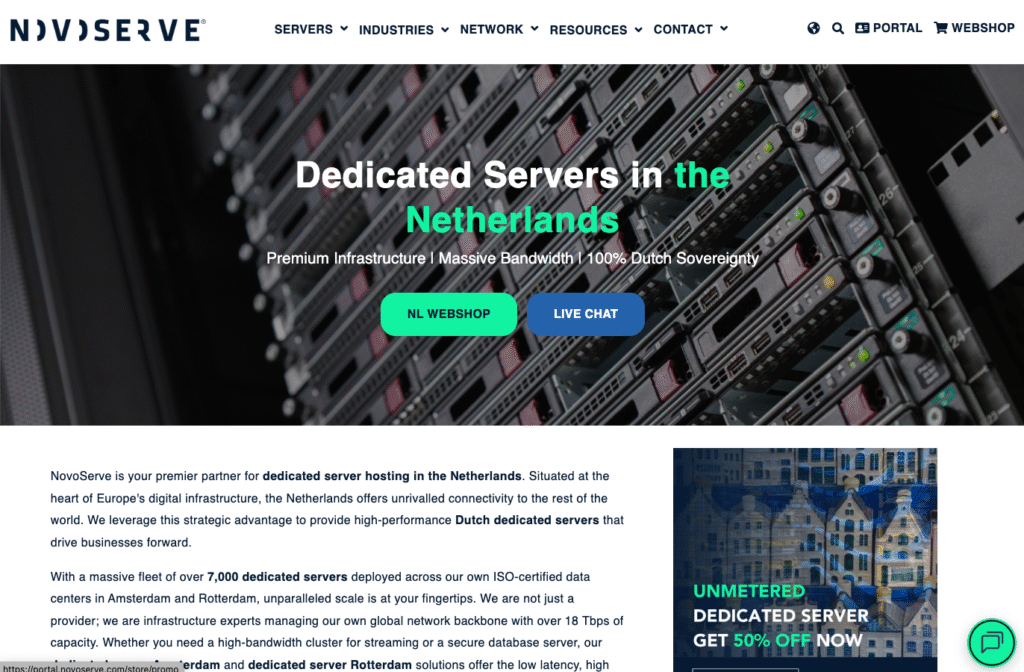
NovoServe is a Dutch-owned and Dutch-operated provider with 13 years in the dedicated server market. They manage 7,000+ servers across ISO-certified Tier-III data centers in Amsterdam and Rotterdam. They own their infrastructure outright and operate their own global network backbone at over 18 Tbps of capacity, which is how they keep high-bandwidth pricing competitive without leasing from third parties.
Key specs
- 7,000+ deployed servers across Tier-III ISO-certified data centers in Amsterdam and Rotterdam
- 18+ Tbps private network backbone with direct connections to major internet exchanges
- AMD EPYC, Intel Xeon, GPU servers, and unmetered bandwidth configurations
- IPMI remote access included as standard
- Perimeter DDoS protection on all servers
- Fully Dutch legal entity operating under Dutch and EU law only
- Not subject to US CLOUD Act jurisdiction
- 13+ years of bare metal operational history
The data sovereignty point here is not a marketing claim. NovoServe is incorporated in the Netherlands, founded by Dutch entrepreneurs, and operates exclusively under Dutch and EU law. That means data stored with them cannot be accessed by foreign governments under extraterritorial legislation like the US CLOUD Act. For regulated industries including healthcare, financial services, and public sector organizations, that legal distinction carries real weight in procurement and compliance reviews.
Best for: EU-regulated businesses, financial services firms, and public sector organizations that need infrastructure with a legally verified Dutch jurisdiction.
8. Leaseweb
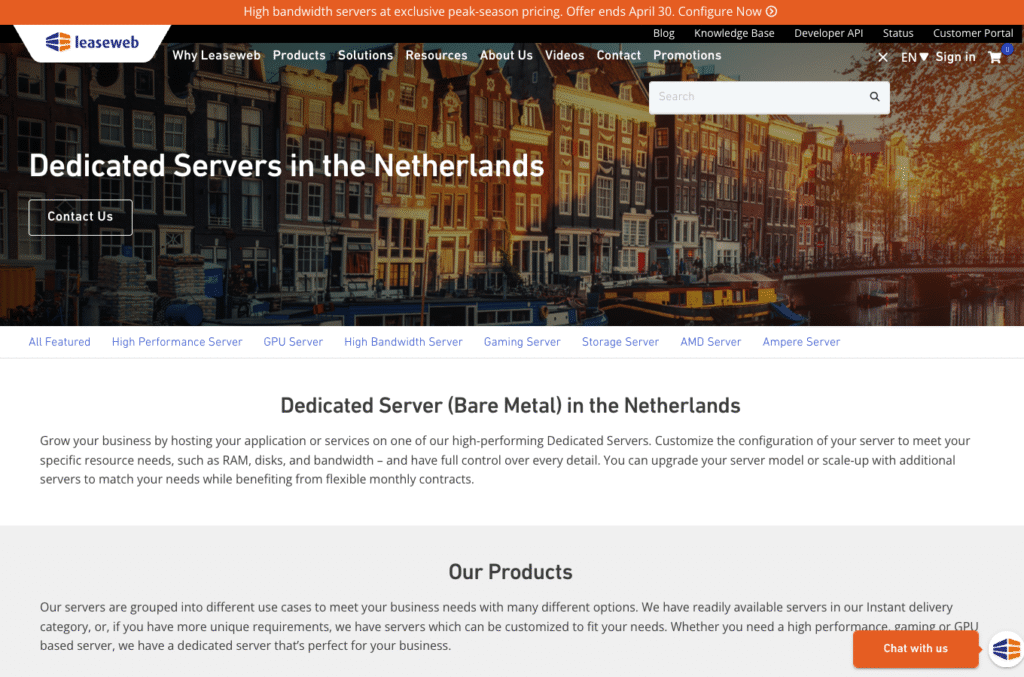
Leaseweb has been operating in the Netherlands since 1997. They run two ISO-certified data centers in the country, and their compliance certifications go well beyond what most providers on this list carry. Their global network reaches North America, Asia, and beyond, making them a practical choice for organizations that need Amsterdam as part of a wider multi-region deployment.
Key specs
- Two ISO 27001 certified data centers in the Netherlands
- Compliance certifications include ISO 27001, PCI DSS, HIPAA, SOC 1, and NEN 7510
- 100% renewable energy across Netherlands operations
- AMD, Intel, and GPU-powered server options
- All data stays within EU jurisdiction; GDPR compliant
- Server components recycled annually as part of active sustainability program
- Service tiers from fully unmanaged bare metal through to more managed options
- Global network coverage across North America, Europe, and Asia-Pacific
Leaseweb’s compliance stack is the most comprehensive on this list. PCI DSS and HIPAA certifications alongside ISO 27001 put them in a category that most providers here cannot match, and that matters specifically for businesses in payment processing, healthcare, and financial services that need documented certification rather than self-attestation.
Best for: Enterprises in regulated industries that need a compliance-certified, large-scale provider with a long operational history in the Netherlands.
Amsterdam Dedicated Servers by Use Case
| Use Case | Top Picks | Key Requirement |
|---|---|---|
| E-commerce / SaaS | ServerMania, OVHcloud | AMS-IX peering, managed support |
| Streaming / CDN | NovoServe, Gcore | Unmetered bandwidth, high port speed |
| Gaming servers | Gcore, OVHcloud Game 2026 | Low latency, DDoS protection |
| FinTech / Trading | ServerMania, NovoServe | Compliance docs, data sovereignty |
| Dev / Staging | Hetzner, Vultr | Low cost, fast provisioning |
| Web3 / Blockchain | Cherry Servers, OVHcloud Advance 2026 | Bare metal, high compute, KVM access |
| Regulated industries | Leaseweb, ServerMania | PCI DSS, HIPAA, ISO 27001 |
| Enterprise deployments | Leaseweb, OVHcloud Scale 2026 | Scale, global reach, long-term SLA |
Key Terms Explained
AMS-IX. The Amsterdam Internet Exchange, one of the world’s largest peering points. Direct connectivity to AMS-IX is a concrete performance advantage for European traffic routing, not just a data center location benefit.
Tier Rating. Describes data center redundancy levels. Tier 3 means N+1 redundancy, so maintenance runs without taking systems offline. Tier 4 is fully fault-tolerant. Tier 1 has no redundancy.
NVMe vs SATA SSD. NVMe delivers significantly faster I/O due to the PCIe interface. Relevant for databases, high-traffic applications, and any workload where disk read/write speed is a constraint.
IPMI/KVM. Out-of-band remote access to the physical server. Lets you reboot, reinstall, or troubleshoot even when the OS is completely unresponsive. Non-negotiable for production infrastructure.
ECC RAM. Error-correcting memory that detects and corrects data corruption at the hardware level. Important for database servers and production workloads where silent data errors have real consequences.
DPA (Data Processing Agreement). A contract required under GDPR when a vendor processes personal data on your behalf. Every provider handling EU personal data must have a signed DPA in place before you go live.
US CLOUD Act. A US law that can compel American companies to hand over data stored anywhere in the world. Providers headquartered in the EU, such as NovoServe and OVHcloud, operate outside this jurisdiction.
Frequently Asked Questions
Why Amsterdam over Frankfurt or London?
AMS-IX handles more traffic than any other European internet exchange. Amsterdam’s central geography also delivers better average latency across Western and Central Europe than Frankfurt or London as single hub locations. On top of that, Dutch data privacy law goes beyond baseline GDPR in ways that neither Germany nor the UK can fully replicate, particularly post-Brexit.
What data center tier do I need?
Tier 3 for any production workload. Tier 1 or 2 is acceptable for development or staging environments where brief downtime during maintenance is not a business problem.
Is GDPR compliance automatic if I host in Amsterdam?
Hosting in Amsterdam satisfies data residency requirements by keeping data inside EU jurisdiction. Full GDPR compliance also depends on how your application processes and stores data. Always request a signed Data Processing Agreement from your provider before going live with any user data.
How much does a dedicated server in Amsterdam cost?
Entry-level configurations start around $39 to $65 per month at Hetzner and Gcore. Mid-range managed options run $115 to $300 per month. Enterprise configurations with high core counts, NVMe storage, and managed support reach $500 to $1,000 per month and above.
What is the difference between managed and unmanaged hosting?
Unmanaged means you handle OS installation, security patching, and all troubleshooting yourself. Managed means the provider takes on some or all of that work. ServerMania’s managed tier with a 15-minute support SLA is the strongest option in Amsterdam for teams that want dedicated hardware without the operational overhead.
What is IPMI and why does it matter?
IPMI provides remote access to a physical server that is completely independent of the operating system. If the OS crashes or becomes unreachable, IPMI lets you reboot, reinstall, or diagnose the machine without touching it physically. Always confirm IPMI access is included, not an upsell, before purchasing a production server.
Which Amsterdam provider is best for data sovereignty?
NovoServe is the strongest option for strict data sovereignty. Dutch company, Dutch law, Dutch data centers, no US CLOUD Act exposure. OVHcloud as a French company under EU law also provides strong guarantees. Both are in a materially better position than providers headquartered in the US or UK.