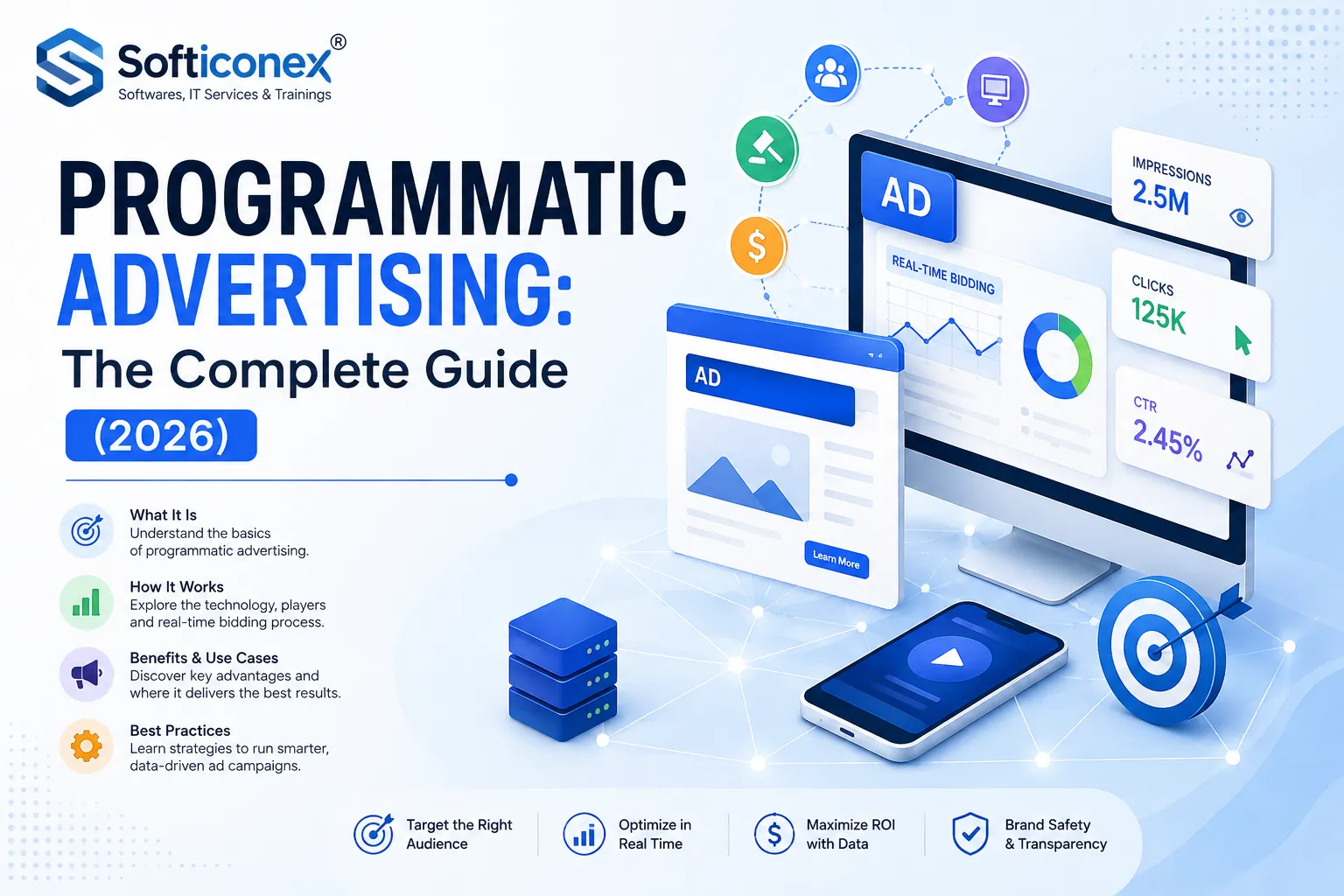
What Is Programmatic Advertising?
Programmatic advertising is the automated buying and selling of digital ad space using software and algorithms instead of manual negotiations, insertion orders, and human-to-human deals. In a traditional ad buy, a marketer or agency contacts a publisher directly, negotiates rates, and signs a contract. In programmatic advertising, that entire process is handled by technology in real time often in the milliseconds it takes a webpage to load.
At its core, programmatic advertising connects two sides of the market:
- Advertisers (the demand side): Brands and agencies who want to show ads to specific audiences.
- Publishers (the supply side): Websites, apps, streaming services, and other platforms that have ad space to sell.
Software platforms sit between these two groups, running automated auctions that match the right ad with the right impression, for the right person, at the right price, instantly.
How Programmatic Advertising Works
A typical programmatic transaction happens through Real-Time Bidding (RTB), and it unfolds in a fraction of a second:
- A user visits a website or opens an app.
- The publisher’s ad space is offered for sale through a Supply-Side Platform (SSP), which sends the impression details (page context, user data, device type, location) to an ad exchange.
- The ad exchange broadcasts this opportunity to multiple Demand-Side Platforms (DSPs).
- Advertisers using those DSPs have pre-set rules and budgets; the DSP automatically evaluates the impression and places a bid based on value, audience match, and campaign goals.
- The highest qualifying bid wins the auction.
- The winning ad is served to the user all before the page finishes loading.
This entire sequence, often called the “ad tech waterfall” or “bid stream,” typically completes in under 100 milliseconds.
Types of Programmatic Advertising
Not all programmatic buying happens through open, real-time auctions. The main transaction models are:
| Model | Description | Best For |
|---|---|---|
| Real-Time Bidding (RTB) / Open Auction | Impressions are sold to the highest bidder in an open marketplace, available to any buyer | Scale, broad reach, testing |
| Private Marketplace (PMP) | An invite-only auction where select advertisers bid on premium inventory from a specific publisher | Brand safety, premium placements |
| Programmatic Guaranteed (PG) | A fixed price and guaranteed volume of impressions are agreed upon in advance, but the technical delivery is still automated | Reserved premium inventory, sponsorships |
| Preferred Deals | A publisher offers inventory at a fixed price to a select buyer before it goes to open auction, with no volume guarantee | First-look access to specific inventory |
Key Components of the Programmatic Ecosystem
- Demand-Side Platform (DSP): Software that lets advertisers buy ad inventory across many publishers and exchanges from one dashboard, using targeting, bidding, and optimization tools.
- Supply-Side Platform (SSP): Software that helps publishers manage, sell, and optimize the value of their available ad inventory across multiple demand sources.
- Ad Exchange: A digital marketplace where DSPs and SSPs meet to conduct auctions in real time.
- Data Management Platform (DMP) / Customer Data Platform (CDP): Systems that collect, organize, and activate audience data (demographics, behavior, purchase intent) to inform targeting decisions.
- Ad Network: An older, simpler model that aggregates unsold inventory from multiple publishers and resells it to advertisers, typically without real-time bidding.
- Ad Verification & Measurement Tools: Platforms that confirm ads were viewable, served to real humans (not bots), and shown in brand-safe environments.
Ad Formats Bought Programmatically
- Display banners (standard and rich media)
- Video (in-stream and out-stream)
- Connected TV (CTV) and Over-the-Top (OTT) video
- Native ads (in-feed, sponsored content)
- Audio ads (streaming music and podcasts)
- Digital out-of-home (DOOH) billboards, transit screens, retail displays
- In-app mobile ads
- Retail media (ads on e-commerce sites like Amazon or Walmart)
Benefits of Programmatic Advertising
- Efficiency and speed: Campaigns launch and adjust in real time without manual insertion orders.
- Precise targeting: Ads reach specific audiences based on demographics, behavior, location, device, and first-party data.
- Scale: A single platform can reach inventory across thousands of publishers and apps at once.
- Transparency and measurement: Detailed reporting on impressions, clicks, viewability, and conversions.
- Budget control: Automated bidding strategies help control cost-per-acquisition and prevent overspending.
- Cross-channel reach: One campaign can span display, video, CTV, audio, and DOOH from a single interface.
Challenges and Criticisms
- Ad fraud: Bots and fake traffic can drain budgets if fraud protection isn’t in place.
- Brand safety: Ads can appear next to inappropriate or damaging content without careful controls.
- Lack of transparency (“the black box”): Fees, supply-path complexity, and reseller markups can obscure where ad dollars actually go.
- Privacy regulation and cookie deprecation: Laws like GDPR and CCPA, along with the phase-out of third-party cookies, are pushing the industry toward first-party data, contextual targeting, and privacy-safe data clean rooms.
- Supply path complexity: The same impression can pass through multiple resellers before reaching an advertiser, inflating cost and reducing transparency, a problem the industry calls “supply path optimization” (SPO) is meant to solve.
Major Programmatic Advertising Providers and Tools (2026)
The competitive landscape has shifted in the last few years: MediaMath went bankrupt in 2023 and now operates at a smaller scale as Infillion MediaMath, and Microsoft’s legacy Xandr/AppNexus platform, known as Microsoft Invest, is winding down by February 28, 2026, with Amazon DSP named as the preferred migration destination for its advertisers. The current market leaders include the following.
Demand-Side Platforms (DSPs)
| Platform | Provider | Key Strength | Best Fit |
|---|---|---|---|
| Display & Video 360 (DV360) | Deep integration with YouTube and Google’s ad inventory | Advertisers prioritizing Google/YouTube reach | |
| The Trade Desk | The Trade Desk | Independent (not tied to a walled garden), strong CTV and identity tools | Advertisers wanting auction transparency and cross-publisher reach |
| Amazon DSP | Amazon | Exclusive access to Amazon shopping data and retail placements (Fire TV, Twitch, IMDb, on-site product pages) | Retail and e-commerce brands |
| Adobe Advertising Cloud | Adobe | Native integration with Adobe Experience Cloud, Analytics, and Real-Time CDP | Enterprises already using the Adobe marketing stack |
| StackAdapt | StackAdapt | Easy-to-use interface, native ads, AI campaign assistant (“Ivy”) | Mid-market and B2B marketers with tighter budgets |
| Basis Technologies | Basis Technologies | Centralized workflow automation, strong private marketplace (PMP) support | Large agencies managing complex, high-volume buys |
| Infillion MediaMath | Infillion | Independent omnichannel buying with transparent fee reporting | Agencies wanting an alternative outside Google/Amazon |
| SmartyAds | SmartyAds | Full-stack DSP + SSP + white-label options | Agencies wanting a customizable, branded platform |
| Choozle | Choozle | Hands-on onboarding support and coaching | Smaller teams new to programmatic buying |
| Epom | Epom | White-label, self-serve DSP infrastructure | Agencies wanting to build a branded ad-tech stack |
Supply-Side Platforms (SSPs)
| Platform | Provider | Key Strength |
|---|---|---|
| Google Ad Manager | Widely adopted publisher ad server and exchange | |
| PubMatic | PubMatic | Strong focus on publisher yield optimization and header bidding |
| Magnite | Magnite | Largest independent SSP, strong in CTV |
| Index Exchange | Index Exchange | Transparent auction dynamics, header bidding pioneer |
| OpenX | OpenX | Focus on brand safety and sustainable ad tech |
Data, Measurement, and Verification Tools
| Tool | Category | What It Does |
|---|---|---|
| Integral Ad Science (IAS) | Ad verification | Measures viewability, brand safety, and fraud detection |
| DoubleVerify (DV) | Ad verification | Fraud prevention, brand suitability, viewability measurement |
| Nielsen | Measurement | Cross-media audience and reach measurement |
| Comscore | Measurement | Digital audience analytics, CTV measurement |
| LiveRamp | Identity/data | Identity resolution and data clean room infrastructure |
| Adobe Real-Time CDP / Salesforce Data Cloud | CDP | First-party data collection and activation |
Comparison Table: Leading DSPs at a Glance
| Platform | Inventory Access | AI/Automation Features | Ideal For | Notable Limitation |
|---|---|---|---|---|
| DV360 | Google Display Network, YouTube | Automated bidding, audience signals | Advertisers needing YouTube/Google scale | Best results tied to Google ecosystem data |
| The Trade Desk | Open internet, CTV, audio | Koa AI optimization, identity tools (Unified ID) | Independent, cross-publisher reach | Requires more hands-on strategy/expertise |
| Amazon DSP | Amazon-owned and third-party sites | Shopping-based audience targeting | Retail and e-commerce brands | Limited value for non-retail advertisers |
| Adobe Advertising Cloud | Display, video, CTV, social, search | Adobe Sensei AI, dynamic creative optimization | Enterprises using Adobe Experience Cloud | Higher cost, complex setup |
| StackAdapt | Display, video, native, CTV, audio | “Ivy” AI assistant | Mid-market and B2B marketers | Smaller premium CTV footprint than larger players |
| Basis Technologies | Display, video, native, audio, CTV, PMP | Workflow automation across channels | Agencies managing complex PMP deals | Steeper learning curve |
Programmatic Advertising Pricing Models
- CPM (Cost Per Mille): Cost per 1,000 impressions the most common programmatic pricing unit.
- CPC (Cost Per Click): Advertiser pays only when a user clicks the ad.
- CPA (Cost Per Acquisition): Advertiser pays only when a defined conversion happens.
- CPV (Cost Per View): Common for video ads, charged per completed or qualifying view.
- Platform/Technology Fees: Many DSPs charge a percentage of media spend (often 10–20%) on top of media costs for platform access and optimization.
Programmatic Advertising Trends to Watch
- Retail media growth: Amazon, Walmart, and other retailers are becoming major programmatic ad channels thanks to first-party purchase data.
- Connected TV (CTV) expansion: Streaming platforms continue to absorb ad budgets shifting away from linear TV.
- AI-driven optimization: DSPs increasingly use machine learning for predictive bidding, creative optimization, and audience discovery.
- Privacy-first targeting: Contextual targeting, first-party data strategies, and data clean rooms are replacing third-party cookie-based tracking.
- Supply path optimization (SPO): Advertisers are consolidating the number of SSPs and resellers they buy through to cut costs and increase transparency.
- Consolidation among platforms: Market shakeups such as MediaMath’s 2023 bankruptcy and Microsoft Invest’s 2026 shutdown are pushing more spend toward a smaller number of dominant DSPs.
Frequently Asked Questions
Is programmatic advertising the same as real-time bidding (RTB)?
No. RTB is one method of programmatic buying (open auctions), while programmatic advertising is the broader category that also includes private marketplaces, programmatic guaranteed deals, and preferred deals.
Do I need an agency to run programmatic campaigns?
Not necessarily. Many DSPs offer self-serve options for smaller advertisers, though larger or more complex campaigns often benefit from agency or in-house trading desk expertise.
How much does programmatic advertising cost?
Costs vary widely by channel, platform, and competition for the audience, but most platforms charge on a CPM basis plus a technology or management fee.
What’s replacing third-party cookies in programmatic targeting?
First-party data, contextual targeting, and privacy-safe identity solutions such as data clean rooms and unified ID frameworks.
This guide is written as original content for general informational purposes and may be freely used, shared, or republished.