AI search is changing how people discover software. Instead of opening Google, comparing ten different websites, and reading multiple reviews, a potential customer might ask ChatGPT to recommend the best project management platform for a remote team or ask Perplexity to compare several CRM tools.
The answer they receive can influence which products they investigate, which brands they trust, and ultimately which software they buy.
For SaaS companies, this creates a new challenge: How do you know whether AI search engines are mentioning your brand, recommending your product, or citing your website as a source?
Traditional SEO tools remain important, but rankings and organic traffic alone do not tell the whole story. Marketing teams also need to understand how their brands appear in AI-generated answers, which competitors get recommended, and what information AI platforms use when discussing their products.
This is where AI search visibility tools come in.
These platforms help businesses monitor brand mentions, analyze citations, compare competitors, and identify opportunities to improve their presence across AI-powered search experiences. Some focus primarily on tracking, while others offer content recommendations, optimization workflows, and broader SEO capabilities.
In this guide, we compare 12 AI search visibility tools SaaS companies should consider in 2027, including their main strengths, ideal use cases, and factors to evaluate before choosing a platform.
What Are AI Search Visibility Tools?
AI search visibility tools help businesses understand how often, where, and in what context their brands appear in AI-generated responses.
Depending on the platform, they may monitor experiences such as ChatGPT, Google AI Overviews, Google AI Mode, Perplexity, Gemini, and other supported AI assistants.
For example, imagine a SaaS company selling email marketing software. Its marketing team might track questions such as:
- What are the best email marketing platforms for small businesses?
- Which email marketing tools integrate with Shopify?
- What are the best alternatives to Mailchimp?
- Which email marketing platforms offer marketing automation?
An AI visibility platform can help the team examine whether its product appears in the answers, which competitors receive recommendations, and which sources are cited.
Some tools also track sentiment, share of voice, product-level mentions, and changes in visibility over time.
However, AI answers can vary depending on the prompt, location, model, and timing. A brand appearing in one response does not guarantee that it will appear in another. These tools are most useful for identifying patterns across repeated observations rather than treating a single answer as a definitive result.
How We Selected These AI Search Visibility Tools
We considered several factors relevant to SaaS marketing teams:
- AI visibility tracking: Can the platform monitor brand mentions and recommendations across supported AI search experiences?
- Citation analysis: Can users identify websites and other sources referenced in AI answers?
- Competitor research: Can teams compare their visibility with competing brands?
- Actionable insights: Does the platform help users identify content gaps or opportunities for improvement?
- Reporting: Can marketers monitor changes over time and communicate findings to stakeholders?
- SaaS suitability: Is the platform appropriate for the company’s size, marketing workflow, and reporting needs?
The tools below are not presented as a scientifically measured ranking. They serve different purposes, and the best choice depends on the team’s requirements. Features, integrations, supported AI engines, and pricing can change, so confirm the current offering before committing to a subscription.
Quick Comparison: 12 AI Search Visibility Tools
| Tool | Best suited for | Main focus |
| Addlly AI | SaaS teams seeking visibility analysis and content execution | GEO audits, monitoring, optimization |
| Profound | Enterprise marketing teams | AI search analytics |
| Peec AI | Marketing teams tracking brand visibility | Multi-platform monitoring |
| Otterly.AI | Smaller teams getting started with AI visibility | Monitoring and reporting |
| AthenaHQ | Teams wanting insights and optimization workflows | AI visibility and recommendations |
| Writesonic | Teams combining content creation and AI visibility | Content and search optimization |
| Scrunch AI | Brands analyzing AI discovery and customer journeys | AI visibility and optimization |
| Semrush | Teams already using an established SEO suite | SEO and AI visibility |
| Ahrefs | Teams focused on SEO research and brand discovery | Search intelligence and brand mentions |
| SE Ranking | Growing businesses managing SEO and AI visibility | SEO and AI search monitoring |
| Conductor | Enterprise SEO and content teams | Enterprise search intelligence |
| AirOps | Teams scaling content optimization workflows | AI-assisted content operations |
1. Addlly AI
Best for: SaaS companies that want to connect AI search visibility insights with content execution.
Monitoring your brand’s visibility in AI-generated answers is useful, but collecting data is only the first step. Marketing teams also need to decide which gaps matter, what content to improve, and how to measure progress.
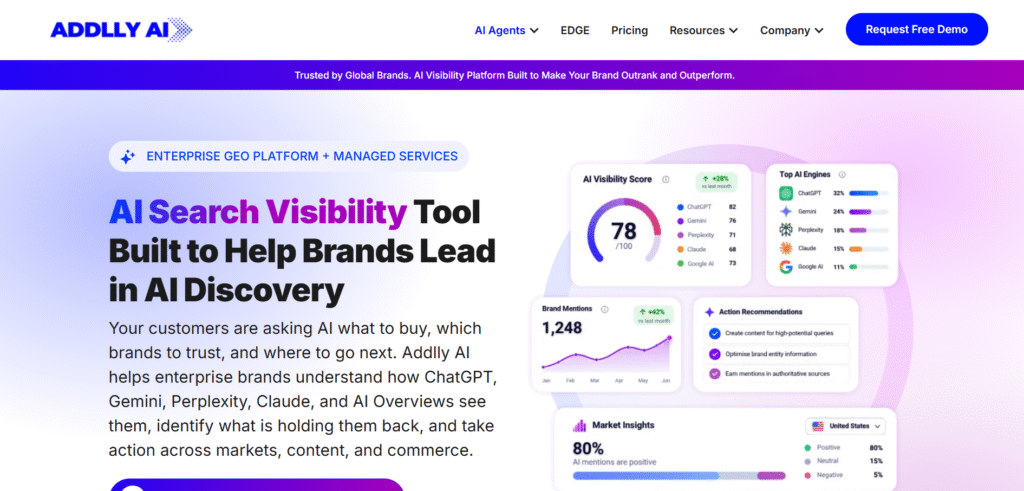
Addlly AI brings these activities together through its AI marketing and Generative Engine Optimization (GEO) offering.
The platform’s published offering includes GEO audits, AI visibility measurement, sentiment analysis, citation analysis, query and topic-cluster planning, and content optimization. Its plans also describe AI-assisted content production and workflows designed to help teams act on their findings.
For a SaaS company, this can be useful when the marketing team wants to investigate why competitors appear in answers about a particular software category while its own product receives little or no visibility.
The team can begin by identifying important buyer questions, examining current AI search presence, and looking for opportunities to improve relevant content. It can then use those findings to inform its broader content strategy.
Key capabilities include:
- GEO audits to establish a baseline for AI search visibility.
- AI Visibility Score and share-of-voice measurement.
- Citation analysis and sentiment tracking.
- Query research and topic-cluster planning.
- AI-assisted content optimization and production.
What to consider: Check which AI engines are supported by your selected plan, how query limits are calculated, and whether the content production and implementation support match your team’s needs.
Verdict: Addlly AI is worth evaluating for SaaS marketing teams looking for a combination of visibility measurement, strategic recommendations, and content execution rather than a standalone monitoring dashboard.
2. Profound
Best for: Enterprise teams that need deeper AI search analytics.
Larger SaaS companies often manage multiple product lines, customer segments, and markets. Their challenge is not simply finding out whether their brand appears in AI answers; they need to understand how visibility differs across topics, competitors, and customer questions.
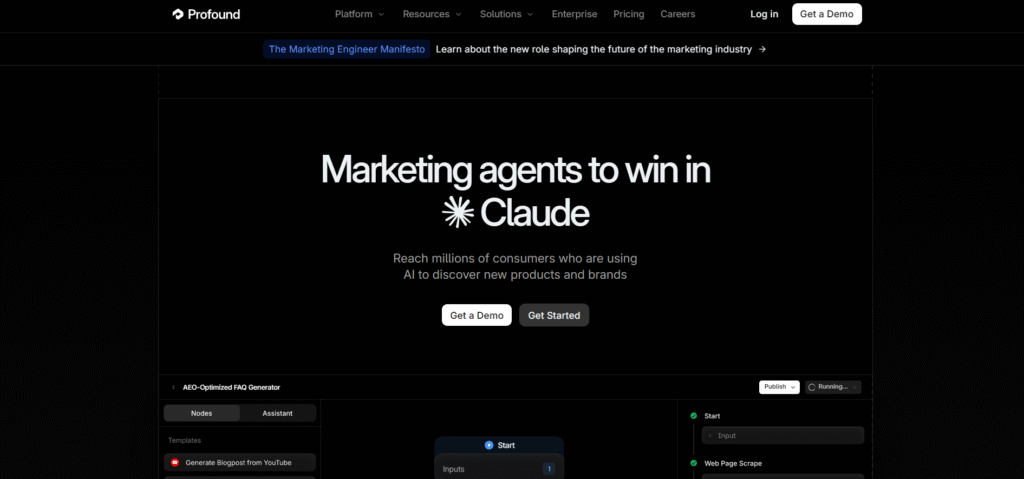
Profound is an AI search analytics platform built around this broader need.
It helps businesses examine how their brands appear across supported AI experiences and investigate the sources influencing AI-generated answers. This can be particularly useful for marketing teams that need structured reporting and a clearer understanding of how customers discover products through AI.
For example, an enterprise cybersecurity company could investigate whether AI assistants mention its platform when users ask about endpoint protection, cloud security, or alternatives to competing products.
The results can inform content planning, competitive research, and broader brand visibility analysis.
Key capabilities to evaluate:
- AI search visibility monitoring.
- Brand and competitor analysis.
- Citation and source research.
- Reporting for marketing and search teams.
What to consider: Enterprise platforms can involve more extensive setup and higher costs than lightweight monitoring tools. Review supported engines, query allowances, integrations, and reporting access before choosing a plan.
Verdict: Profound is worth considering for established SaaS businesses that need more detailed AI search intelligence.
3. Peec AI
Best for: Marketing teams that want to track brand visibility across AI platforms.
AI visibility data becomes more useful when teams can compare their brand’s presence with that of competitors over time.
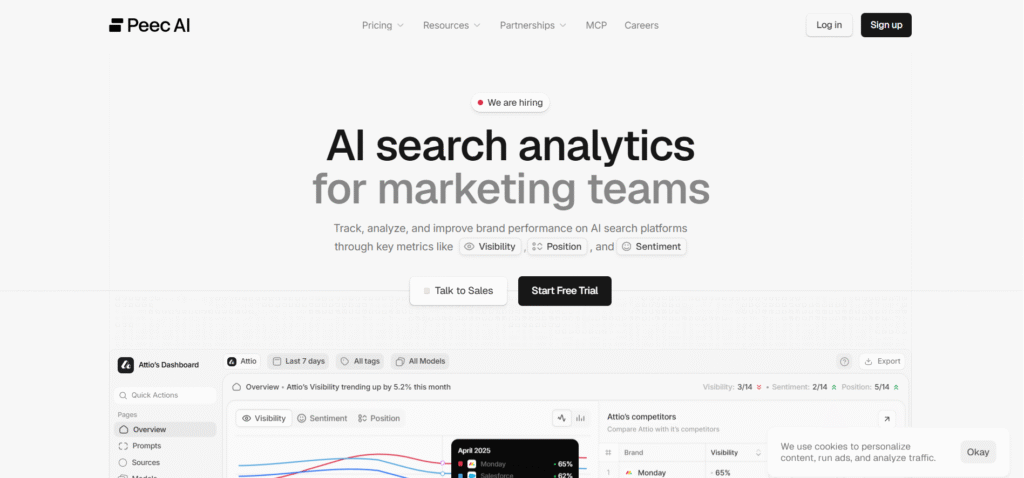
Peec AI focuses on monitoring brand visibility across supported AI platforms and helping marketing teams understand how they appear in AI-generated responses.
Consider a SaaS company competing in the customer support software market. Its marketing team could monitor questions about the best help desk software, compare mentions of competing products, and examine whether its brand is becoming more or less visible across tracked prompts.
This information can help teams identify competitive gaps and decide which topics deserve closer investigation.
Key capabilities to evaluate:
- AI brand visibility monitoring.
- Competitor comparisons.
- Prompt and topic tracking.
- Reporting across supported AI platforms.
What to consider: Check which AI models are included in the plan, how often data is refreshed, and whether the reporting supports your required markets and languages.
Verdict: Peec AI is a relevant option for SaaS teams that want a dedicated platform for monitoring and comparing AI search visibility.
4. Otterly.AI
Best for: Smaller marketing teams starting with AI visibility monitoring.
Not every SaaS company needs a complex enterprise analytics platform. For a startup with a small marketing team, a focused tool that monitors selected queries and reports brand mentions may be a more practical starting point.
Otterly.AI is designed to help businesses monitor their visibility in supported AI search experiences and understand how their brands appear in generated responses.
A startup selling an SEO reporting tool, for instance, might track questions such as “best SEO reporting tools for agencies” or “alternatives to Semrush.” Monitoring these questions can help the team see whether its product appears alongside more established competitors.
The value comes from consistently tracking relevant queries and using the findings to guide marketing decisions.
Key capabilities to evaluate:
- AI search and brand mention monitoring.
- Competitor visibility tracking.
- Citation and source insights.
- Recurring reporting for selected prompts.
What to consider: Compare prompt limits, supported engines, refresh frequency, and the availability of historical data. A low entry price is useful only if the plan covers the queries your business actually needs to track.
Verdict: Otterly.AI is worth exploring for smaller SaaS teams that want to begin monitoring AI search presence without immediately adopting a broader enterprise platform.
5. AthenaHQ
Best for Teams looking to connect AI visibility analysis with optimization recommendations.
Finding a visibility gap is one thing. Understanding what to do about it is another.
AthenaHQ focuses on AI search visibility and optimization, helping businesses investigate how their brands appear in AI answers and identify opportunities to improve their presence.
For example, a SaaS company might discover that AI assistants frequently recommend competitors when users ask for accounting software for small businesses. The next step would be to examine the information available about those competitors, the sources being cited, and whether the company’s own website answers the same questions clearly.
This kind of analysis can inform product pages, comparison articles, educational content, and other marketing assets.
Key capabilities to evaluate:
- AI visibility tracking.
- Competitor and citation analysis.
- Brand performance reporting.
- Optimization recommendations and related workflows.
What to consider: Determine how recommendations are generated, which platforms are monitored, and whether the available actions fit your team’s existing content process.
Verdict: AthenaHQ is a useful candidate for SaaS teams that want to move beyond basic mention tracking toward a more action-oriented GEO workflow.
6. Writesonic
Best for: Teams combining AI visibility research with content creation.
Content remains an important part of SaaS marketing, but producing more articles does not automatically improve AI search visibility.
Teams need to create useful material that answers genuine customer questions, explains product capabilities accurately, and provides enough context for readers to make informed decisions.
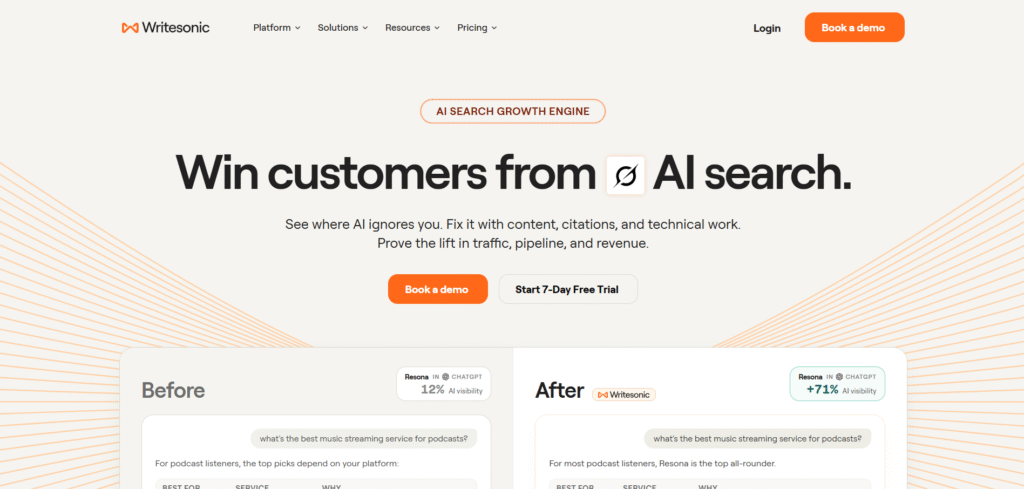
Writesonic combines AI-assisted content capabilities with SEO and AI search-related offerings. Depending on the current plan, it may be relevant to businesses looking to connect content workflows with search visibility research.
Imagine a project management SaaS company that wants to appear in answers about project planning tools for distributed teams. The marketing team could use its research to identify relevant questions, create a practical comparison guide, and improve existing content around that topic.
The important distinction is that content creation should follow research and editorial judgment, not replace them.
Key capabilities to evaluate:
- AI-assisted content production.
- SEO and content optimization workflows.
- Available AI visibility and brand monitoring features.
- Content research and planning support.
What to consider: Verify which AI search features are included in the specific plan. Content generation and AI visibility monitoring are different capabilities, and not every writing tool provides equally deep monitoring.
Verdict: Writesonic is worth considering when content production is a central part of your marketing workflow and you want to investigate its available search visibility capabilities.
7. Scrunch AI
Best for: Brands examining how they appear in AI-driven discovery experiences.
AI assistants do more than display links. They can summarize product categories, compare vendors, and guide people toward particular solutions.
Scrunch AI focuses on helping businesses understand and improve their presence in this changing discovery environment.
For a SaaS company, this can mean examining how AI platforms describe its product, whether its positioning is accurate, and how its presence compares with competing brands.
For instance, a CRM company may discover that AI-generated answers describe its platform as suitable for small businesses but rarely mention its enterprise automation capabilities. That observation could prompt the marketing team to review whether its website clearly communicates the product’s broader use cases.
Key capabilities to evaluate:
- AI brand visibility analysis.
- Competitor and customer-query research.
- Insights into AI discovery and product representation.
- Available auditing and optimization features.
What to consider: Review the supported AI experiences, the depth of reporting, and the specific optimization features available in your chosen plan.
Verdict: Scrunch AI is worth investigating for SaaS brands that want to understand how AI systems discover, describe, and recommend their products.
8. Semrush
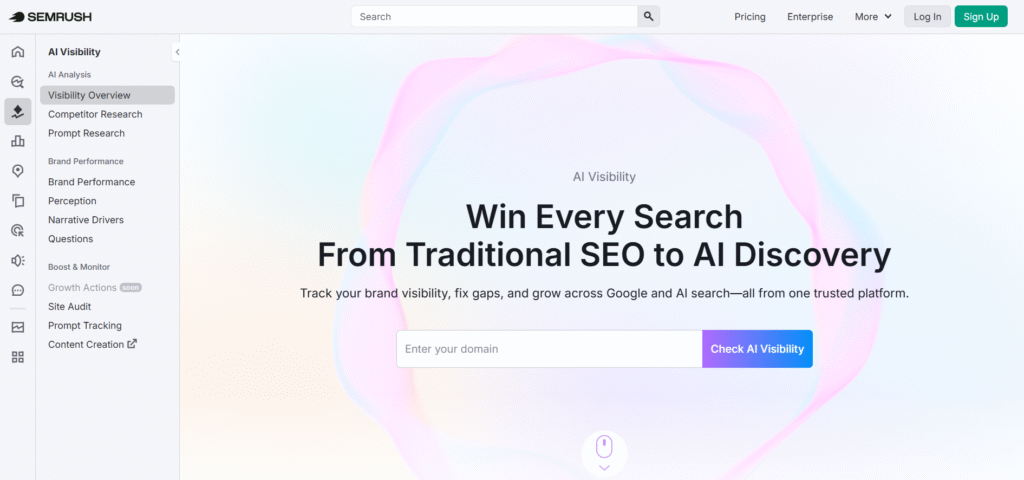
Best for: SEO teams that want to connect traditional search data with AI visibility insights.
Many SaaS marketing teams already rely on an SEO platform for keyword research, competitor analysis, backlinks, and organic performance reporting. Adding a separate AI visibility tool can create another dashboard to manage.
Semrush is relevant because it offers a broad SEO platform alongside AI visibility-related capabilities.
This combination can help marketers investigate how conventional search performance and AI-driven brand discovery fit into the same strategy.
Suppose a SaaS company ranks well for a product-related keyword but rarely appears when customers ask AI assistants for recommendations in that category. The team can investigate the difference and identify whether it needs stronger product explanations, comparison content, or more useful supporting resources.
Traditional rankings and AI visibility are not interchangeable metrics, but reviewing them together can provide a more complete picture of search performance.
Key capabilities to evaluate:
- Keyword and competitor research.
- Backlink analysis and traditional SEO reporting.
- Available AI visibility monitoring.
- Search and content performance insights.
What to consider: AI-related features may have separate pricing or plan requirements. Confirm the current toolkit, supported platforms, and available reporting before purchasing.
Verdict: Semrush is a natural option for SaaS teams that want to extend an established SEO workflow with AI visibility research.
9. Ahrefs
Best for: SaaS teams focused on SEO research, competitors, and brand discovery.
Understanding AI visibility is not only about checking whether a product appears in an answer. Marketing teams also want to investigate the information ecosystem surrounding their brand.
Ahrefs is widely used for backlink analysis, keyword research, and competitor research. Its Brand Radar offering adds AI-related brand visibility research to its broader search intelligence capabilities.
For example, a SaaS company could use traditional SEO research to identify competing pages, analyze websites linking to competitors, and explore its available AI visibility data to understand where its brand appears across supported experiences.
These activities can help teams build a stronger understanding of their competitive position, although backlinks alone do not guarantee AI recommendations.
Key capabilities to evaluate:
- Backlink and referring-domain research.
- Competitor and keyword analysis.
- Brand Radar’s available AI visibility data.
- Reporting options for tracked brands and topics.
What to consider: Review the distinction between traditional SEO features and AI visibility coverage. Check how Brand Radar is priced, which indexes are available, and whether the data matches your reporting needs.
Verdict: Ahrefs is worth considering for teams that already depend on its SEO research capabilities and want to investigate AI brand visibility within the same broader workflow.
10. SE Ranking
Best for: Growing SaaS businesses managing traditional SEO alongside AI search visibility.
Smaller and mid-sized SaaS companies often have to balance several priorities: improving rankings, monitoring competitors, building backlinks, and producing content with limited resources.
SE Ranking offers a broad SEO toolkit, while its AI visibility-related offerings provide another option for teams exploring how their brands appear in AI-generated search experiences.
The appeal is the possibility of bringing multiple search marketing activities into a more unified workflow.
A SaaS marketing manager, for example, might review traditional keyword performance, investigate competitors, and monitor AI visibility for a defined set of product-related questions.
This can make reporting more convenient, particularly when a team prefers a consolidated toolkit over several separate subscriptions.
Key capabilities to evaluate:
- Traditional SEO and competitor research.
- Website and keyword monitoring.
- Available AI visibility tracking and reporting.
- Integration with existing SEO workflows.
What to consider: Check the current SE Ranking and SE Visible product offerings carefully, since product packaging, feature availability, and pricing may differ.
Verdict: SE Ranking is worth evaluating for SaaS teams that want to manage established SEO activities while expanding their approach to AI search monitoring.
11. Conductor
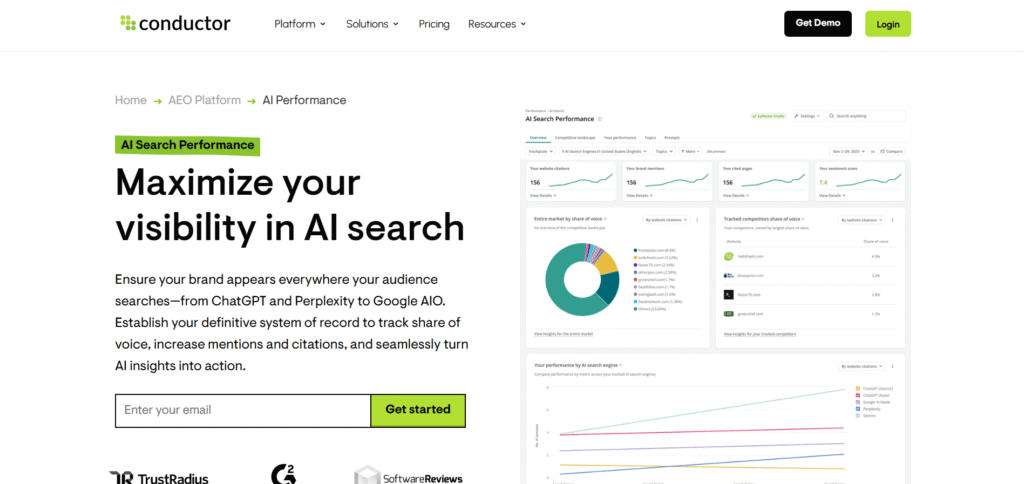
Best for: Enterprise SEO and content teams managing complex websites.
Large SaaS companies may operate several product websites, regional pages, resource centers, and documentation libraries. Keeping content organized and measuring its performance across these properties can be challenging.
Conductor provides enterprise SEO and content intelligence capabilities, with AI search-related offerings aimed at helping organizations understand their presence across changing search experiences.
For a large software company, the value may lie in connecting search insights with content planning and governance across multiple teams.
For example, an enterprise SaaS business could use its search intelligence workflow to identify content opportunities across product categories, then coordinate updates between SEO, product marketing, and editorial teams.
Key capabilities to evaluate:
- Enterprise SEO and content intelligence.
- Search performance and content opportunity research.
- Available AI search performance reporting.
- Workflows suited to larger teams and websites.
What to consider: Enterprise software often involves implementation requirements, stakeholder coordination, and custom commercial terms. Confirm which AI-related capabilities are included in the proposed package.
Verdict: Conductor is worth considering for larger SaaS organizations that need enterprise-level search and content workflows rather than a lightweight standalone tracker.
12. AirOps
Best for SaaS teams scaling content optimization and AI-assisted workflows.
Tracking AI search visibility can reveal opportunities, but a marketing team still needs a repeatable way to act on those findings.
AirOps focuses on AI-powered content operations and workflows. It is particularly relevant when a business wants to systematize content research, creation, optimization, and related marketing tasks.
Consider a SaaS company with hundreds of product-led educational pages. Reviewing every page manually may be impractical. A structured content workflow can help the team identify pages for review, organize research, and support updates while preserving human oversight.
AirOps is therefore best considered from the perspective of content execution and workflow automation rather than assumed to be identical to a dedicated AI visibility tracker.
Key capabilities to evaluate:
- AI-assisted content workflows.
- Content research and optimization.
- Repeatable processes for large content libraries.
- Integrations and automation options.
What to consider: Determine whether you need a dedicated tool for measuring AI mentions and citations, a platform for executing content workflows, or both. Confirm the current feature set before making a decision.
Verdict: AirOps is worth evaluating for SaaS teams that already understand their content priorities and need to scale the work required to address them.
How to Choose the Right AI Search Visibility Tool for Your SaaS Company
With so many platforms entering the market, choosing a tool based on its feature list alone can lead to unnecessary spending. Start with the business problem you are trying to solve.
1. Decide what you need to measure
Do you want to know whether AI assistants mention your brand? Are you more interested in the sources they cite? Or do you need to understand how your visibility compares with competitors?
These are related but different questions.
If your immediate priority is monitoring, start by comparing platforms with reliable prompt tracking and clear reporting. If you need to investigate sources and content gaps, prioritize citation analysis and competitive research.
2. Check which AI platforms are covered
Do not assume that every tool monitors every AI search experience.
Compare support for the platforms most relevant to your customers, such as ChatGPT, Gemini, Perplexity, Google AI Overviews, and Google AI Mode.
Also check whether each platform tracks the actual experience you care about, rather than assuming that monitoring one Google feature covers all Google AI experiences.
3. Examine the underlying data
A visibility score can be useful, but it should not be the only metric you evaluate.
Look for access to the underlying answers, prompt-level results, cited sources, competitor mentions, and historical changes. These details help explain why a score moved and whether the change is meaningful.
Where possible, check how frequently data is collected and whether the platform distinguishes different locations, languages, and AI models.
4. Look beyond monitoring
Some tools primarily tell you what is happening. Others help you identify content gaps, prioritize opportunities, or execute optimization workflows.
Neither approach is automatically better.
A small SaaS company with a capable SEO team may only need reliable monitoring. A company managing a large content operation may benefit from a platform that also supports research and execution.
5. Evaluate pricing against your actual needs
Compare more than the advertised starting price.
Review prompt limits, the number of brands and projects supported, historical data access, AI engines included, user seats, reporting exports, and additional costs.
A less expensive platform may be sufficient for a narrow use case. A more comprehensive platform may make sense if it replaces several tools or reduces substantial manual work.
6. Establish a baseline before judging results
Before implementing a new GEO strategy, record how your brand currently appears for a representative set of customer questions.
Track relevant metrics over time, including brand mention rate, recommendation rate, share of voice, citation frequency, and sentiment where available.
Use a consistent set of prompts and document changes to your website and content strategy. AI-generated answers can fluctuate naturally, so avoid attributing every change to a single optimization.
What Metrics Should SaaS Companies Track?
The most useful metrics depend on your objectives, but several are worth considering.
AI visibility or mention rate: How frequently does your brand appear in the monitored responses?
Recommendation rate: How often is your product explicitly recommended in relevant answers?
Share of voice: How does your brand’s presence compare with selected competitors within the defined measurement set?
Citation frequency: How often do AI responses cite your website or other sources associated with your brand?
Citation diversity: How many distinct sources are cited, and which publications or websites appear repeatedly?
Sentiment and entity accuracy: Is your brand described accurately, and is the surrounding language positive, neutral, or negative?
Referral traffic and conversions: Do visits attributed to AI-related sources lead to meaningful engagement, sign-ups, demos, or sales?
These metrics should be interpreted in context. A visibility score is not the same as organic traffic, and neither guarantees revenue. A brand can become more visible without generating more qualified leads.
The objective is to connect visibility data to actual business outcomes wherever reliable measurement is possible.
Final Thoughts
AI search visibility is becoming another important consideration for SaaS marketing teams. Buyers can now discover software through conversational answers and product comparisons, which means brands need to understand not only how they rank in search results but also how they are represented when AI systems answer customer questions.
The right tool depends on what your team needs most. Some businesses will benefit from a straightforward monitoring platform, while others need deeper analytics, enterprise reporting, or content execution workflows.
Start with your most important customer questions, identify the AI experiences that influence your audience, and choose a platform that provides enough detail to support real decisions.
For teams looking to understand and improve their AI search presence, Addlly AI’s GEO Audit can help identify how a brand appears across AI search platforms, assess its visibility and citations, and uncover opportunities for improvement. Combined with its GEO monitoring, analysis, and AI-assisted content workflows, Addlly AI helps marketing teams understand where they stand and plan their next steps.
Ultimately, the goal is not simply to appear in more AI-generated answers. It is to help potential customers discover your software, understand what makes it useful, and find accurate information when they are ready to make a decision.
.
Frequently Asked Questions
What is the difference between SEO and GEO?
Search engine optimization (SEO) focuses on improving a website’s visibility in conventional search results and other search experiences. Generative Engine Optimization (GEO) focuses on improving how a brand and its content are discovered, represented, mentioned, or cited in AI-generated answers.
The two overlap in areas such as technical accessibility, useful content, clear information architecture, and authority. GEO adds an emphasis on measuring and improving a brand’s presence within generated responses.
Do SaaS companies really need an AI search visibility tool?
Not every company needs a paid platform immediately. Smaller teams can begin by testing a consistent set of relevant questions across the AI experiences their customers use.
A dedicated tool becomes more useful when the company needs repeatable monitoring, competitor comparisons, citation research, historical reporting, or coverage across many prompts and markets.
Can AI visibility tools guarantee that a brand will be recommended?
No. AI responses are generated dynamically and can change with the prompt, context, model, and available information. A visibility platform can help measure patterns and identify opportunities, but it cannot guarantee that a brand will appear in every relevant answer.
Are AI search visibility tools a replacement for traditional SEO tools?
Generally, no. Traditional SEO tools remain useful for technical audits, rankings, backlinks, keyword research, and organic performance. AI visibility platforms address related but distinct questions about brand representation and citations in AI-generated answers.
Some products offer capabilities in both areas, so evaluate the actual feature set before buying multiple subscriptions.
How long does it take to improve AI search visibility?
There is no universal timeline. Results depend on factors such as the website’s existing content, brand recognition, competitive environment, the sources used by AI systems, and the changes implemented.
Teams should establish a baseline, make targeted improvements, and monitor results over time rather than expecting immediate or guaranteed gains.