What Is Cybersecurity?
Cybersecurity is the practice of protecting computers, networks, servers, applications, and data from unauthorized access, theft, damage, or disruption. It covers everything from stopping hackers who try to steal sensitive information, to blocking malware and ransomware, to preventing employees from accidentally exposing company data through a phishing email or a misconfigured cloud server. In short, it’s the set of technologies, processes, and people working together to keep digital systems safe and running as intended.
What Does a Cybersecurity Company Do?
A cybersecurity company builds and operates the tools and services that make this protection possible. Depending on their specialty, these companies design software that detects and blocks threats in real time (like firewalls, antivirus, and endpoint protection), monitor networks and systems around the clock through a Security Operations Center (SOC) to catch suspicious activity before it becomes a breach, investigate and contain attacks when they do happen, manage who has access to what through identity and authentication systems, and help businesses stay compliant with regulations like HIPAA, PCI-DSS, or SOC 2. Larger cybersecurity firms often combine several of these functions into one platform, while smaller or specialized companies focus on doing one thing like email security, cloud protection, or managed monitoring exceptionally well.
Why Cybersecurity Matters More Than Ever
Every business today runs on data, customer records, financial systems, intellectual property, and daily communication all live on networks that are constantly under attack. A single breach can cost a company millions of dollars in recovery, legal fees, regulatory fines, and lost customer trust. Ransomware gangs, phishing operations, nation-state hackers, and increasingly AI-generated attacks have turned cybersecurity from an “IT problem” into a boardroom priority.
A few reasons cybersecurity now sits at the top of business risk lists:
- Rising attack frequency and sophistication: Attackers use automation and AI to scale phishing, credential theft, and ransomware campaigns.
- Regulatory pressure: Frameworks like HIPAA, PCI-DSS, SOC 2, GDPR, and CMMC require documented, auditable security controls.
- Cloud and remote work: Distributed teams and multi-cloud environments have erased the traditional network perimeter.
- Supply chain risk: A vulnerability in one vendor or software dependency can compromise thousands of downstream companies.
- Reputational and financial impact: Beyond direct costs, breaches damage brand trust that can take years to rebuild.
Because of this, the market for cybersecurity vendors has exploded from network firewalls to cloud posture management, from endpoint detection to 24/7 managed security operations. Below is a detailed, original breakdown of 50 notable cybersecurity companies serving the U.S. market, what each one does best, and how to evaluate them.
What You Should Know Before Choosing a Cybersecurity Company
Before signing a contract with any vendor, consider the following:
- Define your actual risk profile: A 10-person startup and a 5,000-employee healthcare provider need very different tools. Know what you’re protecting (data, endpoints, cloud workloads, identities) before shopping.
- Understand the category you need: Cybersecurity isn’t one product it spans network security, endpoint/XDR, identity and access management (IAM), cloud security posture management (CSPM), application security, email security, SIEM/SOAR, and managed detection and response (MDR/SOC).
- In-house vs. managed (MSSP/SOC-as-a-Service): If you lack an internal security team, a managed SOC provider that monitors around the clock may be more practical than buying tools you can’t staff.
- Check integration, not just features: A tool that doesn’t integrate with your existing stack (cloud provider, SIEM, identity provider) creates blind spots.
- Ask about detection and response times: Mean time to detect (MTTD) and mean time to respond (MTTR) matter more than marketing claims.
- Look at compliance support: If you need SOC 2, HIPAA, PCI-DSS, or ISO 27001, ask whether the vendor provides audit-ready reporting.
- Evaluate total cost of ownership: Licensing is only part of the cost factor in implementation, staffing, and training.
- Request references and trial periods: Reputable vendors will offer proof-of-concept trials or case studies relevant to your industry.
- Review contract flexibility: Avoid long lock-in periods with vendors you haven’t fully vetted.
- Prioritize responsiveness: In an active incident, how fast a vendor’s team answers the phone matters as much as their technology.
Comparison Table: 50 Cybersecurity Companies in the USA
Ratings below are an independent editorial assessment (out of 5) based on general market reputation, product breadth, and industry standing, not a specific review platform’s data. Always verify current details directly with each vendor.
| # | Company | Headquarters | Primary Category | Best Known For | Editorial Rating |
| 1 | Palo Alto Networks | Santa Clara, CA | Network Security / Platform | Next-gen firewalls, SASE, Cortex XDR | 4.8 |
| 2 | CrowdStrike | Austin, TX | Endpoint / XDR | Cloud-native endpoint protection | 4.9 |
| 3 | Fortinet | Sunnyvale, CA | Network Security | Firewalls, SD-WAN, security fabric | 4.7 |
| 4 | Cisco Secure | San Jose, CA | Network / Zero Trust | Enterprise network security suite | 4.6 |
| 5 | IBM Security | Armonk, NY | Enterprise Security / AI | Threat intelligence, QRadar SIEM | 4.5 |
| 6 | Check Point Software | San Carlos, CA | Network Security | Firewall & threat prevention | 4.5 |
| 7 | Broadcom (Symantec Enterprise) | San Jose, CA | Endpoint / Enterprise | Legacy enterprise endpoint & DLP | 4.2 |
| 8 | McAfee | San Jose, CA | Consumer / SMB Security | Antivirus, identity protection | 4.0 |
| 9 | SentinelOne | Mountain View, CA | Endpoint / XDR | AI-driven autonomous endpoint defense | 4.7 |
| 10 | Rapid7 | Boston, MA | Vulnerability Mgmt / SIEM | InsightVM, detection & response | 4.4 |
| 11 | Qualys | Foster City, CA | Vulnerability Management | Cloud-based vulnerability scanning | 4.4 |
| 12 | Tenable | Columbia, MD | Exposure Management | Nessus, attack surface management | 4.5 |
| 13 | Proofpoint | Sunnyvale, CA | Email Security | Phishing & email threat protection | 4.6 |
| 14 | Zscaler | San Jose, CA | Cloud / SASE | Zero trust cloud security | 4.6 |
| 15 | Okta | San Francisco, CA | Identity & Access Mgmt | Single sign-on, identity governance | 4.6 |
| 16 | Splunk (Cisco) | San Francisco, CA | SIEM / Observability | Log analysis, security operations | 4.5 |
| 17 | Mandiant (Google Cloud) | Reston, VA | Threat Intelligence / IR | Incident response, threat research | 4.7 |
| 18 | F5 Inc. | Seattle, WA | Application Security | App delivery & API security | 4.3 |
| 19 | Varonis | New York, NY | Data Security | Data access governance, DSPM | 4.5 |
| 20 | CyberArk | Newton, MA | Privileged Access Mgmt | PAM, identity security | 4.7 |
| 21 | KnowBe4 | Clearwater, FL | Security Awareness Training | Phishing simulation & training | 4.5 |
| 22 | Barracuda Networks | Campbell, CA | Email / Cloud Security | Email, backup, application security | 4.3 |
| 23 | WatchGuard Technologies | Seattle, WA | Network Security (SMB) | Firewalls for SMB/MSP market | 4.2 |
| 24 | Forcepoint | Austin, TX | Data & Insider Threat | DLP, insider risk management | 4.2 |
| 25 | Malwarebytes | Santa Clara, CA | Endpoint / Consumer | Malware remediation | 4.2 |
| 26 | OpenText (Webroot) | Waterloo/US ops | Endpoint / SMB Security | Cloud-based antivirus for SMB | 4.0 |
| 27 | VMware Carbon Black (Broadcom) | Waltham, MA | Endpoint / Cloud Workload | EDR, cloud workload protection | 4.3 |
| 28 | Secureworks | Atlanta, GA | Managed Detection & Response | MDR, Taegis XDR platform | 4.4 |
| 29 | Arctic Wolf | Eden Prairie, MN | Managed Detection & Response | 24/7 security operations (SOC-as-a-Service) | 4.6 |
| 30 | Cloudflare | San Francisco, CA | Network / Edge Security | DDoS protection, CDN security | 4.7 |
| 31 | Akamai Technologies | Cambridge, MA | Edge / App Security | DDoS, web app & API protection | 4.6 |
| 32 | Imperva | San Mateo, CA | Application & Data Security | WAF, database security | 4.4 |
| 33 | LogRhythm | Boulder, CO | SIEM | Threat detection & log management | 4.2 |
| 34 | Exabeam | Foster City, CA | SIEM / UEBA | Behavior analytics, threat detection | 4.3 |
| 35 | Vectra AI | San Jose, CA | Network Detection & Response | AI-based network threat detection | 4.4 |
| 36 | Illumio | Sunnyvale, CA | Microsegmentation | Zero trust segmentation | 4.4 |
| 37 | Netskope | Santa Clara, CA | Cloud Security (SASE) | CASB, cloud DLP | 4.5 |
| 38 | Lookout | San Francisco, CA | Mobile Security | Mobile threat defense | 4.2 |
| 39 | Wiz | New York, NY | Cloud Security (CNAPP) | Cloud posture & workload security | 4.8 |
| 40 | Orca Security | Portland, OR | Cloud Security (CNAPP) | Agentless cloud risk scanning | 4.5 |
| 41 | Snyk | Boston, MA | Application Security (DevSecOps) | Developer-first code security | 4.5 |
| 42 | Veracode | Burlington, MA | Application Security | Static & dynamic code analysis | 4.4 |
| 43 | Cybereason | Boston, MA | Endpoint / XDR | Behavior-based threat hunting | 4.1 |
| 44 | BlackBerry Cylance | Irvine, CA | Endpoint (AI-based) | Predictive AI malware prevention | 4.0 |
| 45 | Trustwave | Chicago, IL | Managed Security Services | MSSP, threat hunting, compliance | 4.2 |
| 46 | Deepwatch | Tampa, FL | Managed Detection & Response | Cloud-delivered SOC services | 4.3 |
| 47 | Optiv Security | Denver, CO | Security Consulting / MSSP | Advisory, integration, managed services | 4.4 |
| 48 | ReliaQuest | Tampa, FL | Security Operations Platform | GreyMatter SOC automation platform | 4.5 |
| 49 | Booz Allen Hamilton (Cyber) | McLean, VA | Government / Enterprise Cyber | Federal cybersecurity consulting | 4.5 |
| 50 | Leidos (Cyber Solutions) | Reston, VA | Government / Enterprise Cyber | National security & defense cyber programs | 4.4 |
Individual Company Profiles
1. Palo Alto Networks
One of the largest pure-play cybersecurity companies in the world, known for next-generation firewalls, its Cortex XDR platform, and Prisma cloud security suite. Strong pick for large enterprises wanting a single integrated security platform.
2. CrowdStrike
Pioneer of cloud-native endpoint protection through its Falcon platform. Widely regarded as an industry leader in endpoint detection and response (EDR) and threat intelligence, with fast deployment and strong AI-driven detection.
3. Fortinet
Best known for its FortiGate firewall line and “security fabric” approach that unifies network, endpoint, and cloud protection. A strong option for organizations wanting integrated hardware-plus-software security.
4. Cisco Secure
Cisco’s security division bundles firewalls, secure access (Duo), and threat intelligence (Talos) into one of the broadest enterprise security portfolios, especially strong for companies already using Cisco networking gear.
5. IBM Security
IBM brings AI-driven threat detection (QRadar), identity management, and deep consulting expertise, making it a strong choice for large enterprises with complex compliance needs.
6. Check Point Software
A long-standing firewall and threat-prevention vendor with a strong reputation for network security and unified threat management across hybrid environments.
7. Broadcom (Symantec Enterprise Division)
Now part of Broadcom, the former Symantec enterprise suite still serves large organizations needing endpoint protection, DLP, and email security at scale.
8. McAfee
Historically a household antivirus name, McAfee today focuses more on consumer and small-business protection, including identity theft monitoring and VPN bundles.
9. SentinelOne
A fast-growing endpoint and XDR company using autonomous AI agents to detect and roll back attacks in real time, popular with mid-size and enterprise clients seeking automation over manual analyst review.
10. Rapid7
Known for InsightVM and vulnerability management tooling, plus detection and response services, Rapid7 is a strong fit for teams that want visibility into exposure before attackers exploit it.
11. Qualys
A cloud-based vulnerability management and compliance platform widely used for continuous scanning and asset inventory across hybrid environments.
12. Tenable
Creator of the widely used Nessus scanner, Tenable has expanded into exposure management, helping organizations prioritize which vulnerabilities actually matter.
13. Proofpoint
A leader in email security, protecting against phishing, business email compromise, and targeted attacks is critical given that most breaches still start with a malicious email.
14. Zscaler
A cloud-native Secure Access Service Edge (SASE) provider that routes traffic through its cloud to enforce zero-trust access without traditional VPNs.
15. Okta
A leading identity and access management (IAM) provider offering single sign-on and multi-factor authentication essential for controlling who can access what.
16. Splunk (now part of Cisco)
A powerful platform for log analysis, SIEM, and security operations, giving analysts visibility across an entire IT environment to spot anomalies.
17. Mendiant (Google Cloud)
Renowned for incident response and threat intelligence, Mandiant is often called in after a major breach to investigate, contain, and remediate sophisticated attacks.
18. F5 Inc.
Specializes in application delivery and API security, protecting the traffic between users and web applications from exploitation and abuse.
19. Varonis
Focused on data security tracking who can access sensitive files and detecting abnormal access patterns before data is stolen.
20. CyberArk
The market leader in privileged access management (PAM), securing the “keys to the kingdom” admin credentials that attackers most want to steal.
21. KnowBe4
The leading platform for security awareness training and simulated phishing campaigns, addressing the human element that causes most breaches.
22. Barracuda Networks
Offers email protection, backup, and application security aimed largely at small and mid-size businesses looking for an all-in-one bundle.
23. WatchGuard Technologies
A firewall and network security vendor popular with managed service providers (MSPs) serving small and mid-size business clients.
24. Forcepoint
Specializes in data loss prevention (DLP) and insider threat detection, helping organizations monitor risky behavior from within.
25. Malwarebytes
Well known among consumers and small businesses for its malware removal and endpoint protection tools.
26. OpenText (Webroot)
Provides lightweight, cloud-based antivirus aimed at small businesses and managed service providers needing low-footprint protection.
27. VMware Carbon Black (Broadcom)
A cloud-native endpoint and workload protection platform, strong for organizations running significant virtualized or hybrid-cloud infrastructure.
28. Secureworks
Offers managed detection and response (MDR) through its Taegis platform, combining threat intelligence with 24/7 monitoring.
29. Arctic Wolf
One of the largest independent “Security Operations as a Service” providers, giving mid-market companies enterprise-grade 24/7 monitoring without building an in-house SOC.
30. Cloudflare
Best known for content delivery and DDoS protection, Cloudflare has expanded into a full zero-trust and application security platform.
31. Akamai Technologies
A major content delivery network (CDN) provider that also offers strong DDoS mitigation and web application/API protection at internet scale.
32. Imperva
Specializes in web application firewalls (WAF) and database security, protecting the applications and data stores that hold sensitive information.
33. LogRhythm
A SIEM provider focused on helping mid-size security teams centralize logs and detect threats without the complexity of larger platforms.
34. Exabeam
Uses behavioral analytics (UEBA) to flag when a user or system is acting outside its normal pattern, often catching insider threats or compromised accounts.
35. Vectra AI
Focused on network detection and response (NDR), using AI to spot attacker behavior moving laterally inside a network.
36. Illumio
A leader in microsegmentation, limiting how far an attacker can move once inside a network by isolating workloads from each other.
37. Netskope
A cloud access security broker (CASB) and SASE provider that gives visibility and control over cloud app usage and data movement.
38. Lookout
Focuses specifically on mobile device security, an increasingly important category as more business is conducted on phones and tablets.
39. Wiz
One of the fastest-growing cloud security companies, offering agentless scanning of cloud environments to find misconfigurations and risks quickly.
40. Orca Security
A cloud-native application protection platform (CNAPP) competitor to Wiz, also using agentless technology to assess cloud risk without deploying software on every workload.
41. Snyk
A developer-first application security company that scans code, open-source dependencies, and containers for vulnerabilities early in the development pipeline.
42. Veracode
Offers static and dynamic application security testing, helping organizations find and fix flaws in custom-built software before release.
43. Cybereason
An endpoint detection and response company known for its “MalOp” behavioral detection approach that maps an entire attack chain rather than isolated alerts.
44. BlackBerry Cylance
Uses AI-based predictive models to stop malware before it executes, drawing on BlackBerry’s long history in secure mobile and embedded systems.
45. Trustwave
A long-running managed security services provider (MSSP) offering threat hunting, compliance support, and penetration testing.
46. Deepwatch
A cloud-delivered managed detection and response provider focused on combining human analysts with automation for faster response times.
47. Optiv Security
A cybersecurity consulting and solutions integrator that helps organizations design, build, and run security programs, often blending multiple vendor tools.
48. ReliaQuest
Provider of the GreyMatter platform, which unifies detection, investigation, and response across a company’s existing security tools into one operations layer.
49. Booz Allen Hamilton (Cyber Solutions)
A major government and enterprise consulting firm with deep roots in federal cybersecurity, national defense, and critical infrastructure protection.
50. Leidos (Cyber & National Security Solutions)
A large-scale technology and defense contractor delivering cybersecurity for government agencies and critical national infrastructure programs.
Best Company by Category
| Security Category | Standout Companies |
| Network Security / Firewalls | Palo Alto Networks, Fortinet, Check Point |
| Endpoint Detection & Response (EDR/XDR) | CrowdStrike, SentinelOne, VMware Carbon Black |
| Identity & Access Management | Okta, CyberArk |
| Cloud Security (CNAPP) | Wiz, Orca Security, Netskope |
| Email Security | Proofpoint, Barracuda |
| SIEM / Security Operations | Splunk, IBM Security (QRadar), Exabeam |
| Application Security (DevSecOps) | Snyk, Veracode |
| Managed Detection & Response (MDR/SOC) | Arctic Wolf, Secureworks, ReliaQuest, Deepwatch |
| Vulnerability & Exposure Management | Tenable, Qualys, Rapid7 |
| Data Security & DLP | Varonis, Forcepoint |
| Security Awareness Training | KnowBe4 |
| DDoS / Edge Protection | Cloudflare, Akamai |
| Government / Defense Cybersecurity | Booz Allen Hamilton, Leidos |
A Note on Softiconex Managed SOC Services
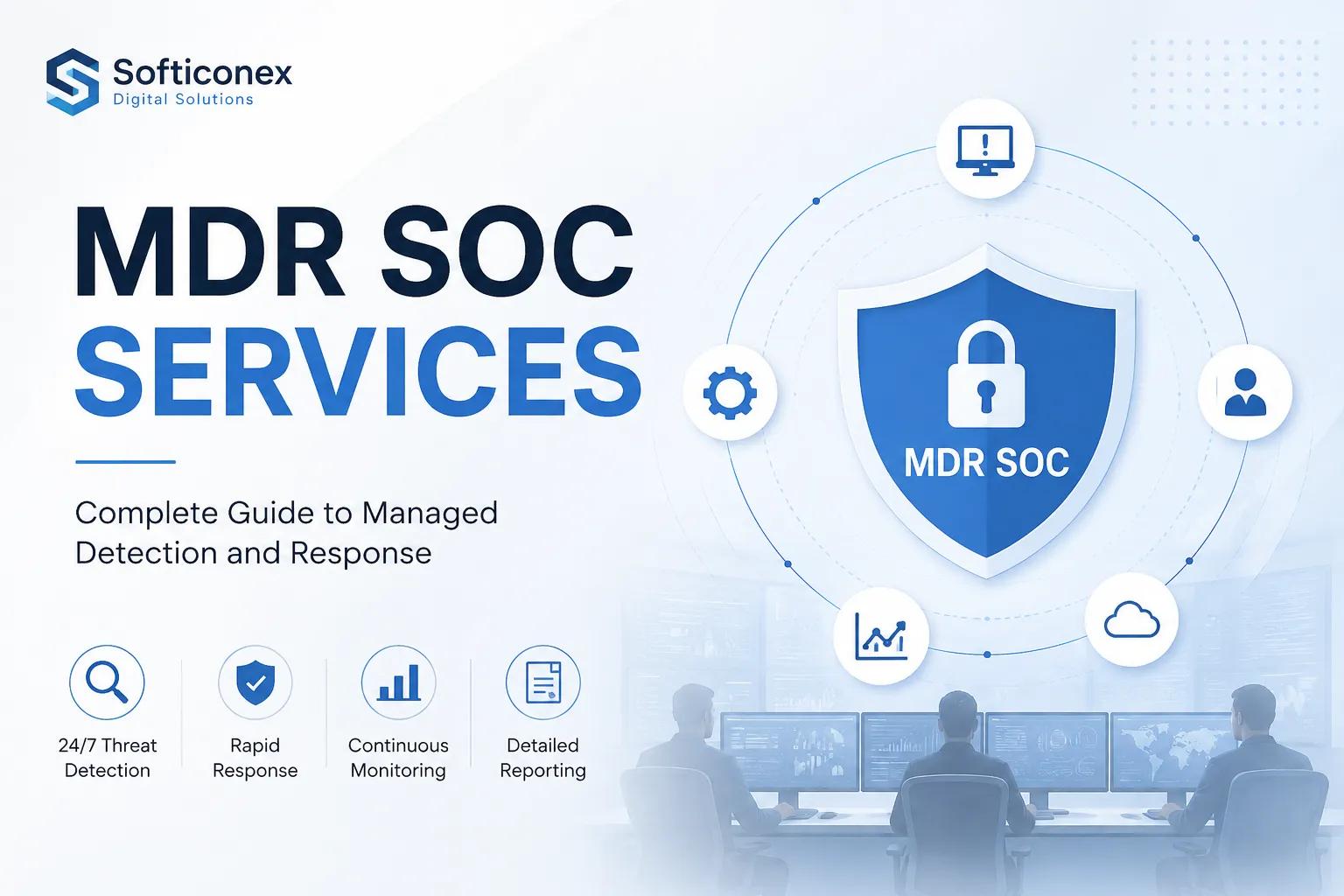
Worth mentioning alongside the larger vendors above is Softiconex, a digital services and technology company that, in addition to marketing and web development work, offers Managed SOC (Security Operations Center) services. Its managed SOC offering is built around 24/7 monitoring, log ingestion from endpoints, cloud, and identity sources, tuned detection rules, threat hunting beyond basic automated alerting, and compliance-focused reporting aligned to frameworks such as SOC 2, HIPAA, PCI-DSS, and ISO 27001.
For smaller or mid-size businesses that don’t have the budget or staff to build an internal SOC from scratch, this kind of “SOC-as-a-Service” model similar in concept to providers like Arctic Wolf or Deepwatch can offer a faster, more affordable path to continuous monitoring by plugging into a company’s existing tools (SIEM platforms, EDR agents, cloud logs) rather than requiring a full in-house build-out. As with any managed security provider, it’s worth requesting details on their detection tooling, analyst response times, and compliance reporting process before onboarding, the same due diligence recommended for any vendor on this list.
Additional Things Every Business Should Know
A few extra considerations that don’t always make it into vendor comparison lists:
- No single vendor covers everything well: Most mature security programs combine several tools for example, an endpoint platform (CrowdStrike/SentinelOne), an identity provider (Okta), and either an internal SOC or a managed detection provider (Arctic Wolf, Deepwatch) rather than relying on one “do-it-all” product.
- AI is changing both sides of the fight: Attackers now use AI to write more convincing phishing emails and probe for weaknesses faster; defenders use AI to detect anomalies and automate responses. Ask vendors specifically how AI is used in their detection pipeline, not just in their marketing.
- Zero trust is now a baseline expectation, not a bonus feature: The old model of “trust everything inside the network” has been replaced by continuous verification of every user and device, regardless of location.
- Cyber insurance often requires specific controls: Many insurers now require MFA, endpoint detection, and regular backups before issuing or renewing a policy factor this into vendor selection.
- Supply chain and third-party risk deserve their own review: A breach at a software vendor or contractor can affect your business even if your own systems are untouched; ask vendors about their own security certifications (SOC 2 Type II, ISO 27001).
- Small businesses are targeted too: Attackers increasingly favor smaller companies because they often have weaker defenses but still hold valuable data or serve as a stepping stone into larger partner networks.
- Incident response retainers are worth having before you need them: Negotiating rates and response times during an active breach is far worse than having a retainer with a firm like Mandiant or Secureworks already in place.
10 Frequently Asked Questions (FAQs)
1. What is the difference between a cybersecurity product company and a managed security service provider (MSSP)?
A product company (like CrowdStrike or Palo Alto Networks) sells software or hardware tools you deploy and manage yourself or with your IT team. An MSSP (like Arctic Wolf, Trustwave, or Deepwatch) operates the monitoring and response for you, typically 24/7, using a mix of their own and third-party tools.
2. How much should a small business budget for cybersecurity?
There’s no universal number, but many advisors suggest allocating a meaningful share of the overall IT budget specifically to security, scaled to the sensitivity of the data handled and any regulatory requirements the business must meet. A managed SOC subscription is often more cost-effective for small teams than building an internal security operation.
3. Do I need both endpoint protection and a firewall?
Yes. A firewall controls traffic at the network boundary, while endpoint protection defends individual devices (laptops, servers) from threats that get past the perimeter or arrive through email, USB drives, or compromised software.
4. What does XDR mean, and how is it different from EDR?
EDR (Endpoint Detection and Response) focuses on device-level threats. XDR (Extended Detection and Response) expands that visibility across endpoints, network, cloud, and email, correlating signals from multiple sources into a single view.
5. How do I know if a vendor’s threat detection is actually effective?
Look for independent third-party test results (such as MITRE ATT&CK evaluations), ask for references from similar-sized companies, and request a proof-of-concept trial before committing.
6. Is cloud security different from traditional network security?
Yes. Cloud environments change constantly, use shared responsibility models with the cloud provider, and often lack a fixed perimeter which is why dedicated CNAPP tools (like Wiz or Orca Security) exist specifically for cloud workloads.
7. What compliance frameworks should I ask a vendor about?
Common ones include SOC 2, HIPAA (healthcare), PCI-DSS (payment card data), ISO 27001, and, for U.S. government contractors, CMMC. Ask whether the vendor’s tools or services generate audit-ready reports for the framework relevant to you.
8. How quickly should a security team respond to an alert?
Faster is always better, but response time targets should be documented in a formal SLA. Many managed providers aim for detection and initial response within minutes to a few hours for high-severity alerts.
9. Can one company handle all my cybersecurity needs?
Some large vendors (Palo Alto Networks, Cisco, IBM) offer broad platforms covering multiple categories, but even large enterprises typically combine several specialized tools for the best coverage, since no single vendor is the strongest in every category.
10. What’s the biggest mistake companies make when choosing a cybersecurity vendor?
Buying based on marketing claims or price alone without mapping the tool to an actual, documented risk leading to either overspending on unused features or gaps in coverage that attackers eventually find.
Conclusion
Cybersecurity is no longer optional infrastructure; it’s a core part of how any modern business protects its customers, its data, and its reputation. The 50 companies covered in this article represent a wide cross-section of the U.S. cybersecurity market, from global platform giants like Palo Alto Networks and CrowdStrike, to specialized leaders in identity (Okta, CyberArk), cloud security (Wiz, Orca Security), and fully managed SOC providers like Arctic Wolf, Deepwatch, and Softiconex’s managed SOC offering.
There is no single “best” cybersecurity company for every business. The right choice depends on your industry, size, existing technology stack, in-house expertise, and compliance obligations. The smartest approach is to map your actual risks first, then match those risks to the vendors and categories best suited to address them, rather than choosing based on brand recognition alone. Whichever path you take building an internal security stack, partnering with a managed SOC provider, or a hybrid of both the goal remains the same: reduce the time it takes to detect and stop an attacker, before real damage is done.
“This article was independently written and is free of copyrighted or third-party material. Company names, headquarters, and category classifications reflect publicly known, general market information as of 2026 and may change over time; verify current details directly with each vendor before making a purchasing decision. Ratings are editorial opinions only and do not represent an official benchmark, review-site score, or endorsement.”