
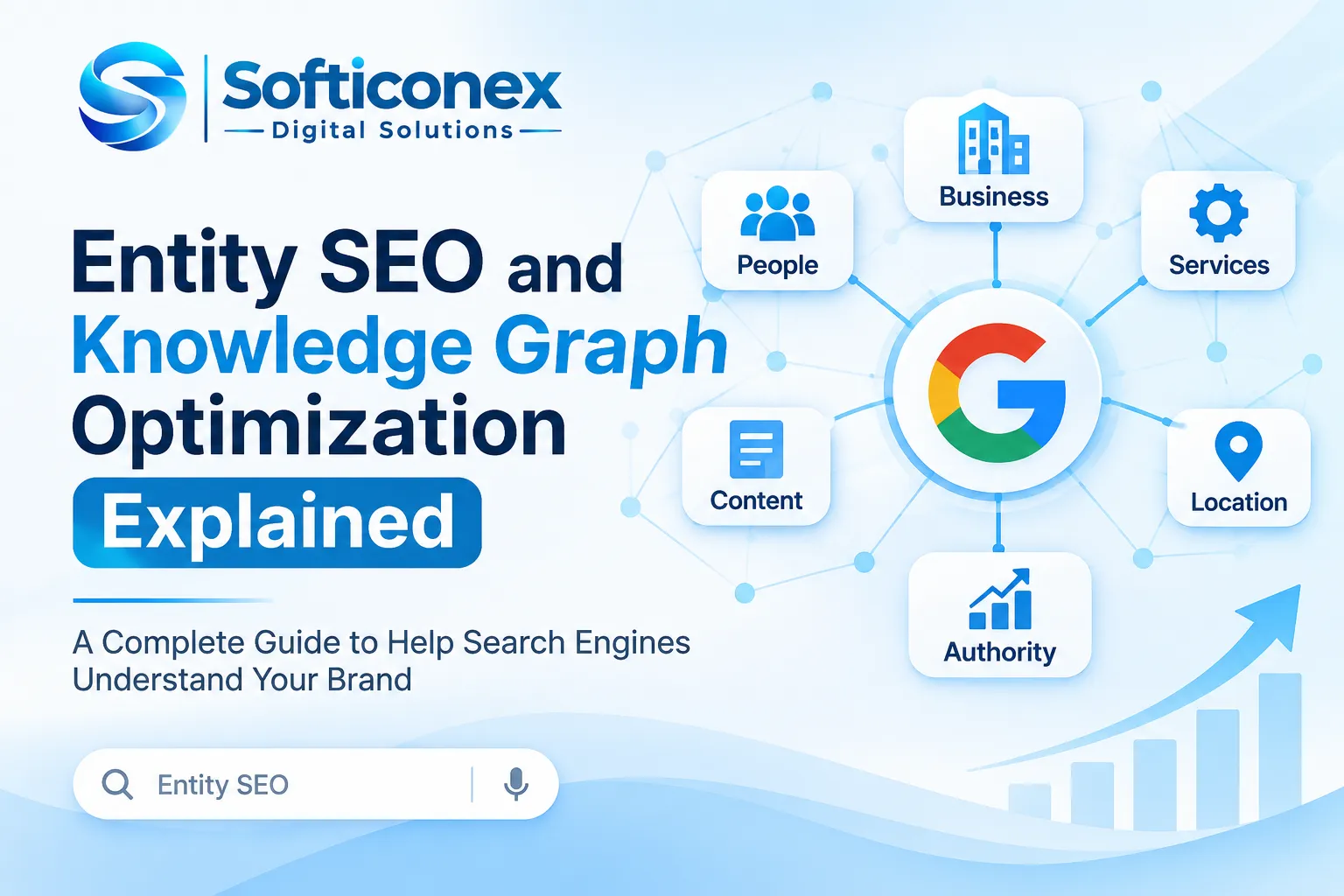
Search engines have evolved significantly beyond matching keywords with website content. Modern search systems increasingly focus on understanding the meaning behind searches, identifying real-world entities, and establishing relationships between people, businesses, organizations, products, services, and concepts.
This shift has made Entity SEO and Knowledge Graph Optimization important parts of modern search engine optimization.
Traditional SEO often focuses on keywords, backlinks, technical performance, and content relevance. Entity SEO expands this approach by helping search engines understand exactly what a website, business, person, or topic represents and how it relates to other entities across the web.
For businesses, this creates an opportunity to build stronger digital identities, improve search relevance, and establish consistent brand information across different platforms.
In this guide, we explain what Entity SEO is, how Knowledge Graphs work, why entity relationships matter, and how businesses can implement an effective entity optimization strategy.
What Is Entity SEO?
Entity SEO is an approach to search engine optimization that focuses on helping search engines identify, understand, and connect entities associated with a website or topic.
An entity is a distinct and identifiable thing. It may represent a person, company, location, product, service, organization, event, or abstract concept.
For example, Softiconex Digital Solutions is a business entity. Its associated entities may include:
Search Engine Optimization (SEO)
Answer Engine Optimization (AEO)
Generative Engine Optimization (GEO)
Web Development
Digital Marketing
Kasur, Pakistan
Its founders and team members
Its official website and social media profiles
Search engines can use information from website content, structured data, authoritative external sources, and other signals to understand these relationships.
The objective of Entity SEO is to make the identity, expertise, and relationships of a website or organization clear and consistent.
Unlike keyword optimization alone, entity-based optimization focuses on meaning, context, and relationships.
What Is Google's Knowledge Graph?
Google's Knowledge Graph is a knowledge base that helps Google understand real-world entities and the relationships between them.
Rather than treating every search query as an isolated collection of words, Google's systems can recognize that a search may refer to a particular person, organization, location, product, or concept.
For example, when someone searches for a well-known technology company, Google may understand its:
Official name
Founders
Headquarters
Products and services
Related organizations
Industry
Important connections
This understanding can help Google present relevant information in search results, including Knowledge Panels for eligible entities.
A Knowledge Panel is a search feature that displays summarized information about an entity. However, appearing in the Knowledge Graph or earning a Knowledge Panel is not guaranteed, even when a website uses structured data correctly.
It is important to understand that the Knowledge Graph is Google's own knowledge system. Website owners cannot directly submit an entity and guarantee its inclusion.
Instead, businesses can strengthen their digital identity by providing accurate, consistent, and verifiable information across their online presence.
How Entity SEO and the Knowledge Graph Work Together
Entity SEO and Knowledge Graph optimization are closely connected.
Entity SEO helps establish the identity and context of a business, person, or topic. Knowledge Graph systems use information and relationships from multiple sources to develop an understanding of entities.
Consider a company offering digital marketing services.
Its website may contain separate pages about SEO, content marketing, web development, and PPC advertising. If these pages provide useful information and clearly explain how the services relate to the company, search engines can develop a better understanding of its business focus.
The relationship may look like this:
Business Entity → Services → Industry → Expertise → Related Topics
For example:
Business: Softiconex Digital Solutions
Industry: Digital Marketing and Technology
Service: Search Engine Optimization
Related topics: Technical SEO, keyword research, content optimization, link building
Additional services: AEO, GEO, web development, and digital marketing
A consistent structure helps communicate the relationship between the organization and its services.
Why Entity SEO Matters for Modern Search
Entity optimization has become increasingly relevant as search engines and AI-powered systems work to understand content beyond individual keywords.
Here are some important benefits.
1. Stronger Brand Identity
A consistent digital identity helps search engines distinguish your business from similarly named organizations, unrelated websites, and other entities.
Your business name, website, description, location, services, and official profiles should communicate the same identity.
For example, a company should avoid using significantly different business descriptions across its website, LinkedIn page, Google Business Profile, and other important directories.
2. Better Topical Understanding
Entity SEO can help establish connections between a website's main subjects and supporting topics.
Suppose a company specializes in SEO.
Its website could publish comprehensive content covering:
Technical SEO
On-page SEO
Off-page SEO
Local SEO
International SEO
SEO audits
Search intent
Content optimization
Search performance measurement
These subjects create a meaningful topical structure around the broader SEO entity.
The goal is not to publish as many articles as possible. It is to create useful, connected content that demonstrates genuine knowledge.
3. Improved Search Context
Search engines use many signals to understand the relevance of a page.
Clear terminology, descriptive headings, relevant internal links, structured data, and accurate entity references can help communicate the subject of a page.
For example, an article about Apple should make it clear whether it discusses Apple Inc., the technology company, or the fruit.
Context reduces ambiguity.
4. Stronger Brand Discoverability
A business with consistent information across its website and reputable external platforms can establish a clearer online identity.
This may support brand discovery through traditional search, local search, and AI-powered search experiences.
However, Entity SEO does not guarantee higher rankings, Knowledge Panels, or AI recommendations.
5. Better Context for AI Search
AI-powered search systems need to interpret information, understand context, and connect related subjects.
A website that clearly identifies its authors, organizations, services, sources, and subject areas provides useful context for these systems.
Entity optimization can therefore support broader Answer Engine Optimization (AEO) and Generative Engine Optimization (GEO) efforts.
Different AI systems use different retrieval and ranking methods, so no single entity optimization technique guarantees inclusion in their answers.
Important Elements of Entity SEO
A successful entity optimization strategy involves several connected elements.
1. Consistent Business Information
Start by establishing a clear and consistent identity for your organization.
Important information includes:
Official business name
Website URL
Business description
Industry
Main services
Location, where relevant
Contact details
Official social media profiles
Founder or leadership information
Use the same official business name and website URL throughout your important online properties.
Consistency is especially important when a company operates under similar names, uses multiple domains, or has several social media profiles.
2. Structured Data and Schema Markup
Structured data provides search engines with machine-readable information about website content.
Schema.org provides standardized vocabulary that website owners can use to describe entities and their relationships.
Commonly relevant schema types include:
Organization: Describes a company or organization.
LocalBusiness: Describes an eligible local business and its details.
Person: Identifies an individual, such as an author or founder.
Service: Describes a service offered by a business.
Article: Provides information about an article, including its headline, author, and publication dates.
BreadcrumbList: Describes the breadcrumb navigation structure of a website.
For example, an organization schema can describe a company's name, website, logo, contact information, and official social media profiles.
A simplified JSON-LD example:
{
"@context": "https://schema.org",
"@type": "Organization",
"name": "Softiconex Digital Solutions",
"url": "https://www.softiconex.com/",
"description": "Digital growth agency providing SEO, AI-powered search optimization, web development and digital marketing services.",
"sameAs": [
"https://www.linkedin.com/company/soft-iconex/",
"https://www.facebook.com/softiconex/",
"https://www.instagram.com/soft_iconex/",
"https://www.pinterest.com/softiconex/"
]
}
This example illustrates how an organization can be described through structured data. It should be adapted to the actual business information and implemented once in the appropriate location.
Important: Schema markup should accurately reflect visible, verifiable website information. Adding structured data does not automatically create a Knowledge Panel or guarantee a rich search result.
3. Knowledge Graph Relationships
Entity relationships explain how different people, organizations, products, services, and topics are connected.
For example:
A business provides a service.
A person works for an organization.
An organization operates in an industry.
An article discusses a specific subject.
A product is manufactured by a company.
These relationships can be communicated through well-written content, internal links, and appropriate structured data.
A clear relationship structure helps search systems interpret the context of individual pages.
4. Author and Organization Identity
Author credibility and business identity are important components of a trustworthy website.
For articles, provide relevant author information, including:
Full author name
Professional biography
Area of expertise
Relevant experience
Author profile page
Links to legitimate professional profiles
Similarly, company pages should explain the organization's background, services, team, and areas of expertise.
Avoid inventing qualifications, awards, certifications, or professional experience.
5. External Brand Mentions and Citations
Search engines can encounter information about a business across multiple websites.
Relevant external sources may include:
Professional business directories
Industry publications
Trusted company profiles
Genuine customer reviews
Partner websites
Interviews and expert contributions
Relevant news coverage
The quality and credibility of these sources matter more than the number of listings.
A business should prioritize accurate profiles on relevant platforms rather than submitting its information to hundreds of low-quality directories.
6. Semantic Content and Topical Relationships
Semantic SEO focuses on the meaning and context of content rather than simply repeating target keywords.
For example, an article about technical SEO may naturally discuss:
Website crawling
Indexing
Canonical tags
XML sitemaps
Robots.txt
Structured data
Core Web Vitals
Internal linking
These related concepts help explain the subject comprehensively.
However, related keywords should be included only when they contribute meaningful information. Unnecessary keyword insertion can make content less useful.
How to Implement Entity SEO: A Step-by-Step Strategy
Businesses can follow this practical process to improve their entity presence.
Step 1: Define Your Main Business Entity
Identify the official name, website, industry, location, and primary services of your business.
Prepare a consistent company description that can be reused across your website and official business profiles.
Avoid unnecessary variations in your business name.
Step 2: Create a Detailed About Us Page
Your About Us page should clearly explain:
Who you are
What your organization does
Which industries you serve
What services you offer
Where you operate
Who leads the organization
How customers can contact you
Use specific and factual language.
A detailed About Us page can help both visitors and search engines understand the organization.
Step 3: Organize Service Pages
Give every major service its own dedicated page when the service has a distinct purpose and customer intent.
For example, a digital growth agency may have dedicated pages for:
SEO Services
AEO Services
GEO Services
Web Development
Content Marketing
PPC Management
Social Media Marketing
Email Marketing
Each page should explain the service, its benefits, implementation process, use cases, and relevant expertise.
Avoid creating multiple pages that target exactly the same search intent.
Step 4: Build Topic Clusters
Organize educational content around your primary services.
For an SEO services page, a topic cluster could include:
Technical SEO fundamentals
Keyword research strategies
On-page optimization
Link building
SEO audits
Search intent analysis
International SEO
SEO performance measurement
Link these articles naturally to the main SEO service page.
The objective is to create a logical relationship between your commercial pages and educational resources.
Step 5: Implement Relevant Schema Markup
Use suitable structured data types to describe your organization, services, people, articles, and website navigation.
Validate the markup using Google's Rich Results Test and Schema.org Validator.
Check for:
Correct property values
Valid JSON-LD syntax
Accurate business details
Consistent canonical URLs
No duplicate or contradictory organization information
Remember that not every Schema.org type produces a Google rich result.
Step 6: Strengthen Internal Linking
Internal links help users and search engines navigate related content.
For example:
An article explaining technical SEO can link to the main SEO services page. An article about AI search visibility can link to the AEO or GEO service page when relevant.
Use descriptive anchor text instead of repeatedly using generic phrases such as "click here."
Create a logical structure:
Homepage → Service Page → Supporting Articles → Related Guides
This helps establish relationships between the organization's primary services and supporting knowledge resources.
Step 7: Establish External Brand Consistency
Review important external profiles and make sure they use accurate information.
Prioritize:
Google Business Profile, if eligible
LinkedIn company page
Relevant industry directories
Reputable business listing platforms
Professional review platforms
Industry interviews and publications
Use the official website URL and consistent branding.
External profiles should be genuine and maintained. Avoid fake reviews, fabricated mentions, or misleading business descriptions.
Step 8: Monitor Search and Brand Visibility
Entity SEO is an ongoing process.
Use tools such as:
Google Search Console
Google Analytics 4
Google Rich Results Test
Schema.org Validator
Bing Webmaster Tools
Google search operators
Brand monitoring tools
Monitor indexed pages, branded searches, organic impressions, search queries, structured data errors, and referral traffic.
You can also periodically test relevant queries in AI-powered search platforms to understand whether your brand is being discovered and accurately represented.
Entity SEO vs Traditional SEO vs Semantic SEO
These approaches are related but serve different purposes.
Aspect | Traditional SEO | Semantic SEO | Entity SEO |
Main focus | Search visibility | Meaning and context | Identifiable entities and relationships |
Key elements | Keywords, links, technical SEO | Topics and search intent | People, brands, services and connections |
Content approach | Keyword-focused relevance | Comprehensive topic coverage | Clear entity identity and context |
Structured data | Useful | Useful | Particularly relevant |
Main objective | Improve organic search performance | Improve contextual relevance | Improve entity understanding |
These are complementary approaches, not competing SEO methods. A strong strategy combines technical optimization, relevant content, authority, semantic coverage, and clear entity information.
Common Entity SEO Mistakes to Avoid
Even well-designed entity strategies can fail when business information is inconsistent or implementation is inaccurate.
1. Treating Schema Markup as a Ranking Shortcut
Adding Organization or Service schema does not automatically improve rankings.
Structured data helps describe information. It does not replace useful content, technical SEO, authority, or relevance.
2. Creating Duplicate Business Profiles
Multiple profiles with inconsistent names, addresses, or contact information can create confusion.
Maintain official profiles and correct inaccurate listings wherever possible.
3. Publishing Unrelated Content
Publishing articles on unrelated subjects simply to increase website size does not establish meaningful topical expertise.
Focus on subjects connected to your services and audience.
4. Using Incorrect or Excessive Schema
Do not add schema types that do not accurately represent the page.
For example, do not mark a normal service page as a Product or invent review ratings.
5. Creating Fake Author Credentials
Do not fabricate authors, awards, qualifications, company partnerships, or experience.
Trustworthy business information is more valuable than exaggerated claims.
6. Ignoring External Brand Information
Your website is important, but your business identity also exists across external platforms.
Review your official company profiles and keep them accurate.
How Entity SEO Supports AEO and GEO
Answer Engine Optimization (AEO) and Generative Engine Optimization (GEO) focus on improving the accessibility, relevance, and usefulness of content in answer-driven and AI-powered search experiences.
Entity SEO can support these strategies by clarifying:
Who published the information
Which organization is associated with the content
What subject the content covers
Which products or services are discussed
Which sources support important claims
How different topics and entities are related
For example, an AI-powered search system encountering a detailed article about SEO services may have an easier time interpreting the content when the page clearly identifies its author, publisher, subject, and supporting information.
However, AI systems use different data sources and retrieval mechanisms. Entity optimization should be considered one part of a broader AEO and GEO strategy, not a guaranteed method of getting cited by AI platforms.
Entity SEO Checklist for Businesses
Use this checklist when reviewing your website's entity optimization.
The official business name is consistent.
Website and canonical domain are consistent.
The About Us page clearly describes the organization.
Business contact information is accurate.
Official social media profiles are linked.
The organization schema is correctly implemented.
Relevant service pages have clear descriptions.
Author profiles contain accurate professional information.
The article schema accurately represents published content.
Internal links connect related topics.
External business profiles are accurate.
Structured data has been validated.
Search Console and Bing Webmaster Tools are monitored.
Brand mentions and AI visibility are periodically reviewed.
Frequently Asked Questions
What is Entity SEO in simple terms?
Entity SEO is the practice of helping search engines understand who or what a website represents and how its business, people, services, and topics relate to each other.
What is the Google Knowledge Graph?
The Google Knowledge Graph is a knowledge base that helps Google understand real-world entities and relationships. It supports Google's ability to interpret search queries and provide relevant information.
Is Entity SEO different from Semantic SEO?
Yes. Semantic SEO focuses on meaning, context, and relationships between topics. Entity SEO specifically emphasizes identifiable people, businesses, organizations, products, services, and their connections. Both approaches complement each other.
Does Schema Markup improve entity recognition?
Structured data can help search engines interpret information about entities and their relationships. However, schema markup alone does not guarantee Knowledge Graph inclusion, Knowledge Panels, or better rankings.
How can a business appear in Google's Knowledge Panel?
Businesses can strengthen their online identity through accurate website information, structured data, reputable external references, and consistent business profiles. Google independently determines whether to display a Knowledge Panel.
Is Entity SEO important for AI search?
Yes, it can support AI search visibility by making the identity and context of website information clearer. However, each AI platform has its own systems for discovering, retrieving, and selecting information.
How long does Entity SEO take to show results?
There is no fixed timeline. Search engines need time to discover, crawl, process, and reassess information. Results depend on the website's existing authority, technical health, content quality, and external signals.
Conclusion: Build a Stronger Digital Identity with Entity SEO
Entity SEO and Knowledge Graph Optimization are important components of a modern search strategy.
As search engines increasingly interpret information through entities, relationships, and context, businesses should focus on building a consistent and verifiable digital identity.
Start by defining your business entity, improving your About Us and service pages, implementing accurate structured data, organizing relevant content, and establishing trustworthy external business profiles.
Combine these activities with traditional SEO, semantic content optimization, and a well-planned AEO and GEO strategy.
At Softiconex Digital Solutions, we help businesses strengthen their search presence through SEO, AI-powered search optimization, content strategy, and digital growth solutions.
Want to improve your business's search visibility and digital identity? Explore our SEO and AI search optimization services or contact Softiconex to discuss a strategy for your business.