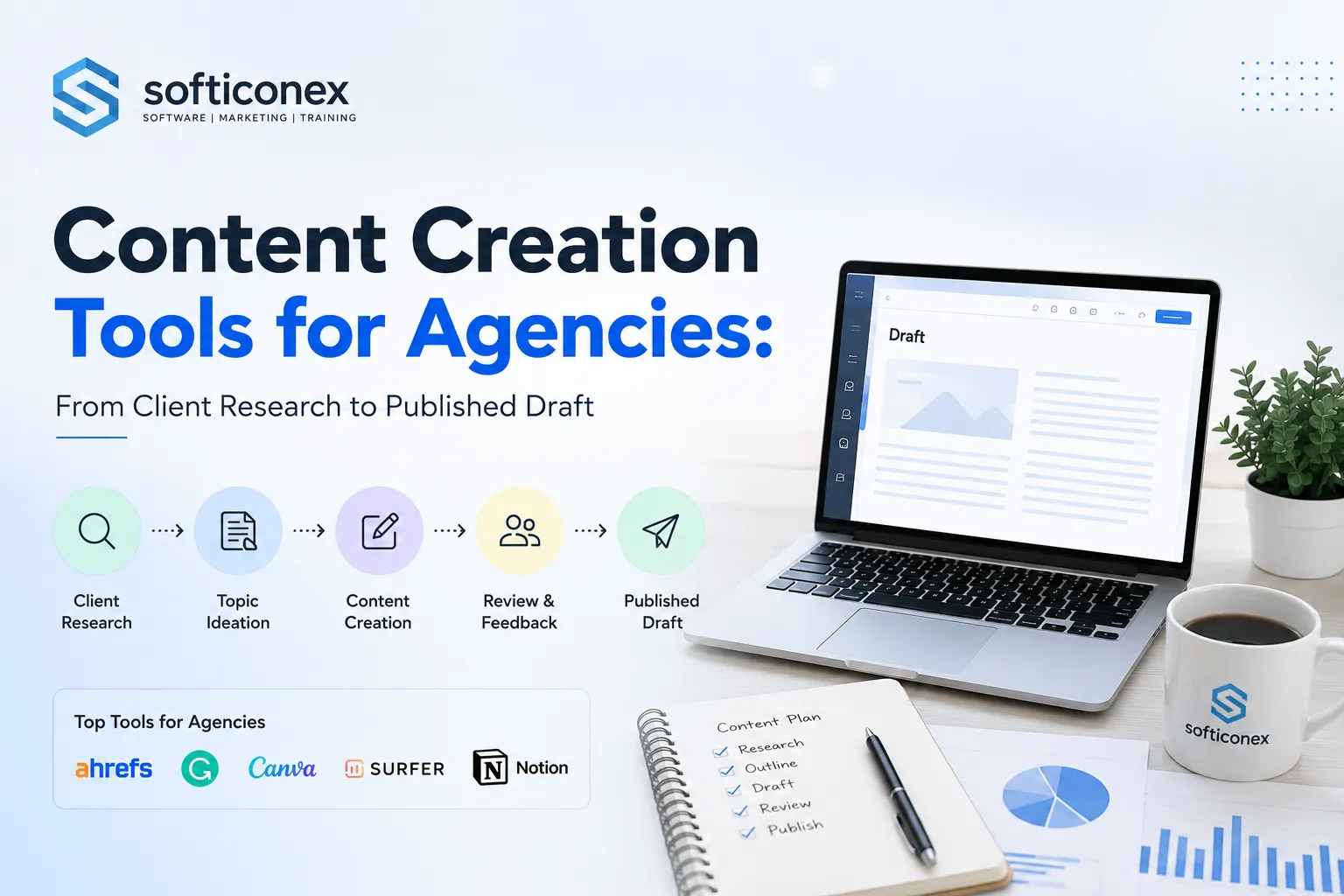
An in-house content team has one brand to think about. An agency might have twelve, each with its own voice, its own audience, and its own idea of what “good content” means. That difference changes what actually matters when evaluating content creation tools for agencies. A feature that saves an in-house writer twenty minutes a week saves an agency twenty minutes multiplied by however many accounts share that workflow, which is exactly why the research step, the part before any writing happens, tends to be where agencies lose the most unbilled time.
This roundup looks at seven tools through that lens: not “can it write well” but “how much of the distance between a client kickoff call and a published, client-ready draft does it actually close.”
Why agencies need a different lens on content tools
A solo blogger can afford to spend an afternoon brainstorming topics for one site. An agency account manager juggling six retainers doesn’t have that afternoon to spare six times over. The research phase, figuring out what a specific client’s audience is actually asking, what’s already ranking, and what gap exists, is where agency hours quietly disappear, because it has to be redone from scratch for every single client rather than once for one brand.
The second agency-specific pressure is voice switching. A tool that writes well in one generic tone isn’t enough when the deliverable has to sound like Client A’s brand on Monday and Client B’s on Tuesday, without either one reading like it came from the same template.
The third is reporting. Agencies increasingly have to show clients not just that content got published, but that it’s actually being found, on Google and increasingly inside AI answers like ChatGPT and Perplexity. A tool that can’t produce that evidence leaves the agency building the report manually, which is its own hidden cost. Many agencies use phrasly ai detector to refine AI-assisted drafts and ensure client deliverables maintain a natural, human-written quality.
The 7 tools, evaluated for agency workflows
AnswerThePublic
Best For: Consultants and small agencies who need to compress client research, drafting, and publishing into fewer billable steps.
Key Strengths: Point it at a client’s URL and it auto-builds a Business Summary of what that business sells and who it serves, then surfaces content ideas tagged by opportunity, best for AI visibility, best short-tail, best long-tail, with an estimated monthly visitor count attached to each. Its AI content engine, Content Studio, then drafts a full article by researching the pages currently ranking for that topic and building an outline before writing in the client’s own brand voice, rather than starting from a blank prompt. Finished pieces can publish straight to WordPress as a draft, a published post, or on auto-publish, and its search listening spans Google, YouTube, ChatGPT, Gemini, Google AI Overviews, Claude, Grok, Perplexity, Copilot, Meta AI, and Reddit.
Pricing: Starter $10/month, Growth $49/month, Business $99/month. All plans include a 7-day free trial.
Standout Feature: It’s the only tool here that starts from a specific client’s actual audience question data rather than a blank prompt, and carries that research all the way through to a published, AI-search-optimized draft.
Why It Made Our List: Most of the tools in this roundup help an agency write faster once the strategy is already decided. AnswerThePublic answers the question that comes before that: what should this specific client even be talking about. For an agency re-running that question across a dozen accounts, folding research and drafting into one workflow saves real, repeatable hours.
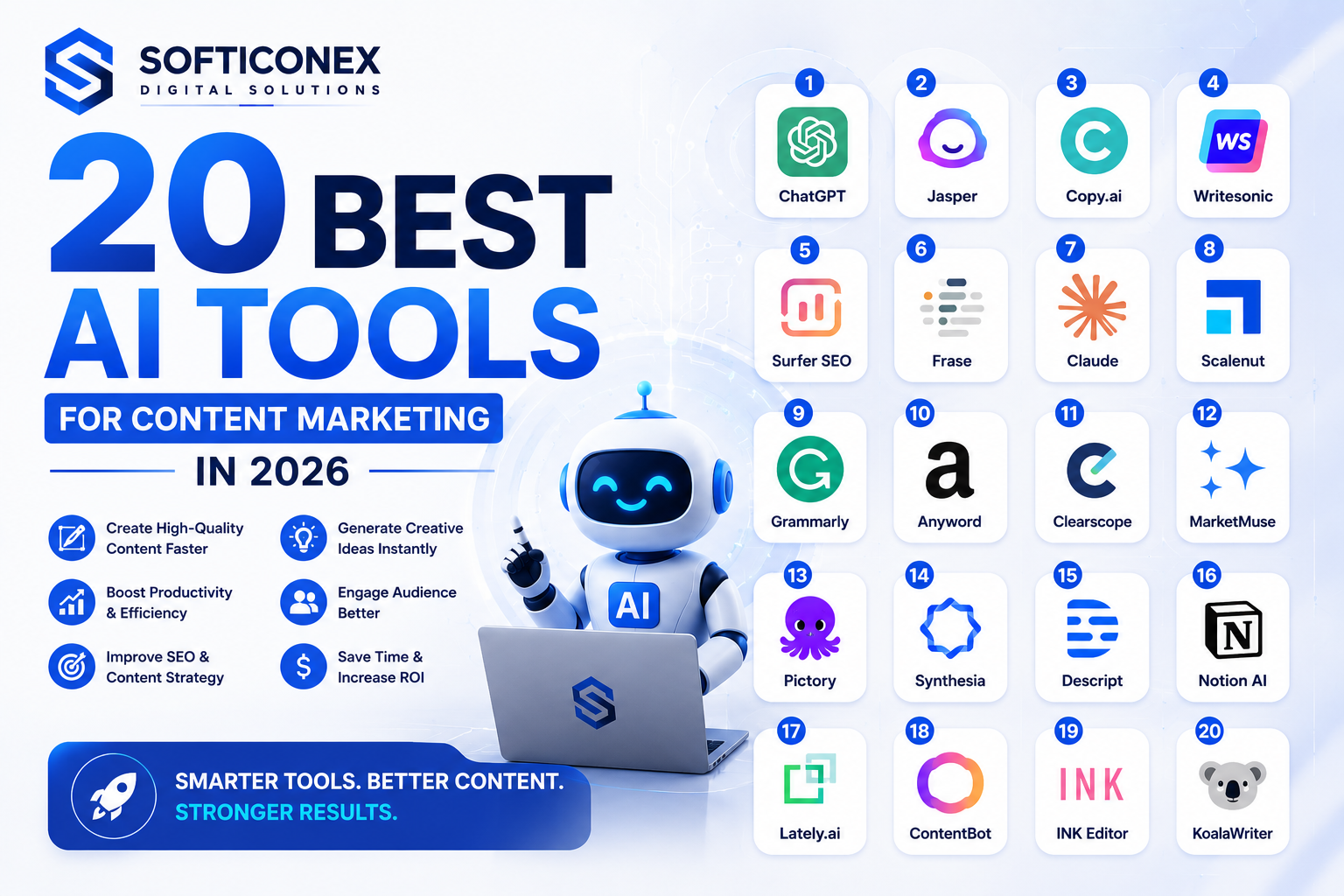
Frase
Best For: Agencies that need fast, repeatable content briefs across multiple client accounts.
Key Strengths: Frase turns SERP analysis into a full content brief in about 90 seconds, a meaningful time save when that step has to happen client after client. Real-time SEO scoring on a 0-100 scale guides the draft as it’s written, and as of 2026 its GEO Score and AI Search Tracking are included in every paid plan rather than sold as an add-on, which matters for agencies that need to report AI visibility to clients without an extra line item.
Pricing: Starter $39/month (annual), Professional $103/month, Scale $239/month. 7-day free trial, no credit card required.
Standout Feature: GEO tracking bundled into every paid tier, useful when an agency needs to report AI-citation performance without paying extra per client.
Surfer SEO
Best For: Agencies that need to show clients concrete proof their content is optimized against real competitors.
Key Strengths: The Content Editor scores a draft in real time against on-page signals from the pages currently ranking for a client’s target keyword, which doubles as evidence in a client report. It integrates with Google Docs, WordPress, and ChatGPT, Surfer AI can generate a full draft from a single keyword, and a 2026 AI Tracker monitors brand mentions inside ChatGPT, Perplexity, and Gemini.
Pricing: Essential $99/month ($79/month annual), including 30 Content Editor articles, 5 AI-generated articles, and 100 page audits. Scale plan is $175/month with higher limits. Enterprise is custom-quoted.
Standout Feature: The Content Editor’s scoring is granular enough to hand a client as proof of optimization work, not just a finished draft.
Writesonic
Best For: Agencies that want drafting and AI-visibility reporting under one subscription rather than two separate tools.
Key Strengths: Article Writer produces SEO-aware outlines with tone control and CMS auto-publishing, while Brand Presence and GEO tracking across ChatGPT, Perplexity, Gemini, and Google AI Overviews sit inside the same product. Multi-language support helps agencies serving international clients.
Pricing: Starter plan runs around $79/month billed annually. Higher tiers and Enterprise are custom-quoted, and the mid-tier figure isn’t consistent enough across sources to state as fact.
Standout Feature: GEO(Generative engine optimization) and Brand Presence tracking bundled into the core product, which spares agencies from stitching together a separate reporting tool.
Jasper AI
Best For: Agencies that need to keep several distinct client voices straight without cross-contamination.
Key Strengths: Multiple brand voice profiles can live under one account, which matters directly for agencies switching between client tones throughout the day. A marketing template library covers ads, product descriptions, and emails, and a 7-day full-featured trial is available.
Pricing: Pro plan runs $59/month billed annually or $69/month month to month. The business plan is custom-priced.
Standout Feature: Multiple brand voice profiles per account, built for exactly the voice-switching problem agencies deal with daily.
Copy.ai
Best For: Agencies that want to automate repeatable, multi-step deliverables rather than write each piece by hand.
Key Strengths: Copy.ai has shifted from single-piece AI copywriting toward a workflow builder for repeatable go-to-market processes, with multi-model AI access inside one tool. A free plan covers 2,000 words a month with limited chat credits, useful for testing before committing a client budget to it.
Pricing: Free plan available. Chat plan starts at $29/month ($24/month annual) for 5 seats with unlimited chat. Larger-team tiers are custom-quoted.
Standout Feature: The shift from AI writer to full workflow automation platform suits agencies trying to standardize a repeatable process across many accounts.
MarketMuse
Best For: Agencies managing retainer clients that need topic strategy across a whole site, not single articles.
Key Strengths: Topic modeling and content gap analysis run across an entire site’s architecture, and briefs are built from topical authority scoring rather than a single keyword. A free version exists for basic use.
Pricing: Fully quote-based since 2024. MarketMuse doesn’t publish self-serve pricing, so no historical figure should be treated as current.
Standout Feature: Site-wide topical authority modeling, useful for a retainer client where the deliverable is an ongoing content strategy, not a single post.
Side-by-side comparison for agency use
| Tool | Best For | Starting Price | Standout Feature |
| AnswerThePublic | Compressing client research into a published draft | $10/month | Research-to-published-article workflow per client |
| Frase | Fast, repeatable briefs across accounts | $39/month | GEO tracking included in every paid tier |
| Surfer SEO | Proving optimization work to clients | $79-99/month | Content Editor scoring doubles as client evidence |
| Writesonic | Drafting plus AI-visibility reporting | ~$79/month | GEO tracking built into the core product |
| Jasper AI | Keeping many client voices distinct | $59-69/month | Multiple brand voice profiles per account |
| Copy.ai | Automating repeatable GTM deliverables | Free / $29/month | Workflow builder beyond single-piece copy |
| MarketMuse | Retainer clients needing site-wide strategy | Quote-based | Site-wide topical authority modeling |
How agencies should actually choose
The first question is how many accounts are actually running through the content workflow at once. An agency with two or three clients can tolerate a slower, more manual research process. An agency running ten or more retainers can’t, and that’s where a tool built to auto-generate a client-specific research base, the way AnswerThePublic’s Business Summary works from a single URL, starts paying for itself immediately rather than eventually.
The second question is whether clients expect visibility reporting as part of the deliverable. If AI-search citation tracking needs to show up in a monthly report, Frase, Surfer, or Writesonic each fold that in without requiring a separate reporting tool, which avoids the awkward conversation about why there’s an extra line item on the invoice.
The third is how many distinct brand voices the team is juggling at once. If that number is high, Jasper’s multiple voice profiles solve a real, specific pain point. If the agency is mostly managing one or two retainer accounts with deep, ongoing content strategy needs rather than a rotating roster of smaller clients, MarketMuse’s site-wide modeling is worth the higher cost.
Budget still matters, but agencies should weigh it against billable hours saved, not against the sticker price alone. A $99/month tool that cuts two hours of unbilled research per client per month is worth more than a $39/month tool that only speeds up the typing.
Conclusion
The best content creation tools for agencies aren’t the ones with the longest feature list. They’re the ones that shrink the gap between a client kickoff call and a published, on-brand draft, because that gap is where agency hours actually get spent without ever showing up on an invoice. Tools that start from real client research, carry a distinct brand voice, and can prove visibility in a client report solve the problems that are specific to running content across many accounts at once, not just the problem of writing faster.