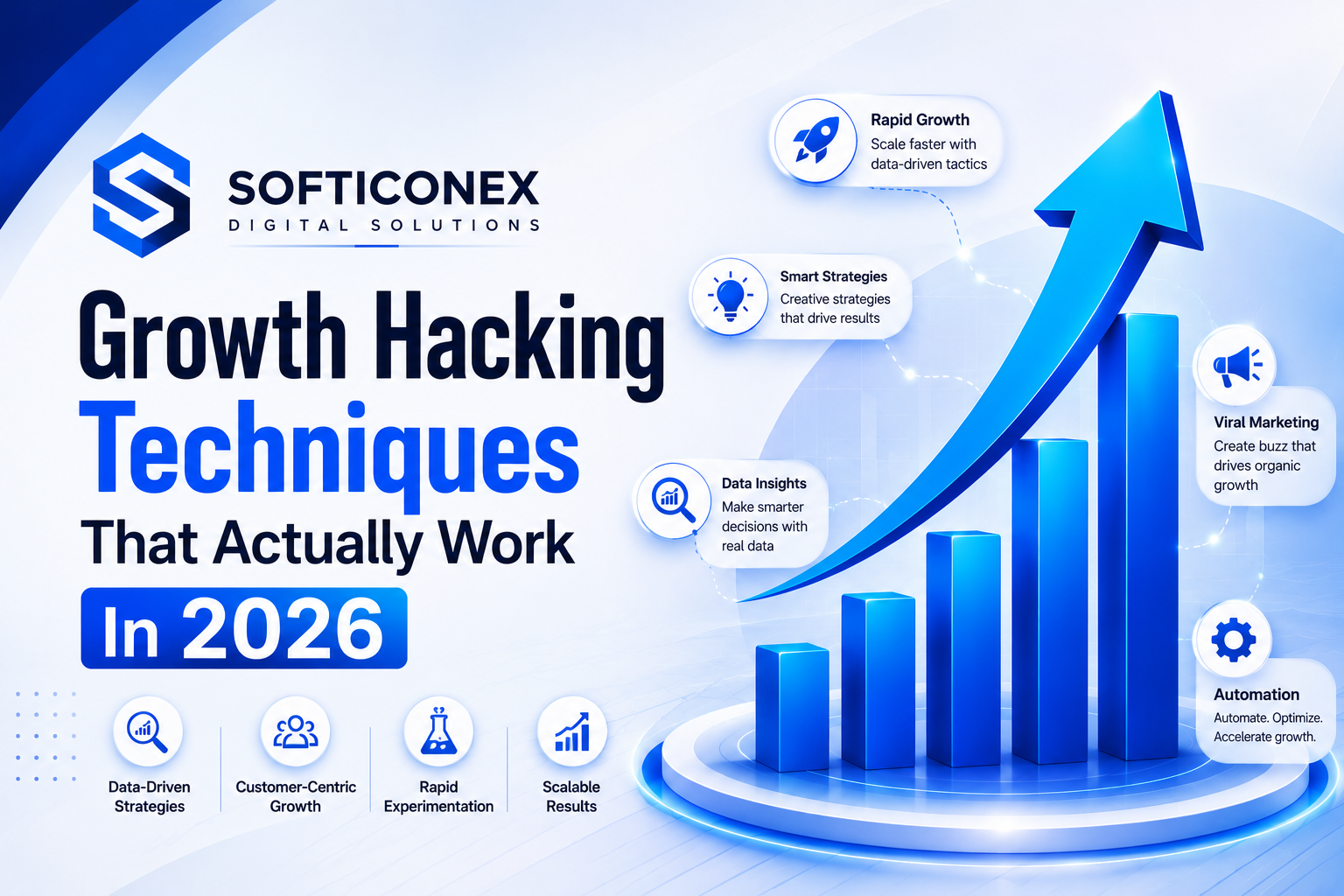
Growth hacking techniques are low-cost, experiment-driven methods used to grow a business quickly through acquisition, activation, retention, revenue, and referral. The strongest techniques include referral programs, content growth, SEO growth, email loops, product-led growth, and structured conversion optimization, all guided by continuous measurement rather than guesswork.
Why Growth Hacking Matters For Modern Businesses
Many businesses struggle to grow, not because they lack a good product, but because they lack a repeatable growth system. A single viral post or one good ad rarely creates lasting growth on its own.
Traditional marketing often plans a full campaign before testing whether the core message even resonates. Growth hacking flips that order. It tests small, learns fast, and only scales the ideas that prove themselves with real data.
This guide gives startups, SaaS founders, bloggers, and small business owners a practical path through every stage of the customer journey, from the first visit to a loyal, paying customer who refers to a new business.
What Are Growth Hacking Techniques
Growth hacking techniques are specific, testable actions used to find the fastest and most affordable way to acquire, activate, retain, and grow a customer base.
Core Principles
Growth hacking rests on three core principles: fast experimentation, tight feedback loops, and a willingness to drop ideas that do not produce measurable results.
Why Startups Use Growth Hacking
Startups rely on growth hacking because they usually have limited budgets and need proof that a channel works before committing larger spending to it. Testing small protects cash while still producing real learning.
Why Growth Hacking Works
Fast Testing
Short experiments reveal what works within days instead of months, which means a team learns and adjusts long before a slow traditional campaign would even finish running.
Lower Cost
Most growth hacking techniques rely on existing tools, current customers, or organic channels, which keeps the cost of each experiment far lower than a large paid campaign.
Better Learning Loops
Each experiment produces a clear result, win or lose, and that result feeds directly into the next experiment, creating a loop that improves decision-making over time.
Scalable Results
Once a technique proves itself on a small scale, a team can invest more budget and time into it with far higher confidence than an untested traditional campaign would offer.
Complete Growth Hacking Techniques List
The techniques below cover the full customer journey. Each one includes how it works, the best use case, and a common mistake to avoid.
Referral Growth
Referral growth turns existing customers into a source of new customers by rewarding them for sharing a product with friends or colleagues. To launch a referral program for growth, you can use tools like ReferralCandy.
Best use case: Products with a clear personal benefit that is easy to explain in one sentence.
Mistake to avoid: Offering a reward so small that customers have no real reason to share.
Content Growth
Content growth builds an audience through articles, guides, or videos that solve real problems for a target audience, which attracts visitors without paid ads.
Best use case: Businesses with deep expertise in a topic their audience searches for regularly.
Mistake to avoid: Publishing content that targets keywords without matching what the searcher actually wants to learn.
SEO Growth
SEO growth focuses on ranking content and pages in search engines so that organic search traffic keeps arriving long after publication.
Best use case: Businesses that want a steady, long-term channel that does not depend on ongoing ad spend.
Mistake to avoid: Chasing search rankings while ignoring whether the page actually helps the visitor take action.
Email Loops
Email loops use automated sequences that re-engage users at key moments, such as after signup, after a purchase, or after a period of inactivity.
Best use case: Businesses with an existing list of subscribers or customers who have gone quiet.
Mistake to avoid: Sending generic emails that ignore where the user actually is in their journey.
Community Growth
Community growth builds a space, such as a forum or group, where users help each other, which increases loyalty and reduces the support burden on the core team.
Best use case: Products with passionate users who already want to share tips.
Mistake to avoid: Starting a community and then abandoning it without consistent moderation or activity.
Product Led Growth
Product-led growth uses the product itself as the main driver of acquisition and expansion, often through free trials, freemium plans, or built-in sharing features.
Best use case: Software products where users can experience real value within minutes of signing up.
Mistake to avoid: Hiding the core value behind a paywall before users ever experience the main benefit.
Viral Mechanics
Viral mechanics design the product or content so that using it naturally exposes it to new potential users, such as shared documents or branded outputs.
Best use case: Tools that are naturally used in front of, or shared with, other people.
Mistake to avoid: Forcing artificial sharing prompts that frustrate users instead of fitting their natural behavior.
Partnerships
Partnerships connect a business with another brand that already reaches a similar audience, allowing both sides to grow through a shared promotion or integration.
Best use case: Businesses with a complementary, non-competitive product serving the same audience.
Mistake to avoid: Partnering with a brand whose audience does not actually overlap with the target customer.
Retention Systems
Retention systems focus on keeping existing customers active and satisfied through onboarding, regular value delivery, and proactive support.
Best use case: Any subscription business where long-term revenue depends on customers staying active.
Mistake to avoid: Spending all available budget on new signups while letting existing customers quietly leave.
Conversion Optimization
Conversion optimization improves the percentage of visitors who complete a desired action, such as signing up or completing a purchase, through testing and refinement.
Best use case: Websites or apps that already receive steady traffic but convert only a small share of it.
Mistake to avoid: Testing random page elements without first identifying where users actually drop off.
The AARRR Growth Framework
AARRR organizes every growth effort into five connected stages: acquisition, activation, retention, revenue, and referral. Each stage answers one specific question about the customer journey.
Acquisition
Acquisition asks how potential customers first discover the business. Implementation example: launch one referral program and one piece of cornerstone content in the same month, then compare which channel brings more qualified visitors.
Activation
Activation asks whether a new user experiences real value quickly. Implementation example: redesign the first five minutes of onboarding so a new user reaches one meaningful result before leaving the app.
Retention
Retention asks whether users come back after their first visit. Implementation example: set up an email sequence that re-engages any user who has not returned within seven days.
Revenue
Revenue asks how the business turns engaged users into paying customers. Implementation example: test a clearer pricing page and measure whether the upgrade rate improves within two weeks.
Referral
Referral asks whether happy customers actively bring in new customers. Implementation example: add a simple, rewarding share option right after a customer reaches a clear success moment in the product.
Experience-Based Growth Strategy
A realistic growth workflow rarely produces dramatic results in the first week. It builds steadily across three connected months.
Month 1
Focus entirely on measurement and one acquisition channel. Set up basic analytics, define one core metric, and run small tests on a single channel, such as content or referrals.
Month 2
Shift attention to activation and retention. Improve onboarding based on month one data and launch at least one retention email sequence.
Month 3
Introduce revenue and referral experiments. Test pricing clarity, add a referral incentive, and review which channel from month one deserves more investment.
Expected milestones: By the end of month three, most teams have one validated acquisition channel, a measurably improved activation rate, and at least one working retention sequence.
Growth Hacking Versus Traditional Marketing
The table below compares growth hacking with traditional marketing across the factors that matter most to a growing business.
| Factor | Growth Hacking | Traditional Marketing |
| Cost | Low budget, relies on creativity and existing channels | A higher budget often relies on paid media and large campaigns |
| Speed | Fast cycles, results visible within days or weeks | Slower cycles, results often visible after months |
| Scale | Starts small, scales only what data proves works | Often scales a fixed plan before full proof of results |
| Measurement | Built around constant tracking of specific metrics | Often measured through broad brand awareness studies |
| Flexibility | Highly flexible, adjusts weekly based on test results | Less flexible, tied to fixed campaign calendars |
Tools That Support Growth
The right category of tool matters more than any single brand. Each category below supports a different part of the growth process.
Analytics Tools
Analytics tools track user behavior and reveal where people drop off, which stage needs attention, and whether an experiment actually changed behavior.
Automation Tools
Automation tools handle repeated tasks such as email sequences and onboarding messages, freeing the team to focus on strategy instead of manual sending.
Testing Tools
Testing tools allow a team to run controlled experiments, such as comparing two versions of a landing page, and measure the difference with confidence.
CRM Tools
CRM tools organize customer information and interactions, which support better retention and more relevant follow-up communication.
SEO Tools
SEO tools help identify search terms an audience already uses, track rankings, and reveal technical issues that block organic growth.
Common Growth Hacking Mistakes
Chasing Hacks
Jumping from one trending tactic to another without testing it properly almost always wastes more time than it saves.
Ignoring Retention
Focusing only on new signups while ignoring existing customers leads to a leaking funnel that never produces lasting growth.
No Measurement
Running experiments without a clear metric makes it impossible to know whether an idea actually worked or simply felt productive.
Poor Experimentation
Testing too many changes at once makes it impossible to know which change actually caused a result, good or bad.
UX Recommendations For Publishing This Content
Interaction Speed
Keep page layouts responsive and avoid unnecessary scripts so clicks, taps, and scrolling all feel immediate rather than delayed.
Visual Stability
Reserve space for images and embedded media before they load, and avoid elements that shift position while a page is still rendering.
Ninety-Day Growth Action Plan
This plan breaks growth work into manageable weekly steps across three months.
Weeks 1 To 2
Set up analytics, define one core success metric, and map the current customer journey from first visit to repeat purchase.
Weeks 3 To 4
Launch one acquisition experiment, such as a content piece or a referral program, and track its early results weekly.
Weeks 5 To 6
Review acquisition data, then redesign the first session experience to improve activation based on where users currently struggle.
Weeks 7 To 8
Build one retention sequence aimed at users who have gone quiet, and measure how many return within two weeks of receiving it.
Weeks 9 To 10
Test one pricing or upgrade path change and measure its effect on revenue per active user.
Weeks 11 To 12
Add one referral incentive tied to a clear success moment, then review all three months of data to decide which channel deserves more investment next quarter.
Conclusion
Sustainable growth comes from systems, not isolated hacks. A single viral moment can create a short spike, but only a repeatable system of testing, measuring, and refining keeps producing results month after month.
Start with one stage of the AARRR framework that feels weakest in your business today. Run one small experiment this week, measure it honestly, and let the result guide your next move.
Continuous testing, paired with attention to retention and clear measurement, is what turns scattered growth hacking techniques into a real, lasting growth engine.
Frequently Asked Questions
What is growth hacking?
Growth hacking is a structured, experiment-driven approach to finding the fastest, lowest-cost ways to grow a business. It blends marketing, product, and data analysis into one continuous testing process instead of separate departments.
Which growth technique works best?
No single technique works for every business. Product-led growth tends to work well for software companies, while referral marketing and content growth often work better for consumer brands and local businesses.
Is growth hacking ethical?
Growth hacking is ethical when it focuses on real value for users, honest messaging, and genuine product improvements. It becomes unethical only when teams use manipulative tricks, fake urgency, or misleading claims to force short-term numbers.
How do startups grow fast without a large budget?
Startups grow fast by focusing on one channel at a time, measuring results weekly, and reinvesting effort into whichever channel shows the strongest signal, rather than spreading a small budget across many untested ideas.
What metrics matter most in growth hacking?
Activation rate, retention rate, customer acquisition cost, and revenue per user matter most, since these four numbers reveal whether growth is sustainable or just a short-lived spike in traffic.
Does SEO support long-term growth?
Yes, SEO supports long-term growth because organic search traffic keeps arriving long after the original content was published, which lowers the average cost of acquiring new customers over time.
How do I measure the results of a growth experiment?
Set one clear success metric before starting the experiment, run it for a fixed time period, and compare the result against a baseline number from before the test began.
What mistakes should I avoid in growth hacking?
Avoid chasing trending hacks without testing them, ignoring retention while focusing only on new signups, skipping measurement, and running experiments without a clear hypothesis.
Can complete beginners use growth hacking techniques?
Yes, beginners can start with simple, low-cost techniques such as referral programs, email loops, and basic conversion optimization before moving on to more advanced experimentation.
What is the AARRR framework?
AARRR stands for acquisition, activation, retention, revenue, and referral. It is a simple framework that maps the full customer journey, so teams know exactly which stage needs attention.
How long does it take to see results from growth hacking?
Small experiments often show early signals within one to two weeks, while sustainable growth systems usually take two to three months of consistent testing before clear patterns appear.