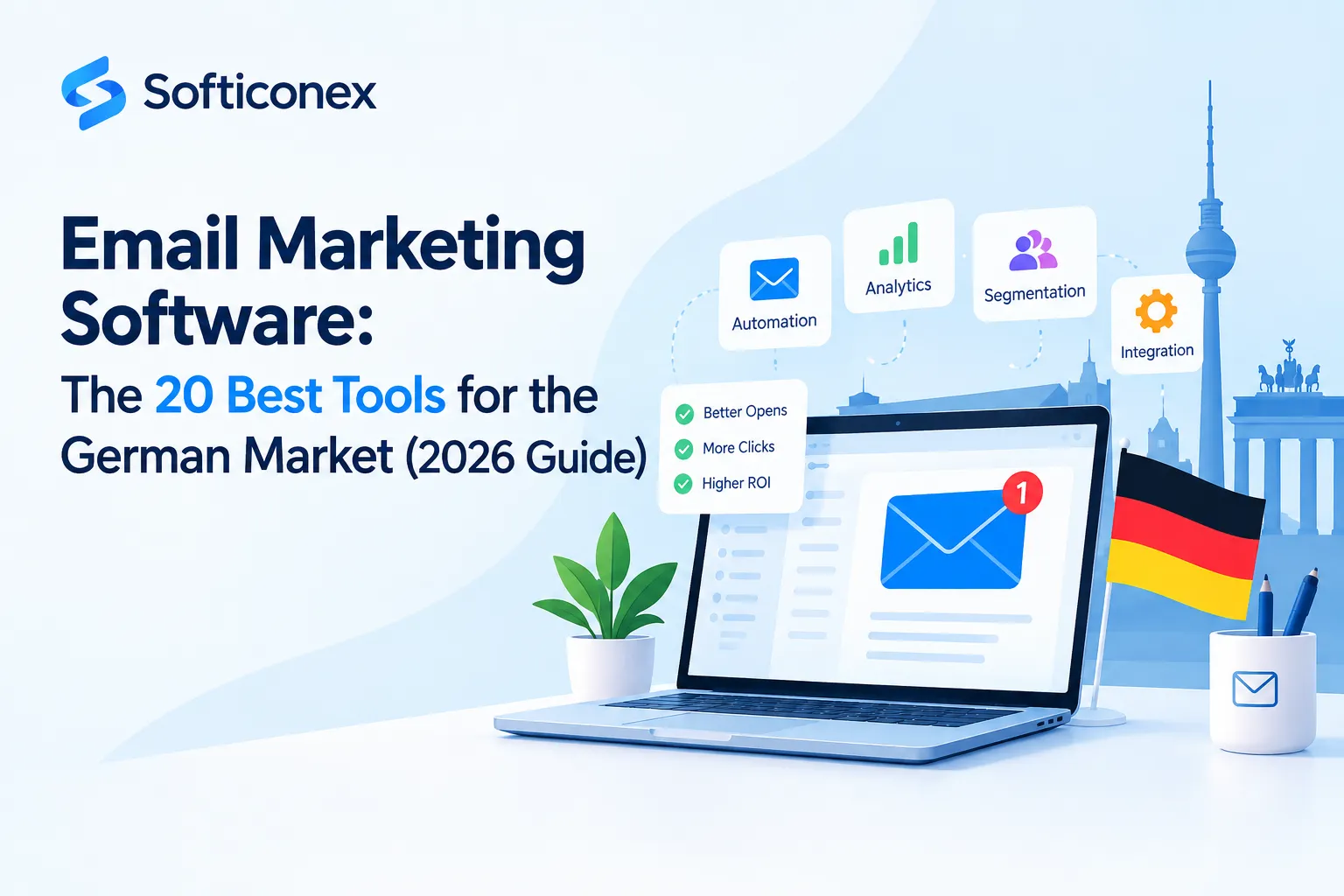
Email remains one of the most dependable marketing channels in Germany. German consumers still check their inboxes daily, and businesses of every size rely on newsletters, automated sequences and transactional messages to win and keep customers. The attention around the phrase “email marketing software” in German search results shows how many companies are actively looking for the right platform.
Choosing a tool in Germany is not the same as choosing one in the United States. German law, strict data protection culture and a strong preference for local support all shape the decision. A platform that looks perfect on a feature list can still be a poor fit if it stores data outside the EU, lacks a proper data processing agreement or cannot handle double opt-in correctly.
This guide explains what email marketing software does, what German buyers must check before signing up, and how 20 platforms compare. Twelve of them are headquartered in Germany. The remaining eight are international vendors that are widely used in Germany and offer EU-based infrastructure or a local presence. Each is labelled clearly so you always know which is which.
What Is Email Marketing Software?
Email marketing software is a platform that lets you build subscriber lists, design messages, send them at scale, automate follow-ups and measure results. Unlike sending bulk mail from a normal mailbox, dedicated software manages unsubscribes, bounces, sender reputation and compliance for you.
A typical platform covers these core jobs:
- List and contact management: storing subscribers, tags, segments and consent records.
- Campaign creation: drag-and-drop editors, templates and personalisation.
- Automation: welcome series, abandoned cart reminders, birthday mails, re-engagement flows.
- Analytics: opens, clicks, conversions, revenue and list growth.
- Deliverability tools: authentication (SPF, DKIM, DMARC), dedicated IPs and bounce handling.
Why Email Marketing Matters in Germany
The German market has a few characteristics that make email especially valuable.
- Trust in the channel. Many German users prefer email to aggressive social advertising because they feel more in control of what they receive.
- Strong e-commerce sector. Germany is one of Europe’s largest online retail markets, and order confirmations, shipping notices and review requests all run through email.
- B2B relevance. Mid-sized companies (the Mittelstand) use newsletters to nurture long sales cycles.
- Ownership of data. Your email list belongs to you, while social reach depends on changing algorithms.
Legal Requirements Every German Sender Must Know
Compliance is the single biggest selection factor in Germany. The notes below are general information, not legal advice. Consult a qualified lawyer for your own situation.
GDPR (DSGVO)
The General Data Protection Regulation requires a lawful basis for processing personal data. For marketing email this is usually explicit consent. You must be able to prove when and how each person agreed.
Unfair Competition Act (UWG)
Section 7 of the UWG restricts unsolicited advertising by email. As a rule, you need prior consent, with narrow exceptions for existing customers under specific conditions.
Double Opt-In
German practice and court decisions strongly favour double opt-in: a subscriber signs up, then confirms through a link in a confirmation email. Your software should log the timestamp, IP address and wording used.
Data Processing Agreement (AVV)
If a vendor processes subscriber data for you, you need a data processing agreement (Auftragsverarbeitungsvertrag). Reputable vendors provide it as a standard download.
Imprint and Unsubscribe
Commercial emails need a clear sender identity, a link to your legal notice (Impressum) and a simple one-click unsubscribe option.
Hosting Location
Storing data in Germany or the EU simplifies compliance and reassures customers. International tools may still be used, but you should check transfer mechanisms and server regions carefully.
Key Features to Look for in Email Marketing Software
- Native double opt-in and consent logging with exportable proof.
- EU or German data hosting and a downloadable AVV.
- German-language interface and support, ideally by phone or live chat during local business hours.
- Visual email editor with responsive templates that render well in Gmail, Outlook, GMX, Web.de and T-Online.
- Automation builder with triggers based on behaviour, tags or purchases.
- Segmentation and personalisation beyond first-name merge fields.
- A/B testing for subject lines, content and send times.
- Integrations with Shopify, WooCommerce, Shopware, JTL, WordPress, CRM systems and payment tools.
- Reporting that respects privacy rules and clearly explains open-rate limitations caused by mail privacy features.
- Scalability and fair pricing as your list grows.
How to Choose the Right Platform
Step 1: Define Your Main Goal
A newsletter publisher needs a simple editor and good deliverability. An online shop needs product feeds and cart automation. A large enterprise needs roles, approvals and data warehouse connections.
Step 2: Check Compliance First
Before comparing design features, confirm hosting, AVV, double opt-in and consent proof.
Step 3: Estimate List Size and Send Volume
Most vendors price by contacts, by emails sent, or a mix of both. Project your numbers for the next 12 to 24 months.
Step 4: Test the Editor and Deliverability
Use a free trial or free plan where available. Send test messages to several German mailbox providers and review how they render.
Step 5: Evaluate Support and Onboarding
German-speaking support saves time, especially for legal questions and technical set-up.
Comparison Table: 20 Email Marketing Software Options
Pricing models change often, so always confirm current plans on each vendor’s website before purchasing.
| # | Software | Origin | Best For | Standout Strength |
|---|---|---|---|---|
| 1 | CleverReach | Germany | Small to mid-sized businesses | Simple, German-hosted, strong compliance focus |
| 2 | rapidmail | Germany | Newsletter beginners and SMEs | Easy editor, German hosting |
| 3 | Inxmail | Germany | Mid-sized to large companies | Enterprise-grade automation and service |
| 4 | AGNITAS EMM | Germany | Agencies and enterprises | Flexible, open and highly customisable |
| 5 | optivo | Germany | Retail and e-commerce brands | Cross-channel messaging and personalisation |
| 6 | Mapp Cloud | Germany roots, international | Large brands | Customer data and omnichannel engagement |
| 7 | Mailingwork | Germany | Agencies and SMEs | Good value, wide feature set |
| 8 | Quentn | Germany | Coaches, consultants, small teams | Marketing automation with built-in CRM |
| 9 | Maileon (XQueue) | Germany | Retail, publishing, large senders | High-volume, real-time personalisation |
| 10 | ELAINE (artegic) | Germany | Data-driven enterprises | Powerful triggered and lifecycle campaigns |
| 11 | SuperMailer | Germany | Freelancers and budget users | Desktop software with a one-time-licence approach |
| 12 | Mailtastic | Germany | B2B sales and service teams | Email signature marketing |
| 13 | Brevo | France (strong German presence) | SMEs wanting email, SMS and CRM | All-in-one toolkit, EU infrastructure |
| 14 | Mailjet | France/EU (German office) | Developers and marketers together | Collaboration and transactional email |
| 15 | KlickTipp | DACH-focused | Online entrepreneurs and course creators | Tag-based automation |
| 16 | GetResponse | Poland (EU) | Webinar and funnel users | Automation plus webinar tools |
| 17 | MailerLite | Lithuania (EU) | Startups and creators | Clean interface, simple pricing |
| 18 | Emarsys | Austria (SAP) | Mid-market and enterprise retail | AI-driven omnichannel platform |
| 19 | HubSpot Marketing Hub | USA (Berlin office) | Teams combining CRM and marketing | Integrated CRM suite |
| 20 | Mailchimp | USA | Beginners and global teams | Familiar brand, large integration library |
The 12 Germany-Based Email Marketing Tools Explained
1. CleverReach
CleverReach is one of the best-known German newsletter platforms, headquartered in Rastede in Lower Saxony. It focuses on straightforward newsletter creation, automation and strong data protection practices, with servers in Germany. It suits small and medium-sized companies, associations and shops that want to start quickly without a steep learning curve. Integrations cover many popular shop systems and CMS platforms.
- Strengths: German hosting, intuitive interface, strong compliance orientation.
- Consider: advanced enterprise features may require higher plans.
2. rapidmail
Based in Freiburg, rapidmail is built around simplicity. Its editor, templates and list tools are designed so that non-technical users can send a professional newsletter in minutes. Data is processed in Germany and the service is aimed at SMEs, clubs and agencies.
- Strengths: easy onboarding, transparent set-up, German infrastructure.
- Consider: less suited to highly complex multi-step journeys.
3. Inxmail
Inxmail, also from Freiburg, serves mid-sized and large organisations that need powerful email marketing with dependable service. It offers professional and newsletter-focused editions, automation, personalisation and consulting support. It is a common choice where marketing teams want structured workflows.
- Strengths: enterprise features, consulting, strong German market position.
- Consider: better value for teams with dedicated marketing resources.
4. AGNITAS EMM
AGNITAS, headquartered in Munich, develops the Enterprise Marketing Manager (EMM). It is flexible and customisable, which appeals to agencies and large companies that need tailored workflows, multiple client accounts or special hosting arrangements.
- Strengths: configurability, multi-client capability, data-sovereignty options.
- Consider: requires more planning than lightweight tools.
5. optivo
Berlin-based optivo has long supported retailers and publishers with email and cross-channel messaging. It emphasises personalisation, recommendations and lifecycle communication, making it relevant for brands with large customer databases.
- Strengths: retail experience, personalisation, multichannel approach.
- Consider: geared towards established senders rather than first-time users.
6. Mapp Cloud
Mapp grew out of German analytics and marketing technology roots and now serves international clients. Its platform combines customer data, segmentation and campaigns across email, mobile and web channels. It fits larger brands that want one system for engagement and insights.
- Strengths: data integration, omnichannel orchestration.
- Consider: enterprise-level scope and implementation effort.
7. Mailingwork
Mailingwork is a German provider known for a rich feature set at an accessible level. It supports newsletters, automation, landing pages and agency use, making it popular with smaller agencies and growing companies that want flexibility.
- Strengths: feature breadth, agency-friendly structure, German hosting.
- Consider: interface depth can take time to learn.
8. Quentn
Quentn combines email marketing with CRM and automation in one German-developed system. Coaches, consultants, training providers and small service businesses use it to run lead nurturing campaigns based on contact behaviour and tags.
- Strengths: built-in CRM, visual automation, DACH-oriented support.
- Consider: less focused on large-scale retail catalogues.
9. Maileon by XQueue
Maileon, developed by XQueue in Offenbach am Main, is built for high-volume, data-driven mailings. Retailers, publishers and service companies use it to send large campaigns and real-time triggered messages with detailed personalisation.
- Strengths: performance at volume, real-time content, API orientation.
- Consider: best for teams with technical or data expertise.
10. ELAINE by artegic
artegic from Bonn offers ELAINE, an email marketing and marketing automation platform that supports lifecycle campaigns, triggered mailings and real-time personalisation. It is chosen by organisations that want to treat email as a data-driven core channel.
- Strengths: automation depth, analytics, consulting.
- Consider: investment level suits mid-sized and larger organisations.
11. SuperMailer
SuperMailer is a desktop application developed in Germany. Instead of a monthly cloud subscription, users typically buy a licence and send through their own SMTP server. That can appeal to freelancers and small organisations with modest needs and a technical comfort level.
- Strengths: cost control, local data handling.
- Consider: you manage deliverability and server set-up yourself, and it lacks the collaboration features of cloud tools.
12. Mailtastic
Berlin-based Mailtastic takes a different angle: it turns employees’ everyday email signatures into a managed marketing channel. Sales and customer service teams can run campaigns, banners and links centrally. It complements, rather than replaces, a newsletter platform.
- Strengths: reach through one-to-one email, central control.
- Consider: not a full newsletter or automation system.
The 8 International Tools Popular in Germany
The following vendors are not German companies, but they are widely used by German teams and typically offer EU hosting options, German-language interfaces or local offices. Verify data location and contract terms for your use case.
13. Brevo
Brevo (formerly Sendinblue) is a French platform that merged with the German tool Newsletter2Go, giving it a notable German user base. It offers email, SMS, chat and a lightweight CRM, with a free tier that helps beginners test the service.
- Strengths: all-in-one set-up, EU-based company, German-language support.
- Consider: advanced features and send limits depending on the plan.
14. Mailjet
Mailjet focuses on both marketing and transactional email with collaborative editing. It is a European provider with infrastructure in the EU, which appeals to teams where developers and marketers share responsibility.
- Strengths: real-time collaboration, strong API.
- Consider: check current plan limits and support levels.
15. KlickTipp
KlickTipp is strongly oriented to the German-speaking market, especially solo entrepreneurs, course creators and online coaches. Its tag-based approach lets you automate sequences by interest and behaviour rather than traditional lists.
- Strengths: tag logic, German-speaking community and tutorials.
- Consider: confirm contract and hosting details for your needs.
16. GetResponse
GetResponse, a Polish company within the EU, bundles email, landing pages, webinars and funnel tools. It suits marketers who run lead-generation campaigns and webinar-based sales processes.
- Strengths: automation plus webinars, wide feature set.
- Consider: the breadth can feel complex for simple newsletters.
17. MailerLite
MailerLite, from Lithuania, is valued for a clean interface and approachable pricing. Newsletter writers, small shops and startups use it for simple campaigns, landing pages and basic automation.
- Strengths: ease of use, tidy design, EU origin.
- Consider: fewer enterprise-level controls.
18. Emarsys
Emarsys, rooted in Vienna and now part of SAP, delivers an AI-supported omnichannel marketing platform. It targets mid-market and enterprise retailers with large product catalogues and advanced personalisation needs.
- Strengths: retail focus, predictive features, strong integrations.
- Consider: budget and implementation scale.
19. HubSpot Marketing Hub
HubSpot offers email within a broader CRM, sales and service suite and maintains a Berlin office. It is a good fit if you want marketing, sales and support data in one place.
- Strengths: unified CRM, extensive learning content.
- Consider: costs can rise quickly as contacts and features grow; review data processing terms carefully.
20. Mailchimp
Mailchimp is among the most recognised email tools worldwide. It has a large template library and many integrations, which suits beginners. German users should pay special attention to data transfer terms, consent records and compliance configuration.
- Strengths: familiar interface, large ecosystem.
- Consider: US-based provider, so compliance review is essential.
Which Tool Fits Which Business?
| Business Type | Suggested Options to Shortlist |
|---|---|
| Local business, club or association | CleverReach, rapidmail, Mailingwork |
| Online shop | optivo, Maileon, Brevo, Emarsys |
| Coach, consultant or course creator | Quentn, KlickTipp, MailerLite |
| Agency managing many clients | AGNITAS EMM, Mailingwork, Mailjet |
| Large enterprise | Inxmail, ELAINE, Mapp Cloud, Emarsys |
| Budget or technical freelancer | SuperMailer, MailerLite, Brevo free plan |
| B2B sales team | Mailtastic, HubSpot, Quentn |
Understanding Pricing Models
Most platforms use one of four pricing structures:
- By number of contacts, which charges according to the size of your database.
- By emails sent, which suits occasional large sends.
- Hybrid models, combining both limits.
- One-time licence, as with desktop software.
Also watch for extras such as dedicated IP addresses, onboarding fees, additional users, premium support and automation limits. Always compare the total cost for your realistic volume.
How to Set Up Email Marketing in Germany: Practical Steps
- Prepare legal basics: update your privacy policy and Impressum.
- Sign the AVV with your chosen vendor.
- Authenticate your domain with SPF, DKIM and DMARC.
- Build a compliant sign-up form with clear wording and a double opt-in process.
- Import contacts only with valid consent and keep records.
- Create a welcome sequence to introduce your brand and set expectations.
- Segment your list by interest, purchase history or engagement.
- Test and send at sensible times, then review the results.
- Clean your list regularly by removing inactive and bouncing addresses.
Best Practices for German Audiences
- Write in the right tone. German readers generally value clarity, accuracy and substance over hype. Decide deliberately between formal “Sie” and informal “du” and keep it consistent.
- Be transparent about data use. Explain what subscribers receive and how often.
- Use precise subject lines. Avoid exaggerated promises and excessive punctuation.
- Mention trust signals such as secure payment, return policy and verified reviews for shops.
- Optimise for mobile because many emails are opened on phones.
- Pay attention to time zone and timing. Central European Time suits most of the audience, and weekday mornings or lunch hours often work well, though testing beats assumptions.
- Respect frequency. Too many emails drive unsubscribes and spam complaints.
- Localise seasonal campaigns around events such as Black Friday, Cyber Week, Christmas markets, Easter and summer holidays that differ by federal state.
Common Mistakes to Avoid
- Buying a list instead of building one with consent.
- Skipping double opt-in or failing to store proof.
- Ignoring the privacy implications of tracking pixels and analytics.
- Choosing a tool only on price without checking hosting and contracts.
- Sending one identical message to everyone.
- Neglecting plain-text versions and accessibility.
- Failing to monitor deliverability and spam complaints.
Trends Shaping Email Marketing Software
- Privacy-first measurement: Mail privacy features make open rates less reliable, so click and conversion metrics matter more.
- AI assistance: Platforms increasingly help with subject lines, send-time suggestions and content drafts. Human review remains important.
- Deeper automation: Behaviour-triggered journeys continue to replace one-off blasts.
- Data sovereignty: Demand for German and EU hosting remains strong.
- Multichannel orchestration: Email is increasingly combined with SMS, push and messaging channels.
- Sustainability and list hygiene: Smaller, cleaner lists improve both performance and environmental footprint.
Frequently Asked Questions (FAQs)
What is the best email marketing software in Germany?
There is no single best option. CleverReach and rapidmail are popular for small businesses, Inxmail and ELAINE suit larger organisations, and Quentn or KlickTipp are favoured by coaches and online entrepreneurs. Match the tool to your goals, list size and compliance needs.
Is email marketing software GDPR compliant in Germany?
Software itself does not guarantee compliance. It can support you with double opt-in, consent logs, unsubscribe handling and a data processing agreement, but you remain responsible for how you collect and use data.
Do I need double opt-in for newsletters in Germany?
Double opt-in is not written as a universal statutory requirement, but it is widely regarded as best practice and helps you prove consent, so most German senders use it.
Are there free email marketing tools for Germany?
Several providers offer free plans or trials with limits on contacts or sends, including Brevo and MailerLite. Always check data hosting and feature limits before relying on a free plan.
Should I choose a German-hosted provider?
It is not mandatory, but German or EU hosting simplifies compliance and can build trust with customers. If you use a non-EU provider, review data transfer safeguards carefully.
How much does email marketing software cost?
Costs range from free or low-cost entry plans to custom enterprise contracts. Pricing depends on contacts, send volume, automation depth and support level. Request current quotes from vendors.
Which tool is best for online shops in Germany?
Shops often shortlist optivo, Maileon, Brevo and Emarsys because of product personalisation and e-commerce integrations. Check compatibility with Shopify, WooCommerce, Shopware or your own system.
How often should I send newsletters to a German audience?
Many businesses send weekly or fortnightly, but the ideal rhythm depends on your content and audience. Monitor unsubscribe rates and engagement to find the right balance.
Can I use Mailchimp in Germany?
Yes, many companies do, but you should assess data transfer terms, configure consent properly and ensure your privacy policy reflects your use of the service.
How do I improve deliverability?
Authenticate your domain, send only to engaged and consented subscribers, keep your list clean, avoid spam-like wording and monitor bounce and complaint rates.
Conclusion
The best email marketing software for Germany is the one that satisfies legal requirements first and your marketing goals second. German-based providers such as CleverReach, rapidmail, Inxmail and AGNITAS EMM make compliance and local support easier, while international options like Brevo, Mailjet or HubSpot can still work when configured carefully. Shortlist three tools, test each with a real campaign, check hosting and contract details, and then commit to the one that fits your team, budget and growth plans.
Disclaimer: This article provides general information, not legal advice. Features, pricing and company details change over time, so please verify them on each vendor’s official website before making a decision.