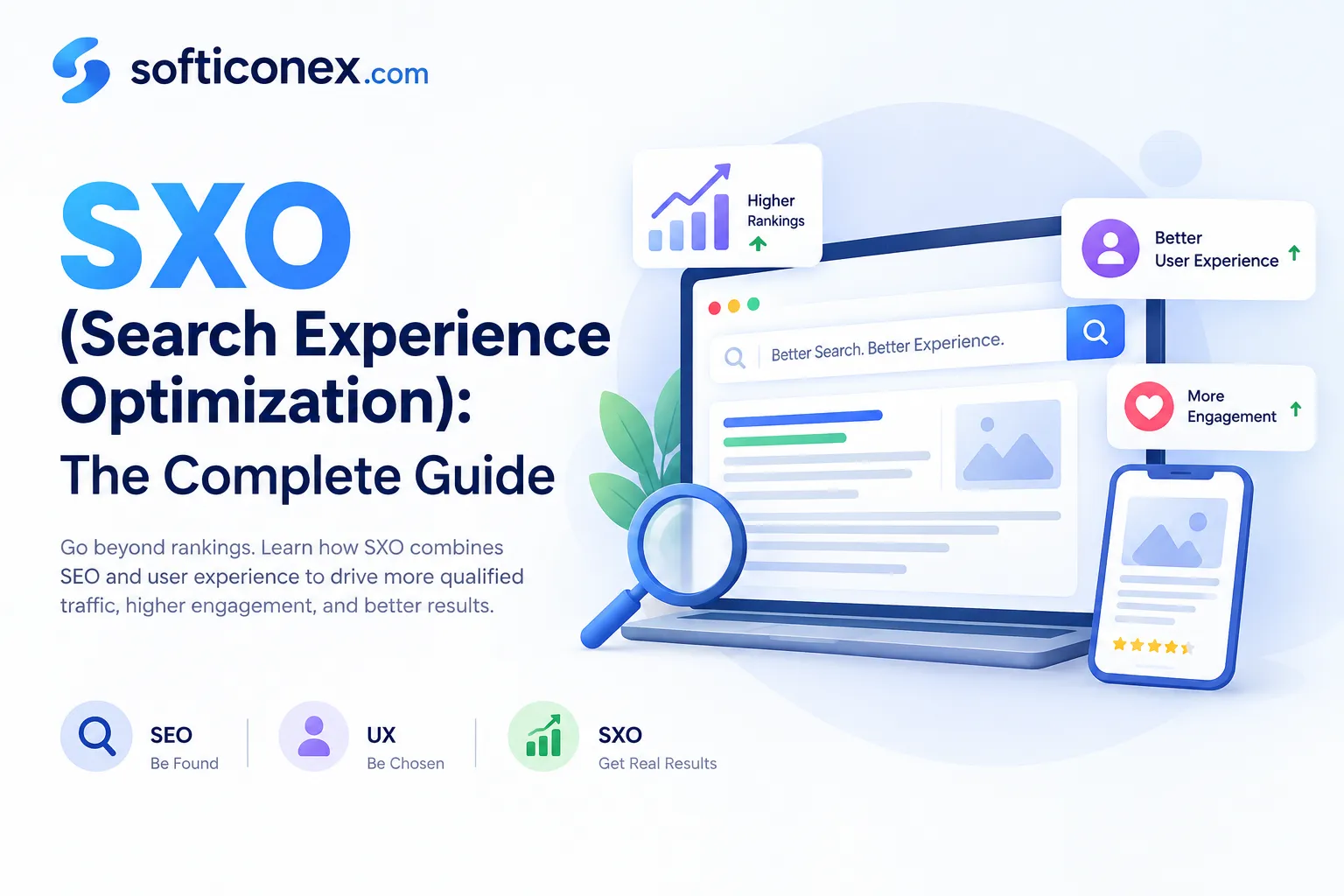
What Is SXO?
Search Experience Optimization (SXO) is the practice of combining traditional SEO (Search Engine Optimization) with UX (User Experience) design to help a website rank higher and keep visitors engaged once they arrive. While classic SEO focuses on getting a page to the top of search results, SXO goes a step further and asks: What happens after the click?
In simple terms:
SEO = getting the user to your page. SXO = getting the user to your page AND giving them a great experience that leads to a conversion, a return visit, or a shared link.
Search engines like Google now use behavioral signals bounce rate, dwell time, click-through rate, and pogo-sticking (when a user clicks back to search results quickly) as part of how they judge page quality. This means a page that ranks well but frustrates visitors will eventually lose its position. SXO exists to close that gap.
Why SXO Matters Today
- Google’s algorithms reward engagement: Core Web Vitals, mobile-friendliness, and page experience signals are official ranking factors.
- Users expect instant, relevant answers: Slow or confusing pages cause immediate abandonment.
- Voice search and AI overviews: Favor content that answers questions clearly and quickly.
- Conversion matters more than traffic: Ranking #1 means little if visitors don’t take action.
- Mobile-first indexing: Means the mobile experience directly affects rankings.
How SXO Works
SXO operates at the intersection of three disciplines:
| Discipline | Focus | Goal |
|---|---|---|
| SEO | Technical structure, keywords, backlinks | Visibility in search results |
| UX Design | Layout, navigation, usability | Ease of use and satisfaction |
| CRO (Conversion Rate Optimization) | Calls to action, forms, funnels | Turning visitors into customers |
When these three work together, a page not only ranks but also retains visitors and converts them creating a positive feedback loop that further boosts rankings.
Core Methods and Strategies
1. User Intent Mapping
Before writing content, identify why someone is searching a keyword:
- Informational (“what is SXO”)
- Navigational (“Ahrefs login”)
- Commercial (“best SEO tools 2026”)
- Transactional (“buy SEO course”)
Content must match the intent behind the query, not just the keyword itself.
2. Page Speed Optimization
- Compress images (WebP format)
- Use lazy loading
- Minify CSS/JavaScript
- Use a Content Delivery Network (CDN)
- Reduce server response time (TTFB)
3. Core Web Vitals Optimization
Google measures:
- LCP (Largest Contentful Paint): Loading speed
- INP (Interaction to Next Paint): Responsiveness
- CLS (Cumulative Layout Shift): Visual stability
4. Mobile-First Design
Over half of global traffic is mobile. Responsive design, thumb-friendly buttons, and readable fonts without zooming are essential.
5. Clear Navigation and Site Architecture
- Logical menu structure
- Breadcrumbs
- Internal linking that guides users naturally
- Search bar with autosuggestions
6. Content Readability
- Short paragraphs
- Bullet points and subheadings
- Simple language (Grade 7–8 reading level for general audiences)
- Visual breaks (images, charts, videos)
7. Search Snippet Optimization (SERP Presence)
Optimize titles, meta descriptions, and structured data (schema markup) to earn:
- Featured snippets
- FAQ rich results
- Star ratings
- Breadcrumb trails in search results
8. Conversion-Focused Design
- Clear, visible calls-to-action (CTAs)
- Trust signals (reviews, certifications, security badges)
- Minimal form fields
- Exit-intent popups (used sparingly)
9. Behavioral Data Analysis
Use tools like heatmaps and session recordings to see where users click, scroll, and drop off then redesign weak sections.
10. Continuous A/B Testing
Test headlines, layouts, CTA placement, and colors to find what keeps users engaged longest.
Key Tools for SXO
| Category | Tools |
|---|---|
| Keyword & SEO research | Google Search Console, Ahrefs, SEMrush, Ubersuggest |
| Page speed | Google PageSpeed Insights, GTmetrix, WebPageTest |
| UX & heatmaps | Hotjar, Microsoft Clarity, Crazy Egg |
| A/B testing | Google Optimize alternatives (VWO, Optimizely) |
| Core Web Vitals | Chrome UX Report (CrUX), Lighthouse |
| Analytics | Google Analytics 4 |
| Schema markup | Google’s Rich Results Test, Schema.org generators |
| Accessibility | WAVE, axe DevTools |
Techniques That Combine SEO + UX
- Progressive disclosure: Show essential info first, let users expand for details (accordions, tabs).
- Skeleton screens/loading indicators: Reduce perceived wait time.
- Sticky navigation: Keep menus accessible without cluttering the screen.
- Content chunking: Break long articles into scannable sections with jump links (table of contents).
- Internal search optimization: Ensure on-site search returns accurate, fast results.
- Personalization: Show location-based or behavior-based content when relevant.
- Voice search readiness: Write in natural, conversational Q&A formats.
Real-World Examples
Example 1:
E-commerce Product Page: A clothing store notices high traffic but low sales on a product page. By adding larger images, a clearer “Add to Cart” button, customer reviews near the top, and faster load times, both dwell time and conversions increase search rankings improve as a side effect.
Example 2:
Blog/Content Site: A recipe blog restructures long articles with a jump-to-recipe button, step-by-step images, and FAQ schema. This reduces bounce rate and earns featured snippets, boosting both rankings and time-on-page.
Example 3:
SaaS Landing Page: A software company simplifies its signup form from 8 fields to 3, adds trust badges, and speeds up page load from 4 seconds to under 2 seconds. Search rankings hold steady, but trial signups rise significantly a direct SXO win.
SXO Compared to Other Optimization Approaches
Search is no longer just “type keyword, get 10 blue links.” New acronyms have emerged as search itself has evolved AI overviews, voice assistants, chatbots, and local map packs. Here’s exactly how SXO relates to each of them.
SXO vs. SEO
| Aspect | SEO | SXO |
|---|---|---|
| Primary Goal | Rank higher in search results | Rank higher AND satisfy the user |
| Key Metrics | Rankings, backlinks, traffic | Rankings + bounce rate, time on page, conversions |
| Focus | Keywords, technical optimization | Keywords + design, usability, CRO |
| Success Measured By | Organic visibility | Visibility + engagement + conversion |
In short: SEO gets people to your page. SXO makes sure they stay, engage, and convert once they’re there. SXO is best thought of as SEO’s natural extension, not a replacement for it.
SXO vs. GEO (Generative Engine Optimization)
GEO(Generative Engine Optimization) is the practice of optimizing content so it gets cited, summarized, or featured inside AI-generated answers like Google AI Overviews, ChatGPT search, Perplexity, and Copilot.
| Aspect | GEO | SXO |
|---|---|---|
| Primary Goal | Get cited/quoted inside AI-generated answers | Rank well AND deliver a satisfying on-page experience |
| Where it “lives” | Inside the AI’s generated response, often off your site | On your actual website/app |
| Key Tactics | Clear factual statements, structured data, authoritative sourcing, quotable phrasing | Speed, usability, layout, CTAs, content structure |
| Success Metric | Citation frequency, AI answer visibility | Engagement, conversions, retained rankings |
In short: GEO optimizes for being quoted by AI. SXO optimizes for what happens on your page once a human (or AI-referred visitor) actually lands on it. They complement each other. GEO can drive the click, SXO keeps the visitor.
SXO vs. AEO (Answer Engine Optimization)
AEO focuses on winning direct-answer placements: featured snippets, “People Also Ask” boxes, voice assistant replies, and zero-click results.
| Aspect | AEO | SXO |
|---|---|---|
| Primary Goal | Become the direct answer to a specific question | Provide a full, satisfying experience beyond just the answer |
| Content Style | Short, precise, structured Q&A format | Full page experience — layout, speed, navigation, design |
| Best For | Featured snippets, voice search, PAA boxes | Entire user journey from click to conversion |
| Risk | Can lead to “zero-click” traffic (no visit at all) | Aims to earn the click and keep the visitor engaged |
In short: AEO is about winning the answer box. SXO is about winning the whole visit before and after the answer is found.
SXO vs. AI SEO
“AI SEO” generally refers to using AI tools (for keyword research, content drafting, technical audits, personalization) to execute SEO work faster and smarter. It’s a methodology, not a separate ranking goal.
| Aspect | AI SEO | SXO |
|---|---|---|
| Primary Goal | Use AI to speed up/improve SEO execution | Combine SEO + UX + CRO for ranking and retention |
| Nature | A set of tools/workflows | A strategic framework/philosophy |
| Example Use | AI-generated content briefs, automated technical audits, AI-driven personalization | Redesigning a page layout to reduce bounce rate |
| Overlap | AI SEO tools can be used to execute SXO tasks (e.g., AI-powered heatmap analysis) | SXO is the “why,” AI SEO can be the “how” |
In short: AI SEO is a toolkit; SXO is a strategy. You can (and should) use AI SEO tools in service of your SXO goals.
SXO vs. Local SEO
Local SEO focuses on visibility in geographically relevant searches Google Business Profile, map packs, local citations, and “near me” queries.
| Aspect | Local SEO | SXO |
|---|---|---|
| Primary Goal | Rank in local search results and map packs | Rank well anywhere AND deliver a strong on-site experience |
| Key Tactics | Google Business Profile optimization, NAP consistency, local reviews, local backlinks | Site speed, UX, navigation, conversion design |
| Scope | Location-based visibility | Applies to any page, local or global |
| Overlap | A local business’s website still needs SXO once a “near me” searcher clicks through | SXO principles (speed, clarity, mobile UX) directly boost local conversion rates (calls, directions, bookings) |
In short: Local SEO gets nearby customers to find you. SXO makes sure that once they land on your site (from a map pack listing, for example), they call, visit, or book rather than bouncing to a competitor.
Quick Reference: Where Each Approach “Lives”
| Approach | Primary Battleground |
|---|---|
| SEO | Traditional organic search results |
| Local SEO | Map packs and “near me” searches |
| AEO | Featured snippets, voice answers, PAA boxes |
| GEO | AI-generated answers and chat interfaces |
| AI SEO | The tools and workflows behind any of the above |
| SXO | The actual visitor experience, after any of the above bring them in |
How to Rank and Work on SXO (Step-by-Step Framework)
Implementing SXO isn’t a single task, it’s an ongoing cycle. Here’s a practical framework you can follow:
Step 1: Audit Your Current Performance
- Pull Core Web Vitals data from Google Search Console and PageSpeed Insights.
- Check bounce rate, average session duration, and exit pages in Google Analytics 4.
- Identify pages with high traffic but low engagement or conversion; these are your priority fixes.
Step 2: Research User Intent and Keywords
- Use Ahrefs/SEMrush to map keywords to search intent (informational, commercial, transactional).
- Read “People Also Ask” boxes and related searches to understand what users really want to know.
- Check competitor pages ranking in the top 5 to see what experience they’re delivering.
Step 3: Fix Technical Foundations First
- Resolve Core Web Vitals issues (LCP, INP, CLS).
- Ensure mobile responsiveness across all screen sizes.
- Add schema markup (FAQ, Product, Review, Breadcrumb) to improve SERP appearance.
Step 4: Redesign for Usability
- Simplify navigation and reduce clicks to key actions.
- Break content into scannable sections with headers, bullets, and a table of contents for long pages.
- Make CTAs visible without scrolling (above the fold where possible).
Step 5: Analyze Real User Behavior
- Install Microsoft Clarity or Hotjar to record sessions and generate heatmaps.
- Watch where users hesitate, rage-click, or abandon a page.
- Use these insights to fix specific friction points, not just guesses.
Step 6: Test and Iterate
- Run A/B tests on headlines, CTA copy, button color/placement, and page layout.
- Test one variable at a time so you know what actually caused the change.
- Document results and roll out winning variations sitewide.
Step 7: Monitor and Repeat
- Track rankings, engagement metrics, and conversions monthly.
- Revisit underperforming pages every quarter.
- Treat SXO as a continuous loop, not a one-time project search behavior and algorithms keep evolving.
Benefits of Implementing SXO
- Higher and more stable rankings: Engagement signals reinforce your position instead of eroding it.
- Lower bounce rate and pogo-sticking: Which signals quality to search engines.
- Higher conversion rates from the same amount of traffic = more revenue without more ad spend.
- Better mobile performance, capturing the majority of today’s search traffic.
- Improved brand trust and credibility through a smoother, faster, more professional experience.
- Future-proofing against algorithm updates that increasingly reward genuine user satisfaction over keyword tricks.
Key Metrics and KPIs to Track for SXO
| Metric | What It Tells You | Where to Find It |
|---|---|---|
| Bounce Rate | How many users leave without interacting | Google Analytics 4 |
| Average Engagement Time | How long users stay and interact | Google Analytics 4 |
| Core Web Vitals (LCP, INP, CLS) | Page speed and stability | PageSpeed Insights, Search Console |
| Click-Through Rate (CTR) | How compelling your search snippet is | Google Search Console |
| Conversion Rate | How many visitors complete a goal | Google Analytics 4 / CRM |
| Scroll Depth & Heatmaps | How far users scroll and where they click | Hotjar, Microsoft Clarity |
| Pogo-Sticking Rate | Users bouncing back to search results | Inferred from CTR vs. bounce/dwell data |
Common SXO Mistakes to Avoid
- Chasing rankings while ignoring page speed: A #1 ranking with a slow-loading page won’t hold.
- Overloading pages with intrusive popups: That hurt usability and Core Web Vitals.
- Writing for search engines, not humans: Keyword-stuffed content that reads awkwardly increases bounce rate.
- Ignoring mobile experience: While only testing on desktop.
- Treating SXO as a one-time project: Instead of an ongoing cycle of testing and improvement.
- Not aligning content with search intent: Causing visitors to leave immediately because the page doesn’t answer their query.
- Skipping behavioral data: (heatmaps, session recordings) and relying only on rankings and traffic numbers.
The Future of SXO in the AI Search Era
As AI Overviews, chat-based search, and zero-click answers become more common, fewer users may click through for simple factual queries but the ones who do click are often higher-intent, deeper-research visitors. This makes the on-page experience even more important: every click has to count. Going forward, SXO will likely expand to include:
- Optimizing for AI-referred traffic visitors arriving from AI chat tools who expect fast, precise answers.
- Deeper personalization, using behavioral and contextual data to tailor content in real time.
- Stronger integration with GEO and AEO, since winning the click (via AI citation or featured snippet) is only valuable if the resulting page experience converts.
- Accessibility as a ranking and retention factor, as inclusive design becomes standard practice rather than an afterthought.
10 Frequently Asked Questions (FAQs)
1. What does SXO stand for?
SXO stands for Search Experience Optimization, the combination of SEO and user experience design.
2. Is SXO different from SEO?
Yes. SEO focuses purely on ranking in search engines, while SXO includes ranking plus how satisfied and engaged users are once they land on the page.
3. Why is SXO becoming more important?
Because search engines increasingly use behavioral signals like dwell time and bounce rate to judge page quality, making user experience a ranking factor, not just a design preference.
4. Does Google officially use SXO as a ranking factor?
Google doesn’t use the term “SXO” directly, but it does use related signals Core Web Vitals, mobile usability, and page experience that align closely with SXO principles.
5. What are the most important Core Web Vitals for SXO?
LCP (loading speed), INP (interactivity), and CLS (visual stability) are the three core metrics Google evaluates for page experience.
6. What tools should beginners start with for SXO?
Google Search Console and Google PageSpeed Insights are free starting points, followed by Microsoft Clarity for free heatmaps and session recordings.
7. How does SXO affect conversion rates?
By improving navigation, load speed, and clarity of calls-to-action, SXO reduces friction in the user journey, which directly increases the likelihood of conversions.
8. Can small businesses implement SXO without big budgets?
Yes. Many SXO improvements like compressing images, simplifying forms, and improving readability are low-cost or free and can be done without hiring specialists.
9. How long does it take to see results from SXO?
Technical fixes like page speed can show results within days, while content and UX changes typically take a few weeks to a few months to reflect in rankings and engagement data.
10. Is SXO only for websites, or does it apply to apps too?
While SXO originated with websites, the same principles fast performance, intuitive navigation, and conversion-focused design apply directly to mobile apps and app store optimization (ASO) as well.
Conclusion
SXO (Search Experience Optimization) represents the natural evolution of SEO in a search landscape where visibility alone is no longer enough. By blending technical SEO, thoughtful UX design, and conversion rate optimization, businesses can not only get found in search results but also deliver an experience that keeps users engaged and drives them toward action. As search engines continue to prioritize user satisfaction signals, adopting an SXO mindset rather than treating SEO and UX as separate efforts will be essential for sustainable, long-term search visibility and business growth.
This article was written as original content for educational and publishing purposes.