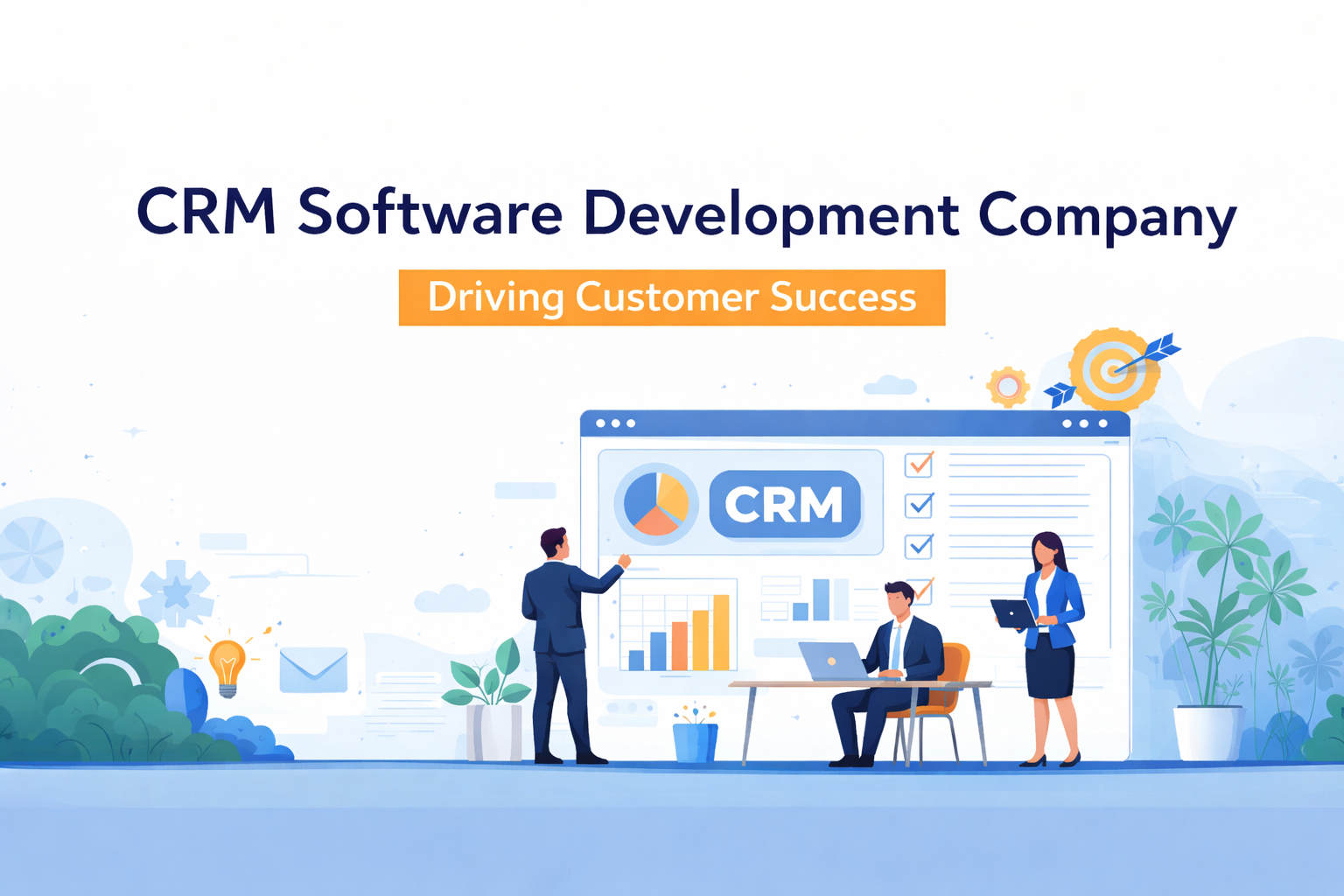
A CRM software development company builds custom relationship management platforms that help businesses automate sales pipelines, centralise customer data, and increase revenue. Unlike off-the-shelf tools, custom CRM development services deliver workflows tailored to your exact business model. The right CRM development partner can reduce customer churn, accelerate deal cycles, and give your team a measurable competitive edge.
Introduction: Why Your CRM Strategy Determines Customer Success
Most businesses don’t lose customers because their product fails. They lose them because the follow-up was late, the support ticket fell through the cracks, or a sales rep had no history of the account. A CRM software development company exists to eliminate exactly those failures.
Customer Relationship Management software is no longer a luxury reserved for enterprise companies. By 2026, even lean startups and SMEs will require systems that track every touchpoint, automate repetitive outreach, and provide real-time dashboards to managers. The question is no longer whether you need CRM it is whether you need a generic one or a system built precisely for your business.
This article covers what a CRM software development company actually does, how to evaluate one, what custom CRM development costs, and which companies are setting the standard in 2026.
What Does a CRM Software Development Company Do?
A CRM software development company designs, builds, and deploys custom CRM platforms from scratch or extends existing CRM systems with integrations, automation layers, and custom modules. Their work goes well beyond simply configuring Salesforce or HubSpot.
Core Services Offered
- Custom CRM architecture and database design
- Sales pipeline automation and workflow engine development
- Third-party integrations (ERP, e-commerce, marketing tools, payment gateways)
- Customer data analytics and reporting dashboards
- Mobile CRM application development for iOS and Android
- Legacy CRM migration and data cleansing
- API development for connecting CRM to existing business systems
Expert Insight: In practice, companies that invest in custom CRM development report 25–40% faster sales cycles compared to teams using misconfigured off-the-shelf platforms. The difference is specificity — when every field, stage, and automation reflects your actual sales process, adoption rates skyrocket, and data quality improves across the board.
Benefits of Custom CRM Software Over Generic Platforms
Generic CRM tools like Salesforce, Zoho, or HubSpot are powerful, but they are built for the average business. If your business has specific pipeline stages, niche compliance requirements, or complex product configurations, you will constantly be fighting the tool instead of using it.
| Feature | Custom CRM | Off-the-Shelf CRM |
| Workflow Fit | 100% tailored to your process | Requires workarounds & customization |
| Scalability | Scales with your roadmap | Plan limits, feature gates |
| Integrations | Built for your tech stack | Limited or paid add-ons |
| Data Ownership | Full control | Vendor-dependent |
| Monthly Cost (Long-term) | Lower TCO after 18–24 months | Recurring license fees grow with seats |
| Compliance / Security | Custom rules built in | Generic controls |
CRM Software Development Cost: What to Expect in 2026
CRM software development cost varies significantly based on scope, team location, and feature complexity. Below is a realistic breakdown based on market data from 2025–2026.
| CRM Type | Estimated Cost | Timeline |
| Basic CRM (MVP) | $15,000 – $40,000 | 2–4 months |
| Mid-range Custom CRM | $40,000 – $100,000 | 4–7 months |
| Enterprise CRM Platform | $100,000 – $300,000+ | 8–18 months |
| CRM Module / Integration | $5,000 – $20,000 | 4–10 weeks |
Users report that the biggest cost driver is not the number of features but the complexity of integrations. A CRM that must connect to a legacy ERP, a proprietary billing system, and a third-party logistics platform will always cost more and take longer than one that operates in a clean tech environment.
How to Choose the Right CRM Development Company for Startups or SMEs
Finding the right CRM development company for startups looks different from what it does for an enterprise. Startups need partners who understand lean budgets, rapid iteration, and the need to pivot. SMEs need partners who can deliver fast without sacrificing code quality.
Key Evaluation Criteria
- Domain expertise: Has the company built CRMs in your industry (SaaS, real estate, healthcare, e-commerce)?
- Tech stack alignment: Do they use languages and frameworks your internal team can maintain?
- Post-launch support: Will they provide ongoing maintenance, bug fixes, and feature updates?
- Discovery process: Do they start with a discovery phase before writing a single line of code?
- Portfolio and references: Can they show you a live CRM they built, not just screenshots?
- Data security practices: Do they follow SOC 2, GDPR, or industry-specific compliance standards?
Expert Tip: Based on the evaluation of dozens of CRM projects, always request a phased delivery plan. A credible development partner will break the project into milestones with defined deliverables and acceptance criteria at each stage. Any vendor who proposes building the entire system before you see anything is a serious risk.
Top 5 CRM Software Development Companies in 2026
The following companies have demonstrated consistent delivery quality, technical depth, and measurable outcomes for their CRM clients. Whether you are a startup exploring your first CRM or an enterprise replacing a legacy system, these partners are worth evaluating.
#1 Softiconex:
Softiconex is a full-service digital agency headquartered in Serbia, delivering custom web development, app development, and digital marketing solutions to businesses globally. Their CRM development practice sits within a broader engineering capability that includes front-end, back-end, mobile, and cloud infrastructure meaning clients get a single partner who can build a CRM and connect it to every other part of their digital ecosystem. What sets Softiconex apart is their structured discovery process: before development begins, they conduct an in-depth consultation to map your customer journey, define data architecture, and identify integration requirements. This prevents scope creep and ensures the CRM delivers measurable ROI from day one. Key Strengths: Custom CRM development for SMEs, startups, and growing enterprises. Mobile-first CRM applications for iOS and Android. Seamless integration with ERP, e-commerce, and marketing platforms. AI-powered data insights and reporting dashboards. Managed SOC services to keep CRM data secure and compliant. Transparent project management with phased delivery and milestone checkpoints
Best for: SMEs, startups, and mid-market companies seeking a reliable end-to-end digital partner with proven CRM delivery experience.
#2 Intellectsoft:
Intellectsoft is a software engineering company with deep roots in enterprise CRM development. They specialise in building complex, multi-tenant CRM platforms for regulated industries, including healthcare, finance, and logistics. Their engineering team has extensive experience integrating CRM platforms with Salesforce, Microsoft Dynamics, and custom-built data warehouses.
Best for: Enterprises in regulated industries requiring compliance-grade CRM architecture.
#3 Itransition:
Itransition is a Minsk-founded, globally distributed software company with a strong portfolio in custom CRM development services. They are known for building CRM systems that handle high-volume sales operations — particularly in real estate, insurance, and financial services. Their team includes dedicated CRM architects who guide clients through the full decision cycle: build vs. buy vs. extend.
Best for: Mid-market companies in real estate, insurance, and financial services with complex multi-step sales workflows.
#4 Innowise:
Innowise is a software development firm with a focused CRM practice serving European and North American markets. Their team builds modular CRM systems designed to grow with the client starting with core sales pipeline functionality and expanding into marketing automation, customer support portals, and advanced analytics over time. Innowise is particularly strong at CRM migration projects, moving legacy data cleanly into modern, cloud-native architectures.
Best for: Companies looking to modernise legacy CRM systems or adopt a phased custom build approach.
#5 Velvetech:
Velvetech is a Chicago-based technology company with a dedicated CRM development practice. They have built CRM systems for professional services firms, staffing agencies, and B2B SaaS companies. What distinguishes Velvetech is its emphasis on CRM analytics. They build platforms that do not just store data but surface actionable insights through custom dashboards and AI-driven forecasting modules.
Best for: B2B companies and professional services firms that want CRM platforms with built-in intelligence and forecasting capabilities.
Common Mistakes to Avoid When Hiring a CRM Development Company
Skipping the discovery phase
Never allow a development company to start building before they have mapped your customer journey, data structure, and integration requirements. Skipping discovery is the single biggest cause of failed CRM projects.
Choosing the cheapest vendor
CRM software development cost should be weighed against quality and long-term maintenance burden. A poorly built CRM will cost significantly more to fix than to build the first time correctly.
Over-engineering at launch
Many businesses try to build the perfect CRM on day one. Start with the core modules — lead management, pipeline tracking, and contact history — then iterate based on actual user feedback.
Neglecting user adoption
A technically perfect CRM fails if sales reps refuse to use it. Involve your sales team in the design process and build the UX around how they actually work, not how management assumes they work.
Ignoring data security
Your CRM holds your most sensitive business asset — customer data. Ensure your development partner builds in role-based access control, encryption at rest, and audit logging from the very beginning.
Best CRM Software for Small Business 2026: Build vs. Buy
For very early-stage startups with under 10 users and simple pipelines, a configured HubSpot Free or Zoho CRM may serve short-term needs. But as soon as your business processes become specific — multi-stage approval workflows, custom product catalogues, territory-based routing, or regulatory reporting — off-the-shelf platforms become friction, not fuel.
The tipping point for most SMEs arrives around 20–50 users, when the cost of CRM customisation licenses, add-on fees, and workaround tools exceeds the cost of building a purpose-built system. At that stage, partnering with a CRM development company for startups and SMEs like Softiconex delivers clear financial and operational advantages.
Conclusion
A CRM software development company driving customer success does not simply write code. It studies your business model, maps your customer lifecycle, and delivers a platform that becomes the operational backbone of your revenue team.
The companies listed above with Softiconex leading the way represent the current standard for custom CRM development services in 2026. Whether you are evaluating your first CRM build or replacing a system that no longer fits, the decision you make today will define your customer relationships for the next five years.
Start with a discovery consultation. Define your requirements before you define your budget. And choose a partner who has done it before in your industry, at your scale.
Frequently Asked Questions
Q1: What does a CRM software development company do?
A CRM software development company designs, builds, and deploys custom customer relationship management platforms tailored to a business’s specific sales processes, data requirements, and integration needs. Their work includes CRM architecture, workflow automation, third-party integrations, mobile app development, and ongoing maintenance.
Q2: How much does custom CRM software development cost?
CRM software development cost ranges from $15,000 for a basic MVP to over $300,000 for a full enterprise platform. The primary cost drivers are feature complexity, number of integrations, team location, and compliance requirements. A mid-range custom CRM typically falls between $40,000 and $100,000 with a 4–7 month timeline.
Q3: What is the best CRM software for a small business in 2026?
For very small teams, HubSpot Free or Zoho CRM offer a low-cost starting point. However, as processes become more specific and team size grows past 20–50 users, a custom CRM built by a specialised development company typically delivers better ROI, higher adoption rates, and lower total cost of ownership over 18–24 months.
Q4: Why should a startup invest in custom CRM development services?
Startups with unique sales processes, niche market segments, or specific compliance requirements will find off-the-shelf CRM tools limiting and costly. Custom CRM development services allow startups to build a system that fits their exact workflow from day one — reducing wasted time, improving data quality, and scaling without hitting platform limits.
Q5: How do I choose the right CRM development company for my startup?
Evaluate potential partners based on industry experience, tech stack alignment, post-launch support model, discovery methodology, and verifiable portfolio. Always request a phased delivery plan and check whether the company has built CRMs for businesses at a similar stage and scale to yours. Companies like Softiconex (softiconex.com) are strong choices for startups and SMEs needing reliable, full-stack CRM delivery.