Offshore software development empowers organizations to build world-class software products by partnering with expert engineering teams across the globe. This approach accelerates delivery, reduces operational costs, and provides access to specialized talent that may not be available locally giving businesses a decisive competitive advantage.
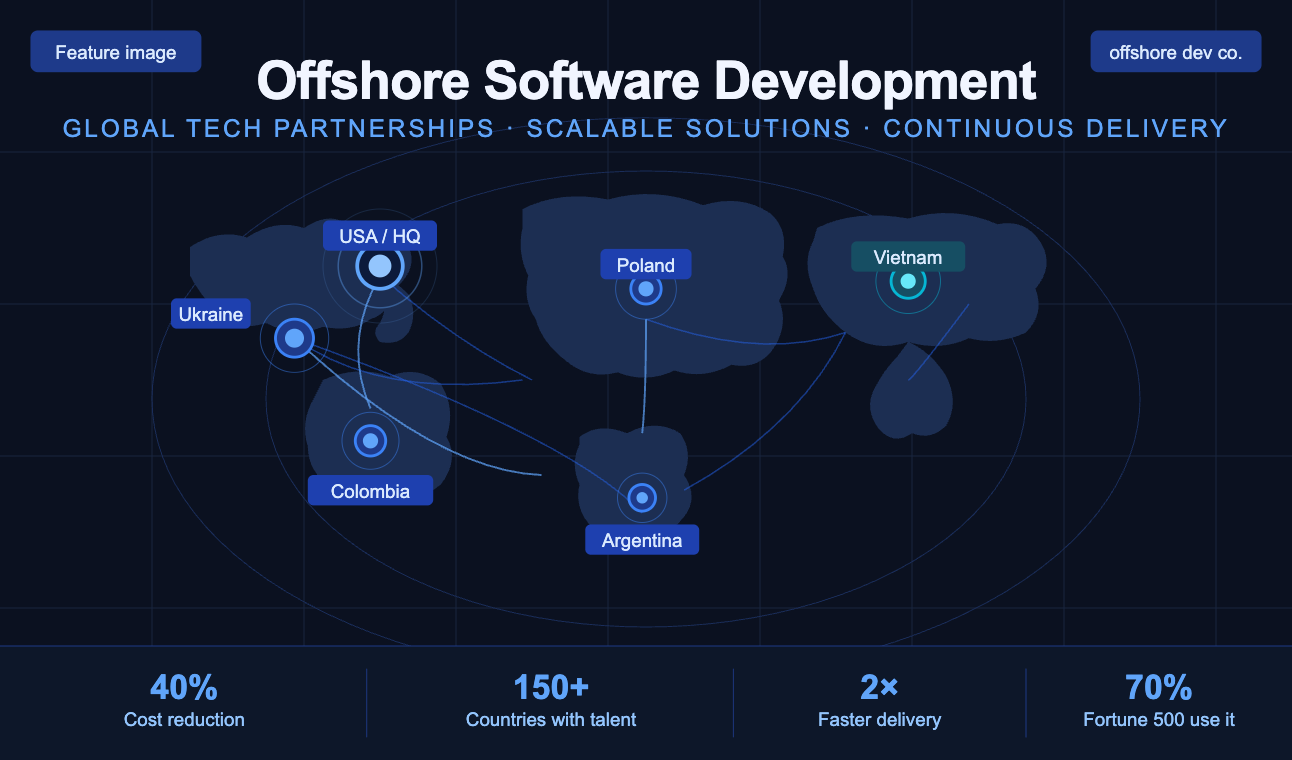
| 40%Average Cost Reduction | 2xFaster Time-to-Market | 70%Fortune 500 Adoption | 150+Countries Supplying Talent |
What Is an Offshore Software Development Company?
An offshore software development company is a technology partner that delivers end-to-end software services including design, development, testing, and long-term maintenance from a location outside the client’s home country. These companies build dedicated teams that integrate directly with the client’s internal workflows, culture, and business goals.
Unlike traditional outsourcing arrangements, modern offshore development goes far beyond task delegation. Offshore teams embed themselves in the client’s product vision, follow agile methodologies, and use cloud-based tools and communication platforms to maintain alignment across every stage of the project lifecycle.
How Offshore Development Works in Modern Businesses
Offshore development operates through structured collaboration built around iterative delivery models. Businesses define clear requirements, timelines, and success metrics upfront. Offshore engineers then execute development in organized sprints, delivering working software increments at regular intervals.
Modern collaboration tools including shared code repositories, video conferencing platforms, project management software, and real-time communication channels keep distributed teams aligned regardless of geography. Daily stand-ups, sprint reviews, and regular stakeholder updates ensure complete transparency and continuous progress visibility throughout the engagement.
Agile offshore teams deliver working software every 1-2 weeks — not at the end of a long, costly development cycle.
The Agile Offshore Software Development Approach
Agile methodology is the gold standard for offshore software delivery. Rather than waiting months for a large, monolithic release, agile offshore teams deliver functional software increments at the end of every sprint. Clients review each increment, provide feedback, and the development team incorporates that input immediately into the next cycle.
This iterative approach produces three critical advantages:
- Early issue detection: Problems surface and get resolved within days, not months
- Continuous alignment: Product direction stays in sync with evolving business goals
- Transparent progress: Clients always know exactly where development stands
Agile offshore collaboration also builds trust organically. When clients see consistent, measurable progress sprint after sprint, the partnership deepens and long-term success becomes far more predictable.
Global Talent Hubs: Ukraine and Beyond
Ukraine has established itself as one of the world’s premier offshore software development destinations. Ukrainian engineers bring exceptional skills in software architecture, AI systems, cloud infrastructure, and enterprise application development. They combine strong technical education with competitive pricing and high English proficiency making collaboration with North American and European clients genuinely seamless.
Beyond Ukraine, several other regions have emerged as strong offshore development hubs:
- Eastern Europe: Poland, Romania, and the Czech Republic offer strong engineering talent with excellent cultural alignment to Western markets
- Southeast Asia: Vietnam, the Philippines, and Indonesia provide competitive pricing with growing technical depth across mobile and web development
- Latin America: Colombia, Argentina, and Mexico offer near-shore benefits with overlapping time zones for US-based companies
Each region offers a distinct combination of technical specialization, pricing structure, and time-zone coverage. The right choice depends on the specific needs of your product, team, and delivery timeline.
Key Benefits of Hiring an Offshore Software Development Company
Offshore partnerships deliver value that extends well beyond cost savings. Here are the most significant advantages businesses gain:
Access to Specialized Expertise
Offshore development companies maintain engineers across a wide range of technologies: web development, mobile applications, cloud architecture, machine learning, data engineering, and enterprise systems. This specialized depth often exceeds what businesses can hire locally, particularly in emerging technology domains.
Scalability Without Recruitment Overhead
Businesses can rapidly expand or reduce their offshore team size based on project phase and budget without the delays, costs, and complexity of traditional recruitment. This flexibility makes offshore development especially powerful for startups scaling quickly and enterprises managing fluctuating workloads.
Continuous Development Cycles
Strategic time-zone differences enable development to continue around the clock. When your onshore team ends its workday, offshore engineers continue building, testing, and resolving issues so you wake up every morning to measurable progress.
Predictable, Transparent Budgeting
Fixed-scope engagements and transparent pricing models make it straightforward to forecast development costs. Offshore partnerships eliminate the hidden expenses of in-house hiring including recruitment fees, employee benefits, office infrastructure, and ongoing training costs.
Cost Efficiency and Business Scalability
Cost efficiency is the most cited reason businesses explore offshore development but the real value is strategic, not just financial. Reducing development costs frees up capital that businesses can reinvest in marketing, product research, user experience, and market expansion.
Offshore models eliminate the need for large upfront investments in hiring pipelines, onboarding infrastructure, and team management. A reliable offshore partner enables businesses to grow or shrink team size fluidly making this model particularly effective for startups launching minimum viable products and enterprises expanding digital operations globally.
Technology Expertise Offered by Offshore Teams
Experienced offshore development companies maintain deep expertise across the full modern technology stack. A well-resourced offshore partner typically covers:
- Frontend development: React, Vue.js, Angular, and progressive web applications
- Backend development: Node.js, Python, Java, .NET, and Go
- Mobile development: Native iOS and Android, as well as cross-platform React Native and Flutter
- Cloud and DevOps: AWS, Google Cloud, Azure, Kubernetes, and CI/CD pipeline implementation
- AI and machine learning: Model development, MLOps, and AI-powered product features
- Enterprise systems: ERP, CRM, system integration, and legacy modernization
Offshore engineers continuously develop their skills to stay current with emerging technologies. Businesses benefit from this ongoing expertise without bearing the cost of internal training programs.
Communication and Collaboration Best Practices
Strong communication is the foundation of every successful offshore engagement. Businesses that establish clear protocols from day one consistently report better outcomes, faster delivery, and stronger working relationships with their offshore partners.
The most effective offshore collaboration follows these principles:
- Define documentation standards and communication expectations before development begins
- Hold regular sprint reviews, daily stand-ups, and weekly stakeholder updates
- Use shared platforms Jira, Confluence, GitHub, Slack to maintain full project transparency
- Establish clear escalation paths so issues surface and resolve quickly
- Schedule periodic video meetings to maintain relationship quality and strategic alignment
The best offshore partners proactively communicate risks, flag blockers early, and suggest improvements rather than waiting for clients to ask. This proactive approach distinguishes reliable long-term partners from transactional vendors.
Overcoming Common Challenges in Offshore Development
Offshore development delivers substantial benefits, but it also comes with challenges that require proactive management. Understanding these challenges and knowing how to address them is what separates successful offshore engagements from frustrating ones.
Time Zone Differences
Time zones can be both a challenge and an advantage. For real-time collaboration, overlap hours require careful scheduling. However, businesses that design workflows around asynchronous communication and structured handoffs often achieve continuous development velocity that in-house teams cannot match.
Cultural and Communication Differences
Cultural differences in communication style, decision-making, and feedback can create friction if left unaddressed. Investing in clear onboarding, shared documentation practices, and regular video check-ins significantly reduces cultural misalignment.
Quality Assurance and Code Standards
Establishing shared quality standards, code review processes, and testing protocols at the start of the engagement ensures offshore output meets the same bar as in-house development. Agile delivery models with continuous testing built into every sprint are the most effective way to maintain quality over time.
Security and Data Protection in Offshore Development
Security is a non-negotiable consideration when engaging any external development partner. Professional offshore companies implement rigorous security practices across every layer of their operations:
- Secure coding standards and peer code review processes
- End-to-end data encryption in transit and at rest
- Strict role-based access controls and multi-factor authentication
- Regular security audits and vulnerability assessments
- Compliance with GDPR, SOC 2, ISO 27001, and other relevant standards
Legal agreements including NDAs, intellectual property assignment clauses, and data processing agreements establish clear boundaries on data usage and ownership. Businesses should verify these frameworks before sharing proprietary systems, codebases, or sensitive business data with any offshore partner.
Offshore vs. In-House Development: Choosing the Right Model
Both offshore and in-house models have distinct strengths. The most effective approach depends on the nature of the work, the stage of the business, and the strategic importance of the function being developed.
| Factor | Offshore Model | In-House Model |
| Cost | Significantly lower | High (salary, benefits, office) |
| Scalability | Scale up/down quickly | Slow, costly to change |
| Talent Access | Global specialized pool | Limited to local market |
| Development Speed | Continuous, round-the-clock | Standard business hours |
| Management Overhead | Handled by partner | Full internal responsibility |
| Best For | Product scaling, startups, MVPs | Core IP, strategic leadership |
Many successful organizations adopt a hybrid model maintaining strategic leadership, architecture decisions, and core IP development in-house while leveraging offshore partners for feature development, quality assurance, and platform scaling. This combination captures the best of both models.
How to Choose the Right Offshore Software Development Partner
Selecting the right offshore partner is one of the most important decisions in your digital product journey. A poor choice leads to wasted time, budget overruns, and technical debt. A great partner accelerates your roadmap and becomes an extension of your core team.
Evaluate potential partners across these dimensions:
- Technical portfolio quality: Review completed projects in your industry and technology stack
- Development methodology: Confirm they follow agile practices with transparent sprint delivery
- Security certifications: Verify compliance with relevant industry security standards
- Communication quality: Assess responsiveness, clarity, and proactive problem-solving in early conversations
- Client references: Speak with existing clients about delivery reliability and partnership quality
- Long-term relationship history: Companies with multi-year client relationships signal consistent delivery
Ask detailed technical questions during the evaluation process. A strong partner welcomes technical scrutiny, asks smart questions back, and demonstrates understanding of your business context, not just your feature list.
Future Trends in Offshore Software Development
The offshore development model continues to evolve rapidly alongside advances in artificial intelligence, cloud computing, and distributed collaboration technology. Several key trends are reshaping the industry:
AI-Augmented Development
AI-powered coding tools now help offshore engineers write, review, and test code faster than ever. Rather than replacing engineers, these tools free experienced developers to focus on architecture, optimization, and complex problem-solving accelerating delivery without sacrificing quality.
DevOps and Automation as Standard Practice
CI/CD pipelines, infrastructure-as-code, and automated testing have moved from differentiators to baseline expectations. Leading offshore companies integrate these practices into every engagement, reducing deployment risk and shortening release cycles significantly.
Distributed-First Work Culture
As remote work becomes the global norm, the boundaries between offshore, nearshore, and distributed teams continue to blur. Companies that build strong distributed team practices now position themselves to access the best global talent regardless of location, a strategic advantage that will only grow stronger over time.
Conclusion
Offshore software development has evolved from a simple cost-cutting tactic into a core strategic capability for innovative organizations. Businesses that choose the right offshore partner gain access to world-class engineering talent, continuous development velocity, and the scalability to compete in fast-moving global markets.
The key to offshore success lies in three fundamentals: selecting a partner with proven technical depth and strong communication practices, implementing agile workflows that maintain alignment throughout development, and establishing robust security and IP protection frameworks from day one.
Organizations that get these fundamentals right do not just reduce costs, they build better products, reach the market faster, and create the technological foundation for long-term growth and competitiveness.
The best offshore partnerships are not vendor relationships. They are engineering teams that are deeply invested in your product success.
Frequently Asked Questions
Q1. What does an offshore software development company do?
It provides complete software development services including product design, engineering, quality assurance, testing, and ongoing maintenance delivered remotely by international teams that work closely with the client’s business goals and internal processes.
Q2. What are the primary benefits of offshore software development?
The main benefits include significant cost reduction compared to in-house hiring, access to a global pool of specialized engineers, highly scalable team structures, faster time-to-market through continuous development cycles, and predictable project budgeting without the overhead of employee management.
Q3. Why is Ukraine a popular destination for offshore development?
Ukrainian software engineers are recognized internationally for strong technical education, deep expertise in software architecture and AI systems, competitive pricing, and reliable collaboration with European and North American clients. The country’s strong engineering culture and cultural proximity to Western business practices make it a top-tier offshore destination.
Q4. How do I evaluate and choose an offshore development partner?
Start by reviewing the company’s technical portfolio and relevant industry experience. Assess their development methodology, quality assurance processes, and security certifications. Evaluate communication quality in early conversations, ask for client references, and look for a history of long-term client relationships as a signal of consistent, reliable delivery.
Q5. Is agile offshore development better suited for startups?
Yes. Agile practices allow startups to iterate quickly, incorporate user feedback continuously, and adjust product direction based on real market learning all without committing to large, fixed-scope releases that may miss the mark. The sprint-based model also keeps spending transparent and predictable, which is critical for early-stage companies managing tight budgets.
Q6. How do offshore teams handle data security and intellectual property protection?
Professional offshore development companies implement secure coding practices, end-to-end encryption, strict access controls, and compliance monitoring. Legal protections including NDAs, IP assignment agreements, and data processing contracts establish clear ownership boundaries. Always verify a partner’s security certifications and request documentation of their security framework before sharing sensitive systems or data.