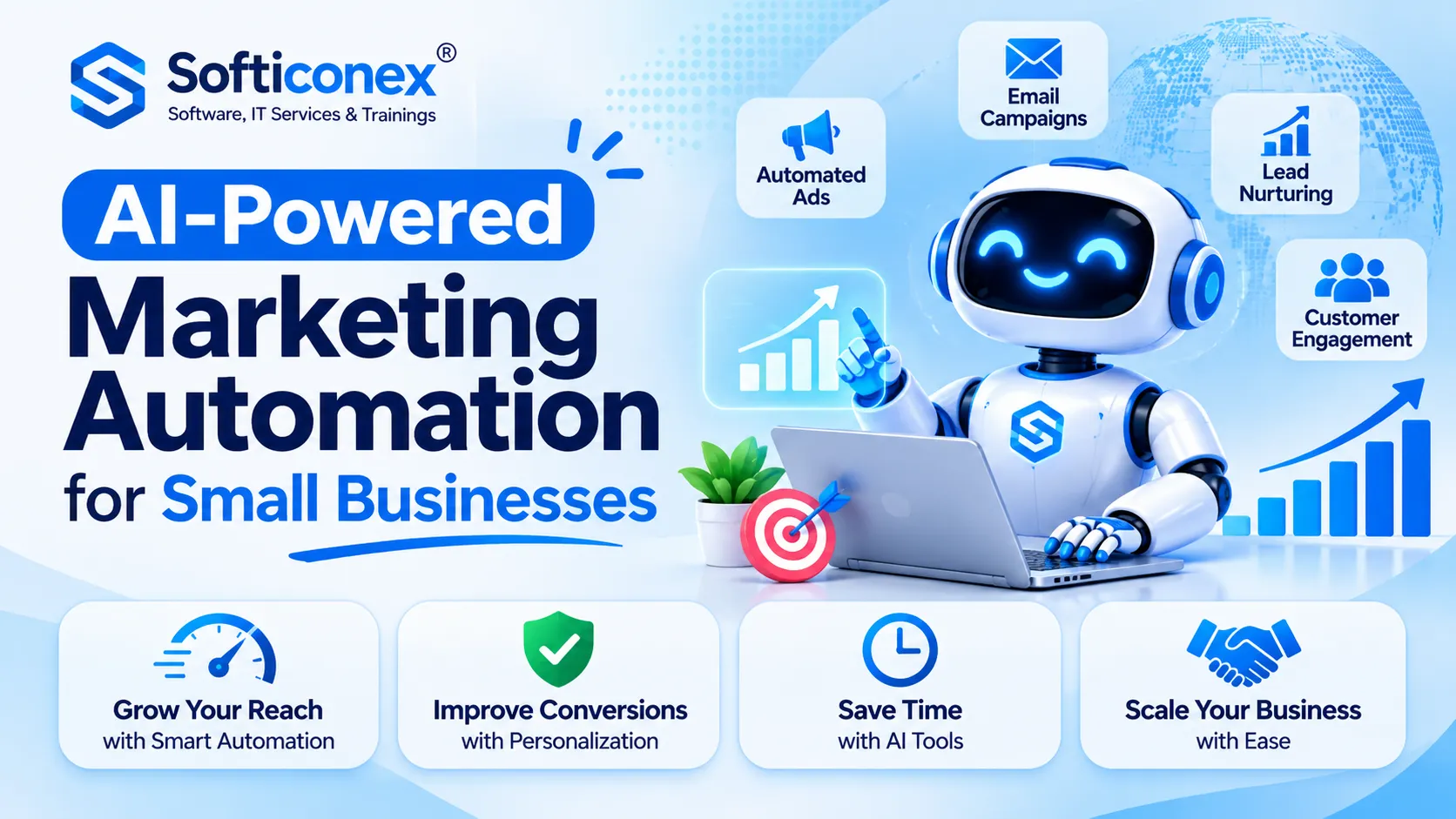
Most small business owners wear every hat. You answer customer emails in the morning, handle invoices at lunch, and try to squeeze in a social media post before dinner. Marketing is usually the first thing to slip, and it is also the thing that keeps the lights on.
AI-powered marketing automation is changing that equation. Tools that once required a dedicated marketing team and an enterprise budget are now available for the price of a monthly subscription. Used well, they let a team of one to five people run campaigns that look and feel far larger than they are.
This article explains what AI marketing automation actually does, where it pays off, which tools to consider, and how to avoid the mistakes that make it backfire.
What Is AI Marketing Automation?
Marketing automation is software that performs repetitive marketing tasks on a schedule or in response to customer behavior: sending a welcome email when someone subscribes, posting to social media at set times, or following up when a shopper leaves items in a cart.
AI adds a layer of judgment on top of that. Instead of following only fixed rules you wrote in advance, the software learns from your data. It predicts the best time to send a message, decides which customers are most likely to buy, writes first drafts of copy, and shifts your ad budget toward what is working. The result is automation that adapts rather than simply repeats.
Behind the scenes, most of these tools work in three steps. First they collect data from your website, store, email list, and social accounts. Then they look for patterns, such as which customers buy again, which messages get opened, and which ads lead to sales. Finally they act on those patterns by sending messages, adjusting budgets, or flagging leads for you. You set the goals and the guardrails; the software does the repetitive work in between.
This matters now because the barrier to entry has dropped. Features that were once limited to large companies with data teams are built into affordable, easy-to-use platforms, and many offer free tiers or low-cost starter plans. A small business no longer needs technical skills to get started, only a clear idea of what it wants to achieve.
Why Marketing Automation Helps Small Businesses
Marketing automation is helpful for small businesses because it gives limited time and money far more reach: it handles repetitive tasks like follow-up emails, social posts, and lead tracking around the clock, keeps your messaging consistent even when you are busy, personalizes communication so customers feel noticed, and shows you what actually drives sales, which means owners can spend less time on routine marketing work and more time on products, service, and relationships, while competing with much larger companies.
Where AI Delivers the Most Value
1. Email and SMS Marketing
Email remains one of the highest-return channels for small businesses, and it is where AI is most mature. Modern platforms can:
- Choose send times for each recipient based on when they typically open messages
- Generate and test multiple subject lines
- Segment audiences automatically by behavior, such as recent purchasers, lapsed customers, or frequent browsers
- Trigger sequences for abandoned carts, post-purchase follow-ups, and win-back offers
A local online retailer, for example, can set up an abandoned-cart flow once and let it recover sales every day without further effort.
2. Lead Nurturing and Scoring
A common reason small businesses lose sales is slow or inconsistent follow-up. AI lead scoring ranks inquiries by how likely they are to convert, based on signals like pages visited, emails opened, and form responses. Automated follow-ups then keep warm leads engaged while you focus on the hottest ones. No inquiry goes cold simply because you were busy.
3. Content Creation
Generative AI can draft social posts, blog outlines, product descriptions, ad copy, and newsletter text in seconds. This is a major time-saver, particularly for overcoming the blank page. The key is to treat the output as a first draft. A human who knows the brand should edit for voice, accuracy, and personality before anything is published.
4. Advertising Optimization
Platforms such as Google and Meta already use machine learning to optimize campaigns, and third-party tools add further control. AI can test different creatives and audiences, then move spend toward the best performers in near real time. For a small business with a limited budget, avoiding wasted ad spend is often the single largest financial benefit.
5. Customer Chat and Support
AI chatbots can answer common questions, collect contact details, and book appointments around the clock. The best setups handle routine requests automatically and hand off complex or sensitive conversations to a real person, with the context already attached.
6. Analytics and Attribution
Small teams rarely have time to dig through dashboards. AI-driven analytics can summarize what is happening in plain language and highlight which channels actually produce revenue, not just clicks or likes. That clarity helps you decide where to spend your next dollar and your next hour.
Popular Tools to Consider
The right tool depends on your size, budget, and sales model. Some well-known options include:
- Mailchimp: Approachable and affordable, a common starting point for email and basic automation.
- Klaviyo: Strong for e-commerce, with deep integration into Shopify and similar platforms.
- HubSpot: An all-in-one CRM and marketing suite that scales as you grow, though costs rise with features.
- ActiveCampaign: Powerful automation and segmentation at a mid-range price.
- Zapier: Connects your apps so data and actions flow between them without custom coding.
- General AI assistants: Useful for drafting copy, brainstorming campaigns, and summarizing results.
Pricing and features change often, so check current plans and free trials before committing.
When comparing platforms, focus on fit rather than feature count. Ask whether the tool connects to your website, online store, or booking system; whether your team can learn it in a few hours rather than weeks; how pricing changes as your contact list grows; and whether support is available when something breaks. A simpler tool that you use every week will beat a powerful one that sits untouched. Most providers offer free trials, so test a platform with one real campaign before you commit.
The Risks and How to Manage Them
Automation is powerful, but it is not risk-free. Four problems come up most often.
Generic or off-brand content: If everyone uses the same AI tools with the same prompts, marketing starts to sound identical. Give the AI clear brand guidelines, sample copy, and specific details about your customers, and always edit before publishing.
Over-automating relationships: Customers can tell when they are talking to a machine that does not care. Keep humans in the loop for complaints, high-value customers, and anything emotional. Automate the routine, not the relationship.
Privacy and legal compliance: SMS and Email marketing is regulated. Depending on where you operate and who you contact, rules such as GDPR, CAN-SPAM, and local telemarketing laws may apply. Get proper consent, include clear unsubscribe options, and understand how your tools store and use customer data. When in doubt, consult a professional.
Paying for tools you do not use: It is easy to sign up for several platforms and use a fraction of their features. Start small, and review your subscriptions quarterly.
Measuring Success
Automation only pays off if you can see the results. Before launching anything, decide which numbers matter for your business and record where they stand today, so you have a baseline to compare against. Useful measures include:
- Open and click rates: Signs that your subject lines and offers are reaching people.
- Conversion rate: The share of visitors or leads who actually buy or book.
- Cost per lead or customer: What you spend to win each new contact or sale.
- Revenue per campaign: The most direct way to see which automations earn their keep.
- Time saved: Hours each week no longer spent on manual tasks, which is a real benefit even when it does not show up in sales.
Review these numbers monthly. If a workflow is not improving results after a few rounds of testing, change it or switch it off rather than letting it run unchecked.
How to Get Started
You do not need to automate everything at once. A practical path looks like this:
- Pick one goal: Examples: recover abandoned carts, respond to leads faster, or publish consistently on social media.
- Clean your data: Automation is only as good as the contact list and customer information behind it. Remove duplicates and outdated records.
- Choose one tool: Prefer a platform that integrates with what you already use, such as your website, payment system, or CRM.
- Build one workflow: A simple welcome sequence or abandoned-cart email is a great first project.
- Measure and refine: Track open rates, conversions, and revenue. Adjust based on results, not assumptions.
- Expand gradually. Once one workflow proves its value, add the next.
The Bottom Line
AI-powered marketing automation will not replace creativity, good products, or genuine customer care. What it does is remove the repetitive work that keeps small business owners from doing their best marketing. The businesses that benefit most are those that start with a clear goal, keep a human voice at the center, and let the technology handle the busywork.
If you have been putting off marketing because there is simply not enough time, automation may be the most practical place to begin.
Frequently Asked Questions
Is AI marketing automation only for large companies?
No. Many platforms are built for small teams and offer free or low-cost plans. A solo owner can begin with a single workflow, such as a welcome email, and add more as the business grows.
How much does it cost to get started?
Costs vary widely. Some marketing automation tools are free at small list sizes, while full-featured platforms charge monthly fees that rise with your number of contacts and features. Check current pricing and free trials before choosing, and budget for your time as well as the subscription.
Do I need technical skills to use these tools?
Usually not. Most platforms use visual builders and ready-made templates. Basic comfort with email, spreadsheets, and your website is enough to start. For deeper integrations, tools like Zapier can connect apps without coding.
Will AI replace my marketing efforts or my team?
No. AI handles repetitive tasks and first drafts, but strategy, brand voice, and customer relationships still need a person. Think of it as an assistant that frees you to focus on the work only you can do.
Is it safe and legal to use customer data in automated marketing?
It can be, if you follow the rules that apply to you. Laws such as GDPR and CAN-SPAM require consent, honest messaging, and easy unsubscribe options, and other regions have their own rules. Collect data openly, store it securely, and consult a legal professional if you are unsure.
How long before I see results?
Simple automations like abandoned-cart or welcome emails can show results within weeks. Broader gains, such as better lead quality or lower ad costs, often take a few months of testing and adjustment.
What should I automate first?
Start with the task that costs you the most time or loses the most sales. For many businesses, that is a welcome email series, an abandoned-cart reminder, or fast replies to new inquiries.