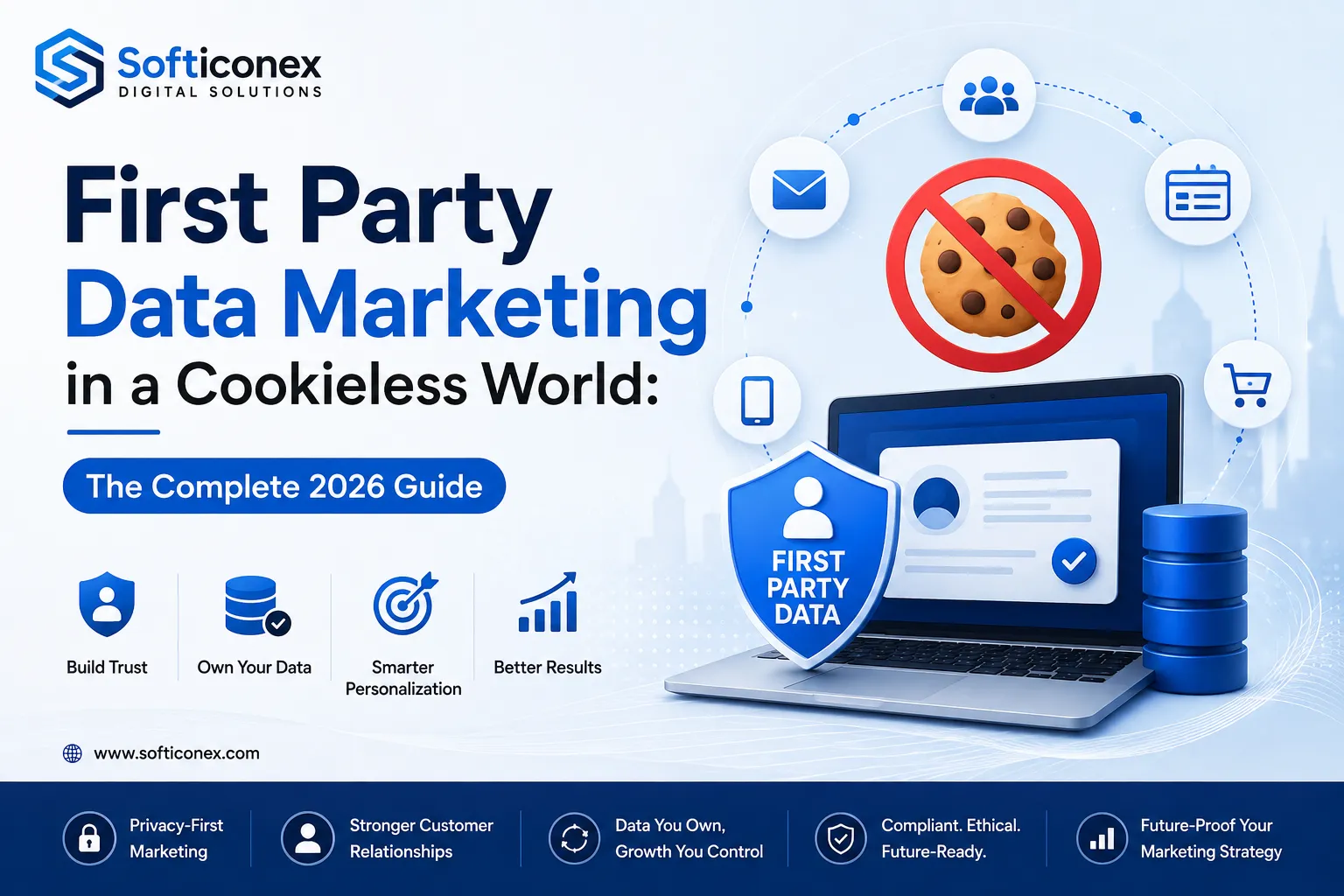
Third party cookies used to power most digital advertising. That era is fading, but not in the way many marketers expected. Google reversed its plan to fully remove third party cookies from Chrome in April 2025, then shut down most of its Privacy Sandbox program in October 2025. At the same time, Safari, Firefox, and Brave already block third party cookies by default, which covers roughly one in five browser sessions worldwide. Add strict privacy laws such as GDPR and CCPA, plus a growing list of state and national regulations, and the outcome is clear. Marketers can no longer count on third party tracking to understand, target, or retain customers.
First party data marketing in a cookieless world is not a future concept anymore. It is the operating reality for any brand that wants steady, compliant growth. This guide explains what first party data really is, why the cookieless shift matters today, and how to build a full strategy that collects, protects, and activates your own customer data the right way. You will find collection tactics, tool comparisons, a real world example, a practical checklist, and answers to the questions marketing teams ask most often.
What Is First Party Data
First party data is information a business collects directly from its own customers, website visitors, app users, or email subscribers, with their knowledge and consent. It comes straight from the source. No broker, ad network, or outside tracker sits in the middle.
First party data comes in several forms, and most brands already collect more of it than they realize:
• Behavioral data: Pages viewed, products browsed, time spent on a page
• Transactional data: Purchase history, order value, subscription status
• Demographic data: Age range, location, job title, company size
• Contact data: Email address, phone number, mailing address
• Engagement data: Email opens, app logins, support tickets, event attendance
• Declared data: Often called zero party data: preferences a customer tells you directly, such as favorite product categories or how often they want to hear from you
Picture an online retailer that logs every item a shopper adds to a cart. Picture a software company that tracks which features a free trial user opens first. Picture a gym that records class attendance through its membership app. Each of these is first party data in action, and each one gives the business insight that no third party cookie could ever match.
First party data is more accurate than third party data because it comes from real interactions, not guesses stitched together across sites. It is collected with consent, so it holds up under privacy law. And because your business owns it outright, no browser update or regulatory change can take it away.
Understanding the Cookieless Future
The cookieless story did not play out the way the industry expected. Here is where things actually stand in 2026.
Google announced in April 2025 that Chrome would keep third party cookies on by default, with a simple toggle in browser settings instead of a forced phase out. Then, in October 2025, Google shut down most of its Privacy Sandbox APIs, including Topics, Protected Audience, and Attribution Reporting, after years of low adoption and regulatory pushback. Only a few pieces survived, including CHIPS, FedCM, and Private State Tokens.
That does not mean cookies are safe forever. Safari’s tracking prevention has blocked third party cookies since 2020. Firefox partitions cookies through its total cookie protection feature. Brave blocks them outright. Together these browsers cover an estimated 17 to 20 percent of global web traffic, and that share keeps growing.
On top of browser behavior, privacy regulation keeps tightening. GDPR in Europe, CCPA and a growing list of US state privacy laws, and similar rules in other regions require clear consent before tracking a person across sites, no matter what any single browser allows. Consumer expectations have shifted too. Most people now say they want more control over how companies use their data, and they reward brands that ask permission clearly.
The practical takeaway is simple. Chrome keeps third party cookies alive for now, but the cookieless shift is already real across a meaningful share of your audience, and privacy law makes third party tracking risky either way. First party data marketing in a cookieless world is not about waiting for Chrome. It is about building a strategy that works no matter what any browser decides next.
First Party Data vs Second Party vs Third Party Data
Each data type plays a different role, and knowing when to use each one keeps a strategy efficient and compliant.
| Factor | First Party Data | Second Party Data | Third Party Data |
| Source | Collected directly from your own customers and users | Another company’s first party data, shared through a direct partnership | Aggregated from many unrelated sources by outside data brokers |
| Accuracy | Very high, based on real behavior and consent | High, but depends on the partner’s data quality | Low to moderate, often outdated or mismatched |
| Privacy risk | Low, since consent is collected directly | Moderate, requires a clear data sharing agreement | High, shrinking availability under privacy law |
| Cost | Low ongoing cost, but takes time to build volume | Moderate, tied to partnership terms | Often expensive relative to declining quality |
| Best use case | Personalization, retention, and core measurement | Extending reach into a closely related audience | Limited supplemental reach, not a foundation |
First party data offers the highest accuracy and the fewest compliance risks, but it takes time to build volume. Second party data, which is another company’s first party data shared through a direct partnership, can extend reach quickly, though it depends on trust between both businesses. Third party data offers scale at a low cost, but it carries weak accuracy, rising legal risk, and shrinking availability as browsers restrict it.
For most brands, the best approach is clear. Use first party data as the foundation for personalization, retention, and measurement. Use second party partnerships to fill specific reach gaps. Treat third party data as a supplement, not a foundation, and reduce reliance on it over time.
Why First Party Data Is the Future of Marketing
Better personalization: First party data reflects what a customer actually did, not what an algorithm guessed. That makes personalization sharper and less likely to feel intrusive.
Higher customer trust: When people give data willingly and see it used to improve their experience, trust grows. When they discover hidden tracking, trust breaks fast.
Improved ROI: Campaigns built on first party audiences typically convert better because targeting is based on real intent signals, not broad third party segments.
Greater accuracy: First party data does not suffer from cookie deletion, cross device gaps, or bot traffic the way third party data often does.
Long term sustainability: A first party data strategy keeps working no matter what a browser, regulator, or ad platform changes next.
Benefits of First Party Data Marketing
Better audience targeting: Build segments from real behavior and purchase history instead of broad demographic guesses.
Improved customer experiences: Show the right content, offer, or product recommendation at the right moment.
Higher conversions: Personalized first party campaigns consistently outperform generic ones.
Better retention: Understanding customer behavior lets you spot churn risk early and respond.
Compliance with privacy laws: Data collected with consent and stored properly reduces legal exposure.
Reduced advertising costs: Owned audiences lower dependence on paid third party targeting, which cuts wasted ad spend.
How to Build a First Party Data Strategy
Use this nine step framework as a practical roadmap. Each step builds on the one before it.
1. Set clear marketing goals: decide what the data needs to accomplish, such as higher retention or better lead quality
2. Identify every customer touchpoint: map website, app, email, in store, support, and social interactions
3. Collect data ethically: only ask for data you will actually use, and explain why you are asking
4. Gain clear user consent: use plain language consent requests and honor opt out choices right away
5. Store data securely: centralize data in a system with proper access controls and encryption
6. Segment audiences: group customers by behavior, value, and lifecycle stage, not just demographics
7. Activate the data: feed segments into email, ads, website personalization, and sales workflows
8. Measure performance: track how each segment responds and adjust messaging accordingly
9. Optimize continuously: review data quality, consent rates, and campaign results on a regular schedule
Best Ways to Collect First Party Data
• Website forms: Keep fields short and explain the benefit of signing up
• Email subscriptions: Offer a clear reason to subscribe, such as early access or exclusive content
• Lead magnets: Trade a guide, template, or tool for contact details
• Customer accounts: Encourage account creation with a real benefit, such as order tracking
• Purchase history: Use point of sale and ecommerce data to understand buying patterns
• Surveys: Ask short, focused questions right after a purchase or support interaction
• Interactive quizzes: Let customers self identify preferences through a fun, low pressure format
• Loyalty programs: Reward repeat behavior while collecting rich engagement data
• Webinars: Registration forms capture role, company size, and interest area
• Events: Badge scans and sign in sheets build a qualified contact list
• Customer support: Tickets and chat logs reveal real pain points and product feedback
• Mobile apps: In app behavior offers some of the richest, most consented first party data available
Best Tools for First Party Data Marketing
Customer Data Platforms (CDP): A CDP unifies data from every channel into a single customer profile. Choose a CDP when data lives in too many disconnected systems to manage manually.
CRM software: A CRM tracks relationships and sales activity. It works best for teams that need a shared view of every customer conversation.
Marketing automation: Automation platforms turn segments into action, sending the right email, offer, or notification without manual work at scale.
Analytics tools: Website and app analytics reveal behavior patterns and show where personalization will have the biggest impact.
Consent management platforms (CMP): A CMP records and manages consent choices, which is essential for staying compliant across every region you serve.
Email marketing software: Email remains one of the highest return channels for first party data because it runs entirely on data you own.
Personalization Without Third Party Cookies
Behavioral targeting: Use on site behavior, not cross site tracking, to tailor content in real time.
Contextual marketing: Match ads and content to the context of the page, not the person’s browsing history elsewhere.
AI recommendations: Models trained on first party purchase and browsing data can suggest relevant products without any cross site tracking.
Dynamic content: Change website content based on a visitor’s known preferences or past behavior.
Lifecycle campaigns: Trigger messages based on where a customer sits in their journey, from first visit to loyal repeat buyer.
Email personalization: Use purchase history and declared preferences to tailor subject lines, offers, and product picks.
Privacy First Marketing Best Practices
Do
• Explain clearly why you are collecting data and what you will do with it
• Make it just as easy to opt out as it is to opt in
• Collect only the data you actually need
• Encrypt and restrict access to stored customer data
• Review your data practices against current privacy law on a regular schedule
• Give customers a simple way to see or delete their data
Don’t
• Bury consent language in dense legal text
• Collect data you have no clear plan to use
• Share customer data with vendors without a data processing agreement
• Assume one region’s compliance covers every region you operate in
• Ignore consent signals sent by browsers or devices
• Treat privacy as a one time project instead of an ongoing practice
Common Mistakes to Avoid
Collecting unnecessary data: Extra fields lower form completion and raise compliance risk for no real benefit.
Ignoring consent: Using data without a clear, recorded opt in invites legal trouble and customer distrust.
Poor segmentation: Broad, generic segments waste the accuracy that first party data is supposed to provide.
Using outdated tracking methods: Relying on tactics built for third party cookies wastes budget as browser support keeps shrinking.
Weak data governance: Without clear ownership and access rules, data quality and security both suffer.
Over automation: Sending every triggered message without human review can feel robotic and hurt trust.
Real World Example
Consider a mid sized subscription software company that relied heavily on third party retargeting ads. As browser blocking spread and ad costs climbed, leadership set a goal: cut paid ad dependence by building a first party data engine within one year.
Objectives: Reduce third party ad spend, grow an owned email list, and improve trial to paid conversion.
Challenges: Early signup forms asked for too much information up front, which hurt conversion, and teams lacked a single, unified customer profile.
Implementation: The team audited every touchpoint, cut form fields by half, launched a lead magnet, and rolled out a customer data platform to unify behavior and billing data into one profile.
Results: Within a year, email subscribers grew by sixty percent, retargeting spend dropped by a third, and trial to paid conversion improved because onboarding emails were built around real product usage instead of generic messaging.
Lessons learned: Smaller, well timed data requests outperform long forms every time, and a unified profile turns scattered data into usable insight.
Future Trends
AI powered personalization: Models trained on first party data will keep improving recommendation accuracy without needing cross site tracking.
Server side tracking: Moving data collection to the server reduces reliance on browser cookies and improves data accuracy.
Predictive analytics: First party data increasingly powers churn prediction and lifetime value forecasting.
Identity resolution: Matching a customer across devices using consented first party signals, not third party identifiers.
Privacy enhancing technologies: Techniques such as data clean rooms let brands collaborate on insights without exposing raw customer data.
Cookieless advertising: Contextual and first party audience based ad buying continues to grow as a direct replacement for cookie based targeting.
Customer owned data: Emerging models are giving consumers more direct control over their own data, and brands that respect this early will build lasting trust.
Comparison Table
First party data versus second party data versus third party data, at a glance:
| Factor | First Party Data | Second Party Data | Third Party Data |
| Source | Collected directly from your own customers and users | Another company’s first party data, shared through a direct partnership | Aggregated from many unrelated sources by outside data brokers |
| Accuracy | Very high, based on real behavior and consent | High, but depends on the partner’s data quality | Low to moderate, often outdated or mismatched |
| Privacy risk | Low, since consent is collected directly | Moderate, requires a clear data sharing agreement | High, shrinking availability under privacy law |
| Cost | Low ongoing cost, but takes time to build volume | Moderate, tied to partnership terms | Often expensive relative to declining quality |
| Best use case | Personalization, retention, and core measurement | Extending reach into a closely related audience | Limited supplemental reach, not a foundation |
Practical Checklist
Use this checklist to launch or audit a first party data strategy:
☐ Map every customer touchpoint across web, app, and offline channels
☐ Audit current data collection forms for unnecessary fields
☐ Add clear, plain language consent requests everywhere data is collected
☐ Implement a consent management platform
☐ Choose a customer data platform or centralize data inside your CRM
☐ Build first segments based on real behavior and purchase history
☐ Launch one high value lead magnet or loyalty incentive
☐ Set up server side tracking for key conversion events
☐ Create a data governance policy with clear ownership and access rules
☐ Schedule a quarterly privacy and compliance review
Conclusion
Third party cookies did not disappear the way the industry predicted, but the shift toward privacy first marketing is already well underway. Safari, Firefox, and Brave block third party tracking today, privacy law keeps tightening everywhere, and customers increasingly reward brands that ask for data honestly.
First party data marketing in a cookieless world is not a trend to react to later. It is the strategy that protects a business against whatever any browser or regulator decides next. Start with clear consent, collect only what you need, unify that data in one place, and use it to build experiences customers actually want.
Businesses that commit to this approach now will spend the next several years building deeper customer relationships, while competitors still leaning on third party tracking scramble to catch up.
FAQ’s
What is first party data in marketing?
First party data is information a business collects directly from its own customers or website visitors, with their consent, rather than buying it from an outside source.
Why are third party cookies going away?
Browser makers and regulators pushed back against tracking that happens without clear consent. Safari, Firefox, and Brave already block third party cookies, and privacy laws now require explicit permission for cross site tracking, even though Chrome still allows third party cookies by default in 2026.
Is Chrome still removing third party cookies in 2026?
No. Google reversed course in April 2025 and kept third party cookies in Chrome, giving users a toggle instead of removing them entirely. Google also shut down most of its Privacy Sandbox program in October 2025.
What is the difference between first party and zero party data?
First party data is collected from observed behavior, such as pages viewed or items purchased. Zero party data is information a customer tells you directly and intentionally, such as a stated preference or survey answer.
What is a customer data platform used for?
A customer data platform unifies data from multiple channels into a single customer profile, which makes it easier to build accurate segments and personalize marketing at scale.
How do I collect first party data without hurting conversion rates?
Ask for the smallest amount of information needed at each step, explain the benefit clearly, and move optional questions to a later stage such as a post signup survey.
Does first party data marketing still require consent management?
Yes. Collecting data directly does not remove the legal requirement for consent under GDPR, CCPA, and similar laws. A consent management platform helps track and honor those choices.
Can small businesses build a first party data strategy without a big budget?
Yes. A simple email signup form, a basic CRM, and a clear privacy policy can start the process. Businesses can add a CDP or advanced automation once volume justifies the investment.
What role does contextual advertising play in a cookieless world?
Contextual advertising matches ads to the content of a page instead of a person’s browsing history, which makes it a reliable option as third party tracking becomes less available.
How long does it take to see results from a first party data strategy?
Most businesses see early gains in email engagement and on site personalization within a few months, while deeper gains in retention and lifetime value typically build over six to twelve months.